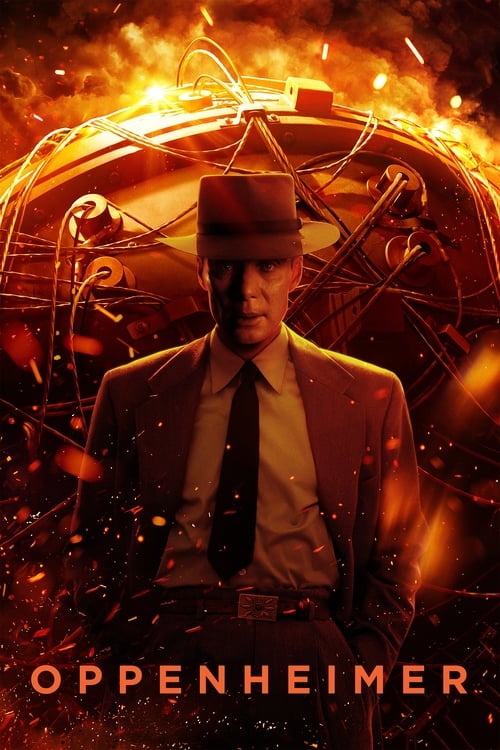
Oppenheimer
2023 · Christopher Nolan
Made a three-hour physics biopic the year's second-biggest cultural event, revived IMAX-film-print pilgrimage culture, and generated real debate about depicting Hiroshima's victims — plus a delayed, fraught Japanese release.
For when you want a big, serious night at the movies — something demanding that earns your full attention and leaves you chewing on it for days. This is a challenge, not a comfort watch, and it rewards committing to it in one sitting.
What it's about
J. Robert Oppenheimer, the physicist who led the Manhattan Project, races to build the atomic bomb in the New Mexico desert during World War II — and then has to live in the world he made. The film moves between the wartime scramble at Los Alamos, a closed 1954 security hearing that puts his loyalty on trial, and a Senate proceeding years later that recasts everything as contested testimony. It's a biography told as an interrogation: genius, ambition, and conscience all under oath at once.
The experience
Three hours that move like a thriller — dense, propulsive, and loud, with a score that never lets your pulse settle. The bomb test is one thing; the dread that follows is another, and the film keeps tightening even when it's just men arguing in small rooms. You leave rattled and talking.
Performances
Cillian Murphy carries the film with a gaunt, haunted stillness — a man watching his own consequences arrive. Robert Downey Jr., as Lewis Strauss, does career-best work in a role that's all wounded pride and calculation.
The craft
Nolan shoots history like a ticking bomb: large-format photography, real-world effects over digital shortcuts, and editing that braids three timelines without losing you. The sound design and Ludwig Göransson's score are physical forces — this is a film that genuinely demands the biggest screen and loudest room you can find. Even the black-and-white sequences have a reason, marking whose version of events you're inside.
Why it matters
Its release opposite Barbie created the 'Barbenheimer' phenomenon and proved a three-hour R-rated historical drama could be a global blockbuster — becoming one of the highest-grossing R-rated films ever and a defining cultural event of 2023.
Snapshot
Christopher Nolan's three-hour historical epic places J. Robert Oppenheimer — physicist, idealist, security risk — at the center of three converging time-frames: the scientific and political crucible of the Manhattan Project, the 1954 closed security hearing that stripped him of his clearance, and the 1959 Senate confirmation proceedings for Lewis Strauss (Robert Downey Jr.) that reframe every prior scene as contested testimony. Rather than march through a life chronologically, Nolan builds the film as a dossier interrogating its own subject: the man who cracked open the atom and then had to live inside the world that followed. Released July 21, 2023 — simultaneously with Greta Gerwig's Barbie, generating the "Barbenheimer" cultural event — Oppenheimer became one of the highest-grossing R-rated films in cinema history and swept the 96th Academy Awards with seven wins, including Best Picture, Best Director, Best Actor (Cillian Murphy), and Best Supporting Actor (Robert Downey Jr.).
Industry & production
Nolan adapted the film from American Prometheus: The Triumph and Tragedy of J. Robert Oppenheimer (2005), the Pulitzer Prize-winning biography by Kai Bird and Martin J. Sherwin — a dense, 700-page account that had taken the two historians twenty-five years to complete. Nolan wrote the screenplay himself, his first solo screenplay credit on an adaptation of an existing work.
The film was produced by Nolan and his longtime producing partner and wife, Emma Thomas, alongside Charles Roven, under their Syncopy banner. Its distribution marked a significant industry moment: after a public rupture with Warner Bros. over the studio's decision to simultaneously release Tenet (2020) and subsequently the entire 2021 slate on HBO Max, Nolan moved to Universal Pictures. Universal's willingness to commit to an exclusive theatrical window and a substantial marketing budget for a three-hour, dialogue-dense, R-rated film about nuclear physics signaled confidence in Nolan's commercial pull — confidence the grosses vindicated.
Principal photography took place in and around New Mexico, California, and New Jersey; the actual Los Alamos mesa landscape in New Mexico was used extensively. The production secured access to preserved Manhattan Project sites. Shooting was conducted on an approximately $100 million budget — modest by the standard of Nolan's effects-heavy blockbusters — reflecting that the film's spectacle would be concentrated and purposeful rather than sustained.
Technology
Oppenheimer is the most technically ambitious analog large-format production in recent memory, and arguably the most significant statement on behalf of photochemical cinema since the early days of IMAX's dramatic expansion.
Nolan and cinematographer Hoyte van Hoytema shot primarily on 65mm large-format film and IMAX 15-perf/65mm film — the largest film frame in commercial cinema. A critical, and technically unprecedented, element was the decision to shoot the black-and-white sequences (designating the objective "Fusion" strand, associated with Lewis Strauss's Senate testimony) in black-and-white large-format film. Kodak, in collaboration with the production, developed a new black-and-white emulsion for the IMAX format; no black-and-white IMAX film had been commercially produced in decades, and the process required significant photochemical research. The result was that Oppenheimer became the first narrative film to include sequences shot in black-and-white IMAX.
The Trinity test explosion — the film's emotional and structural apex — was achieved without computer-generated imagery. Special effects supervisor Scott Fisher and his team used a combination of practical miniatures, burning magnesium, aluminum powder, liquid propane, and classical in-camera pyrotechnic techniques scaled and photographed to simulate the expanding fireball and shockwave. The decision was philosophically consistent with Nolan's filmmaking practice and also, the production argued, technically superior: the organic, unpredictable behavior of physical combustion on large-format film produced detail and texture that digital simulation would have approximated but not equaled.
Technique
Cinematography
Van Hoytema's work across Interstellar (2014), Dunkirk (2017), and Tenet (2020) established a Nolan-van Hoytema visual grammar: proximity, grain, optical imperfection embraced as expressivity. In Oppenheimer the grammar is further refined and structurally encoded. The color sequences ("Fission" — Oppenheimer's subjective world) are rendered with a warm, occasionally luminous palette, van Hoytema using the IMAX frame's vast horizontal real estate to place faces in extreme close-up against enormous environmental contexts — mesa skies, blackboard equations, congressional chambers. The subjectivity is reinforced by macro-scale inserts of colliding particles, quantum disturbances, and spreading ripple patterns that literalize Oppenheimer's interior physics. The black-and-white "Fusion" sequences (Strauss's external perspective) are cooler, more forensic, their tonal contrast harsher. The chromatic split is not merely aesthetic but epistemological: warmth and interiority versus coolness and objecthood.
Editing
Jennifer Lame's editing — her second Nolan collaboration after Tenet — is the film's structural engine. Three timelines must be held in suspension simultaneously, the viewer positioned to receive each scene with a different quantum of knowledge than the last, so that dramatic irony accrues gradually and then collapses. Lame's cuts frequently exploit sound as a bridge — the next scene's audio arriving before the cut, or a line of dialogue from the hearing rooms interrupting a Los Alamos memory — a device inherited from Nolan's earlier work but here systematized into a near-musical principle. The editing of the Trinity sequence is among the film's most discussed achievements: Nolan and Lame delay the audio of the detonation — the crowd watches the fireball rise in near-silence before the shockwave hits — an empirically accurate representation of the speed-of-light/speed-of-sound differential, but also a moment of pure cinematic suspension in which the audience occupies the same dread as the witnesses.
Mise-en-scène / staging
Nolan's staging is characteristically architectural: actors disposed across the depth of the frame in configurations that encode power, isolation, or complicity. The Gadget assembly sequences in the Los Alamos tower use a vertical axis (men ascending, the device above them) that Nolan frames to emphasize both the mundanity and the sacrality of the act. The 1954 hearing is staged as a pressure-chamber: fluorescent interior, Oppenheimer isolated at the center of an arc of questioners, the deliberate inversion of the open New Mexico landscapes. The film makes considerable use of bodies in crowd — the Los Alamos community reacting to the Hiroshima announcement, a large auditorium cheering the bomb's success while Oppenheimer imagines the incinerated bodies beneath the feet of a celebrating audience. That sequence — a hallucination within a celebration — is the film's most overtly expressionistic staging choice.
Sound
Ludwig Göransson's score is dense and agitated in a manner that departed from the Hans Zimmer textures of Nolan's preceding decade. Göransson layered bowed strings (frequently violin played in extreme registers), electronic processing, and percussion to build a sonic fabric that mimics fission — accumulation, instability, chain reaction. The score rarely resolves; tension is sustained rather than released. Equally significant is the sound design surrounding the Trinity test: the choice to render the blast's initial visual in near-silence before the concussive audio arrives is a collaboration between score, sound design, and editing that required careful calibration of silence as a dramatic tool.
Performance
Cillian Murphy's performance operates through restraint and interiority. He rarely raises his voice; much of what Oppenheimer feels is communicated through stillness, his pale eyes — frequently filling the IMAX frame — doing work that other actors would accomplish through movement. The physical transformation (Murphy lost considerable weight to play the late Oppenheimer) serves the character's post-bomb diminishment. Robert Downey Jr.'s Lewis Strauss is the film's structural antagonist and perhaps its most complex supporting performance: Downey plays resentment beneath bonhomie beneath procedural authority, the layers revealing themselves inversely as the Senate timeline converges. Emily Blunt's Kitty Oppenheimer — underwritten by the screenplay relative to the biography's account — commands attention through an anger that clarifies into a kind of furious political intelligence in the hearing sequences.
Narrative & dramatic mode
Oppenheimer is structured as a nested interrogation — a man's life examined through two official proceedings, one of which is itself examined through a third. Nolan adapts Bird and Sherwin's "American Prometheus" title (the Titan who gave fire to humanity and was punished eternally for it) into a non-linear dramatic architecture in which the punishment is known before the crime is fully displayed, and the crime itself is never simple enough to adjudicate. The film declines the biopic's conventional arc of triumph and fall; instead it situates triumph and catastrophe as simultaneous and inseparable. The hearing transcripts that Bird and Sherwin quote extensively in their biography are absorbed into the film's dialogue, though the degree of compression and dramatization means the hearing sequences are not verbatim reconstructions.
Genre & cycle
Oppenheimer occupies the intersection of several genre traditions: the historical biopic, the courtroom-procedural thriller, and the American epic of moral conscience. Its closest generic ancestors in prestige Hollywood are films like All the President's Men (Pakula, 1976) — investigative procedure as existential stakes — and Lawrence of Arabia (Lean, 1962) — the monumental figure whose brilliance and self-mythology cannot stabilize a coherent moral identity. Nolan's film released contemporaneously with a broader cycle of prestige historical productions but distinguished itself by scale and commercial ambition. The "Barbenheimer" pairing — Oppenheimer and Barbie on the same release date — became a genuine cultural phenomenon, driving record summer box office and renewing discourse about the theatrical experience as a shared social event.
Authorship & method
Christopher Nolan is the dominant authorial presence — writer, director, co-producer — and Oppenheimer recapitulates his signature preoccupations: the deconstruction and reconstruction of time as narrative material; the man whose extraordinary mind is also the source of his undoing; the mechanics of memory and testimony as unreliable but constitutive; the weight of secrets and their cost on intimate relationships. His method — close collaboration with a consistent producing partner (Emma Thomas), cinematographer (van Hoytema since Interstellar), and a commitment to practical, in-camera technique at large format — is filmmaking as a coherent craft philosophy rather than a technological opportunism.
Hoyte van Hoytema has become one of contemporary cinema's most significant large-format practitioners; his work here consolidates a signature. Jennifer Lame brought to the edit a background in independent American cinema (her work with Noah Baumbach), and the result was editing that carried both the precision of a genre thriller and a psychological interiority less common in Nolan's prior work. Ludwig Göransson's score was his first for Nolan; his willingness to work against resolution and comfort, and his integration of period-appropriate references (folk music, the mournful quality of strings associated with American tragedy), proved well-suited to the material. The absence of Hans Zimmer — Nolan's composer across seven films — was audible in the shift from expansive, harmonically rich texture to something more agitated and unresolved.
Movement / national cinema
Oppenheimer is an American film by a British-American director — Nolan was born in London, raised between England and the United States, and holds dual citizenship. Universal Pictures is an American studio. The film is emphatically engaged with American history and American self-examination: the Manhattan Project, McCarthyism, the Red Scare, the structure of Cold War loyalty hearings, and the question of what the United States does to the intellectuals it recruits and then suspects. That a British-born director produced Hollywood's most searching recent account of American atomic guilt is consistent with an outsider's freedom to interrogate a mythology from within the industry that sustains it.
Era / period
The film arrived in the mid-2020s moment of post-pandemic theatrical recovery, when the major studios and exhibition chains were urgently seeking evidence that the multiplex could sustain films for adults. Oppenheimer's commercial performance — alongside Barbie — provided that evidence, at least temporarily. It represents the apex of what has been called the "Nolan effect": the filmmaker's name alone functioning as a theatrical guarantee capable of drawing audiences to a three-hour, R-rated, formally complex production without franchise IP. The film also arrived during a period of renewed public anxiety about nuclear proliferation, AI-enabled weapons development, and the ethics of scientific discovery — contexts that amplified the film's resonance beyond cinephile circles.
Themes
The central thematic engine is the Faustian bargain: what does it cost to build the thing that ends the war, and who holds the debt? Nolan refuses to resolve the question, which is also Bird and Sherwin's conclusion: Oppenheimer was neither martyr nor villain but a man whose complexity the security state could not accommodate. Subsidiary themes include the corruption of institutional loyalty — how patriotism becomes a weapon wielded against those who served it; the relationship between intellectual achievement and moral accountability; the uses of memory in the construction of official history; and the American capacity for self-congratulation about atrocities its citizens perpetrated and its government subsequently obscured. The film also explores, more quietly, the psychology of envy and resentment in the figure of Strauss — a bureaucrat of genuine intelligence who cannot forgive a genius for receiving the world's admiration.
Reception, canon & influence
Oppenheimer received an extraordinary critical response on release, with consensus positioning it among Nolan's strongest work and among the best American films of its decade. At the 96th Academy Awards (March 2024), it won seven awards: Best Picture, Best Director, Best Actor, Best Supporting Actor, Best Film Editing, Best Cinematography, and Best Original Score — a sweep that placed it alongside the most decorated productions in the Academy's history.
The influences the film draws on are eclectic and largely unacknowledged in public record: the non-linear, testimony-structured portrait of a complex historical figure recalls Citizen Kane (Welles, 1941), and Nolan has spoken admiringly of Welles in various contexts; the compression of a life into its official and unofficial hearings owes something to the theatrical tradition of Heinar Kipphardt's In the Matter of J. Robert Oppenheimer (1964); the epic scale and moral ambiguity of Lawrence of Arabia casts a shadow. Nolan's own Dunkirk (2017) prepared the three-strand temporal architecture.
The film's forward influence is still early to assess definitively — it was released less than two years before this writing. What is already visible: its demonstration that large-format film photography and practical effects constitute a commercially viable alternative to digital production; its role in reviving industry conversation about analog film; and its evidence that a film engaging seriously with historical atrocity and political persecution can reach a mass theatrical audience when executed with sufficient craft and with a distributor willing to commit to the theatrical window. Whether it reshapes the biopic or the historical epic as genres in ways subsequent productions will absorb remains an open question.
A Deleuzian reading
The desert is dark and then it isn't.
The full Deleuzian reading of Oppenheimer →
Reception
Arrived in July 2023 as half of the Barbenheimer phenomenon and was hailed as an event movie from day one; the coronation completed at the 2024 Oscars with seven wins including Best Picture, and it's already settled in as Nolan's critical high-water mark.
How Oppenheimer was received, from release to now →
Influences: the films it descends from and the films it influenced
- Citizen Kane (1941) — The nested-testimony architecture — a protagonist's death prompting an institutional inquiry that unlocks competing non-linear biographical fragments — is the direct structural template for Oppenheimer's dual-hearing frame and its permanent epistemological irresolution.
- Rashomon (1950) — Kurosawa's competing-testimony format renders historical truth structurally inaccessible — each account internally coherent, collectively contradictory — inaugurating the nested-interrogation mode Nolan deploys to keep Oppenheimer's guilt and heroism simultaneously irresolvable.
- Hiroshima Mon Amour (1959) — Resnais encodes trauma versus present consciousness in separate photographic registers — B&W for the atomic ruins, color for the affair — organizing a fractured narrative around an atrocity that won't recede from memory; Oppenheimer inherits both the B&W/color epistemological split and atomic devastation as the psychic wound around which biography reorganizes.
- Judgment at Nuremberg (1961) — Kramer's pressure-chamber courtroom staging — in which legal procedure forces defendants, witnesses, and audience to confront historical complicity in state-sanctioned atrocity — is the procedural template for Oppenheimer's 1954 security hearing as the film's moral crucible.
- Lawrence of Arabia (1962) — Lean and Freddie Young's Super Panavision 70mm location photography — isolating a self-destroying genius within monumental landscape — establishes the large-format epic portrait of the historical subject as both mythic and damned, the mode van Hoytema and Nolan work within and against.
- 2001: A Space Odyssey (1968) — Kubrick and Douglas Trumbull's insistence on in-camera large-format practical imagery — the rotating centrifuge built full-scale, star-fields photographed optically — is the philosophical precedent for Nolan's practical-effects mandate: the Trinity detonation and fission chain-reactions produced without CGI.
- The Conversation (1974) — Walter Murch's sound design — surveillance recordings replayed with shifting emphasis, audio as the primary register of psychological state — establishes the model Nolan and Richard King extend in the delayed Trinity detonation and the fission score that builds pressure without resolving.
- Amadeus (1984) — Forman structures the biopic entirely around retrospective institutional interrogation — Salieri's confession as a competing-testifier framing device through which fragmented biography is delivered — establishing the template of a rival institutional voice controlling and distorting access to the dead genius.
- JFK (1991) — Stone's multi-strand montage intercutting courtroom testimony with dramatized reconstruction and newsreel footage — making epistemological uncertainty the film's formal subject — is the direct editing ancestor of Oppenheimer's triple-perspective structure, each timeline's visual grammar encoding a different claim on historical truth.
- Memento (2000) — Nolan's foundational experiment in fragmented non-linear structure as formal correlative for damaged epistemology — the audience experiencing events through the protagonist's unreliable cognitive access — is the laboratory where the psychological architecture of Oppenheimer's testimony sequences was first developed.
- Interstellar (2014) — The first Nolan–van Hoytema collaboration on 70mm IMAX and anamorphic 35mm established the large-format, film-native workflow and on-set practical-photography discipline — shooting the cosmos in-camera, building sets at scale — that Oppenheimer extends to B&W IMAX, the format's first use in monochrome.
- Dunkirk (2017) — The three-strand temporal architecture — mole (one week), sea (one day), air (one hour) — with separate emotional registers converging at a single climax is the direct structural prototype for Oppenheimer's three-timeline suspension; Nolan tested the temporal collision mechanics here before applying them to biographical form.
- The Brutalist (2024) — Corbet's choice of VistaVision large-format anamorphic as an anti-digital statement — for a 3.5-hour genius-destroyed-by-ambition biopic — extends Oppenheimer's proof-of-concept that analog large-format photography at epic runtime remains commercially and aesthetically viable against the streaming default.
- Conclave (2024) — Berger builds a feature-length thriller entirely within institutional pressure-chamber staging — cardinals sequestered in sealed rooms, voting procedures as suspense mechanics — extending Oppenheimer's demonstration that large-scale drama can sustain itself through procedural confrontation and interiority alone.
- The Bride! (2026) — Redirects the IMAX 15/70 expansion away from landscape and onto the close-up and the monochrome subjective passage, making ratio a punctuation mark for interiority — the immediate precedent for how the seed times its expansions.
- Zodiac (2007) — Fincher compresses two decades of documented institutional investigation through aggressive temporal ellipsis — police interviews, newspaper archives, official hearings — making the accumulation of procedural evidence the film's primary affect; the same documentary-procedural mode Oppenheimer deploys in its hearing sequences.
- The Trial of the Chicago 7 (2020) — Sorkin's courtroom pressure-chamber procedural intercutting the 1968 Convention riots with 1969–70 trial testimony deploys the same genre apparatus as Oppenheimer's 1954 hearing: institutional legal procedure as the vehicle for retroactive political persecution of ideological threats to state power.
- Dune: Part Two (2024) — The contemporary IMAX large-format event film that, like Dune: Part Two, proves experimental capture and a grave, slow aesthetic can drive mass-scale theatrical success — including shared infrared/large-format experimentation.
- Small Things Like These (2024) — The immediately preceding Murphy vehicle whose interiorized, watchful lead performance — conscience legible only in the eyes — is the very register he sustains and miniaturizes here as actor-producer.
- The Odyssey (2026) — The immediate methodological predecessor: IMAX film capture (including custom IMAX black-and-white stock), Göransson's rhythm-forward score and Jennifer Lame's cutting — the exact collaborator apparatus reassembled here.
- The Wind Rises (2013) — Extends the creation-and-complicity biopic: a brilliant designer whose masterwork is a weapon, portrayed with sympathy that refuses to resolve the ethics — the exact moral ambivalence Wind Rises pioneered for the medium.
- The Fantastic 4: First Steps (2025) — Contemporary demonstration of large-format IMAX capture reconstructing a mid-century period world with tactile physical detail, the same photographic and design conviction.
- Pressure (2026) — The Trinity weather-hold — a storm, a forecaster, and an irreversible order deferred — staged as a countdown with sound deliberately withheld; the nearest contemporary treatment of meteorology itself as suspense mechanism.
Similar films
- The Brutalist (2024) — influence & lineage · same viewing thread
- Dunkirk (2017) — influence & lineage
- Interstellar (2014) — influence & lineage
- The Trial of the Chicago 7 (2020) — influence & lineage · same viewing thread
- The Right Stuff (1983) — same viewing thread
- First Man (2018) — same viewing thread
- Darkest Hour (2017) — same viewing thread
- Steve Jobs (2015) — same viewing thread
All the films related to Oppenheimer →
Watch it with: curated runs of related films
- Great Men, Grand Reckonings — A run of prestige true stories about singular, obsessive men chasing an epochal achievement — the bomb, the moon, the checkered flag, a nation — and reckoning with what it cost them and everyone around them.