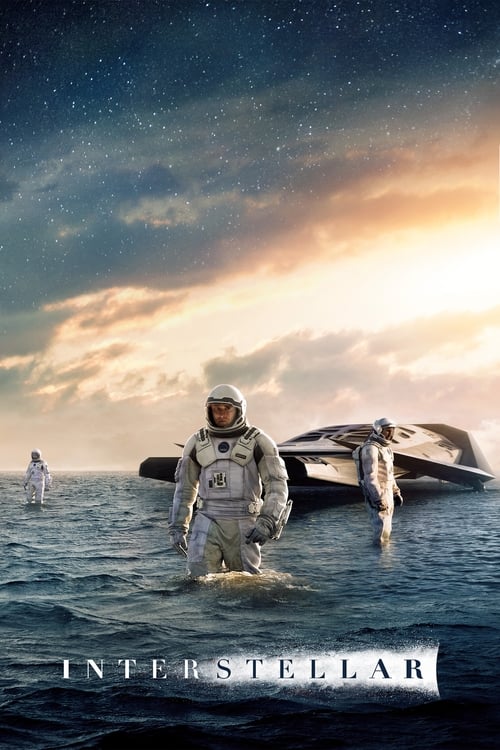
Interstellar
2014 · Christopher Nolan
The director whose every release is treated as a referendum on theatrical cinema itself: Oppenheimer's IMAX-70mm pilgrimage culture, the Barbenheimer phenomenon, and now The Odyssey selling out screenings a full year in advance. Naming him signals you believe in the big screen; arguing about him (cold characters, muddy sound mixing) is its own cottage industry.
For when you want to be swept up by something enormous — a big-feelings, big-ideas night where you're happy to surrender three hours and come out a little teary and a little starstruck. Great with company, devastating alone.
What it's about
Earth is slowly dying — crops failing, dust storms swallowing towns — and a former pilot turned reluctant farmer is recruited for a secret NASA mission: fly through a newly discovered wormhole to search for a world humanity can move to. The catch is relativity itself: near a black hole, hours for the crew mean years back home, so every decision he makes in space costs him time with the daughter he left behind. It's a space epic where the enemy isn't aliens — it's distance, gravity, and the clock.
The experience
Huge and overwhelming one minute, intimately devastating the next — it swings between white-knuckle set pieces and scenes that quietly wreck you. Expect awe, real tension, and at least one moment where the physics of time becomes an emotional gut-punch.
Performances
Matthew McConaughey anchors the spectacle with raw, unguarded emotion — one scene of him simply watching messages from home is among the most affecting things he's done.
The craft
Shot largely on IMAX film with practical sets and models, so the spacecraft, ice fields, and black hole have real weight and texture; the black hole imagery was built from actual physics equations and looks like nothing before it. Hans Zimmer's organ-driven score is a character in itself — thunderous, churchlike, relentless. If any film demands the biggest screen and loudest speakers you can find, it's this one.
Why it matters
It reset the bar for scientifically serious blockbusters — its black hole visuals informed real astrophysics imagery — and cemented the idea that a demanding, emotional hard-sci-fi epic could be a global event.
Snapshot
A near-future ecological crisis has rendered Earth's atmosphere hostile to crops; NASA operates in secret, and former pilot Cooper (Matthew McConaughey) is recruited to lead a crew through a newly discovered wormhole in search of habitable planets. The mission unfolds across relativistic time — hours on one planet equal years on Earth — fracturing Cooper's relationship with his daughter Murph across decades. The film resolves through a tesseract constructed inside a black hole, where Cooper manipulates gravity and time to transmit scientific data to Murph, enabling humanity's escape. Interstellar is among the most ambitious science-fiction spectacles of its era: a work that takes relativistic physics seriously while centering its emotional stakes on familial love and the human drive to persist beyond extinction.
Industry & production
The project originated not with Nolan but with producer Lynda Obst and theoretical physicist Kip Thorne, who had long discussed a film grounded in genuine astrophysics. A treatment was developed at Paramount Pictures with Steven Spielberg attached to direct; Jonathan Nolan wrote a screenplay during that period. When Spielberg departed to develop other projects, Christopher Nolan — fresh from completing The Dark Knight Rises (2012) — was brought in. Nolan substantially rewrote his brother's script, retaining certain structural elements while shifting the story's emotional register toward the father-daughter relationship at its core. Kip Thorne remained as executive producer and science consultant throughout, a role that proved consequential to the film's visual and conceptual design.
Production was financed jointly by Paramount Pictures and Warner Bros. Pictures — an unusual arrangement reflecting both the film's scale and Nolan's leverage as a filmmaker whose prior run had been consistently commercially successful. The shoot took place across multiple locations: farmland sequences in Alberta, Canada stood in for Cooper's near-future Midwest; Iceland's volcanic landscapes served both the ocean world (Miller's planet) and the ice world (Mann's planet). Practical sets built to full scale on soundstages included the spacecraft Endurance interior. The production was committed from the outset to shooting on photochemical film rather than digital acquisition.
Technology
Interstellar represents the most extensive use of IMAX 15/70mm film photography in any narrative feature to that point in the format's history. Hoyte van Hoytema acquired as much footage as possible on IMAX negative — expanding the frame from the standard 2.39:1 anamorphic scope ratio to the IMAX 1.43:1 near-square aspect ratio for extended passages, most notably the space sequences. This results in a film that changes shape on a proper IMAX screen, a deliberate immersive strategy Nolan had employed partially on The Dark Knight (2008) and more fully here.
The black hole Gargantua represents the most technically significant achievement in the film's production history. Nolan's visual effects team, led by Paul Franklin at Double Negative (DNEG), worked directly with Thorne to render Gargantua using equations from general relativity. The process required purpose-built raytracing software to simulate how photons would travel through the extreme gravitational field of a spinning Kerr black hole. The result — the bright accretion disk bending around and behind the black hole's silhouette — was not merely a visual approximation but a physically accurate simulation. The work was scientifically substantial enough that Thorne and colleagues published findings derived from the rendering process in peer-reviewed astrophysics journals, the first instance of a Hollywood production's visual effects contributing meaningfully to published physics research.
Technique
Cinematography
Hoyte van Hoytema joined as director of photography after Wally Pfister — Nolan's DP on every feature from Memento (2000) through The Dark Knight Rises — departed to direct Transcendence (2014). Van Hoytema brought a slightly warmer, more naturalistic photographic sensibility; his prior work on Let the Right One In (Alfredson, 2008), Tinker Tailor Soldier Spy (Alfredson, 2011), and Her (Jonze, 2013) had demonstrated considerable tonal range.
For Interstellar, van Hoytema employed both 35mm anamorphic and 15/70mm IMAX film stocks, with the format changes structurally meaningful rather than arbitrary. Earth-bound sequences are shot in anamorphic scope, establishing the horizon-wide flatness of the dying farmland; as the Endurance crew passes through the wormhole and operates in space, the frame expands to IMAX proportions, literally enlarging the visual world the characters inhabit. Interior spacecraft lighting tends toward a cool, institutional blue-white clarity; planetary surfaces are distinguished by their atmospheric color temperatures. The cinematography avoids the hyperstylized contrast of some earlier Nolan work, aiming instead for a documentary groundedness that makes extraordinary events more viscerally immediate.
Editing
Lee Smith, who had edited every Nolan feature from Batman Begins (2005) onward, cut Interstellar. The film runs 169 minutes and is structured around a series of long-form temporal displacements: as Cooper's crew ages months in transit while years and then decades pass on Earth, Smith constructs parallel montages that make the asymmetry of relativistic time emotionally concrete. The sequence in which Cooper watches years of accumulated video messages from Earth — including a visibly aging Murph — intercutting with his impassive face in the Endurance cockpit is among the film's most powerful editorial choices, converting an abstract physics concept into sustained, grief-saturated duration.
The docking sequence, in which Cooper pilots a damaged shuttle to connect with the spinning Endurance, is notable for its formal precision: tight cockpit instrumentation intercut with exterior space footage to generate claustrophobic spatial disorientation. The film's final act, set within the tesseract, presents Smith with a problem of genuine structural novelty — how to cut a scene set "outside time" in a way that remains spatially intelligible. The solution — a grid of fragmented moments from the film's own timeline, reassembled to create comprehensible cause-and-effect across non-linear space — is largely satisfying and has no clear precedent in mainstream cinema.
Mise-en-scène / staging
Nolan stages most scenes in depth, with foreground and background planes actively in use — a habit consistent across his work. The farmland sequences are particularly deliberate: long grass blowing in wind, dust accumulating on windowsills, the slow suffocation of an ecosystem conveyed through the accretion of environmental detail rather than expository statement. These sequences draw on both the naturalistic American realism associated with Terrence Malick and on archival photography from the Dust Bowl era; the brown-gray palette and modest domestic interiors establish the film's emotional register before any science-fiction element appears.
In space, staging becomes a function of the Endurance's modular ring architecture, which Nolan uses to clearly establish spatial relationships between cockpit, living quarters, and the centrifuge — relationships the film exploits for the confrontation with Mann in the third act. The tesseract sequence departs from all prior staging logic: Cooper moves through a three-dimensional library of time-frozen domestic moments, and Nolan stages this as an architecturally coherent environment that happens to be non-Euclidean, using repeated tracking shots through the bookshelf-corridor to orient the viewer within what is, geometrically, an impossible space.
Sound
Hans Zimmer's score is among the most discussed and debated elements of the film's reception. Nolan gave Zimmer a single page of personal text describing the emotional core of the film — the father-daughter relationship — before Zimmer began composing, without viewing footage. The score is built principally around the pipe organ, an instrument whose overtone-rich sustain and physical magnitude suited the film's sense of cosmic scale. The organ combines with choir and strings in a way that alternates between the ceremonial and the cosmological, and several cues incorporate a ticking-clock motif that creates temporal urgency against the film's themes of dilated time.
Richard King served as supervising sound editor and sound designer. Interstellar became a reference point in ongoing debates about theatrical sound mixing: certain lines, particularly in action sequences, were mixed beneath music and sound effects in a way that some audiences found unintelligible. Nolan addressed this in interviews, characterizing the choice as intentional — a decision to treat sound as an experiential element rather than a transparent information-delivery system. The position was not universally accepted.
Performance
Matthew McConaughey's casting as Cooper drew on the critical reappraisal his work had undergone in the preceding years — the so-called McConaissance, anchored by Mud (Jeff Nichols, 2012), Dallas Buyers Club (Jean-Marc Vallée, 2013, for which he won the Academy Award for Best Actor), and True Detective (HBO, 2014). McConaughey brings an unglamorous practicality to Cooper — a working pilot and farmer more comfortable with machinery than abstraction — and the performance is effective in large part because it resists heroic inflation. The video-message sequence is built almost entirely on his reactive face; it sustains.
Anne Hathaway as scientist Amelia Brand carries the film's most philosophically burdened dialogue — a monologue arguing that love may function as a force that transcends physical dimensions — and navigates it with considerable steadiness. Michael Caine, in his fifth Nolan collaboration, plays Professor Brand with characteristic authority. Jessica Chastain as the adult Murph and Mackenzie Foy as young Murph create a convincing psychological continuity across the temporal gap their performances must bridge.
Narrative & dramatic mode
Interstellar is structured as a problem-solution narrative with a nested dramatic irony: the audience comes to understand, before most characters do, that the mysterious "ghost" communicating through gravity in Cooper's farmhouse is Cooper himself, transmitting from the future. The film deploys this irony across a very long runtime, asking the viewer to hold a series of scientific premises — wormholes, time dilation, black hole interiors, the fifth dimension — in simultaneous relation with an emotionally unambiguous throughline about parental love and abandonment.
The narrative mode is epic in scale — multiple planetary destinations, decades of diegetic time — but intimate in its dramatic stakes, which are ultimately between two people across a temporal gap. This tension between the cosmological and the personal is thematically intentional, and places the film in a long tradition of science fiction that uses the physics of extreme environments to externalize interior emotional states. The film's resolution, in which love (or its physical analog, gravity) is literally the mechanism of salvation, is either the film's most profound statement or its most sentimental evasion, depending on the viewer's tolerance for metaphysical literalization.
Genre & cycle
Interstellar belongs to the tradition of hard science fiction in cinema — a category defined less by rigorous accuracy (no film fully achieves this) than by the ambition to engage seriously with scientific concepts and allow them to drive narrative and visual form. Its closest predecessors are Kubrick's 2001: A Space Odyssey (1968) and Zemeckis's Contact (1997), both of which stage human encounters with the cosmological through a lens simultaneously scientific and spiritually inflected.
The film also participates in an early-2010s cycle of prestige science fiction that includes Gravity (Cuarón, 2013) and The Martian (Scott, 2015) — films sharing a commitment to physical plausibility and a renewed interest in NASA-era exploration mythology as emotional material. Interstellar is the most philosophically ambitious of this grouping and the most willing to proceed beyond the physically verifiable into speculative territory.
Authorship & method
Christopher Nolan's filmmaking practice is defined by consistent commitments: photochemical acquisition, practical effects as foundation, location-based production, theatrical exhibition as primary mode of address, and structural complexity as signature rather than obstacle. Interstellar extends all of these tendencies. The transition from Wally Pfister to van Hoytema produced no visible rupture in approach, though van Hoytema's photography is, in aggregate, marginally softer and more naturalistic than Pfister's colder precision.
Jonathan Nolan's contribution to the screenplay is difficult to fully disentangle from Christopher's revision, but certain structural moves — the hidden NASA, the binary mission plans, the robot companions TARS and CASE — appear consistent with Jonathan's interest in institutional logic and technological mediation, visible in his later work on Westworld (HBO, 2016–). Hans Zimmer's collaboration with Nolan, which began with Batman Begins (2005), reached perhaps its most individually distinctive expression here: the organ-heavy score departs from the electronic-industrial textures of the Dark Knight trilogy and the compressed brass of Inception, representing a genuine compositional evolution in the partnership. Lee Smith's editing, production designer Nathan Crowley, and producer Emma Thomas complete the core collaborative unit whose continuity across Nolan's work makes meaningful auteurist analysis possible.
Movement / national cinema
Interstellar is a British-American co-production directed by a British filmmaker working firmly within the Hollywood blockbuster system, with financing reflecting the post-millennial model in which major studios share risk across national boundaries. Nolan holds a sui generis position in contemporary Hollywood: sufficiently commercially reliable to command near-total creative autonomy on productions of this scale, yet consistently choosing subject matter and formal approaches at the edge of mainstream palatability.
The film does not align meaningfully with any national cinema movement or political tradition. Its sensibility is broadly that of Anglo-American secular humanism — techno-optimistic, committed to human exceptionalism, sentimental about the family as the primal social unit. Any analysis of its cultural politics must account for the specific form of American space mythology it inhabits: NASA as moral institution, the frontier explorer as heroic archetype, the abandonment of space exploration as civilizational pathology.
Era / period
Interstellar arrives at a moment in Hollywood production when the consolidation of franchise filmmaking — particularly Marvel Cinematic Universe product — was constraining the space available for expensive original films. The film represents one of the last major expressions of a production model (expensive, auteur-driven, original intellectual property) that was becoming increasingly rare at the studio level. Its commercial success — approximately $677 million worldwide against a reported production budget of approximately $165 million, though precise figures should be treated as approximate — provided evidence that audiences would engage with ambitious science fiction outside franchise contexts, a data point subsequently invoked in discussions of films like Arrival (Villeneuve, 2016).
The film also arrives during a genuine popularization of astrophysics as public intellectual matter: the era of Cosmos: A Spacetime Odyssey (2014), the BICEP2 controversy over primordial gravitational waves (2014), and the approach of the first direct gravitational wave detection (LIGO, announced 2016). Kip Thorne was a figure of considerable public scientific presence during this period, which gave Interstellar's scientific ambitions a cultural context they would not have had a decade earlier.
Themes
The film's explicit central theme is the conflict between individual attachment — specifically parental love — and the demands of collective survival. Cooper must abandon his children to save humanity; the drama of whether this sacrifice is justified or redeemable drives the emotional logic of the entire film. Closely related is the theme of intergenerational obligation: the film consistently frames the relationship between living and future generations as a form of moral debt, and its resolution hinges on the transmission of knowledge across temporal gaps that biological life cannot bridge unaided.
Dylan Thomas's "Do Not Go Gentle into That Good Night," recited by Michael Caine's Professor Brand at intervals throughout the film, functions as its explicit moral motto: survival as a form of ethical rage against entropy. The film also engages, more obliquely, with ecological collapse — the blight killing Earth's crops is presented without attributable human cause, a framing some critics noted sidesteps questions of anthropogenic responsibility. The near-future America depicted early in the film is deflated and inward-looking, a society that has abandoned the ambition of space exploration; this retrenchment is treated as a civilizational failure of nerve rather than a political consequence.
Reception, canon & influence
Critical reception was strongly positive but not unanimous. The film's scale, ambition, and scientific engagement were widely praised; its sentimental resolution and, for some critics, the overwrought literalism of its final act were objects of significant criticism. The film won the Academy Award for Best Visual Effects; the sound-mix controversy extended into the post-release period and became part of the broader cultural footprint. In aggregate, Interstellar received reviews that praised its ambitions while acknowledging a gap between those ambitions and their emotional execution.
Influences on the film are principally three. 2001: A Space Odyssey (Kubrick, 1968) established the grammar of slow, observational space cinematography, the HAL-like robotic companion — here the sardonic TARS — and the transcendent alien encounter rendered through abstract visual form. Tarkovsky's Solaris (1972) introduced the concept of a space mission as occasion for confronting the limits of human knowledge, and the entanglement of guilt, memory, and love in scientific inquiry. Sagan's Contact (novel 1985, Zemeckis film 1997) stages a wormhole transit as both scientific event and personal revelation and provides the template for the scientist-protagonist who experiences the cosmological as emotionally transformative. The farmland aesthetic of the film's early passages draws on Malick — particularly The Tree of Life (2011), a meditation on childhood, time, and cosmological scale — though van Hoytema's approach is more functional and less lyrical than Emmanuel Lubezki's work in that film.
Legacy and forward influence are visible in several directions. Denis Villeneuve's Arrival (2016) shares Interstellar's willingness to use temporal structure as the primary narrative device and its positioning of scientific comprehension as an emotional experience; both films were central texts in a mid-2010s critical reassessment of the "intelligent blockbuster." James Gray's Ad Astra (2019) similarly draws on the NASA-mythology aesthetic and the solo protagonist in extreme-space-isolation template. More diffusely, Interstellar normalized within the prestige blockbuster a willingness to extend running times, withhold exposition, and treat the audience as capable of assimilating relativistic concepts without remediation.
The rendering of Gargantua carries a specific scientific legacy. Techniques developed by DNEG under production constraints contributed to the research community's visual vocabulary for black hole rendering, and the peer-reviewed publications derived from that work represent an unusual instance of commercial filmmaking generating scientifically consequential output. When the Event Horizon Telescope collaboration released the first actual photograph of a supermassive black hole in 2019, the resemblance to Gargantua was noted widely in both the scientific and popular press — an accidental validation that closed the loop between Thorne's theoretical input and the film's visual imagination.
A Deleuzian reading
Start with the dust.
The full Deleuzian reading of Interstellar →
Reception
In 2014 it was the rare Nolan film critics genuinely split on — dinged as sentimental and overstuffed next to the airtight Inception. A decade on, sold-out IMAX 70mm re-releases and a permanent perch in the IMDb Top 30 have settled the question: it's become the Nolan film people cry about, not quibble over.
How Interstellar was received, from release to now →
Influences: the films it descends from and the films it influenced
- 2001: A Space Odyssey (1968) — TARS directly inherits HAL 9000's template of sardonic machine intelligence, and the tesseract bookshelf reactivates Kubrick's Stargate grammar for rendering post-human transcendence through abstract, non-representational visual form.
- Solaris (1972) — Tarkovsky's formal model of a space mission structured as confrontation with the limits of scientific rationality — where love and guilt materialize as literally present phenomena — is the direct precedent for Interstellar's fifth-dimensional love-as-physical-force resolution.
- Close Encounters of the Third Kind (1977) — Establishes the template of the agrarian American male who abandons his domestic world and family for a cosmological calling, with first contact staged as a sensory-overwhelming revelation rather than adversarial encounter.
- The Right Stuff (1983) — Provides the NASA-mythology aesthetic template — test-pilot/astronaut as American heroic archetype set against institutional bureaucracy — that structures the hidden-NASA revelation and Cooper's positioning as the last of a dying breed.
- Lawrence of Arabia (1962) — The roadshow prestige production model Nolan explicitly invokes: large-format photography of genuinely hostile practical environments, extended runtime without expository padding, and theatrical exhibition as primary mode of address.
- Contact (1997) — The wormhole transit rendered simultaneously as a scientifically exact event and personally overwhelming revelation — Arroway's first-person-POV transit directly prefigures Cooper's — establishing the scientist-protagonist who experiences cosmological phenomena as emotionally transformative.
- The Tree of Life (2011) — Van Hoytema's agrarian farmland photography for Interstellar's Earth passages directly adopts the naturalistic-documentary texture of Lubezki's work, and Malick's structural device of juxtaposing domestic intimacy against cosmological-scale imagery is the template Nolan borrows.
- Inception (2010) — Establishes Nolan's method of staging non-Euclidean impossible geometry using practically constructed sets rather than digital augmentation — the rotating corridor and city-fold built in camera — which Interstellar directly extends to the physical tesseract bookshelf.
- The Dark Knight Rises (2012) — Hoyte van Hoytema maintains IMAX 15/70mm photochemical capture after Pfister's departure, proving the methodology transferable; Hans Zimmer's choral-drone score language extends directly from TDKR's 'Deshi Basara' template; Lee Smith's long-form sequence architecture governs the docking sequence and the wave-planet passage at the same extended durations.
- Tinker Tailor Soldier Spy (2011) — Consolidates van Hoytema's path to major 35mm/65mm photochemical cinematography — the texture and naturalistic light grammar honed on Tinker Tailor scaled up.
- Oblivion (2013) — Continues the memory-haunted, contemplative-blockbuster mode with in-camera practical environments and a synth-organ score deployed as emotional ballast against cosmic scale.
- Silent Running (1972) — Ecological collapse on a dying Earth drives a botanical-salvation mission, realized with practical miniatures and a non-anthropomorphic but characterful robot (TARS) — Trumbull's eco-SF-with-real-models lineage at scale.
- Dunkirk (2017) — Extends Interstellar's intentional-dialogue-burial technique to its logical limit: entire action sequences deliberately rendered without comprehensible speech, with Zimmer's score functioning as sole semantic and emotional carrier — a direct amplification of Interstellar's sound-mix controversy.
- Arrival (2016) — Extends Interstellar's temporal-non-linearity-as-primary-revelation-mechanic directly: the apparent memory sequences revealed as future in exactly the structural move Nolan uses with the Cooper-Murph relationship, both films anchoring the mid-2010s intelligent-blockbuster critical reassessment.
- First Man (2018) — Deploys Interstellar's IMAX format-switching strategy precisely: cramped 16mm-ratio handheld photography inside capsules expanding to full 65mm IMAX for the lunar surface, with Gosling's reactive, inward male performance following the template McConaughey established.
- Ad Astra (2019) — Directly adopts the NASA-mythology solo-protagonist extreme-space-isolation structure; Pitt's reactive-face performance mode follows McConaughey's template, and the agrarian Earth-opening echoes Interstellar's farmland passages.
- Tenet (2020) — Extends Interstellar's non-Euclidean temporal logic into large-scale action choreography: the palindromic battle sequence renders time inversion through practically choreographed spatial sequences, continuing Nolan's commitment to making impossible geometries physical rather than digital.
- Oppenheimer (2023) — Shot on 65mm/IMAX photochemical stock without digital intermediate — the most direct extension of Interstellar's photochemical mandate — and deploys Interstellar's relativistic-parallel-montage approach through non-linear intercutting of the courtroom present against the Trinity-test past.
- Project Hail Mary (2026) — Relativity-driven dual timeline in which physics literally separates loved ones across elapsed time, anchoring hard-SF spectacle to real equations rather than hand-waving.
- Nope (2022) — Hoyte van Hoytema's first large-scale deployment of IMAX 65mm for American agricultural landscape — dust-storm sequences and cornfield horizon lines held at ground level against open sky — develops the specific photographic grammar of scale and texture he brought directly to Nope five films later.
- The Fantastic 4: First Steps (2025) — Demonstrates large-format IMAX photography carrying a cosmic-scale story on a foundation of warm domestic/parental emotion — family-as-vulnerability driving the spectacle.
- Gravity (2013) — Contemporaneous IMAX prestige sci-fi that deploys the same format-switching logic between intimate close-up faces and vast spatial establishes, jointly defining the mid-2010s blockbuster's tolerance for silence, slow pacing, and visual abstraction in space sequences.
- The Martian (2015) — Contemporaneous prestige hard-scifi sibling deploying the same production toolkit — anamorphic 35mm, restrained Zimmer score, scientific-accuracy production design — for a tragic-transcendent register against The Martian's comic-optimistic one; together they define the era's tonal range.
- Dune (2021) — Sibling project in IMAX-format serious sci-fi epic with Hans Zimmer's invented organ-based sonic palette deployed for sheer physical, theater-shaking immersion.
- Prometheus (2012) — Pursues the same scale-disparity cosmic awe and human-origins quest, using large-format deep-staging to stage tiny figures against monumental phenomena while smuggling metaphysics into blockbuster form.
- The Odyssey (2026) — First Nolan–van Hoytema collaboration, establishing their practice of IMAX capture with practical in-camera photography of physical environments rather than green-screen.
- Wicked (2024) — Nathan Crowley's practical-set build philosophy — physical environments constructed and shot in-camera as a counter-model to CGI — is the same production-design methodology Crowley brings to Wicked's Oz.
- Twisters (2024) — Sibling in anamorphic dust-bowl Americana — practical, in-camera dust and windstorms shot large-format across corn-field heartland, wedding regional agrarian imagery to spectacle.
- Sunshine (2007) — Shares the tragic-rational-choice engine — a crew member coldly computes that his own death buys the mission its delta-v — and matches Sunshine's practically-lit cockpit photography and its use of a maximalist, near-continuous score as narrative pressure rather than accompaniment.
Similar films
- Project Hail Mary (2026) — influence & lineage · same viewing thread
- Arrival (2016) — influence & lineage · same viewing thread
- 2001: A Space Odyssey (1968) — influence & lineage · same viewing thread
- Contact (1997) — influence & lineage · same viewing thread
- Gravity (2013) — influence & lineage
- Dunkirk (2017) — influence & lineage
- Ad Astra (2019) — influence & lineage
- Inception (2010) — influence & lineage
All the films related to Interstellar →
Watch it with: curated runs of related films
- Alone in the Void — A run of films about a single mind pitted against the vastness — rationing air, doing the math, reaching across impossible distance — best watched together for how survival keeps tipping into awe.