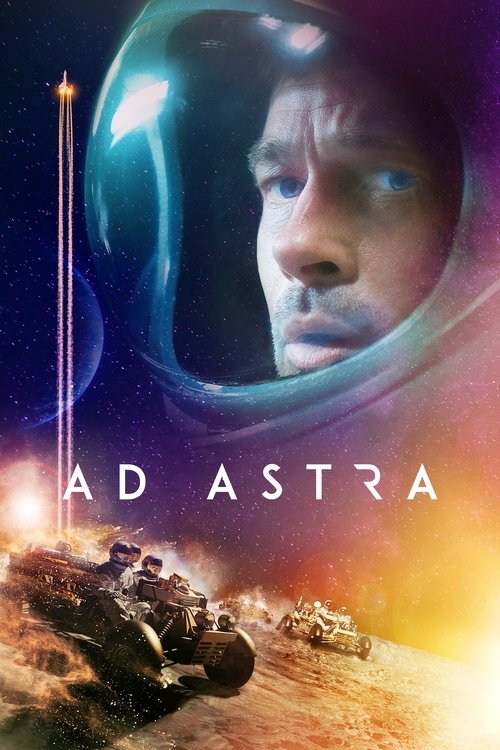
Ad Astra
2019 · James Gray
When you want a film to sit quietly inside for days — melancholy, gorgeous, contemplative. Not for a restless night; for when you're ready to feel something about fathers, ambition, and loneliness.
What it's about
In a near future where humanity has spread across the solar system, a famously unflappable astronaut is sent on a classified mission: mysterious power surges threatening Earth appear to trace back to a lost expedition near Neptune — one commanded, decades ago, by his own father. The journey takes him from the Moon to Mars and beyond, each leg stripping away another layer of the composure he's built his life on. It's a space epic that's really about a son and an absent father.
The experience
Slow, hushed, and hypnotic — closer to a meditation than a thrill ride, though it detonates a few startling set pieces along the way. It leaves you with a lump in your throat and a strange calm, the feeling of vast distances and one small unresolved relationship.
Performances
Brad Pitt gives one of his most interior performances, doing nearly everything with stillness and a murmured voiceover — the drama lives in micro-expressions under a helmet. Tommy Lee Jones brings granite weight to a man more myth than memory.
The craft
Hoyte van Hoytema's cinematography makes space feel both sublime and desolate — lunar chases, Mars interiors bathed in amber, Neptune's cold blue — and Max Richter's score aches underneath it all. The sound design treats silence as a material; on a big screen with good speakers it's genuinely enveloping.
Why it matters
It marked James Gray's leap from intimate New York dramas to studio-scale filmmaking without surrendering his voice, and it stands with the era's wave of serious, inward-looking science fiction that used space to talk about grief.
Snapshot
Ad Astra is James Gray's sixth feature and his first foray into science fiction, a contemplative, near-future space odyssey that uses the genre's hardware to stage an intimate drama of paternal abandonment. Brad Pitt plays Roy McBride, an astronaut dispatched across the solar system to make contact with his father, Clifford (Tommy Lee Jones), a pioneering space explorer presumed dead near Neptune whose long-dormant research project is now emitting power surges that threaten Earth. The film marries the production scale of a studio space picture to the introspective register of Gray's earlier chamber dramas (The Yards, Two Lovers, The Immigrant), pitching itself explicitly against the optimism of the genre: where most space narratives reach outward toward wonder, Ad Astra travels outward only to discover emptiness, and turns the journey into an argument for the sufficiency of human connection on Earth. Released by 20th Century Fox in the late stages of that studio's absorption by Disney, it premiered at the Venice Film Festival in competition and divided audiences and critics between admiration for its craft and frustration with its melancholy interiority.
Industry & production
Ad Astra was developed over several years, with Gray and co-writer Ethan Gross building the screenplay around a deliberately stripped, almost mythic father-son spine. It was a comparatively large undertaking for a director whose previous films had been mid-budget dramas; reported budgets place it in the range of roughly $80–100 million, financed and distributed by 20th Century Fox, with Brad Pitt's company Plan B Entertainment among the producing entities and Pitt himself central both as star and producer. The production's path to release was unusually fraught: the film was repeatedly pushed back, moving across multiple announced dates, partly owing to extensive visual-effects work and partly to the corporate upheaval surrounding Disney's acquisition of 21st Century Fox, which was completed in early 2019. It ultimately premiered in competition at the 76th Venice International Film Festival in August 2019 and opened theatrically the following month.
Commercially the film was a modest performer relative to its cost, the kind of prestige genre picture that earns respect more readily than profit; precise figures should be treated cautiously, but it is widely understood to have underperformed against its budget at the box office. Gray has spoken publicly, in interviews around the release, about friction with the studio over the film's tone and its heavy reliance on voiceover narration, a tension that reflects the broader difficulty of placing an austere, auteur-driven space drama inside a blockbuster distribution apparatus. The film stands, in this sense, as one of the last ambitious adult-oriented genre projects shepherded through the old Fox before its identity was folded into Disney.
Technology
The film was photographed digitally by Hoyte van Hoytema, a cinematographer closely associated with large-format and celluloid work, and its imagery leans on the textural richness of high-resolution capture combined with extensive, carefully integrated visual effects. The production designed a near-future solar system that is plausible rather than fantastical: a commercialized Moon with branded concourses and lawless contested zones, an underground Mars facility, and the long interplanetary transits between them. Visual effects houses built the spacecraft, planetary vistas, and the climactic Neptunian rings through a combination of physical sets, models, and digital extension, with the aim of a tactile, lived-in plausibility rather than spectacle for its own sake. The film's technological imagination is notably skeptical: it extrapolates not utopia but the replication of terrestrial commerce, bureaucracy, and conflict across space, so that the Moon hosts the same consumer franchises and the same violence as Earth. This grounded extrapolation is itself the film's most distinctive technological statement.
Technique
Cinematography
Hoyte van Hoytema's photography is the film's most celebrated element. Working in a palette of deep, saturated reds, golds, and cold blues, he gives each waypoint in the journey a distinct chromatic identity — the burnished interiors of spacecraft, the lunar gray shading into amber, the encroaching blackness of the outer system. The lighting often isolates Pitt's face in close-up, lit to register the smallest flickers of suppressed feeling, so that the camera treats the human countenance as the true landscape. Van Hoytema balances this intimacy against passages of awed scale: the opening fall from the space antenna, the lunar rover chase, and the final approach to Neptune. Throughout, the visual strategy enforces the film's thesis — the vastness of space rendered beautifully yet coldly, a sublime that offers no comfort, against which the warmth of a single illuminated human face is set as the only available source of meaning.
Editing
The film is cut by John Axelrad and Lee Haugen for a measured, deliberate rhythm that privileges contemplation over momentum. Action sequences are admitted but kept brief and functional; the dominant tempo is slow, with long takes of travel, waiting, and interior reflection. The most contested editorial decision is the pervasive use of Roy's voiceover, which threads almost continuously through the film, narrating his psychological state and the results of mandated psychological self-evaluations. This narration smooths and explicates the interior journey, and critics divided sharply over whether it deepened the film or over-determined it; Gray himself has indicated it was expanded under studio pressure. The editing's larger achievement is structural: it organizes the film as a series of discrete planetary stations, each a self-contained moral or emotional test, in the manner of a quest narrative.
Mise-en-scène / staging
Gray stages the film as a procession of enclosed, controlled environments — capsules, corridors, airlocks, command rooms — punctuated by sudden exposures to the void. The contained interiors emphasize Roy's psychological confinement and the bureaucratic regimentation of his world, while the exterior vistas dwarf the human figure. The film repeatedly composes Pitt as a small, solitary element within overwhelming geometry, both technological and cosmic. Production design renders the future as a familiar institutional present extended outward, all functional surfaces and corporate signage, refusing the sleek futurism of genre convention in favor of something worn and bureaucratic.
Sound
Sound design is central to the film's effect, alternating the absolute silence of vacuum with the close, breathing intimacy of the suit interior, so that the audience is held inside Roy's sealed perceptual world. Max Richter contributes to the score alongside composer Lorne Balfe and additional music, producing a restrained, mournful sonic register dominated by sustained tones and minimal melodic movement that mirrors the film's emotional suppression. The sound mix uses the contrast between roar and silence as a dramatic device — the violence of a launch or impact against the deathly quiet of space — reinforcing the sense of isolation that is the film's psychological subject.
Performance
Brad Pitt delivers one of his most internalized performances, calibrated to extreme restraint: Roy is a man whose professional value lies in a resting heart rate that never exceeds a clinical threshold, and Pitt plays the entire film at the edge of suppressed emotion, allowing feeling to surface only in micro-expressions and in the cracking of the mandated self-evaluations. It is a performance built almost entirely on stillness and the voice. Tommy Lee Jones, appearing substantially only in the final act, gives Clifford a haunted, fanatical gravity — the absent father as a man consumed by a quest that has hollowed out his humanity. The supporting cast, including Ruth Negga as a Mars-born administrator, Donald Sutherland as a compromised colleague, and Liv Tyler in a brief, near-wordless role as Roy's estranged wife, function largely as way-stations and mirrors for Roy's interior progress rather than as fully developed figures, a choice consistent with the film's mythic, single-protagonist design.
Narrative & dramatic mode
The film's dramatic mode is the quest-as-interior-journey, structured explicitly along the lines of a descent narrative: a son travels progressively outward and inward to confront a near-mythic father, with each planetary stage functioning as a trial. Commentators have widely noted the debt to Joseph Conrad's Heart of Darkness — the journey upriver toward a charismatic, isolated figure who has gone beyond the bounds of sanity in pursuit of a mission — transposed to interplanetary space, with Clifford as a Kurtz figure. The surface plot of averting catastrophe is consistently subordinated to the psychological narrative of a man examining his own emotional repression, his inheritance of his father's coldness, and his decision to reject it. The continuous voiceover makes this interiority literal, turning the film into something close to a confessional monologue staged against cosmic scale. The resolution is deliberately anti-climactic in genre terms: the revelation at journey's end is the absence of revelation — no alien intelligence, no transcendent answer, only a damaged man and an empty universe — and the film's true climax is emotional and terrestrial, a turn back toward human relationship.
Genre & cycle
Ad Astra belongs to the cycle of contemplative, scientifically grounded "prestige" space films that gained prominence in the 2010s, often grouped with Gravity (2013), Interstellar (2014), The Martian (2015), and First Man (2018). Like these, it pursues a register of realism and existential weight rather than space-opera adventure, and it shares with First Man in particular an interest in the emotionally suppressed astronaut as a study in masculine reticence. Its deeper lineage, however, reaches back to the philosophical space cinema of an earlier era — Kubrick's 2001: A Space Odyssey (1968) for its cosmic awe and its journey toward an enigmatic threshold, and Tarkovsky's Solaris (1972) for its insistence that the meaning of space travel is finally psychological and earthbound. Against the wonder of much of the genre, Ad Astra positions itself as a deliberate inversion: a space film arguing that there is nothing out there, and that the proper object of human longing is each other.
Authorship & method
James Gray is a director long associated with classical, character-driven dramas set largely in New York, working in a deliberately unfashionable mode of moral seriousness and emotional gravity influenced by Coppola, Visconti, and the European art cinema of the 1960s and 1970s. Ad Astra extends his career-long preoccupation with fathers, sons, family obligation, and inherited identity — themes that run through Little Odessa, The Yards, We Own the Night, and The Immigrant — into a new generic and budgetary register, while retaining his fundamentally intimate sensibility. Gray has described the film, in interviews, in terms of personal and even autobiographical feeling about fatherhood and emotional inheritance, and has been candid about the tension between his authorial intentions and the demands of a large studio production, particularly regarding the voiceover and tone.
His key collaborators shape the film decisively. Co-writer Ethan Gross worked with Gray on the screenplay's spare, mythic architecture. Cinematographer Hoyte van Hoytema — whose credits include Her, Interstellar, and Dunkirk — brings a large-format sensibility and a gift for marrying intimacy to scale. The score by Max Richter and Lorne Balfe (with additional music) supplies the film's mournful emotional undertone. Editors John Axelrad and Lee Haugen, longtime Gray collaborators, sustain the contemplative pace. The result is a film unmistakably of a piece with Gray's authorship despite its unfamiliar trappings: the spacecraft and planets are vehicles for the same questions of family and self that have always driven his work.
Movement / national cinema
The film is a product of American studio cinema, but Gray's artistic affinities lie conspicuously with European and classical traditions rather than with contemporary Hollywood. Critically he is often described as a more revered figure in France than in the United States, and his sensibility — its moral seriousness, its melodramatic gravity, its debt to literary and art-cinema models — places Ad Astra in dialogue with the international auteur tradition even as it operates within a Hollywood genre and budget. It is best understood as an American auteur film working against the grain of its own national industry's commercial expectations.
Era / period
Ad Astra is a film of the late 2010s, arriving at the crest of the decade's cycle of serious space cinema and at a moment of consolidation in the American film industry, as the major studios contracted around franchise tentpoles and the space for mid-to-large adult dramas narrowed. Its very existence — and its commercial difficulty — reflects this transitional moment: produced by a Fox in the act of disappearing into Disney, it stands near the end of a particular model of studio-backed auteur filmmaking. Its near-future setting, with its privatized Moon and casual interplanetary commerce, registers contemporary anxieties about the corporatization of space exploration then gathering force in the era of private spaceflight.
Themes
The film's governing theme is paternal abandonment and the inheritance of emotional repression: Roy must journey to his father in order to free himself from becoming him. Around this core cluster several others. There is a sustained meditation on masculine isolation and the cost of the stoic, mission-focused ideal of manhood, embodied in Roy's clinically suppressed affect. There is a critique of the human compulsion to seek meaning in the cosmos — the father's lifelong search for extraterrestrial intelligence is figured as a kind of grand, destructive vanity, a refusal to value the life and family already at hand. Against the disappointment of the void, the film advances a counter-thesis of presence and human connection: the discovery that the universe is empty becomes, paradoxically, an argument for the preciousness of earthly relationships. The film also reflects, through its privatized and militarized solar system, on humanity's tendency to export its commerce, conflict, and bureaucracy wherever it goes, finding no escape from itself in the stars.
Reception, canon & influence
Critical reception was strong but divided. The film drew wide praise for van Hoytema's cinematography, for Pitt's restrained central performance — often cited among his finest — and for Gray's ambition in mounting a genuinely personal, philosophically serious space drama at studio scale. Many critics admired its willingness to subordinate spectacle to interiority and to end on an anti-heroic, inward note. Detractors found it ponderous, faulted the relentless explanatory voiceover for flattening its mysteries, and questioned the plausibility of some of its episodic incidents. Audience response was more muted, the film's contemplative melancholy proving a difficult fit for the expectations of a star-driven space release, which contributed to its modest commercial showing.
Its influences run backward to the philosophical space cinema of Kubrick and Tarkovsky, to Conrad's Heart of Darkness as a narrative template, and to the 2010s cycle of grounded space realism that immediately preceded it. Forward influence is harder to assess so close to the event and should be claimed only tentatively: Ad Astra has come to occupy a respected place within Gray's filmography and within the recent canon of introspective science fiction, frequently invoked in discussions of the "astronaut interiority" subgenre and of the broader argument that the meaning of space travel is finally a human and terrestrial question. Its lasting reputation appears to be that of an admired, flawed, deeply personal film — a director's intimate drama wearing the costume of a blockbuster, valued more by critics and cinephiles than by the mass audience it was nominally made for.
A Deleuzian reading
Start with the face.
The full Deleuzian reading of Ad Astra →
Reception
Landed in September 2019 to strong reviews but a shrug from general audiences (a B- CinemaScore and soft box office after being marketed as a Brad Pitt space thriller), and has since been steadily reappraised as one of the era's great melancholy sci-fi films.
How Ad Astra was received, from release to now →
Influences: the films it descends from and the films it influenced
- 2001: A Space Odyssey (1968) — Establishes the vacuum-silence sound grammar and contemplative long-duration pacing that subordinates spectacle to existential interiority, treating the spacecraft interior as a mirror for the protagonist's inner state.
- Solaris (1972) — Models the outward space voyage as a dramatization of inward grief, using meditative durations in which the cosmos becomes a projection of memory and unresolved family feeling rather than a site of action.
- Apocalypse Now (1979) — Supplies the literal Heart of Darkness narrative template — an upriver/outbound mission to confront and terminate a revered renegade authority figure — carried by a numbed first-person interior-monologue voiceover, exactly Ad Astra's structural spine.
- Aguirre, the Wrath of God (1972) — Provides the doomed-obsessive-expedition shape that ends at a deranged patriarch isolated past the edge of the known world, the Kurtz/Clifford McBride figure whose monomania the quester must reckon with.
- The Godfather Part II (1974) — Source of Gray's classical melodramatic restraint and his abiding subject of inherited paternal identity, staged in somber, dialogue-driven interiors that prize emotional gravity over kineticism.
- Her (2013) — Van Hoytema's collaborator method here — warm, shallow-focus facial close-ups that mine a withdrawn man's interiority inside a skeptical, lived-in near-future — is the visual approach he carries directly into Ad Astra.
- Interstellar (2014) — Van Hoytema's large-format technique marrying intimate human scale to cosmic vastness, plus the grounded-space-realism mode dramatizing a father separated from his child across space, is a direct precursor of method.
- Gravity (2013) — Anchors the 2010s grounded-space-realism cycle with its vacuum-silence sound design and single-protagonist physical-survival immersion that Ad Astra inherits and turns inward.
- First Man (2018) — Defines the contemporary astronaut-interiority mode: a grief-repressed man whose restrained, near-affectless performance and intimate close-up framing privilege private mourning over the iconography of the mission.
- The Martian (2015) — Extends The Martian's wide-low-angle lone-astronaut-against-Martian-terrain visual grammar and NASA institutional framework into psychological interior mode, using the same Wolski-adjacent widescreen isolationist composition for introspection rather than problem-solving.
- The Tree of Life (2011) — Binds cosmic-scale imagery to a hushed, fragmentary voiceover of a son's reckoning with his father, the same yoking of celestial spectacle to intimate paternal grief through whispered interior narration.
- Arrival (2016) — Shares the anti-spectacle, melancholic sci-fi register scored by Max Richter's mournful minimalist strings, reframing a first-contact premise as a fundamentally human, emotional reckoning.
- The Lost City of Z (2016) — Gray's own immediately prior film runs the same Heart-of-Darkness obsessive-quest-into-the-unknown structure around paternal absence, with identical classical restraint, here transposed from Amazon jungle to deep space.
- Moon (2009) — Builds psychological drama from enclosed near-future spacecraft interiors and isolation, using the confined station as a pressure chamber for a lone man's identity, a staging Ad Astra echoes.
- Sunshine (2007) — A crewed voyage toward a celestial body where the mission decays into awe and madness and crew members are picked off in episodic incidents, sharing the contemplative-dread tonal arc toward a transcendence the film distrusts.
- High Life (2018) — An austere, anti-transcendent space drama built from sterile interiors and bodily intimacy that strands a father adrift in the void, refusing blockbuster scale for the same inward, melancholic register.
- Contact (1997) — Frames the meaning of space travel as a terrestrial, familial question rooted in a lost father, arriving at the same anti-spectacle conclusion that the cosmos answers a human rather than a technological longing.
Similar films
- Interstellar (2014) — influence & lineage
- First Man (2018) — influence & lineage
- Moon (2009) — influence & lineage
- 2001: A Space Odyssey (1968) — influence & lineage
- Gravity (2013) — influence & lineage
- Solaris (1972) — influence & lineage
- The Tree of Life (2011) — influence & lineage
- Sunshine (2007) — influence & lineage