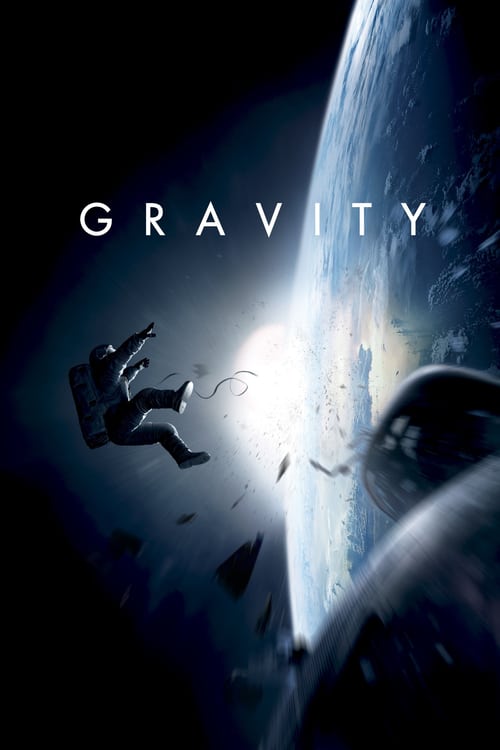
Gravity
2013 · Alfonso Cuarón
For when you want pure edge-of-your-seat spectacle that's over before dinner gets cold — a short, intense ride rather than a long haul. It's a thrill first, a tearjerker second.
What it's about
On her first space mission, engineer Ryan Stone is spacewalking with veteran astronaut Matt Kowalski when a storm of orbital debris tears their shuttle apart, leaving them adrift 372 miles above Earth with dwindling oxygen and no contact with the ground. What follows is a stripped-down survival ordeal: one person, the void, and the problem of getting home.
The experience
Ninety minutes of held breath — it's as physically gripping as movies get, but between the crises it turns quiet, lonely, and unexpectedly moving. You come out shaky and grateful for solid ground.
Performances
Sandra Bullock carries almost the entire film alone, often just a face inside a helmet, and makes terror, grief, and stubbornness read at every moment; George Clooney's easy calm is exactly the anchor the opening needs.
The craft
Cuarón built the film from astonishing extended takes that float you through the wreckage without a visible cut, using camera technology invented for the movie, and the sound design honors the silence of space — explosions you feel rather than hear. This is the definition of a film that demands the biggest screen and best speakers you can find.
Why it matters
A massive hit that won Cuarón the Oscar for directing and became a landmark for long-take digital spectacle — proof a blockbuster could be this experimental and this popular at once.
Snapshot
A catastrophic debris strike leaves two astronauts adrift above Earth with depleted oxygen, disabled communications, and no rescue in sight. Over ninety minutes, Gravity compresses survival cinema into a single unbroken existential ordeal, dispensing with subplots, flashbacks, and ensemble dynamics in favour of something closer to a sustained cinematic poem about falling and not falling. Technically, it is the product of years of custom-engineered production infrastructure developed specifically for the film; artistically, it is Alfonso Cuarón's most formally concentrated work — a demonstration that spectacle and interiority are not opposing impulses. The film became one of the highest-grossing dramas of its decade and remains a landmark in the industrialization of long-take cinematography.
Industry & Production
Cuarón conceived the project around 2008–2009, immediately after completing the press cycle for Children of Men (2006). Development stretched across roughly four years, during which the production design, pre-visualisation pipeline, and bespoke lighting technology were built from scratch — the gap between Cuarón's films reflecting not creative dormancy but an engineering problem that had no existing solution.
The film was produced by David Heyman — then best known for the Harry Potter series — under his Heyday Films banner in partnership with Cuarón's Esperanto Filmoj, with Warner Bros. distributing. The budget has been reported at approximately one hundred million dollars, a significant figure for a film with two principal cast members and no action set pieces in the conventional sense. The project attracted high-profile interest at the casting stage: several reports indicate Angelina Jolie was attached early before Sandra Bullock was confirmed; Robert Downey Jr. was among those considered for Kowalski before George Clooney accepted the role. The casting decisions matter dramatically — both Bullock and Clooney carry established star personas (resourceful everyman competence for Bullock; charming veteran authority for Clooney) that the film deploys then systematically strips away.
The majority of the visual effects were executed by Framestore, the British VFX house, under the supervision of Tim Webber. The collaboration required Framestore to build new simulation pipelines for the behavior of tethers, debris, and bodies in microgravity. Worldwide box office reached approximately 723 million dollars, representing an extraordinary return on investment and a commercial argument, still debated, that art-cinema formal ambition and multiplex audiences are not mutually exclusive.
Technology
The central technical problem was philosophical before it was engineering: how do you photograph weightlessness without making the camera weightless, and how do you light space without a practical light source on set?
Cuarón and Lubezki's solution was the LED light box, a cube of programmable LED panels capable of projecting the film's pre-rendered visual environment — rotating Earth, star fields, reflections — directly onto the actors' faces and suits. This meant that the light reaching Bullock's face during any given moment was the actual light that would logically exist in that scene's geography, rather than a studio approximation. The technique collapsed the boundary between lighting and production design and allowed Lubezki to avoid the compromised look of actors lit in ways inconsistent with their supposed environment.
For camera movement, the production engineered a system pairing the LED box with a robotic arm rig on which Bullock was suspended and precisely maneuvered, allowing the camera — itself controlled by a second robotic arm — to execute movements through her that no human operator could physically perform. Extensive pre-visualisation, closer to animation production than traditional film prep, governed almost every sequence before a single day of principal photography. The workflow effectively meant that Cuarón directed an animated film first and then used the pre-vis as a locked blueprint for live-action execution.
The VFX work at Framestore extended to the integration of Bullock's face and hair — the only practical elements — into fully CGI bodies and environments for large portions of the film. The challenge of simulating hair in microgravity, separating and drifting with physical plausibility, occupied a significant portion of the VFX development.
Technique
Cinematography
Emmanuel Lubezki's work on Gravity is the apotheosis of the aesthetic he had been developing across his career — fluid, unbroken, motivated-by-light, spatial — but extended into conditions no previous cinematography had attempted. The celebrated opening sequence unfolds in a sustained take lasting approximately thirteen to seventeen minutes (accounts differ depending on how concealed transitions are counted), establishing the film's fundamental grammar: the camera as a body in space, indifferent to human scale, capable of moving from extreme long shot to extreme close-up within a single continuous arc.
The shot is metrically precise. Objects orbit the frame; the camera rotates to maintain the correct spatial logic; the horizon of Earth appears and disappears as an orientation anchor. When debris strikes and the grammar of the shot shatters, the cut itself becomes an event — the first edit as rupture, the film's form enacting its subject.
Throughout, Lubezki coordinates three competing scales: the sublime (Earth from orbit, the void), the architectural (the geometry of stations and shuttle bays), and the intimate (Bullock's face inside the helmet, the fogging of her visor). The transitions between these scales, accomplished without cuts, are the film's primary vehicle of meaning.
Editing
Gravity won the Academy Award for Best Film Editing — a paradox that illuminates what editing actually is. The film contains roughly 156 shots across 91 minutes, an extraordinarily low count by contemporary standards. Mark Sanger, who shared the editing credit with Cuarón, has spoken about how the film's rhythm was managed at the level of camera movement and score rather than the cut. The editorial decisions that won the Oscar were largely decisions about when not to cut, and about managing tension through duration rather than accumulation. This is editing as a conceptual choice embedded in production design.
The few hard cuts in the film are consequently charged — they arrive as punctuation in a form that has trained the audience to experience continuity as norm.
Mise-en-scène / Staging
Staging for weightlessness requires rethinking the choreography of the human figure. Bodies do not rest on surfaces; they drift, rotate, and collide. Cuarón and his choreographers worked extensively on the logic of Bullock's physical performance in three dimensions, and the LED box / robotic arm system meant that her body's orientation at any given moment had to be pre-calculated against the camera's movement path.
The mise-en-scène is also a thematic text. Ryan Stone is repeatedly composed in foetal positions, curled inside modules, breathing recycled air through suit oxygen lines that function as umbilical imagery. The film is explicit about this — when Stone removes her suit inside the ISS airlock, floating in a near-natal curl in a white environment, the visual metaphor requires no decoding. Cuarón has acknowledged the intentionality of the rebirth arc and its staging.
Sound
The film operates under a productive constraint: there is no sound in space, yet a silent film was not the aim. The solution is diegetically motivated subjectivity — we hear what Ryan Stone hears through her suit: the clanking of metal transmitted through her gloves and boots, her breathing, her voice, communications through static. Ambient sound reaches her (and us) only through contact.
Steven Price composed the score for Gravity, his first major studio feature. Price and Cuarón developed a vocabulary of low-frequency bass pulses and swell-and-silence architecture that creates visceral physiological response — the bass communicates impact and threat in a register the body feels before the ear processes. The score swells most prominently at moments of relative safety, creating a counterintuitive tension: relief feels dangerous because the film has trained us to distrust calm. Price won the Academy Award for Best Original Score. Glenn Freemantle won for sound editing.
Performance
Bullock carries approximately eighty-five percent of the film alone, and the physical demands of the shoot — suspended on rigs for extended periods, performing in pre-determined robotic choreography — meant that her acting choices were constrained in ways unusual for a lead performance. She could not walk the set, could not find her character through spatial improvisation. The performance is consequently more interior than kinetic — fear, grief, and determination registering through breath control, minute facial shifts, and voice.
Clooney's role is essentially that of a grounding device: his affable competence establishes normalcy before the catastrophe and voices the film's coaching philosophy (his instructions to Stone are literally the film's instructions to the audience on how to survive what follows). His absence once the debris strikes is felt structurally rather than dramatically.
Narrative & Dramatic Mode
Gravity is a bottle film and a mythological one simultaneously. The narrative unit is the survival ordeal — a compressed, goal-driven sequence with clear stakes and a ticking clock — but the dramatic mode is closer to initiatory myth: a character enters a threshold condition (space, catastrophe, isolation), is stripped of all prior identity, and must decide whether to live. Ryan Stone's backstory — a dead daughter, a grief so thorough it has eroded her will to survive — is disclosed economically, not dwelt upon. It functions as the psychological wound that the ordeal forces open and, through extremity, cauterises.
The film resists the conventions of ensemble disaster cinema (no ensemble, no intercut ground perspective, no rescue team) and of psychological drama (no interiority beyond the immediate). Its dramatic mode is closest to what might be called kinetic elegy — sustained momentum in the service of emotional reckoning.
Genre & Cycle
Gravity arrives at the intersection of several genre lineages. It is survival cinema — related to Cast Away (Zemeckis, 2000), 127 Hours (Boyle, 2010), and the lone-protagonist-vs-environment tradition — but radicalizes the form by removing the environment itself. It is space cinema, inheriting from 2001: A Space Odyssey, Apollo 13, and the post-Moon (Jones, 2009) cycle of intimate space films that had been building in the early 2010s. And it is formally aligned with what might be called the long-take prestige film, a cycle that includes Children of Men, Birdman (Iñárritu, 2014), and 1917 (Mendes, 2019) — films that use the sustained take as a marker of craft ambition and critical seriousness.
Gravity was instrumental in establishing that cycle's commercial viability. Its success created conditions in which extended-take production infrastructure became a prestige investment rather than an art-cinema eccentricity.
Authorship & Method
Alfonso Cuarón has consistently worked across genre and national context — Mexican art cinema (Y Tu Mamá También, 2001), British literary adaptation (Great Expectations, 1998; Harry Potter and the Prisoner of Azkaban, 2004), dystopian science fiction (Children of Men) — while maintaining thematic obsessions with transition, exile, and the political valence of bodies in space. Gravity is his most extreme formal experiment, a film in which production method and thematic argument are inseparable.
Co-written with his son Jonás Cuarón, the screenplay is a deliberately stripped instrument — minimal dialogue, no backstory exposition beyond what is essential, no subplot. The father-son collaboration produces a script that reads closer to a treatment than a conventional feature screenplay, trusting that the production will supply what dialogue withholds.
Emmanuel Lubezki (credited as "Chivo") had photographed Y Tu Mamá También, Children of Men, and The New World (Malick, 2005) before Gravity; he would win three consecutive Academy Awards for Gravity, Birdman, and The Revenant (Iñárritu, 2015). His method — natural or motivated light, fluid handheld or crane movement, refusal of classical coverage — is here subjected to conditions that required that method to be rebuilt entirely through technology.
Steven Price brought a background in music supervision and scoring (he had worked on Lord of the Rings supplemental material and other projects) but Gravity was his emergence as a composer. The score was composed against locked picture in close collaboration with Cuarón, who had specific ideas about the relationship between sound and visual rhythm.
Mark Sanger, the editor, worked within the unusually tight constraints of a film whose cuts were almost entirely pre-determined by the robotic camera choreography.
Movement / National Cinema
Gravity is a Hollywood studio film by a Mexican director working with a British VFX house, a British producer, a largely British crew, and American stars. It defies straightforward national categorization.
Cuarón is one of the three directors — with Guillermo del Toro and Alejandro González Iñárritu — who collectively constitute what became known, somewhat reductively, as the "Three Amigos" or "Mexican Wave" of filmmakers who brought Latin American sensibilities and art-cinema training into the mainstream Hollywood industry in the 2000s and 2010s. Gravity is the most commercially integrated of the three directors' studio films and the least obviously "Mexican" in setting or subject; nevertheless, Cuarón's insistence on long-take formalism over fragmented action-movie grammar, and his orientation toward interiority over spectacle as the primary value, reflect an aesthetic formation shaped partly by his training in and around Mexican cinema institutions and his early exposure to European art cinema.
Era / Period
Gravity is a film of the early 2010s prestige blockbuster moment — the period in which studios and audiences were negotiating the scale of the post-Avatar (Cameron, 2009) spectacle-film, and in which 3D exhibition was still being tested as a viable premium format. The film was designed for and benefits from both IMAX and 3D exhibition, and it was among the more persuasive arguments that 3D could serve intimacy and dread rather than merely spatial showmanship.
It also belongs to a period of renewed studio investment in non-franchise, original concept films at the upper end of the budget range — a category that has contracted considerably in the decade since. In retrospect, Gravity looks like a high-water mark for that form: an original screenplay, no sequel, no IP, a hundred-million-dollar bet on a director's vision.
Themes
Survival and will to live. The film's dramatic spine is Ryan Stone's decision to survive — a decision that must be actively made rather than defaulted to, because her grief over her daughter has left her without the baseline attachment to life that survival normally assumes. The survival narrative is also a therapy narrative.
Rebirth. The imagery is persistent and deliberate: the foetal curl, the umbilical tether, the amniotic interior of the airlock, the emergence from water at the end. Stone does not merely escape; she is born again, and the film's final image — hands in mud, standing upright on Earth for the first time in the narrative — is explicitly the evolution of a species.
Vastness and smallness. The film sustains a dialectic between the sublime scale of space and the minute scale of human life. The opening image — Earth slowly rotating, serene and enormous — establishes a cosmic indifference that the film never revokes. Human survival is not cosmically significant; it is personally significant, and that distinction is the film's moral argument.
Isolation and connection. Stone is isolated by catastrophe, but the film populates her solitude with voices — Kowalski's transmitted instructions, a Chinese radio operator, a stranger on an AM frequency — suggesting that connection persists even when materially impossible.
Reception, Canon & Influence
Critical reception was strongly positive, with several critics identifying it as an immediate technical landmark. It holds a high approval rating on Rotten Tomatoes and received wide year-end awards attention. Dissenting voices — most substantively from critics focused on the film's emotional schematism — argued that the rebirth arc is too neatly allegorical, that Stone's grief backstory is efficiently sketched rather than inhabited, and that the film achieves formal greatness at the cost of genuine dramatic complexity. Neil deGrasse Tyson's widely circulated list of scientific inaccuracies (the relative orbital distances of the ISS, the Hubble telescope, and the Tiangong station; physics of debris rings) entered cultural conversation and generated debate about the obligations of science-fiction spectacle to physical plausibility. The film won seven Academy Awards, including Best Director — the first time an Academy Award for directing had gone to a Mexican filmmaker.
Influences on the film (backward). The most direct formal ancestor is 2001: A Space Odyssey (Kubrick, 1968) — the long takes in weightless environments, the use of classical music and silence, the preference for an experiential rather than narrative account of space travel. Tarkovsky's Solaris (1972) and Stalker (1979) are relevant antecedents for the idea that science fiction can be the vehicle for sustained meditation on consciousness and will. The sustained-take work in Children of Men (Cuarón, 2006) is the immediate precursor: the car-attack sequence in that film, with its single unbroken shot following action through a confined vehicle, is the direct formal experiment from which Gravity's grammar evolves. The zero-gravity photography in Ron Howard's Apollo 13 (1995) and the NASA documentary tradition provide the iconography of authentic space experience against which Gravity measures its departures.
Legacy / what it shaped (forward). Gravity's most direct progeny are technical rather than narrative. The pre-visualisation-as-production-blueprint methodology it demonstrated became more widely adopted for complex action sequences. The sustained-take prestige cycle — most visibly Birdman and 1917 — owes something to the commercial proof of concept Gravity provided. Subsequent space films, including The Martian (Scott, 2015) and Interstellar (Nolan, 2014, which was in production concurrently), exist in the atmosphere it created, though both take formally opposite approaches — dialogue-heavy, classically edited — suggesting that Gravity's formal argument was admired more than imitated. Lubezki's three consecutive Oscar wins transformed his method from an art-house signature into an industry aspiration, with subsequent cinematographers increasingly adopting natural-light, fluid-take approaches in studio productions. The film's demonstration that a nearly solo-performer film could sustain multiplex audiences for ninety minutes without genre scaffolding has been invoked — with varying accuracy — in the marketing of subsequent minimalist survival dramas.
A Deleuzian reading
Watch the moment she comes loose.
The full Deleuzian reading of Gravity →
Reception
In 2013 it was an event — rapturous Venice premiere, huge box office, and 7 Oscars including Cuarón's historic Best Director win. Since then it's cooled into the textbook 'you had to see it in a theater' film, with home rewatches driving a quiet reappraisal downward.
How Gravity was received, from release to now →
Influences: the films it descends from and the films it influenced
- 2001: A Space Odyssey (1968) — Kubrick's extended silent sequences in zero gravity — the docking and pod-bay scenes structured as duration rather than action — establish the convention that space travel warrants experiential time rather than edited compression, the formal logic Gravity inherits and drives to a ninety-minute extreme.
- Children of Men (2006) — The car-attack and Bexhill battle sequences, shot by Lubezki using cameras bolted to spinning rigs passing through a moving vehicle, are the direct prototype for Gravity's grammar: a camera that stays inside violent action through continuous movement rather than cutting away to a safety position.
- Solaris (1972) — Tarkovsky's technique of using the orbiting station as a material projection of the protagonist's grief — hallucinations literalized as present bodies — directly models Gravity's treatment of cosmic isolation as a theater for Ryan Stone's unresolved mourning; the Kowalski apparition is a direct structural echo.
- Apollo 13 (1995) — Howard's zero-gravity photography, achieved by filming actors aboard NASA's reduced-gravity aircraft over forty-four flights, established the visual vocabulary of authentic weightlessness — tumbling bodies, floating objects — that Gravity's wire-and-LED-volume approach both inherits and consciously departs from as its benchmark of spatial realism.
- Cast Away (2000) — Zemeckis demonstrated that a single performer could sustain multiplex engagement for two hours through physical survival action and near-wordless sequences; the symbolic externalization of interiority through objects (Wilson as grief-anchor) directly anticipates Gravity's use of the Kowalski hallucination and the foetal-rebirth imagery to carry emotional weight without dialogue.
- Rope (1948) — Hitchcock's foundational experiment in manufacturing suspense through the sustained take rather than through editing accumulates dread by making duration itself the source of pressure; Gravity extends this logic into action cinema — the cut as relief, its deliberate withholding as unbroken anxiety.
- Silent Running (1972) — The first major American space film to build its dramatic architecture entirely on a solo performer in an enclosed craft with minimal supporting cast, establishing the bottle-film space survival structure — one person, one vessel, one existential question — that Gravity formalizes into a genre template.
- For All Mankind (1989) — Cuarón and Lubezki's extended long-take immersion technique makes weightlessness a continuous duration the audience inhabits rather than observes — applying the phenomenological-duration principle Reinert established with archival footage to CGI-enabled fiction.
- The Adventures of Tintin (2011) — Designed its lighting and camera moves inside the computer and then 'photographed' the result with virtual cameras — the same virtual-cinematography logic as Tintin's Bagghar take, applied to ostensibly live-action.
- Avatar (2009) — Virtual cinematography and CG-constructed long takes that treat stereoscopic depth as an immersive storytelling instrument, the post-Avatar legitimization of digital 3D as craft.
- Enter the Void (2010) — Mainstreams the disguised-cut unbroken long take and weightless drifting POV, the floating-viewpoint grammar Noé helped normalize for immersive spectacle.
- Harry Potter and the Prisoner of Azkaban (2004) — The orchestrated, physics-driven single-take camera Cuarón rehearsed on Azkaban's Time-Turner and Quidditch scenes becomes the entire structural logic of the opening thirteen-minute shot.
- Birdman or (The Unexpected Virtue of Ignorance) (2014) — Lubezki's second consecutive Oscar win for a simulated continuous take directly inherits Gravity's commercial proof of concept — that the long-take film could win major awards and sustain theatrical audiences; Iñárritu's use of pre-visualization-as-production-blueprint and the camera's unbroken passage through confined theatrical space applies the Gravity methodology to a terrestrial setting.
- The Revenant (2015) — Lubezki's third consecutive Oscar extends the Gravity grammar — natural light, fluid camera movement through an extreme hostile environment, the camera inside the action rather than observing it — into wilderness survival; the bear attack sequence directly applies the same logic as the debris-field sequences: no relief cut, the camera absorbing the violence alongside the body.
- 1917 (2019) — Roger Deakins' simulated-continuous-take war film is the most commercially successful heir of the long-take prestige cycle that Gravity inaugurated; its pre-visualization workflow — every shot of the film pre-built as an animated sequence before a day of principal photography — directly adopts the production methodology Cuarón developed and demonstrated as viable.
- The Martian (2015) — Scott uses Watney's video-log narration and dense scripted dialogue — Weir's novel converted directly into verbal problem-solving — to substitute expository information for the subjective phenomenological immersion Gravity achieves through withheld backstory and continuous takes; both films are solo-survivor space films whose craft strategies are antithetical.
- Project Hail Mary (2026) — Single-hander space survival shot inside a custom LED light-box rig, the practical precursor to PHM's virtual-production LED volume for in-camera spaceflight lighting.
- Ad Astra (2019) — Anchors the 2010s grounded-space-realism cycle with its vacuum-silence sound design and single-protagonist physical-survival immersion that Ad Astra inherits and turns inward.
- The Running Man (2025) — Steven Price wrote score as sound design — music and effects occupying one continuous field — and used total silence as structural punctuation rather than absence, the method behind the abrupt silences that bracket the set pieces.
- The Lost Bus (2025) — Tim Webber's LED light box — surrounding the performer with screens playing the environment so that moving light is captured in-camera on faces — is the technical grandparent of shooting the bus inside a volume where the firelight falling on McConaughey is exposed rather than graded in later.
- All Is Lost (2013) — Chandor's near-wordless solo-survivor film, released four months before Gravity, constructs an identical formal constraint — one body, one indifferent environment, no dialogue exposition — but achieves interiority through classical close-up editing and Redford's face rather than the kinetic continuous take, making the two films a controlled comparison in competing grammar for the same bottle-film survival structure.
- Moon (2009) — Sam Rockwell's solo-performer space film shares Gravity's bottle-film architecture and uses psychological doubling as its interiority device where Gravity uses hallucination, but commits to dialogue-driven exposition and conventional cutting, placing it in the same genus while marking the formal fork: Moon trusts narrative; Gravity trusts duration.
- Interstellar (2014) — In concurrent production with Gravity and sharing its thematic terrain of cosmic survival and parental loss, Nolan and Hoyte van Hoytema take the formally opposite approach — classical cutting, extensive expository dialogue, Hans Zimmer's organ score over silence — demonstrating that the two films are dialectical responses to the same subject: one phenomenological, one propositional.
- Life of Pi (2012) — Lee's solo-survivor spectacle, released the year before, shares Gravity's reliance on a CGI-constructed environment as primary dramatic space and a mythic initiatory arc culminating in symbolic rebirth, but achieves immersion through 3D stereoscopic depth and classical cutting rather than the single-take kinetic approach — the nearest precedent for Gravity's ambition to make a CGI-dependent film feel phenomenologically inhabited.
- WALL·E (2008) — Cuarón and Lubezki's sustained wordless survival sequences in space — where the sound mix oscillates between diegetic silence and scored sensation, using acoustic architecture rather than dialogue to carry emotional state — share WALL·E's formal strategy; both films also use the contrast between Earth's warm color temperature and the cold blue-white of space as a structural emotional register.
- Locke (2014) — Released the same era, it isolates a lone performer in a sealed capsule whose lifeline is a disembodied radio voice — the confined survival drama scaled up with the same dependence on off-screen ensemble audio.
- Alien: Romulus (2024) — Shares the single-protagonist orbital-survival setpiece built on hard-physics jeopardy — debris fields, vacuum, and zero-G peril — that Romulus restages in its acid-blood and decaying-orbit climax.
- Flow (2024) — Choreographs a freely floating virtual camera through fully CG space in extended unbroken takes, the same 'shoot a built 3D world with a liberated lens' logic Flow runs on a Blender budget.
- Sunshine (2007) — Systematises Sunshine's vacuum acoustics into a rule — sound exists only where it can be conducted through suit, hull or body — and extends the helmet-interior POV shots Boyle uses in the unshielded spacewalk into the film's governing camera position.
Similar films
- The Martian (2015) — influence & lineage · often watched together
- Children of Men (2006) — influence & lineage · often watched together
- Interstellar (2014) — influence & lineage
- Apollo 13 (1995) — influence & lineage
- Moon (2009) — influence & lineage
- Project Hail Mary (2026) — influence & lineage
- Birdman or (The Unexpected Virtue of Ignorance) (2014) — influence & lineage
- The Revenant (2015) — influence & lineage
All the films related to Gravity →