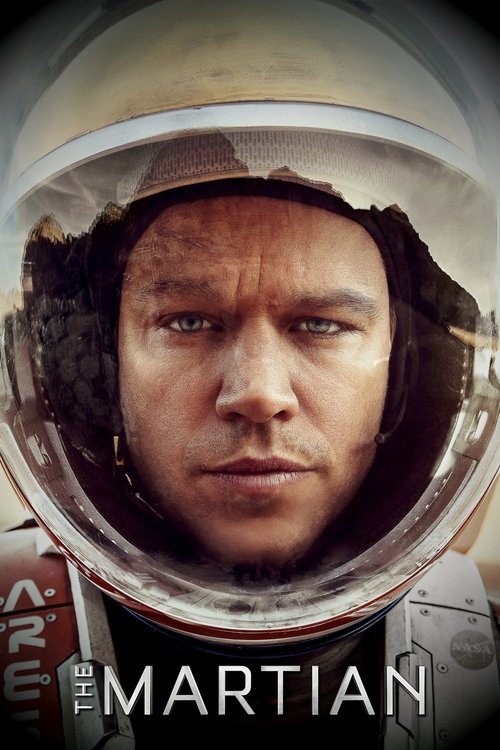
The Martian
2015 · Ridley Scott
For when you want to feel good about people again — a comfort watch with real stakes, perfect for a night when you want smart entertainment that leaves you lighter than it found you.
What it's about
A NASA botanist is left for dead on Mars after a storm forces his crew to evacuate without him. Alive but alone on a planet that can't support him, he has to grow food, ration everything, and find some way to tell Earth he's still breathing — while mission control and his guilt-stricken crewmates scramble to figure out what a rescue would even look like. It's a survival story built out of duct tape, math, and stubbornness.
The experience
Surprisingly funny and brisk for a movie about slow starvation on a dead planet — every crisis becomes a puzzle, and watching each one get solved is genuinely satisfying. The peril is real, but the film keeps choosing hope over dread, and it's hard not to grin along with it.
Performances
Matt Damon carries huge stretches alone, talking to cameras and himself, and makes the wisecracking feel like a survival mechanism rather than a bit — charming without ever hiding the fear underneath.
The craft
Ridley Scott shoots Mars as a place of harsh, rust-colored beauty, and the film's science-first plotting makes every improvised fix legible and earned. The scale of the landscapes and the space sequences reward the biggest screen you can find, and a cheeky disco-heavy soundtrack keeps the tone buoyant.
Why it matters
One of the most warmly embraced Hollywood science fiction films of its decade, it proved that hard-science optimism could be a crowd-pleaser and gave Ridley Scott one of the biggest hits of his late career.
Snapshot
A stranded NASA botanist improvises his survival on Mars while teams on Earth and aboard the rescue vessel Hermes race to bring him home. The Martian is an anomaly in Ridley Scott's career and in the history of science fiction film: a hard-science survival narrative that refuses tragedy, trading the genre's customary dread for problem-solving momentum and sardonic wit. Where Scott's earlier science fiction excavated existential horror — Alien (1979), Blade Runner (1982) — The Martian offers the genre as optimism machine, a portrait of collective human ingenuity that became one of the most warmly received Hollywood science fiction films of the decade. Its particular achievement is tonal: it holds comedy and genuine peril in stable suspension without cheapening either.
Industry & production
The film derives from Andy Weir's 2011 self-published novel, serialized chapter by chapter on his personal website before accumulating enough of a readership to attract Crown Publishing, which released the book in 2014. The origins matter: the novel's texture is that of a software engineer's thought experiment, obsessively worked through in first-person logs — a form that translates unusually directly to screen.
20th Century Fox acquired the rights and attached Drew Goddard to write and direct. Goddard completed the screenplay — a model of adaptation discipline — before departing to develop The Sinister Six for Sony, a project that ultimately did not proceed. Ridley Scott stepped in as director at relatively late notice, accelerating preproduction. The swiftness of that transition, the fact that Scott began principal photography within months of attachment, shows in the film's confident economy rather than any visible seam.
Principal photography took place primarily at Korda Studios in Budapest, Hungary, where production designer Arthur Max — Scott's collaborator across a dozen features — constructed the full interior of the Habitat (the "Hab") and the NASA facilities on functional practical sets. The Martian surface was shot in the Wadi Rum desert of southern Jordan, a location with a long cinematic history (David Lean used it for Lawrence of Arabia, 1962) whose red sandstone topography provides a convincing analog for the Martian regolith. The combination of Eastern European studio infrastructure and Jordan's location work is characteristic of contemporary Hollywood's distributed global production model.
NASA collaboration was substantial and unusual. The space agency provided technical advisors and access to facilities, and in a widely noted instance of institutional marketing aligned with entertainment, NASA timed announcements about evidence of liquid water on Mars to coincide with the film's theatrical release in September 2015. The film became, in effect, an unofficial piece of public outreach for the Mars exploration program NASA was developing.
Technology
The Martian was photographed using RED Dragon digital cameras and released in a 2.39:1 anamorphic aspect ratio, both in standard and 3D presentations. The 3D is used conservatively — Scott does not exploit it for spectacle in the post-Avatar manner, but deploys it to deepen the sense of spatial enclosure inside the Hab and to extend the apparent scale of the Martian vistas.
Visual effects were handled by a consortium of houses, with Framestore, Moving Picture Company, and others responsible for the Martian environment extensions and the sequences aboard the Hermes. The effects work is deliberately restrained in character: the goal was photorealistic integration of practical photography and CGI that would recede from consciousness rather than announce itself. This was in keeping with the film's broader scientific credibility project. The Hab sets were built and dressed in consultation with engineers; the physics of low-gravity movement and orbital mechanics are presented with unusual rigor for a mainstream studio release. Scott and the production's scientific advisors made conscious tradeoffs — the film's central visual emblem, a Martian dust storm fierce enough to strand Watney, is in fact aerodynamically implausible given Mars's thin atmosphere — but these were acknowledged departures from the record, not careless ones.
Technique
Cinematography
Dariusz Wolski, the Polish-born cinematographer who has become Scott's primary collaborator since Prometheus (2012), makes a systematic distinction between three visual worlds: the warm, ochre-saturated palette of the Martian surface; the cool, corporate fluorescence of NASA's Houston facilities; and the sterile, metallic blue-white of the Hermes. The color grammar is consistent and functional — it allows the intercutting of three simultaneous narrative spaces without disorientation. On Mars, Wolski shoots Watney in wide, low-angle frames that emphasize the featureless horizon and the absurdity of a single human figure in that immensity. Inside the Hab, the lensing tightens considerably, using close-ups and medium shots that would be at home in a bottle episode of prestige television. This compression is not a budget concession but a deliberate spatial argument: the film understands that survival is experienced in the immediate and the close.
Editing
Pietro Scalia, who has edited eight of Scott's films, faces in The Martian a structural challenge characteristic of ensemble rescue narratives: three geographically separated story strands that must be held in productive tension rather than allowed to defuse one another. Scalia manages this by treating each strand at a different rhythm — Watney's Mars sequences move in longer takes punctuated by the video-log structure, the NASA sequences adopt a brisker, conference-room pace, and the Hermes material is given a quieter, slightly elegiac register. The intercuts build towards a climactic convergence without the spatial confusion that often afflicts multi-location action finales. The film runs approximately 141 minutes in its theatrical cut (an extended cut adds material), a length that would be unusual for a survival thriller but which the narrative's episodic, problem-by-problem logic can sustain.
Mise-en-scène / staging
Scott and Arthur Max design the Hab as a recognizably domestic space made alien: IKEA-functional under oppressive circumstances, a greenhouse and laboratory and bedroom squeezed into a structure built for weeks that must last months. The staging within it is deliberately mundane — Watney at a workbench, Watney tending potato plants under grow-lights — which is both scientifically accurate and dramatically useful, since the normalcy of the activity throws the abnormality of the context into relief. The Martian exterior sequences, by contrast, give Scott room for the visual grandeur he demonstrated in Blade Runner and Gladiator (2000): long shots of a single suited figure against ancient geology, a visual vocabulary of sublime isolation.
Sound
The film's most distinctive sound design choice is the running use of 1970s disco and pop from Commander Lewis's abandoned music collection — the only entertainment Watney has available on Mars. The conceit is drawn directly from Weir's novel and translates with ease: Donna Summer, David Bowie's "Starman," and ABBA appear at intervals as diegetic music that comments ironically on Watney's predicament, providing the film with a structural counterpoint analogous to the use of pop songs in a Scorsese montage. The effect softens the film's survival grimness and reinforces its tonal thesis — that humor is itself a survival mechanism. Harry Gregson-Williams's score is relatively modest by contemporary blockbuster standards, supplementing rather than overwhelming the diegetic material.
Performance
Matt Damon's performance is organized almost entirely around a single instrument: the video log. Watney addresses a fixed camera in his Hab almost as a stand-up addresses an audience, and Damon calibrates each log entry as a performance of coping — never breaking into open despair, consistently finding the joke even when the situation is worst. The technique carries a risk, since it can read as anti-dramatic, but Damon grounds the persona in physical exhaustion and constraint; the wit is effort, not ease. The supporting ensemble — Jessica Chastain, Jeff Daniels, Chiwetel Ejiofor, Kristen Wiig, Michael Peña, Sean Bean — are largely confined to reaction and logistics, but the film uses this deliberately: they are witnesses to Watney's predicament, and their growing emotional investment licenses the audience's.
Narrative & dramatic mode
The Martian is structured as a survival procedural, a subgenre that prioritizes problem-solving over psychological revelation. Its narrative unit is the "sol" (Martian day) — a measure Watney himself uses in his logs — and the film advances by presenting a problem, showing its solution, and presenting the next problem. This iterative structure is borrowed directly from the novel and is somewhat unusual for a feature film, which typically organizes around escalating dramatic reversals rather than sequential problem resolution. The effect is cumulative rather than climactic until the final rescue sequence, which concentrates the accumulated tension.
The video-log device — Watney addressing his recording equipment in the second person, speaking to a hypothetical future audience — is a form of epistolary narration that creates intimacy and comic distance simultaneously. It also allows Damon to externalize thought without resort to traditional voiceover, keeping the audience inside Watney's cognition without breaking the realistic frame. Parallel to this first-person strand, the film runs a procedural ensemble narrative on Earth that draws on the tradition of films like Ron Howard's Apollo 13 (1995): conference rooms, whiteboard equations, government bureaucracy navigated under pressure.
Genre & cycle
The Martian belongs to a specific early 2010s cycle of prestige hard science fiction: films attempting scientific rigor, spectacular verisimilitude, and mainstream emotional accessibility simultaneously. Alfonso Cuarón's Gravity (2013) and Christopher Nolan's Interstellar (2014) are the immediate cycle-mates, each arriving within two years. What distinguishes The Martian within this cycle is its rejection of the tragic or metaphysical register that Cuarón and Nolan both employ: there is no dead child, no relativistic time-dilation grief, no darkness at the edges of the genre. The film is resolutely comic in the classical sense — it is a comedy of ingenuity rather than a tragedy of the cosmic.
Its more distant ancestors include the Robinson Crusoe survival-on-a-hostile-landscape tradition (the film's single-castaway structure is explicit enough that Robinson Crusoe on Mars, Byron Haskin's 1964 film, might be named as a direct genre antecedent), and the NASA-procedural cycle stretching from The Right Stuff (1983) through Apollo 13.
Authorship & method
Ridley Scott at 77 is among the oldest working directors of major studio releases, and The Martian demonstrates both the strengths and limits of his late-career method. The visual intelligence that has distinguished his work since The Duellists (1977) is fully present: he and Wolski construct images of sustained formal quality, and the production design ambition is uncompromised. What is less present is the darker thematic undertow of his strongest work; The Martian is emotionally and intellectually straightforward in ways that Blade Runner or even Black Hawk Down (2001) are not, and it is possible to read this either as a deliberately chosen register or as a function of Scott's distance from his source material's sensibility.
Drew Goddard's screenplay is a piece of intelligent, self-effacing craft. He strips the novel's most technically exhaustive passages to their dramatic essence, preserves the voice, and adds connective tissue without inflating the runtime. His earlier genre work — Cloverfield (2008, as writer), The Cabin in the Woods (2012, as writer-director) — showed a facility with structural games and genre deconstruction that is here channeled into something more linear but no less precise.
Wolski, Scalia, Max, and Gregson-Williams constitute a house style around Scott that has become one of the more identifiable studio auteurist signatures in contemporary Hollywood, analogous in some respects to the stock company system of classical Hollywood. Each brings a refinement to familiar craft rather than a radical departure.
Movement / national cinema
The Martian is a product of the globalized Hollywood studio system: financed and distributed by a major American studio, physically produced in Hungary and Jordan, drawing on an international cast and crew. Its Chinese subplot — in which the China National Space Administration provides a classified booster to enable Watney's rescue — was noted by commentators as a calculated appeal to the Chinese theatrical market, which had become commercially essential to American blockbusters by the mid-2010s. Whether this represents a meaningful internationalization of Hollywood's narrative imagination or a form of market accommodation dressed as narrative inclusivity is a question the film does not itself resolve. What is visible on screen is a story in which national competition yields to international collaboration, which at minimum represents a departure from the Cold War geopolitics that structured earlier NASA procedurals.
Era / period
The Martian appeared at a moment of unusual optimism about human spaceflight's near-term possibilities. SpaceX was conducting its early Falcon 9 tests; NASA had announced the Orion capsule and preliminary Mars architecture concepts; and the public appetite for Mars as a destination was measurably growing. The film caught and amplified this cultural mood in ways that Gravity (set in low Earth orbit) and Interstellar (set in a dying-Earth near-future) did not quite reach. It is, in this respect, the most topically specific of the 2010s prestige hard-sci-fi cycle — tied to a particular moment of institutional hope that predates the political reconfiguration of the space program later in the decade.
Themes
The Martian is about what intelligence costs and what it enables. Its central thesis, stated by Watney directly in the film's key monologue, is that survival is accomplished by solving one problem at a time — a statement that is simultaneously a cognitive strategy and a philosophy. The film trusts science not merely as a dramatic mechanism but as a value: it is science that will save Watney, and the moral weight of the film rests on the proposition that applying knowledge with discipline and humor constitutes something like heroism.
Collective human intelligence is the film's other dominant theme, staged through the NASA ensemble. The rescue is not achieved by a single genius or a courageous individual act (though the finale requires individual courage) but by an institutional knowledge-sharing that crosses organizational and national boundaries. The CNSA subplot, however calculated its commercial motivations, is thematically coherent with this.
The film is also, more quietly, about bureaucratic courage: Teddy Sanders (Jeff Daniels) and the NASA director navigate political pressure to make decisions that prioritize a single life at enormous institutional cost. This is presented without irony — the film genuinely believes that these institutions can function as they should.
Reception, canon & influence
Backward — influences on the film. The immediate literary source is Weir's novel, but the cinematic lineage is traceable: Apollo 13 (1995) established the NASA-procedural template that The Martian refines; Cast Away (2000) demonstrated that a single-character survival film could sustain feature length if the performance was strong enough; and Gravity (2013) immediately preceded it as the decade's dominant space-survival film and set audience expectations for photorealistic orbital physics. The Robinson Crusoe inheritance is generic and acknowledged.
Critical reception. The film received wide critical approval on release, praised for Damon's performance, the screenplay's tonal discipline, and the production's visual ambition. It received seven Academy Award nominations, including Best Picture and Best Actor, without winning in a competitive year, and won two Golden Globes — Best Motion Picture Comedy or Musical and Best Actor Comedy or Musical — a categorization that generated some industry discussion about the Golden Globes' structural distinction between dramatic and comedic categories, since The Martian does not neatly occupy either.
Forward — legacy and influence. The Martian has had a measurable effect on the public communication of Mars exploration: NASA's public outreach consistently references the film, and it is regularly cited in popular science contexts as a plausible near-future scenario. Its influence on subsequent science fiction film is harder to isolate precisely — the vogue for "optimistic hard sci-fi" that it joined continued in films like Hidden Figures (2016) and First Man (2018), though those films have different registers and concerns. What The Martian established most clearly is a proof of concept: that a film premised on scientific methodology rather than scientific catastrophe, comic rather than tragic in mode, could command a major studio release and broad popular enthusiasm. That demonstration has remained available to subsequent filmmakers as an argument about what the genre can do.
A Deleuzian reading
A man sits down in front of a camera and explains, very calmly, that he is going to die here.
The full Deleuzian reading of The Martian →
Reception
A rare case of no arc needed — it landed in 2015 as a critical and box-office smash and has settled comfortably into 'modern comfort classic' status, the go-to example of optimistic, feel-good sci-fi in a decade of grim space movies.
How The Martian was received, from release to now →
Influences: the films it descends from and the films it influenced
- Apollo 13 (1995) — Established the NASA-procedural dramatic template The Martian directly inherits: multi-strand intercutting between an isolated crew and a mission-control ensemble, where tension is generated by parallel engineering problem-solving rather than action sequences.
- Cast Away (2000) — Demonstrated that a solo survival performance could anchor a studio feature via direct-address camera relationship: Hanks's confessional bond with Wilson prefigures Damon's video-log monologues as psychological survival mechanism and structural narrative device.
- Alien (1979) — Scott's foundational space procedural: fully realized functional set design establishes spatial logic the audience learns alongside characters, and diegetic mechanical sound design grounds science fiction in procedural reality — methods carried forward intact into The Martian's Hab sequences.
- 2001: A Space Odyssey (1968) — Established the anamorphic widescreen grammar of human figures dwarfed within vast functional environments: the wide low-angle isolation shot of a suited figure against monochrome terrain is Kubrick's compositional vocabulary, absorbed directly into Scott and Wolski's Mars surface imagery.
- The Right Stuff (1983) — Established the NASA-procedural genre's tonal register: institutional ensemble — administrators, engineers, families — as emotional counterweight to a lone heroic figure, where collective organizational ingenuity is dramatized as thrillingly as individual achievement.
- Robinson Crusoe on Mars (1964) — The direct genre-template ancestor: a single astronaut improvises survival from available Mars surface resources, establishing the resource-inventory dramaturgy and survival-procedural narrative geometry that The Martian inherits and validates with contemporary scientific accuracy.
- Gravity (2013) — Immediately set audience expectations for photorealistic space environments with practical-physics staging — objects float, momentum carries, suit mechanics obey — that The Martian inherits and extends from orbital mechanics to Martian one-third-G surface physics.
- The Andromeda Strain (1971) — Hypothesis-elimination structure applied to solo survival science — each problem Watney solves narrows the field of possible deaths — and the NASA procedural sequences inherit Andromeda Strain's dramatization of actual scientific method, not scientific intuition, as the engine of narrative.
- Prometheus (2012) — Continues Scott's partnership with cinematographer Dariusz Wolski begun on Prometheus, applying the same desaturated, deep-staged planetary-landscape photography to a lone figure on an alien world.
- Castaway on the Moon (2009) — Extends the Crusoe survival-improvisation grammar of growing your own food (potatoes echoing Castaway's cornfield) and treating isolation as a procedural, problem-solving optimism.
- The Flight of the Phoenix (1965) — Makes improvisation from a closed parts inventory the entire plot engine, with each fix explained in working detail before it is attempted — the Phoenix procedural extended to feature length and dependent on the same wager that watching a build is dramatic.
- Hidden Figures (2016) — The most direct inheritor of The Martian's NASA-procedural tonal register: collective human ingenuity as primary dramatic engine, institutional ensemble witnessing individual breakthrough, and an optimistic register where scientific competence is portrayed as intrinsically heroic.
- Arrival (2016) — Extends the prestige hard-scifi methodology-as-drama template: scientific process generates plot tension, anamorphic widescreen isolates the protagonist within vast functional environments, and a restrained score refuses spectacle in favor of procedural texture — the same formal commitments, applied to linguistics rather than botany.
- First Man (2018) — Extends The Martian's NASA-procedural structure toward interiority and grief: where The Martian is extroverted and comic, First Man is introverted and elegiac, demonstrating the register's expressive range by applying the same genre architecture — mission intercutting, institutional ensemble — for opposite emotional ends.
- Ad Astra (2019) — Extends The Martian's wide-low-angle lone-astronaut-against-Martian-terrain visual grammar and NASA institutional framework into psychological interior mode, using the same Wolski-adjacent widescreen isolationist composition for introspection rather than problem-solving.
- Project Hail Mary (2026) — Same Andy Weir source and same Drew Goddard screenplay; the video-log confessional that converts solitary problem-solving into spoken narration is inherited wholesale as PHM's procedural-optimism engine.
- Black Hawk Down (2001) — Scott's most advanced deployment of multi-strand crisis intercutting before The Martian: simultaneous geographically dispersed action threads edited under continuous time pressure, a structural method Scott transfers directly to the parallel NASA/JPL and Mars-surface narrative architecture.
- The Cabin in the Woods (2012) — Goddard's writer-director work formalizes the structural device central to his Martian screenplay: an institutional ensemble observing screens and managing systems reacts to a protagonist's survival scenario in real time, creating a dual-narrative geometry of watcher and watched.
- Interstellar (2014) — Contemporaneous prestige hard-scifi sibling deploying the same production toolkit — anamorphic 35mm, restrained Zimmer score, scientific-accuracy production design — for a tragic-transcendent register against The Martian's comic-optimistic one; together they define the era's tonal range.
- Guardians of the Galaxy (2014) — Simultaneous development of diegetic period pop music as a space-survival emotional counterpoint device: both films structure their soundtracks around curated 70s pop as character-defining cultural artifact, deploying comedy and anachronistic pleasure as psychological armor against spatial isolation.
- Moon (2009) — Builds load-bearing drama from a lone worker's procedural problem-solving inside a single off-world habitat, extending Moon's inhabited-workspace realism.
Similar films
- Arrival (2016) — influence & lineage · same viewing thread · often watched together
- Project Hail Mary (2026) — influence & lineage · same viewing thread
- Interstellar (2014) — influence & lineage · same viewing thread
- Apollo 13 (1995) — influence & lineage · same viewing thread
- Gravity (2013) — influence & lineage · often watched together
- 2001: A Space Odyssey (1968) — influence & lineage · same viewing thread · often watched together
- Alien (1979) — influence & lineage
- Ad Astra (2019) — influence & lineage
All the films related to The Martian →
Watch it with: curated runs of related films
- Alone in the Void — A run of films about a single mind pitted against the vastness — rationing air, doing the math, reaching across impossible distance — best watched together for how survival keeps tipping into awe.