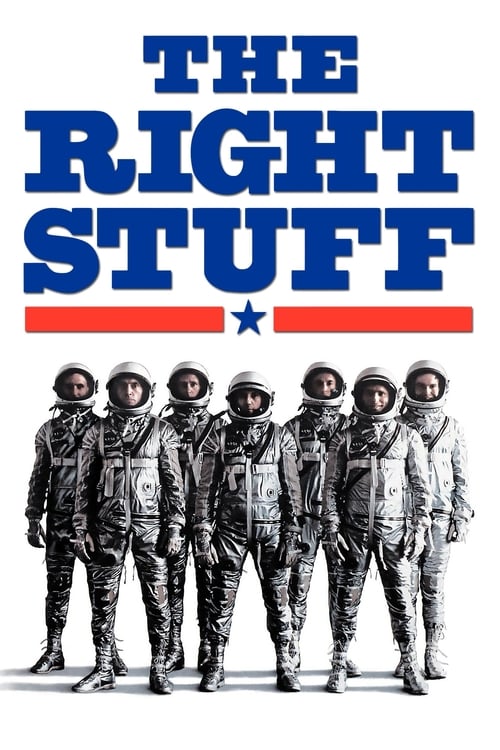
The Right Stuff
1983 · Philip Kaufman
For when you want a grand, old-fashioned epic that earns its runtime — a Sunday-afternoon movie that leaves you feeling bigger than when you sat down. Comfort viewing with real substance underneath.
What it's about
At the dawn of the Space Race, America goes looking for its first astronauts among the hotshot test pilots of the high desert — men who fly experimental jets past the edge of what's survivable. The film follows the seven chosen for the Mercury program as NASA turns them into instant celebrities, while out at Edwards Air Force Base, Chuck Yeager — the best pilot alive, and never asked — keeps pushing the envelope in obscurity. It's the story of what real courage looks like, and what happens when the government needs it packaged for television.
The experience
Big, funny, and thrilling in a way three-hour historical epics rarely are — it swings between white-knuckle flight sequences, sly political comedy, and moments of genuine awe. You come out grinning and a little choked up, with a permanent soft spot for men who strap themselves to rockets.
Performances
Sam Shepard gives Chuck Yeager an unhurried, laconic cool that anchors the whole film, and Ed Harris makes John Glenn's squeaky-clean earnestness both funny and quietly moving. The ensemble around them — Scott Glenn, Dennis Quaid, Fred Ward — is one of the great pilot crews in movies.
The craft
Philip Kaufman shapes Tom Wolfe's sprawling book into something both satirical and sincere, cutting between the myth-making machinery of NASA and the lonely poetry of a man alone in the sky. The flight sequences still feel dangerous — rattling cockpits, screaming engines, the desert floor rushing up — and Bill Conti's soaring score is doing exactly what it should. Absolutely a big-screen, good-speakers film.
Why it matters
It set the template for how movies dramatize the space program — the mix of hardware, heroism, and skepticism that nearly every astronaut film since has borrowed. It also confirmed that New Journalism could translate to the screen with its irony intact.
Snapshot
Philip Kaufman's three-hour-plus adaptation of Tom Wolfe's 1979 New Journalism landmark arrives as one of the most formally ambitious American films of its decade: an epic of masculine mythology that simultaneously celebrates and interrogates the very heroism it stages. Spanning roughly 1947 to 1963, it moves between two overlapping American frontiers — the high-desert proving grounds of Edwards Air Force Base, where Chuck Yeager breaks the sound barrier and defines an airborne ideal, and the televised spectacle of the Mercury program, where NASA transforms test pilots into astronauts and astronauts into brand names. The film's central tension, drawn faithfully from Wolfe, is the gap between those two things: the private, unnameable quality that keeps a man alive at Mach 1, and the public performance the Cold War demanded in its place.
Industry & production
The Right Stuff was produced by The Ladd Company and distributed by Warner Bros., arriving in October 1983 as one of the year's prestige bets. The adaptation had a notoriously difficult gestation. Wolfe's book, written in his hyperbolic New Journalist mode, was widely considered resistant to conventional screenplay structure; the subjective, ironic prose that animated the prose could not simply be transposed to screen. Kaufman wrote the screenplay himself, a process he reportedly undertook over several years, and in doing so made choices that departed significantly from straightforward literary fidelity. He retained the dual-track structure — Yeager's parallel story running alongside the Mercury Seven — but modulated Wolfe's most corrosive irony into something more elegiac.
The production was expensive for its era, and the film's commercial performance was disappointing relative to its cost, opening against stiff competition and failing to attract the broad audience Warner Bros. had hoped for. Its length — the theatrical cut runs approximately 193 minutes — was a persistent point of friction with exhibitors. Despite eight Academy Award nominations and four wins (Best Film Editing, Best Sound, Best Sound Effects Editing, Best Original Score), the film did not recover its investment on its initial domestic theatrical run. It was only through subsequent cable broadcast and home video that it found the audience that would eventually cement its reputation.
Technology
Kaufman and cinematographer Caleb Deschanel shot anamorphic widescreen, making full use of the Panavision frame to render both landscape and ensemble. The vast alkali flats of the California desert and the skies above them demanded a different compositional logic than studio-bound production — figures are frequently dwarfed by their environment, a deliberate formal choice that comments on the hubris of the endeavor while retaining the myth's sublimity.
The aerial photography presented considerable logistical challenges. The sequences depicting high-altitude and supersonic flight required coordination between second-unit work, cockpit inserts, and a sound design apparatus sophisticated enough to make invisible phenomena (the sound barrier, the edge of the atmosphere) experientially vivid. The sonic boom that punctuates Yeager's achievement — a shock wave felt on the ground before it is understood — is one of the film's most carefully engineered effects. The film's sound team, led to Academy Award recognition, created a vocabulary of jet acoustics that would influence subsequent aviation productions.
Archival and documentary footage is integrated selectively, particularly in sequences depicting actual Mercury launches and public appearances. Kaufman's intercutting of newsreel material with dramatized footage was handled with enough care that the seams are largely invisible, and the strategy grounds the film's more lyrical passages in historical fact.
Technique
Cinematography
Caleb Deschanel's work on The Right Stuff is among the most praised of his career, earning an Academy Award nomination. His approach varies systematically with the film's two registers. The Edwards sequences are shot with a quality of openness and natural light that evokes the mythic American West — dust, glare, the bleached infinity of the Mojave. The horizon is always present, always receding. In the Mercury sequences, the visual world tightens: press pools, television cameras, the sealed interior of a capsule. The difference is not merely in subject matter but in how the frame itself behaves — spacious and contemplative in the desert, increasingly compressed and mediated as NASA's publicity apparatus takes hold.
Deschanel uses long lenses to isolate Yeager against landscape and sky, reinforcing Sam Shepard's laconic remove from the social world around him. By contrast, the Mercury Seven are frequently photographed in groups, in public configurations, the ensemble frame expressing their shared subjection to institutional and media forces.
Editing
Five editors are credited — Glenn Farr, Lisa Fruchtman, Stephen A. Rotter, Douglas Stewart, and Tom Rolf — and the work they produced won the Academy Award for Best Film Editing. The achievement is structural as much as rhythmic. The film manages two timelines, two tonal registers, and an enormous ensemble across three hours without losing narrative or thematic coherence. The intercutting between Yeager's X-1A crash at the film's climax and Gordon Cooper's orbital flight is the most celebrated sequence: a montage that cross-cuts myth and modernity, the lone rider and the media spectacle, the body in extremis and the body in triumph, suggesting they are not alternatives but two faces of the same impossible aspiration.
The editing also governs the film's use of comedy — the absurdist bureaucratic sequences, the medical humiliations the astronauts endure, the satirical treatment of the press — allowing tonal pivots that would collapse in less precisely controlled hands.
Mise-en-scène / staging
Kaufman's staging consistently places his characters in relation to scale — to landscape, to aircraft, to the crowd. The saloon in the desert, the drive-in movie, the long expanse of runway: these are not merely period settings but environments that configure the film's symbolic geography. Yeager operates in open, unmediated space. The Mercury Seven increasingly inhabit ceremonial spaces: press conferences, training facilities, the interior of a public relations campaign.
The film's single most indelible staging choice may be the recurring figure of Yeager on horseback — an interpolated image that makes the Western subtext explicit. This rider in the desert, approaching or departing, frames the film's meditation on the American hero as a frontier type, and the frontier as always already closing.
Sound
Bill Conti's score alternates between propulsive heroic brass — the "Yeager's Triumph" motif has the stride of a Western — and more ceremonial passages that frame the Mercury program's civic theater. The score won the Academy Award for Best Original Score. Sound design, which also won, earns equal credit: the specific acoustic character of the X-1 in flight, the pressurized silence of the capsule, the roar of the Atlas rocket, are rendered with a precision that makes the stakes of the physical world legible to an audience that has never been near any of it.
Performance
The ensemble work is exceptional and remarkably coordinated across a large cast. Sam Shepard's Yeager is constructed almost entirely from physical comportment and reticence — a performance of omission that proves more commanding than any of the film's more verbal roles. Shepard received an Academy Award nomination for Best Supporting Actor. Ed Harris brings an almost painful earnestness to John Glenn, making the film's most genuinely patriotic figure neither ironic nor naive. Dennis Quaid's Gordon Cooper is the film's most conventionally charismatic performance, anchoring the final act. Fred Ward as Gus Grissom gives the film's most internally complex turn: a man haunted by the perception that he panicked, that the hatch blew on his watch, that history has decided against him without proof.
The women's roles — Barbara Hershey as Glennis Yeager, Mary Jo Deschanel as Annie Glenn, Pamela Reed as Trudy Cooper — are given more screen time and dramatic weight than was common for the period-piece ensemble, though the film remains structurally male-centered.
Narrative & dramatic mode
The film's narration is indirect and quasi-epic, with a near-mythic voice-over that echoes Wolfe's own rhetorical grandeur while doing the work of compression that a three-hour running time still cannot accomplish without such assistance. The structure is deliberately non-linear in its opening movement — establishing the Pancho Barnes Flying Fraternity, Yeager's sonic-barrier flight, the death of a colleague — before settling into a roughly chronological account of the Mercury program.
The film sustains two modes of address simultaneously: earnest admiration for what these men did and bodies endured, and dry satirical observation of what American institutions made of the fact. These modes do not undercut each other; Kaufman holds them in productive tension. The scenes of bureaucratic absurdity (the astronauts subjected to degrading medical testing; the debate over whether to include a window in the capsule) comment on the heroism without diminishing it.
Genre & cycle
The Right Stuff occupies an unusual generic position. It is an epic historical drama, but its visual and symbolic vocabulary is substantially that of the Western — Yeager is explicitly the lone rider, Edwards Air Force Base the last frontier, the astronaut program the moment the wilderness closes and is replaced by bureaucracy and television. Howard Hawks's aviation films are a clear precursor. The film also belongs to the tradition of the ensemble military drama, and to what might be called the American mythology film — a strain of prestige production concerned with national self-examination through historical episode, alongside films like Patton (1970) and All the President's Men (1976).
The film appeared at the tail end of a brief early-1980s revival of interest in the space program following the first Space Shuttle flights. It is not a product of that enthusiasm so much as a reckoning with it.
Authorship & method
Philip Kaufman is one of American cinema's most genuinely literary directors — drawn to large, formally complex source materials and to the problems of adapting consciousness to image. His filmography includes a notable remake of Invasion of the Body Snatchers (1978) and later The Unbearable Lightness of Being (1988) and Henry & June (1990), all adaptations that foreground interiority and philosophical register. Kaufman was also among the early contributors to the story treatment for Raiders of the Lost Ark, a fact that suggests the range of his commercial instincts alongside his art-cinema affinities.
On The Right Stuff, his most important collaborators were Caleb Deschanel, whose visual intelligence shaped the film's tonal geography; Bill Conti, whose score navigated the film's tonal range; and the five-editor team whose structural achievement undergirds everything else. Kaufman's own screenplay is the foundation: the decision to retain Yeager as a structuring presence, the choice of where irony yields to sincerity, the adaptation of Wolfe's centrifugal energy into sustained dramatic momentum.
Movement / national cinema
The film is American cinema in the fullest sense — preoccupied with national mythology, with the frontier and its successive closings, with the relationship between individual excellence and institutional co-optation. It engages directly with the genre traditions of American popular film (the Western, the war film, the biopic) while deploying the formal ambition of the New Hollywood, the movement with which Kaufman is loosely associated. It does not belong to any international movement, though its willingness to sustain formal complexity and tonal irony in a prestige production reflects the broader influence of European art cinema on American filmmaking of the period.
Era / period
The Right Stuff is a product of the early 1980s moment when the generation that had lived through the Mercury and Apollo programs as defining national experiences began to historicize them. The film arrives after the disillusionment of Vietnam and Watergate, after the space program's cultural centrality had been replaced by more ambivalent national moods, and in the context of a Reagan-era revival of explicit patriotism that the film both partakes of and quietly queries. Its nostalgia is structural rather than sentimental: it mourns a conception of heroism that the film itself demonstrates was always partially fictional.
Themes
The film's animating inquiry is the nature of heroism in a media age. Tom Wolfe's "the right stuff" is an ineffable quality — courage, capability, coolness — that cannot be described, only recognized and embodied. The Mercury program's great irony, as both book and film render it, is that the men selected for possessing this quality were then systematically stripped of the autonomy that allowed it to express itself: they rode capsules they could not pilot, performed for cameras rather than flying, became symbols rather than actors. Yeager, who never entered the program, retains the quality precisely because he remains outside the institutional apparatus.
Secondary themes include the mythology of the American frontier and its exhaustion; the tension between individual excellence and collective enterprise; the role of women in sustaining the masculine performance (the astronaut wives function as both support and implicit critique); and the bureaucratic and mediated nature of modern heroism.
Reception, canon & influence
Critical reception on release was strong — Roger Ebert awarded the film four stars, and substantial critical attention recognized it as an unusual achievement in American epic filmmaking — but the film's commercial underperformance created an anomalous position: critically significant, institutionally recognized (eight Oscar nominations), but not a popular event film. Over subsequent decades, through television broadcast and home video, the film accumulated the canonical status that the theatrical run withheld.
Influences on the film: The Western genre, and specifically its elegiac mode (Shane, The Man Who Shot Liberty Valance), provides the film's structural metaphor. Howard Hawks's aerial films and the tradition of the test-pilot picture are formal antecedents. D.W. Griffith's model of the American epic, mediated through the New Hollywood's critique of that model, shapes the film's ambition and its willingness to interrogate its own mythologizing. Documentary and newsreel footage of the Mercury program functions as both historical anchor and tonal device.
Legacy: The Right Stuff established formal and thematic templates that subsequent astronaut films have worked within or against. Ron Howard's Apollo 13 (1995) is unthinkable without it — the procedural dramaturgy, the ensemble of test-pilot types, the integration of documentary material, the treatment of NASA as both institutional subject and visual spectacle. Damien Chazelle's First Man (2018) is in explicit dialogue with the film, adopting a more interior and psychologically reduced approach that defines itself partly against Kaufman's more expansive mythologizing. The Disney+ miniseries remake (2020) acknowledges the original's canonical status while attempting to contemporize Wolfe's framework for a streaming audience.
Kaufman's film also modeled a viable form for prestige American historical drama: long, literary, tonally complex, unwilling to resolve its ambivalences, willing to ask what the heroism was actually for. That the form proved commercially difficult has not diminished its influence; the films that matter to the tradition are those that demonstrated what was possible, not only what was profitable.
A Deleuzian reading
Start with the rider.
The full Deleuzian reading of The Right Stuff →
Reception
An eight-Oscar-nominee that bombed at the box office in 1983 — pundits even blamed its failure for hurting John Glenn's presidential campaign. Four decades on it's routinely called one of the great American epics of the 80s.
How The Right Stuff was received, from release to now →
Influences: the films it descends from and the films it influenced
- Lawrence of Arabia (1962) — Freddie Young's Super Panavision 70 grammar — human figure scaled to near-invisibility against bleached desert horizon, long-lens heat-shimmer compression — is the direct anamorphic template Caleb Deschanel adapts for the Mojave sequences.
- The Searchers (1956) — John Ford's Ethan Edwards — the lone horseback figure whose absolute code constitutionally excludes him from civilization's resolution — is the structural archetype for Sam Shepard's Yeager, the mythic remainder who cannot be institutionally absorbed.
- Patton (1970) — Francis Ford Coppola's screenplay structure of the great warrior as historical anachronism — privately sublime, publicly unmanageable — is Kaufman's direct template for Yeager's dual-register tragedy, with Jerry Goldsmith scoring both films in an identical martial-elegiac register.
- Dr. Strangelove or: How I Learned to Stop Worrying and Love the Bomb (1964) — Kubrick's staging of Cold War aerospace bureaucracy as absurdist theater — the military institution rendered as slapstick — is the formal ancestor of Kaufman's press-conference and astronaut medical-examination sequences, where NASA's public apparatus is played for dark institutional comedy.
- 2001: A Space Odyssey (1968) — Kubrick's systematic compositions of humans dwarfed by spacecraft architecture, and his treatment of aeronautical acoustics as philosophical rather than merely realistic phenomena, directly inform Kaufman's capsule staging and his formal problem of making invisible supersonic events experientially present.
- Apocalypse Now (1979) — Walter Murch's multi-layered sound design for the helicopter assault — aerial combat as total acoustic immersion, the rotor texture as existential rather than merely realistic — established the grammar for treating flight sound as a philosophical event that The Right Stuff's sonic-boom design directly inherits.
- McCabe & Mrs. Miller (1971) — Vilmos Zsigmond's natural-light anamorphic work and Altman's overlapping-dialogue ensemble staging in wide-frame group compositions establish the post-classical American grammar that Deschanel and Kaufman inherit for the Mercury Seven sequences, where each figure's position within the frame carries the institutional argument.
- Days of Heaven (1978) — Malick's emotionally adjacent voiceover that creates ironic distance from the visual action — narrating around heroism rather than through it — is the formal ancestor of Kaufman's New Journalist narrator; Haskell Wexler's natural-light anamorphic work established the desert cinematography grammar Deschanel inherits.
- Woman in the Moon (1929) — Kaufman's Mercury launch sequences build their formal and emotional rhythm around the countdown to zero — the device Woman in the Moon introduced to cinema and which was subsequently adopted by actual German rocket engineers at Peenemünde as operational launch protocol — making the film both a historical reconstruction and a direct inheritor of the dramatic grammar Lang invented.
- Only Angels Have Wings (1939) — Builds an entire epic on professionalism-as-moral-code and grace under pressure among test pilots and astronauts, with the laconic understatement and empty-chair mourning descending straight from Hawks's flyers.
- Top Gun (1986) — Tony Scott inherits the jet acoustic vocabulary and low-angle aircraft-against-sky compositions but evacuates Kaufman's mythological ambivalence: the sonic boom becomes kinetic pleasure rather than philosophical event, and the lone-rider figure is reabsorbed into institutional triumph rather than structurally excluded from it.
- Born on the Fourth of July (1989) — Oliver Stone adopts the archival-newsreel-integration technique and dual-register narrative structure, while editors David Brenner and Joe Hutshing deploy a parallel-montage climax counterpointing public patriotic ceremony against private devastation — directly inheriting Kaufman's Yeager/Cooper cross-cutting method.
- Apollo 13 (1995) — Ron Howard directly adopts The Right Stuff's parallel-montage grammar for NASA crisis drama: simultaneous cross-cutting between capsule and Mission Control, archival newsreel integration, and the dual register of institutional procedure against individual physical extremity at the structural level.
- The Thin Red Line (1998) — Malick extends Kaufman's formal grammar — large male ensemble staged across anamorphic widescreen landscape through physical reticence, philosophical voiceover as counter-narrative to institutional heroism — into WWII via John Toll's cinematography, which explicitly rhymes with Deschanel's approach to natural light and negative space.
- Interstellar (2014) — Nolan extends the sonic-boom design vocabulary into space through Hans Zimmer's gravitational-wave score and the docking sequence's acoustic architecture, while adopting the dual-timeline cross-cutting structure and the thesis that heroic sacrifice is structurally unwitnessable by those it serves.
- First Man (2018) — Chazelle returns to the Mercury-Gemini-Apollo terrain with Linus Sandgren's anamorphic restraint in explicit dialogue with Deschanel's, mirrors Kaufman's dual-track architecture (mission timeline against domestic grief timeline), and confronts the same formal problem of rendering invisible acoustic and psychological threshold phenomena — reentry, grief, the sound barrier — viscerally present.
- Contact (1997) — Kaufman's strategy of staging scientist-pilots against NASA's bureaucratic apparatus in wide Panavision compositions that emphasize institutional scale over individual bodies — climaxing in Senate hearing sequences — is Contact's direct procedural template for Ellie Arroway's post-transit congressional testimony arc.
- The Martian (2015) — Established the NASA-procedural genre's tonal register: institutional ensemble — administrators, engineers, families — as emotional counterweight to a lone heroic figure, where collective organizational ingenuity is dramatized as thrillingly as individual achievement.
- Ford v Ferrari (2019) — The structural model for Ford v Ferrari's craftsman's tragedy: Chuck Yeager as instinctual airman-artisan whose refusal to sand down his edges for institutional palatability results in bureaucratic ejection from the very program his skill made possible — the exact arc Jez Butterworth maps onto Ken Miles within the Ford corporate machine.
- Top Gun: Maverick (2022) — Establishes the mythos of the pilot's body absorbing physical risk — real aircraft, hangar-light romanticism, and competence-as-virtue — that underwrites Maverick's embodied-G-force performance ethic.
- October Sky (1999) — Space-Race-era flight and rocketry shot with documentary texture, treating the iterative trial-and-failure of test engineering as dramatic procedural.
- The Unbearable Lightness of Being (1988) — Kaufman's own interleaving of staged scenes with period newsreel; the photochemical-compositing technique he refines to drop his actors into the degraded 1968 Soviet-invasion footage.
- The Natural (1984) — Caleb Deschanel photographed both films in consecutive years, carrying an identical anamorphic mythology-of-achievement grammar — golden natural light, long-lens hero isolation, the sacred American landscape as frame for masculine achievement — making the craft relationship continuous rather than merely influential.
- Jack Reacher (2012) — Caleb Deschanel's classical, legible, stable image-making — the same cinematographer's grayed realism and unshowy compositional grounding he supplies to Reacher.
- The Black Stallion (1979) — Deschanel scales the rim-lit silhouette against a burning horizon from horse to aircraft, using backlit figures and heat-haze long lenses to convert documentary-looking material into mythic scaffolding — the Black Stallion optical philosophy applied to men.
Similar films
- First Man (2018) — influence & lineage · same viewing thread
- Apollo 13 (1995) — influence & lineage
- Top Gun (1986) — influence & lineage
- Dr. Strangelove or: How I Learned to Stop Worrying and Love the Bomb (1964) — influence & lineage
- Interstellar (2014) — influence & lineage
- Patton (1970) — influence & lineage
- Oppenheimer (2023) — same viewing thread
- Top Gun: Maverick (2022) — shared sensibility
All the films related to The Right Stuff →
Watch it with: curated runs of related films
- Great Men, Grand Reckonings — A run of prestige true stories about singular, obsessive men chasing an epochal achievement — the bomb, the moon, the checkered flag, a nation — and reckoning with what it cost them and everyone around them.