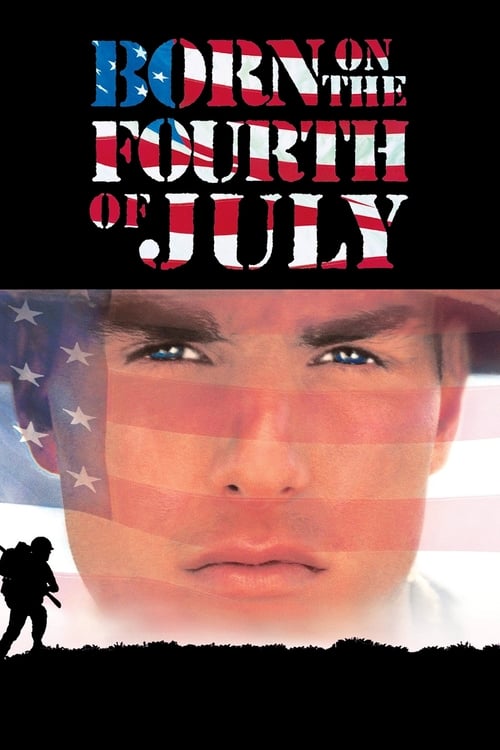
Born on the Fourth of July
1989 · Oliver Stone
For when you want a big, angry, wear-you-out American epic — a film that earns its tears rather than begging for them. This is a challenge, not comfort viewing, but it pays off in feeling.
What it's about
A fiercely patriotic kid from Long Island grows up believing everything his country tells him, enlists in the Marines, and comes home from Vietnam paralyzed from the chest down. Based on Ron Kovic's own memoir, it follows him through squalid VA hospitals, a family that can't face what happened to him, and years of rage and drift — until he finds a new fight as an anti-war activist. It's the story of a man's faith in a national myth breaking, and what he builds from the wreckage.
The experience
Punishing, furious, and finally stirring — it moves from Fourth-of-July warmth to hospital-ward squalor to full-throated protest, and it doesn't flinch at any stage. You come out shaken but also weirdly energized, the way a great speech leaves you.
Performances
Tom Cruise, in the role that proved he could really act: he plays Kovic from gung-ho teenager to broken veteran to firebrand, and the physical and emotional deterioration is fearless. It rewrote what audiences thought he was capable of.
The craft
Oliver Stone directs at full volume — sweeping crowd scenes, brutal hospital passages, a screen that moves from golden hometown light to grimy institutional murk as the dream curdles. The scale and the score are built for a big screen, and the editing drives two decades of a life forward without ever losing the man at the center.
Why it matters
The second film in Stone's Vietnam trilogy, it won him his second Best Director Oscar and shifted the war movie's attention from the jungle to the home front — to what America did to its veterans after the shooting stopped. It also permanently changed Tom Cruise's career.
Snapshot
Born on the Fourth of July is Oliver Stone's adaptation of Ron Kovic's 1976 memoir of the same name, charting the arc of a fervently patriotic Long Island Catholic boy who enlists in the Marines, is paralyzed from the chest down by a battlefield wound in Vietnam, and returns to an indifferent America before transforming into a leading voice of the anti-war movement. It was the second installment of Stone's loosely conceived Vietnam trilogy, following Platoon (1986) and preceding Heaven & Earth (1993), and it represented a deliberate shift of vantage from the jungle to the home front — the war as it metastasizes through a single body and a single national myth. Tom Cruise, then primarily a star of glossy commercial vehicles, took the role of Kovic in a performance that decisively expanded his range. The film won Stone his second Academy Award for Best Director and was a critical and commercial success, consolidating his late-1980s standing as Hollywood's most combative political dramatist. It remains one of the canonical American films about the domestic costs of Vietnam and about the betrayal felt by those sent to fight it.
Industry & production
The project had a long and frustrated gestation that is itself part of the film's history. Stone and Kovic had attempted to mount an adaptation in the late 1970s with Al Pacino attached to play Kovic; that version collapsed when financing fell through shortly before shooting, a failure Stone has discussed in interviews as a formative disappointment. It was only after the commercial and Oscar success of Platoon gave Stone leverage that the picture became viable. The film was produced for Universal Pictures, with Stone and A. Kitman Ho producing; Kovic co-wrote the screenplay with Stone, adapting his own memoir, which lent the production an unusual degree of first-person authority over its source.
Casting Tom Cruise was a calculated gamble. Cruise was among the most bankable young stars in Hollywood after Top Gun and Rain Man, and his association with confident, physically vital characters made the casting of a wheelchair-bound paraplegic both a marketing risk and a dramatic provocation. The film was shot largely in the Dallas, Texas area, with locations standing in for Massapequa, Long Island and for Mexico, along with sequences depicting the Veterans Administration hospital and the chaotic protest scenes at the 1972 Republican National Convention in Miami. Made in the late 1980s on a substantial but not blockbuster-scale budget, it became one of the year's prestige successes and a strong commercial performer; precise figures should be checked against authoritative sources rather than asserted here.
Technology
The film was shot photochemically on 35mm color stock, the industry standard for major studio releases of the period, and finished for conventional theatrical projection. There is no significant optical or digital-effects dimension to the picture in the way one associates with the era's emerging blockbuster technologies; its ambitions are dramatic and physical rather than technological. Where the production's craft is most evident is in the extensive, period-specific reconstruction of two decades of American life — 1950s and early-'60s suburban Americana, the Vietnam combat zone, the squalor of a VA hospital, and large-scale crowd sequences — achieved through location work, art direction, and crowd staging rather than effects. The convincing depiction of Kovic's paralysis and rehabilitation depended on prosthetic and practical means and on Cruise's physical performance rather than any technological intervention.
Technique
Cinematography
The film was photographed by Robert Richardson, Stone's principal cinematographer of the period and one of the defining American image-makers of the late twentieth century. Richardson's collaboration with Stone produced a recognizable visual signature — most famously a hot, often overhead key light that blows out backgrounds into halated whiteness, lending memory and trauma a hallucinatory glare. In Born on the Fourth of July the camera tracks Kovic's trajectory from the saturated, almost mythic warmth of his boyhood Fourth of July parades to the harsh, desaturated brutality of combat and the fluorescent degradation of the hospital. Richardson modulates the palette to mark Kovic's psychological descent and eventual politicization, and uses mobile, subjective camerawork — handheld in the chaos of battle and protest, more composed in the suburban idyll — to bind the audience to Kovic's point of view. The work is of a piece with the expressive, sometimes aggressive style Richardson and Stone refined across this run of films.
Editing
Cut by David Brenner and Joe Hutshing, the film exhibits the propulsive, rhythmically charged editing that characterized Stone's late-1980s work. The structure is essentially chronological but operates through a series of escalating set-pieces, and the cutting tightens dramatically in moments of crisis — the battlefield confusion in which Kovic mistakenly kills a fellow Marine, the nightmarish disorder of the VA hospital, the violence and adrenaline of the convention protests. The editors juxtapose the iconography of American optimism with its subsequent betrayal, building meaning through collision as much as continuity. The film's considerable runtime is shaped into distinct movements — innocence, war, abjection, awakening, activism — and the editing manages the difficult task of sustaining momentum across a deliberately episodic, biographical sweep.
Mise-en-scène / staging
Stone stages the film as a pointed dialectic between American myth and American reality. The early Massapequa sequences are composed with an almost Rockwellian iconography — parades, fireworks, baseball, the high-school wrestling match, the prom — that the film will systematically dismantle. The combat and hospital sequences are staged for maximum physical degradation: mud, blood, rats, and neglect in the VA ward become a visual indictment of how the nation treats its wounded. The Mexican sequences, in which paralyzed veterans seek oblivion in drink and prostitution, are staged as a kind of purgatory. Throughout, Stone uses the recurring motifs of flags, uniforms, religious imagery, and the figure of the mother to dramatize the collision of Kovic's faith — patriotic and Catholic — with his disillusionment.
Sound
The score is by John Williams, an unexpected pairing given Williams's association with Spielberg and with grander symphonic idioms; here he supplies a restrained, elegiac voice, with a prominent trumpet theme (performed by jazz trumpeter Tim Morrison) that lends Kovic's story a mournful, valedictory quality. The music works against easy triumphalism, coloring even the patriotic imagery with foreboding. The sound design otherwise contrasts the comforting ambient textures of suburban America with the disorienting assault of combat and the clinical noise of the hospital. Period popular music situates the film precisely across the late 1950s through early 1970s, grounding Kovic's biography in the shifting cultural soundscape of the era.
Performance
The film rests on Tom Cruise, who carries nearly every scene and ages the character from eager adolescent to broken veteran to hardened activist. Cruise's performance is notable for its physical commitment — the management of a body that has lost sensation and autonomy — and for its emotional volatility, culminating in raw confrontations with his family and a wrenching reckoning with the family of the Marine he killed. The supporting cast includes Willem Dafoe as a fellow embittered, wheelchair-bound veteran encountered in Mexico, whose nihilism mirrors and pressures Kovic's own; Raymond J. Barry and Caroline Kava as Kovic's parents, embodying the wounded patriotism and religious conservatism Kovic must break from; and Kyra Sedgwick as a hometown love interest who becomes connected to the anti-war movement. Stone draws ensemble work that keeps the film's political argument anchored in family melodrama.
Narrative & dramatic mode
The film is a biographical Bildungsroman turned inside out: rather than tracing a young man's integration into society, it traces his violent expulsion from the myths that formed him and his reconstitution as a dissident. Its dramatic mode is melodrama in the fullest, non-pejorative sense — operating through heightened emotion, familial conflict, moral clarity, and large public reckonings. The structure is a conversion narrative, religious in shape: faith, fall, suffering, doubt, and rebirth into a new creed. Kovic's body is the film's central text, the literal site where the war's contradictions are written, and the narrative repeatedly returns to scenes of confession and accusation — most powerfully in the imagined and actual confrontations over the soldier he killed and the comrades he lost. The film's emotional maximalism is intentional, a rhetorical strategy designed to move an audience toward Kovic's hard-won political position.
Genre & cycle
Born on the Fourth of July belongs to the cycle of American Vietnam films that crested in the late 1970s and the 1980s — The Deer Hunter, Coming Home, Apocalypse Now, Platoon, Full Metal Jacket — but it sits specifically within the "homecoming" subgenre concerned with the wounded veteran's return, a tradition reaching back to The Best Years of Our Lives (1946) and, most directly relevant, Hal Ashby's Coming Home (1978), with which it shares the figure of the paralyzed veteran radicalized against the war. It is simultaneously a war film, a political biopic, and a domestic melodrama. As biopic it participates in the prestige-drama tradition of the based-on-a-true-story star vehicle; as war film it deliberately relocates the genre's concerns from the combat zone to the unglamorous aftermath, making the wheelchair, not the rifle, its defining image.
Authorship & method
The film is a quintessential Oliver Stone work and is inseparable from his biography as a decorated, twice-wounded Vietnam combat veteran — a fact that lent his Vietnam films a claim to authenticity that shaped their reception. Stone's method here, as across his late-1980s peak, fused confrontational political argument with an aggressively expressive, emotionally overwhelming style; he was less interested in detachment than in moving and provoking audiences. The co-authorship with Ron Kovic is central: the screenplay's first-person authority derives from Kovic's lived experience and his own prose memoir, and the long-deferred friendship between the two men (dating to the failed 1970s attempt) informs the film's fidelity to Kovic's perspective. The key collaborators constitute Stone's recurring creative team of the period: cinematographer Robert Richardson, whose lighting became a Stone trademark; editors David Brenner and Joe Hutshing; and, in a notable departure from his usual collaborators, composer John Williams. This combination — Richardson's incandescent imagery, kinetic editing, and Williams's elegiac score — defines the film's sensibility.
Movement / national cinema
The film is a product of mainstream American studio filmmaking, but it belongs to the strain of politically engaged Hollywood cinema that flourished in the 1970s New Hollywood era and persisted through directors like Stone into the late 1980s. It can be understood as a late expression of the questioning, anti-establishment energies of the post-Watergate American cinema, channeled into the prestige-studio format. It is also distinctly a film of the Reagan-era reckoning with Vietnam: produced as the United States was still negotiating the war's memory and meaning, it stands as an explicit rejoinder to the period's resurgent militarism and to the rehabilitative, vengeful Vietnam fantasies (the Rambo cycle) that dominated 1980s popular culture.
Era / period
Released at the very end of the 1980s, the film arrived as Cold War certainties were dissolving and as Hollywood was reassessing Vietnam after Platoon had legitimized the subject commercially. Its production sat at the hinge between the Reagan and Bush administrations, and its argument — that patriotic faith had been betrayed by the institutions that demanded sacrifice — resonated with a national mood increasingly willing to confront the war's costs. The film looks back across the very period it dramatizes, the 1950s through the early 1970s, and uses that historical sweep to narrate the loss of postwar American innocence, making it both a period piece and a work very much of its own late-Cold-War moment.
Themes
The film's governing theme is betrayal — of the soldier by the state, of the citizen by the myths of nation and faith, of the body by violence. It is centrally concerned with patriotism and its perversion: Kovic's journey is from an unexamined, near-religious nationalism to a deeper patriotism of dissent. Masculinity is a sustained preoccupation, with Kovic's paralysis figured partly as a crisis of manhood — physical, sexual, and social — that the film refuses to resolve through conventional restoration. Catholicism and guilt run throughout, the conversion-narrative structure giving the film a spiritual as well as political dimension. It examines the neglect and abjection visited on wounded veterans, the gulf between official ceremony and lived consequence, and the redemptive possibility of political action as a means of reclaiming dignity from suffering. Underlying all of this is the question of how a nation remembers and mythologizes its wars.
Reception, canon & influence
The film was received as a major critical achievement and a commercial success, and it brought Stone his second Best Director Oscar; it was nominated across multiple categories and won for editing as well. Cruise's performance was widely praised as a revelation and earned him his first Academy Award nomination for Best Actor, decisively repositioning him as a serious dramatic actor. Some critics and commentators have debated the film's emotional maximalism and its tendency toward rhetorical overstatement — a recurring point of contention in Stone's work — but its power and conviction were broadly acknowledged. (Specific review quotations and exact awards tallies should be verified against authoritative sources rather than paraphrased from memory.)
Its lines of influence run backward to The Best Years of Our Lives and especially to Coming Home, the most direct precursor in its portrait of a radicalized paralyzed veteran, and to the broader Vietnam cycle that Platoon had reopened; Kovic's own memoir is of course the foundational source. Forward, the film consolidated the template of the politically charged, star-driven Vietnam-veteran drama and reinforced Stone's stature as the era's preeminent chronicler of American political trauma, a reputation he extended into JFK (1991) and Nixon (1995). For Cruise, it was a pivot point that licensed later dramatic risk-taking. As a cultural artifact it endures as one of the defining cinematic statements on the domestic aftermath of Vietnam — the film that, perhaps more than any other, made the wounded returning veteran the central image of the war's cost to America.
A Deleuzian reading
Start with a body that works.
The full Deleuzian reading of Born on the Fourth of July →
Reception
A major hit and Oscar-season heavyweight in 1989 — eight nominations, and Oliver Stone's second Best Director win — it's since settled into the shadow of Platoon, remembered less as a standalone classic than as the moment Tom Cruise proved he was a real actor.
How Born on the Fourth of July was received, from release to now →
Influences: the films it descends from and the films it influenced
- The Deer Hunter (1978) — Supplies the hometown-ritual / war-rupture / damaged-homecoming three-movement structure, opening on small-town Americana before the war shatters it, which Stone reproduces with Massapequa's parades and prom.
- Platoon (1986) — Establishes Richardson's subjective handheld combat camera and Stone's veteran-authenticity authorship; Born on the Fourth of July is its narrative sequel, carrying the same immersive battlefield grammar into the wounding scene.
- Full Metal Jacket (1987) — Stone extends FMJ's diptych methodology and physical-transformation logic — Tom Cruise's emaciated, paralyzed body completing the military institution's destruction of selfhood that FMJ depicts in formation — while the film's structural division between pre- and post-war identity directly inherits Kubrick's two-part anatomy of manufactured violence.
- The Right Stuff (1983) — Oliver Stone adopts the archival-newsreel-integration technique and dual-register narrative structure, while editors David Brenner and Joe Hutshing deploy a parallel-montage climax counterpointing public patriotic ceremony against private devastation — directly inheriting Kaufman's Yeager/Cooper cross-cutting method.
- Johnny Got His Gun (1971) — Extends the maimed-veteran-as-argument into Vietnam, making the paralyzed body returned from war the film's central anti-war rhetoric exactly as Trumbo does with Joe.
- American Sniper (2014) — Inherits the consolidated template Stone created: the major movie star (Cooper for Cruise) anchoring a homecoming drama where combat damage detonates inside domestic American life rather than abroad.
- The Doors (1991) — Stone and Richardson developed their mixed-stock cinematography — 35mm and 16mm intercut as a psychological index rather than a period marker — and their impressionistic music-driven editing grammar on this collaboration; The Doors is the direct technical continuation and intensification of Richardson's lighting-scheme oscillation between warm nostalgia-amber and clinical blue-gray within single scenes.
- The War (1994) — Carries the veteran's psychic and bodily trauma home as the drama's engine, modeling the wounded father-figure whose unhealed war defines the family's emotional weather.
- The Best Years of Our Lives (1946) — Establishes the wounded-veteran reintegration structure and the casting of authentic bodily disability (Harold Russell) for unfakeable realism — the precedent for Stone building the film around a paralyzed body returning to a hometown that cannot absorb it.
- The Men (1950) — Its clinical VA paraplegic-ward rehabilitation realism (Brando learning catheters and wheelchair life) is the direct ancestor of Stone's harrowing Bronx VA hospital sequences, down to the procedural attention to spinal-injury bodily care.
- Coming Home (1978) — The most direct precursor: the radicalized, wheelchair-bound Vietnam veteran whose paralysis becomes the engine of an antiwar political conversion — Stone inherits this exact arc and intensifies it into melodrama.
- Taxi Driver (1976) — Models the psychically wounded returning Vietnam vet rendered through aggressively subjective POV, licensing Stone's first-person, Kovic's-eye camera and his treatment of male trauma as interiorized derangement.
- Midnight Cowboy (1969) — Pioneers the New Hollywood subjective-flashback montage that intercuts idealized memory against degraded present — the formal basis for Stone's myth-versus-reality dialectic of golden boyhood against the VA's squalor.
- Apocalypse Now (1979) — Storaro's expressive, emotionally over-saturated lighting treats the camera as a subjective psychological instrument — the precedent Robert Richardson pushes further into the incandescent, halated key light that becomes Stone's signature.
- Raging Bull (1980) — Provides the immersive subjective treatment of a degraded male body and masculine self-destruction through kinetic editing rhythms, a template for Stone's coupling of bodily ruin with emotional overstatement.
- Salvador (1986) — First full deployment of the Stone–Richardson method: confrontational political reportage shot with restless kinetic montage, the working-out of the aggressive, argument-driven style applied here to a veteran's story.
- JFK (1991) — Extends the Richardson halation and Kovic-era kinetic montage into the political-investigation biopic, scaling the myth-versus-reality dialectic from one veteran's body to the national mythos.
- Heaven & Earth (1993) — Completes Stone's Vietnam trilogy by transposing the same homecoming-trauma melodrama onto a Vietnamese woman's displacement, reusing the elegiac-score-plus-incandescent-imagery sensibility built here.
- Natural Born Killers (1994) — Pushes Richardson's halated overhead key light and the kinetic mixed-format montage to a hallucinatory extreme — the maximalist endpoint of the editing-Oscar style first perfected on this film.
- Nixon (1995) — Carries the star-driven political-biopic-as-American-trauma template forward, deploying the same expressive montage and subjective-memory intercutting to anatomize a public figure's psyche.
Similar films
- Platoon (1986) — influence & lineage
- Nixon (1995) — influence & lineage
- Apocalypse Now (1979) — influence & lineage
- The Deer Hunter (1978) — influence & lineage
- American Sniper (2014) — influence & lineage
- Taxi Driver (1976) — influence & lineage
- JFK (1991) — influence & lineage
- Forrest Gump (1994) — influence & lineage