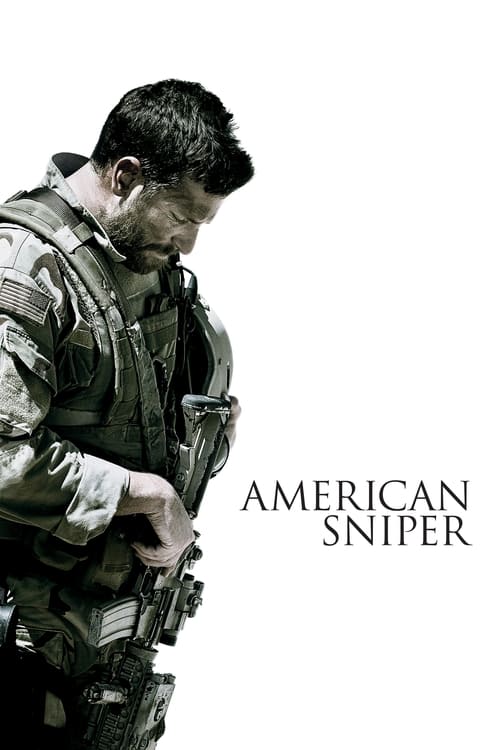
American Sniper
2014 · Clint Eastwood
For when you're ready for something serious and demanding — a war film that follows the soldier home. Not a light night; it sits with you.
What it's about
Chris Kyle, a Texas-raised Navy SEAL, becomes the most lethal sniper in American military history across four tours in Iraq, where his reputation makes him a marked man. Between deployments the film follows him home, where the war keeps living in his head and his marriage strains under everything he can't say.
The experience
Tense and stripped-down in combat — rooftop overwatch sequences that wind you tight — and quietly aching at home. It's a heavy, sobering watch that refuses to tell you exactly what to feel about its hero.
Performances
Bradley Cooper bulked up and burrowed into Kyle, playing the drawl and certainty on the surface and the accumulating damage underneath — a performance of remarkable restraint.
The craft
Clint Eastwood directs with characteristic economy: spare, unshowy, letting silence and sound design carry the dread, especially in the sniper's-scope sequences where a single decision holds the whole frame still. The quiet is as loud as the gunfire.
Why it matters
It became the highest-grossing American war film at the domestic box office and a genuine cultural flashpoint, igniting a national argument about heroism, myth-making, and the cost of the post-9/11 wars.
Snapshot
A battlefield biopic that became the highest-grossing domestic war film in American cinema history and one of the most politically divisive studio releases of the 2010s. Based on Navy SEAL Chris Kyle's 2012 memoir, the film follows Kyle through four tours of duty in Iraq—his kills accumulating, his family receding—and attempts to hold the tension between myth-making and psychological disintegration without entirely resolving it. That Eastwood refuses full resolution is either the film's central integrity or its central evasion, depending on the critic. What is beyond dispute: American Sniper landed in January 2015 with the force of a cultural event, touching every live wire in post-9/11 American public life simultaneously.
Industry & production
Chris Kyle was shot and killed at a Texas shooting range in February 2013 by a troubled veteran, Eddie Ray Routh, fourteen months before the film's release. His death transformed the project from a standard military-service narrative into something more fraught and elegiac, and screenwriter Jason Hall had already spent considerable time with Kyle before that killing, material that shaped the screenplay's intimacy with Kyle's particular idiom and self-understanding.
Steven Spielberg was the film's original director, with Bradley Cooper already attached as Kyle. Spielberg's departure—attributed to scheduling conflicts and diverging creative visions about the degree of moral complexity the script should carry—brought Eastwood aboard relatively late. This is documented but the precise nature of the creative disagreement is not on full public record; accounts mention that Spielberg wanted a more explicitly bifurcated portrait of Kyle and his Iraqi counterpart, Mustafa, giving the "enemy sniper" greater interiority. Eastwood's version substantially compresses Mustafa, a choice that became a flashpoint in the reception debate.
The production was financed and distributed by Warner Bros. in partnership with Village Roadshow Pictures. It shot in part on Moroccan locations standing in for Iraq (a standard logistical workaround for post-invasion Iraq productions), with additional American locations including sections of Detroit. Eastwood kept to his characteristically compressed schedule.
The film's release strategy—limited Christmas Day 2014 expansion followed by wide release in January 2015—proved commercially decisive. Its box-office run was extraordinary by any measure, and particularly remarkable given that Iraq War films had, as a category, performed poorly throughout the mid-2000s; Lions for Lambs, In the Valley of Elah, Rendition, and Green Zone had all underperformed or outright failed commercially. American Sniper's success was widely read by industry analysts and cultural commentators as evidence of a constituency that had not been served by the earlier, more skeptical wave of post-invasion films.
Technology
No documented unusual production technologies distinguish the film. Eastwood shot digitally, consistent with his practice in this period, and the film does not deploy conspicuous visual-effects innovation. The most-discussed technological footnote involves a scene in which a rubber prop baby substitutes for a real infant in a domestic scene; the substitution was visible enough to become widely ridiculed online, and Eastwood acknowledged it was a last-minute scheduling necessity. The moment is trivial in itself but became a kind of shorthand in critical discourse about the film's alleged clumsiness in its domestic register.
Barry Ackroyd's cinematography, discussed below, did represent a specific technological and methodological choice: the importation of handheld, documentary-inflected camera practice into a studio combat film.
Technique
Cinematography
The hiring of Barry Ackroyd was the most consequential single technical decision on the production. Ackroyd built his reputation on Paul Greengrass's United 93 (2006) and Kathryn Bigelow's The Hurt Locker (2008)—two films that had defined the visual grammar of post-9/11 combat cinema: tight focal lengths, restless handheld movement, an editing rhythm designed to simulate the cognitive overload of close-quarters violence. Ackroyd brought this grammar to American Sniper, and the collision between his verité-adjacent aesthetic and Eastwood's more classical, observational directorial sensibility produces the film's distinctive visual texture.
The combat sequences in Fallujah and elsewhere have a claustrophobic, grain-adjacent urgency that reads as documentary authenticity. The domestic sequences in Texas—the supermarkets, the nurseries, the master bedrooms—are shot more flatly, with less agitation, a stylistic gap that either enforces the film's thematic argument (Kyle cannot find in civilian life the heightened aliveness war provides) or marks a tonal failure in the material, depending on interpretation.
The film's signature image is the opening sequence: Kyle's eye at a rifle scope, a child in the crosshairs, the decision held in suspension. This framing—the world as a circle of magnified lethality, other lives as targets assessed and weighed—recurs throughout and functions as the film's visual thesis statement about Kyle's mode of perception. Sightlines, in the most literal sense, are the film's formal subject as much as its narrative subject.
Editing
Joel Cox, Eastwood's editor since the 1970s (their collaboration extends back to The Outlaw Josey Wales), cut the film with Gary D. Roach. Cox is among the most understated of major Hollywood editors; his work tends to be invisible in the derogatory sense critics mean when they call editing "seamless," which is to say it subordinates itself entirely to Eastwood's directorial rhythms. The film's structure—four Iraq tours intercut with the domestic Texas scenes—creates a temporal fragmentation that the editing handles through sharp, sometimes deliberately jarring cuts between the two registers, enforcing the psychic dislocation that the script frames as Kyle's central wound.
The editing received an Academy Award nomination, which is the extent of what can be documented with confidence about its formal recognition.
Mise-en-scène / staging
Eastwood's staging is classically American in the Fordian tradition: the arrangement of bodies in space encodes social and psychological relationships without calling attention to itself. The film's most formally interesting staging choices occur in Kyle's stateside scenes, where Eastwood repeatedly frames him as displaced—wrong-sized for the suburban interior, his body still tuned to a spatial vigilance that the living room cannot accommodate. The famous VA waiting room scenes, and the later sequences of Kyle watching war footage at home, use a kind of spatial dissociation: Kyle in the foreground, the domestic space slightly out of register around him.
Eastwood avoids the operatic grandeur that might be expected of the subject. The violence is precise and unglamorous in the specific manner of a shooter's craft, which is itself an interpretive choice: to render killing as a technical act rather than a spectacular one is to implicate the viewer in the precision rather than to distance them from it through aestheticized horror.
Sound
The sound design is one of the film's strongest elements and the dimension in which its ambivalence about violence becomes most technically legible. The crack of the rifle, its delay, the silence before impact—the film's sonic vocabulary around Kyle's kills is measured and clinical in a way that refuses both the excitement of the action film and the grotesquerie of more explicit anti-war aesthetics. This restraint is a tonal argument in itself.
The score is spare and refrains from the swelling patriotic orchestration that the film's detractors feared and its defenders would have found embarrassing. This spareness works in the film's favor: it does not editorialize where the images and Cooper's performance should carry the weight. The precise creative attribution for the score is less thoroughly documented in the public record than the film's other creative contributions, and the scholarly literature does not emphasize it, suggesting the score's function is primarily supportive rather than generative.
Performance
Bradley Cooper's physical transformation—reported to involve substantial weight and muscle gain, well in excess of his standard build—was the visible surface of a performance that reached deeper than bodywork. Cooper's Kyle is not an intelligent man in any conventional sense; his intelligence is entirely somatic and situational, tuned to the sniper's discipline of patience and spatial calculation. The performance's intelligence lies precisely in its willingness to give Kyle limited interiority while making that limitation itself the subject of observation. Cooper does not condescend to Kyle; he inhabits the man's self-conception with a kind of unironic commitment that the film would not have survived without.
Sienna Miller, as Taya Kyle, does what the screenplay asks—which is not quite enough. The domestic subplot is the film's weak material, and Miller works against the thinness of the script rather than benefiting from it.
Narrative & dramatic mode
The film employs a classical biopic structure—cradle to grave, with four tours as its organizing rhythm—but Eastwood and Hall bend it slightly by foregrounding Kyle's self-mythology rather than adjudicating it. The "Legend" nickname that Kyle carried in his unit is both the film's subject and, implicitly, its formal problem: how do you make a film about a man who was already a legend in his own self-narration without either capitulating to that legend or defensively dismantling it?
Eastwood's answer is to stay at the surface of Kyle's consciousness, which is a legitimate choice that risks tautology. We see what Kyle sees; we know what Kyle knows; the film's horizon of awareness is substantially Kyle's horizon. This is not the same as endorsing his worldview—Eastwood is too experienced a filmmaker to collapse that distinction—but it creates the condition under which the film can be simultaneously read as hero-worship and as a clinical portrait of psychological constriction.
The PTSD material, concentrated in the film's final act, is handled with more restraint than most films of this type. The diagnosis is present without being resolved by a therapeutic arc. Kyle's recovery remains incomplete and ambiguous, and his death—depicted only through title cards, Eastwood wisely refusing to dramatize it—preserves that ambiguity.
Genre & cycle
American Sniper sits at the intersection of three generic formations: the military biopic, the post-9/11 Iraq War film, and the returning-veteran drama. Its enormous commercial success made it the capstone of a cycle that had begun with The Hurt Locker (2008) and continued through Zero Dark Thirty (2012) and Lone Survivor (2013). All of these films negotiate—with varying degrees of discomfort—the absence of a stable moral framework for the Iraq and Afghanistan conflicts. Bigelow's films achieve their power through formal intelligence and deliberate ethical suspension; Lone Survivor opts for a purer celebration of unit loyalty; American Sniper attempts something between them.
The sniper as cinematic figure has a long genealogy: the unnamed sniper of Kubrick's Full Metal Jacket, Carlos Hathcock in Sniper (1993), Jude Law's Zaitsev in Enemy at the Gates (2001). The figure concentrates moral problems specific to modern warfare—distance, precision, calculated killing—and has recurred with greater frequency in post-9/11 cinema as those problems became culturally acute.
Authorship & method
Eastwood at eighty-four years old working at the pace of a director in his forties: this biographical fact is inseparable from the film's critical context. He made American Sniper with the same compressed, few-takes methodology he has employed since the 1970s—a production philosophy rooted partly in frugality, partly in a genuine aesthetic preference for the energy of first and second takes over the technically polished quality of the tenth. The results in this film are slightly uneven: Cooper's performance has the aliveness Eastwood's method produces, but the domestic scenes, in particular, have an incompleteness that might have been resolved with more coverage.
Jason Hall's screenplay adaptation of Kyle's memoir is more nuanced than it was given credit for in the initial reception storm. Hall introduces several scenes not in the memoir—most significantly, the structuring moral question of the opening minutes—and the script's silences are often more eloquent than its dialogue.
Barry Ackroyd's influence on the film's visual language has been discussed above. The collaboration between Ackroyd's documentary instincts and Eastwood's classical sensibility produced a film that looks different from any other Eastwood film while remaining recognizably his—a relatively rare outcome when a director works with a cinematographer whose aesthetic is strongly formed in another tradition.
Movement / national cinema
The film is an American studio production in the most direct sense: financed, distributed, and consumed primarily within American cultural circuits, and animated by concerns—military service, national identity, the cost of wars conducted in America's name—that are specifically and self-consciously American. It has almost no meaningful relationship to international art cinema; its concerns are not exportable in the way that, say, The Hurt Locker's formal innovations were.
Within American cinema, it belongs to a tradition of films made by and about working-class masculine duty that runs from John Ford through Don Siegel—the Siegel connection is worth noting, given that Siegel directed Eastwood in several defining early films and that Eastwood's entire directorial sensibility is inflected by Siegel's economy and his focus on male competence under pressure.
Era / period
The film is thoroughly a product of the post-9/11 decade and specifically of the historical moment—approximately 2013 to 2016—in which American public discourse about the Iraq War shifted from active guilt and ambivalence toward something more complex: a desire to honor individual service without relitigating the policy decisions that deployed those individuals. American Sniper served that desire in ways that made it culturally useful to a very large audience. It is also a product of a period of intense polarization in American public life, which accounts for the ferocity of the critical argument it provoked: the film became a screen onto which both its defenders and attackers projected far larger political arguments.
Themes
The film's central theme is the cost of the warrior's vocation carried inside the body of a man who returns to civilian life without having been granted the psychological permission to stop being a warrior. Kyle's PTSD is framed not as the consequence of trauma in the clinical sense but as the consequence of purpose: he was extraordinarily good at a specific and lethal thing, and that competence left no room for the ordinary competences civilian life requires.
Masculinity and its discontents run through every scene. Kyle's father delivers, in the film's early pages, the film's governing metaphor: there are wolves, sheep, and sheepdogs, and the sheepdog's job is to protect the flock. This taxonomy is crude enough that Eastwood's decision to include it is either a sympathetic rendering of Kyle's actual worldview or an invitation to the audience to assess it—an ambiguity the film preserves.
American exceptionalism, hero-mythology, the construction of the "Legend," and the relationship between individual service and state violence are all present, though not always in full critical focus. The film is more interested in what Kyle felt than in what his country asked him to do and why.
Reception, canon & influence
Critical reception was sharply split along lines that broadly mapped onto pre-existing political affiliations, which itself became part of the film's story. Defenders—including several critics not ordinarily sympathetic to military-themed cinema—argued that Eastwood's restraint and Cooper's performance achieved a genuine tragic register: the portrait of a man whose excellence destroyed him. Detractors—concentrated in prestige critical organs—argued that the film's structural decision to inhabit Kyle's perspective without sufficient critical distance amounted to a form of ideological endorsement, and that the compression of the Iraqi characters into near-ciphers was not ambiguity but avoidance. Richard Brody's hostile notice in The New Yorker became a touchstone of the latter position; the film also drew public comment from Michael Moore and Seth Rogen, both negative, that generated enormous press friction and arguably accelerated the box-office performance.
The film received six Academy Award nominations: Best Picture, Best Actor (Cooper), Best Adapted Screenplay (Hall), Best Film Editing, Best Sound Editing, and Best Sound Mixing. The degree to which it prevailed in any category is less thoroughly documented in the scholarly record than its nomination history.
Influences on the film include, most directly, Bigelow's The Hurt Locker (2008) for its visual and tonal grammar of Iraq War filmmaking—Ackroyd's presence links the films directly—and Zero Dark Thirty (2012) for the model of a procedural whose protagonist's efficacy is rendered without moral resolution. The Vietnam War film tradition—particularly The Deer Hunter (1978) for its returning-veteran structure and Michael Cimino's attention to the cost of war's expertise on men who survive it—is a more distal but relevant influence. Eastwood's own prior films about masculine violence and moral residue—Unforgiven, Mystic River, Gran Torino—constitute a necessary context; American Sniper is in conversation with those films even where it diverges from their more explicit moral reckoning.
Legacy and forward influence is difficult to assess cleanly this close to the film's release, but several effects are documentable. The film's commercial performance demonstrably altered the industry's risk assessment for military-themed productions; Hacksaw Ridge (2016) and subsequent films about individual military service were made in a market the film helped to define. Cooper's performance—and particularly his physical transformation—influenced subsequent thinking about actor preparation in the industry in the way that transformative performances periodically do. More broadly, the film became a case study in film and cultural studies for the problem of the "politically contested war film": how formal choices constitute moral claims, whether formal ambiguity is a virtue or an evasion, and whether box-office success can be read as a form of cultural referendum. These arguments, still unresolved, ensure the film a place in any serious account of American cinema's engagement with its nation's post-9/11 wars.
A Deleuzian reading
Start with the circle.
The full Deleuzian reading of American Sniper →
Reception
It landed in January 2015 as a box-office earthquake — the biggest domestic hit of 2014 and a six-time Oscar nominee — while simultaneously becoming a full-blown culture-war battlefield. A decade on, it's remembered as much for the discourse it detonated as for the film itself, and it rarely comes up in conversations about Eastwood's best work.
How American Sniper was received, from release to now →
Influences: the films it descends from and the films it influenced
- The Hurt Locker (2008) — Barry Ackroyd shot both films using simultaneous multi-camera long-lens coverage that captures unrepeatable performance proximity without directing the actor; American Sniper's Iraq sequences inherit this specific cinematographic method directly through the same operator.
- Zero Dark Thirty (2012) — Establishes the post-9/11 procedural model in which a protagonist's lethal operational competence is rendered in granular tactical detail without the film's score or editorial grammar ever supplying a moral verdict — American Sniper adopts this structural withholding as its central formal strategy.
- The Deer Hunter (1978) — Cimino's home-front / war-zone structural intercutting — using domestic space as a precise measure of what combat has permanently subtracted from a man — is the direct architectural template for American Sniper's Iraq / Texas alternation and its returning-veteran-who-cannot-re-enter structure.
- Unforgiven (1992) — Eastwood's own established template for the gap between a man's mythologized reputation and the actual texture of his violence, using sparse score and classical wide-frame staging as formal correlates of moral ambiguity; American Sniper's formal grammar is continuous with this film's approach while refusing its explicit reckoning.
- The Searchers (1956) — The Fordian classical staging compositions — figure isolated in landscape, the domestic threshold as literal boundary of belonging — that Eastwood directly inherits and deploys in the Texas sequences as a formal counterweight to the Iraq handheld work, grounding the film in the Ford-Siegel masculine tradition the dossier names explicitly.
- Patton (1970) — The self-mythology biopic structure in which the subject's own mythic self-construction is rendered as simultaneously impressive and diagnostic of what the man cannot see about himself; American Sniper inherits this ironic-yet-sympathetic double focus on the legend-making process without Schaffner's explicit critical distance.
- Black Hawk Down (2001) — Scott's desaturated multi-handheld visual grammar, non-hierarchical ensemble staging of combat, and refusal of a commanding aerial perspective established the genre expectations for modern urban combat cinematography that American Sniper inherits as its default formal vocabulary before inflecting it toward the sniper's singular optic.
- Born on the Fourth of July (1989) — The veteran biopic structure in which PTSD is rendered as an unbridgeable gap between the hero recruited by national mythology and the man who actually returns; Stone's device of showing the self-myth constructed during service unraveling in domestic space is the narrative architecture American Sniper adopts without Stone's editorializing score.
- Full Metal Jacket (1987) — The sniper sequence's rifle-scope circular vignette as a framing device that implicates the viewer in precision killing through visual identification with the shooter's optic; Eastwood extends this from an isolated sequence into the film's dominant POV identity, making the scope the protagonist's defining perceptual apparatus.
- Jarhead (2005) — The Iraq War film's grammar of psychological dissolution through operational waiting — specifically the sniper protagonist whose technical excellence finds no sanctioned outlet — establishes the genre's central tension between training and circumstance that American Sniper inherits and resolves differently by supplying the kinetic release Jarhead withholds.
- Shooter (2007) — Brings the Iraq War sniper figure to prestige treatment using Shooter's procedural vocabulary: ballistic calculation under pressure, stoic veteran performance register, and wide-angle compositions of open terrain that use the sniper's sovereign distance to convey both mastery and moral isolation.
- Enemy at the Gates (2001) — Revives the dueling-marksmen premise outright — two opposing snipers stalking each other across a battlefield, the held-breath silence broken by one isolated gunshot.
- Hacksaw Ridge (2016) — Made directly in the commercial and critical market American Sniper proved viable for individual-military-heroism biopics; inherits the physical-transformation performance as awards-season strategy and the structure of a soldier whose personal conviction diverges from institutional expectation, with Gibson intensifying the combat spectacle American Sniper deliberately underplays.
- Thank You for Your Service (2017) — Written and directed by Jason Hall, who adapted American Sniper's screenplay; directly extends the narrative / ptsd-without-resolution architecture into a structurally parallel returning-veteran drama, with Hall now controlling both the adaptation strategy and the directorial choices that on American Sniper were Eastwood's domain.
- The Wall (2017) — Directly inherits American Sniper's rifle-scope framing and clinical sound design of precision killing — the crack-and-delay report as a moral event — extending the scope's implicating optic into the film's entire formal conceit: a two-character Iraq War film built on the same asymmetry between shooter, target, and viewer that American Sniper establishes as the genre's defining formal problem.
- A Star Is Born (2018) — Cooper absorbed Eastwood's economical, few-takes, trust-the-actor directing method as its star and carried that low-coverage, performance-first discipline into his own debut.
- Lone Survivor (2013) — Contemporaneous sibling using the same handheld verité grammar and special-operations solemnity, with a similarly contested political reception that split along pre-existing ideological lines rather than aesthetic evaluation — both films became cultural referenda on the same question about whether inhabiting the operator's perspective constitutes endorsement.
- In the Valley of Elah (2007) — The returning-veteran drama's device of rendering PTSD through behavioral dissociation — the soldier who cannot decode his own trauma — without supplying therapeutic resolution; American Sniper inherits this structural refusal of psychological closure while relocating it from the detective framework to the biopic's public-legend frame.
Similar films
- The Hurt Locker (2008) — influence & lineage
- Lone Survivor (2013) — influence & lineage
- Jarhead (2005) — influence & lineage
- Hacksaw Ridge (2016) — influence & lineage
- Vice (2018) — often watched together
- Warfare (2025) — shared sensibility
- Million Dollar Baby (2004) — shared sensibility
- Fury (2014) — shared sensibility
All the films related to American Sniper →