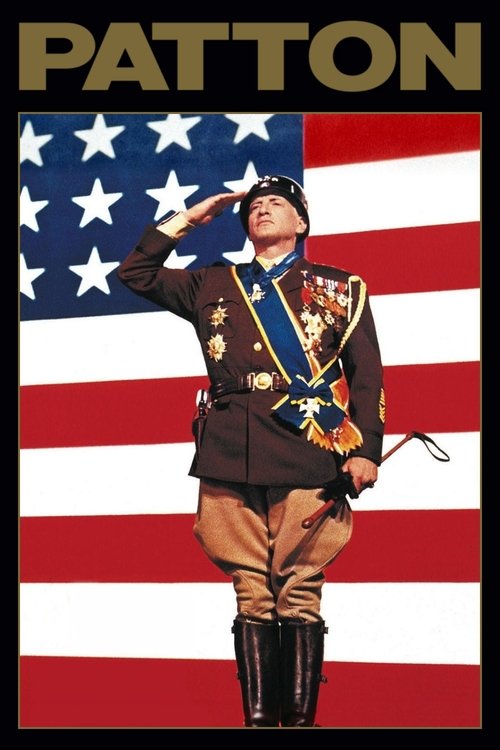
Patton
1970 · Franklin J. Schaffner
For when you want an epic with a brain — a long, absorbing Sunday-afternoon watch that gives you spectacle and then leaves you chewing on what kind of man you just spent three hours admiring.
What it's about
A biography of General George S. Patton, the brilliant, theatrical, self-mythologizing American tank commander of World War II — from the North African campaign through the race across Europe to the fall of the Third Reich. It's as much about his flaws as his genius: the temper, the insubordination, the belief in his own destiny that made him both indispensable and impossible.
The experience
Big, commanding, and stranger than a war epic has any right to be — thrilling in its battle sweep, but shot through with irony, so you're never sure whether you're watching a tribute or an indictment. That double vision is what keeps it fascinating for nearly three hours.
Performances
George C. Scott doesn't play Patton so much as occupy him — the growl, the swagger, the flickers of vulnerability — in one of the most complete character portraits American film has produced. The opening monologue alone, delivered in front of an enormous flag, became instantly iconic.
The craft
Franklin J. Schaffner stages the war on a vast widescreen canvas of tanks, deserts, and winter fields that rewards the biggest screen available, while the screenplay smuggles ambivalence into every triumph. Jerry Goldsmith's score, with its echoing trumpet triplets, gives the general's sense of destiny an eerie, haunted sound.
Why it matters
It swept seven Academy Awards including Best Picture and became the defining prestige film of its moment — remarkable for being embraced by hawks and doves alike, each convinced it took their side.
Snapshot
A monumental war biopic that defies easy ideological capture, Patton presents General George S. Patton Jr. as simultaneously heroic and self-destructive, anachronistic and prophetic, admirable and alarming. Its seven Academy Awards — including Best Picture, Best Director, and Best Actor — confirmed it as the defining prestige film of its era, yet its strange tonal doubleness has kept it genuinely unsettling ever since. The film functions simultaneously as a tribute to military genius, a critique of martial hubris, and an elegy for a type of warrior already obsolete by the time he fought. That three audiences — hawks, doves, and cinephiles — could each find vindication in the same two hours and fifty-nine minutes is its deepest formal achievement.
Industry & production
The film's origins lie with producer Frank McCarthy, a retired brigadier general and former aide to General George C. Marshall who spent the better part of a decade trying to bring the project to 20th Century Fox. McCarthy's primary sources were Ladislas Farago's biography Patton: Ordeal and Triumph (1963) and General Omar Bradley's memoir A Soldier's Story (1951), the latter grounding the film in an eyewitness perspective that would eventually shape Karl Malden's characterization of Bradley as a structural counterweight to Patton's excess.
Francis Ford Coppola — then a young writer in his mid-twenties — was engaged to write the screenplay in the mid-1960s. His initial draft ran to extraordinary length and was, by most accounts, deliberately ambivalent about its subject, drawing Patton as a figure whose genius was inseparable from dangerous vanity and whose worldview bordered on the sociopathic. The studio found the script too uncomfortable, and veteran writer Edmund H. North was brought in to revise it toward a more conventionally heroic register. The two writers shared the Oscar for Best Original Screenplay, though the precise division of credit has been contested; Coppola has spoken in interviews about the significant divergences between his conception and the finished film. What survived from Coppola's instincts was the structural audacity — particularly the opening monologue — and an undercurrent of irony that the revision could not entirely smooth away.
Casting was contentious. George C. Scott had already established himself as one of the most formidable American stage and screen actors of his generation, with Anatomy of a Murder (1959) and The Hustler (1961) demonstrating his capacity for intense, barely contained energy. He accepted the role with some reluctance, reportedly skeptical of hagiography, and that skepticism arguably enabled his extraordinary performance. The production shot across multiple European locations — Spain, Portugal, England, and Morocco — which stood in for North Africa, Sicily, England, France, Germany, and other theaters of the war. The scope was genuinely epic, and McCarthy's military connections helped secure access to equipment and cooperation that gave the film unusual logistical authenticity.
Technology
Patton was photographed in Dimension 150, a 65mm spherical-lens process developed in the 1960s as a wide-gauge alternative to anamorphic formats. The 65mm negative, printed to 70mm for roadshow theatrical release, yielded an image of exceptional depth, clarity, and tonal range. Where anamorphic lenses of the period produced their characteristic shallow-focus glamour and horizontal compression artifacts, Dimension 150 gave cinematographer Fred Koenekamp a larger, crisper frame in which landscape and figure could coexist in sharp relief — essential for a film requiring both intimate portraiture and large-scale battle choreography. The roadshow release format included an overture, intermission, and entr'acte music, situating the film explicitly within the prestige event-cinema tradition that Lawrence of Arabia (1962) and Doctor Zhivago (1965) had recently elevated. Jerry Goldsmith's score was recorded to take advantage of the multi-channel magnetic stereo sound available in 70mm roadshow venues.
Technique
Cinematography
Koenekamp's visual strategy is rooted in a tension between grandeur and isolation. The battle sequences — particularly the engagement at El Guettar, where Patton's forces repulse Rommel's tanks — exploit the 65mm frame's ability to hold vast compositions without losing legibility: men and machines arrayed across North African desert, the horizon line low and immense. Yet the film repeatedly cuts from these epic canvases to tight close-ups of Scott's face that reduce the world to one man's reaction. The famous opening shot — Patton striding from the far background to fill the frame before an enormous American flag — announces this dialectic immediately: figure against emblem, individual against institution, human scale against national myth. The flag fills the entire screen, a flat graphic that looks almost like a painted backdrop, deliberately theatrical. Koenekamp holds this composition without conventional establishing context, forcing the audience into the film's perspective before they have had time to situate themselves critically.
Editing
Hugh S. Fowler's editing won the Academy Award and deserves it. The film sustains nearly three hours without losing momentum, managed partly through the structural alternation between the European and North African theaters and partly through a cutting rhythm that mirrors Patton's own temperament — impatient, decisive, occasionally reckless. The battle sequences are edited with clarity unusual for action filmmaking of the period: geography is legible, the strategic logic readable. Fowler and Schaffner understood that the real drama of military command is spatial — who is where, why, and with what consequence — and the editing serves that understanding. The film also handles temporal compression across multiple years and campaigns with minimal expository dialogue, relying instead on intertitles, Bradley's narration in the early sections, and visual ellipsis.
Mise-en-scène / staging
Schaffner's most consistent staging choice is to make Patton physically dominate every composition he enters. Scott is frequently shot from below, or positioned on elevated ground — a tank, a ruin, a hill — while subordinates and interlocutors occupy lower registers of the frame. This is not merely hagiography; it becomes, cumulatively, a diagnosis of Patton's psychology. The man cannot conceive of an equal visual field. When the film wants to register his diminishment — his relief from command, his humiliation at the hands of Allied politics — Schaffner places him in interiors that dwarf him: vast headquarters rooms, diplomatic corridors, spaces where others are seated at tables and Patton must stand awkwardly on the periphery.
The slapping incident — in which Patton strikes a shell-shocked soldier in a field hospital — is staged with deliberate restraint. Schaffner does not cut away or cushion the moment. The camera holds, the act is plain, and the silence that follows is more damning than any editorial commentary.
Sound
Goldsmith's score is one of his most celebrated, and rightly so. It anchors the film's tonal duality by pairing a militaristic march theme — trumpet-led, instantly recognizable — with more ambivalent harmonic and textural material that surfaces when the film contemplates Patton's inner life or his anachronism. Goldsmith reportedly used unconventional orchestrations for the period, and the score avoids the triumphalist sweep that would have resolved the film's tensions into simple heroism. The sound design in battle sequences is muscular but not excessive by later standards; the film trusts silence and near-silence in ways that post-Dolby action cinema seldom does.
Performance
George C. Scott's refusal of the Best Actor Oscar — he called the Academy Awards a "meat parade" and announced in advance that he would not accept — became one of the most discussed acts in Hollywood history, a gesture entirely in keeping with his characterization of Patton himself. The performance is a sustained act of inhabitation rather than impersonation. Scott does not attempt a precise physical replica; he builds from the inside out, finding Patton's self-mythology, his genuine tactical intelligence, his terrifying emotional volatility, and his almost childlike hunger for glory. The voice — higher-pitched than one might expect, nasal, clipped — is one of cinema's great physical choices. Scott makes Patton simultaneously ridiculous and magnificent, often within the same sentence.
Karl Malden's Bradley functions as a moral register against which Patton's excesses are measured, and Malden navigates the thankless task of playing the sane, competent professional with enough specificity to be more than a foil.
Narrative & dramatic mode
The film adopts a biographical-epic structure familiar from Hollywood prestige pictures but inflects it with a persistent ironic undercurrent. The narrative follows a loose arc from Patton's vindication in North Africa through his strategic triumphs in Sicily and France to his political eclipse after the war's end, but it is less interested in conventional dramatic causality than in the accumulation of character revelation. Bradley's occasional voiceover (concentrated in the early sections) initially positions the film as a measured memorial tribute, but this framing device quietly recedes as Patton grows too large to be contained by anyone else's perspective. The film's conclusion — Patton walking alone across a Spanish plain, his dog at his heels, a final monologue about the transience of glory drawn loosely from ancient rhetoric — is openly elegiac and deliberately anti-climactic, refusing the triumphalist closure the preceding battles might have earned.
Genre & cycle
Patton sits at the intersection of the Hollywood war film and the Great Man biopic, two genres with long institutional histories in American cinema. Its immediate predecessors in the war-film cycle include The Longest Day (1962) and Battle of the Bulge (1965) — large-scale ensemble reconstructions of specific campaigns — but Patton departs from that model by subordinating historical reconstruction to psychological portraiture. It arrives at a transitional moment for the genre: the Vietnam War had thoroughly destabilized the moral grammar of the WWII film, and Patton's ambivalence — its ability to be read as both a celebration and a critique of military culture — was almost certainly a condition of its commercial and critical success. It could speak to audiences who needed a hero and to audiences who were suspicious of heroes simultaneously.
The film influenced a subsequent cycle of morally complicated military biopics, though few matched its tonal sophistication.
Authorship & method
Franklin J. Schaffner occupies a peculiar place in auteur history: a director of evident craft and intelligence whose career resists the unified thematic signature that auteurist criticism prizes. His previous film, Planet of the Apes (1968), had demonstrated an ability to handle large-scale spectacle without sacrificing character texture, and his theatrical background — extensive work in live television drama in the 1950s — gave him fluency with actor-centered composition and sustained performance. On Patton, his contribution was above all architectural: the film holds together across its considerable length and tonal range because Schaffner understood where to be still and where to move, when to let Scott command the frame and when to situate him within a larger visual argument. He is not an obtrusive filmmaker, and that restraint is itself a choice in service of the subject.
Fred Koenekamp's contribution to the film's visual identity is substantial, though he is less celebrated than the project's other collaborators. Jerry Goldsmith, by contrast, was already a recognized master of film scoring by 1970, and Patton consolidated that reputation. Edmund H. North's revisions to Coppola's draft remain a matter of scholarly interest for what they reveal about Hollywood's limits in absorbing genuinely adversarial biographical material; the finished film is more heroic than Coppola intended but more complicated than North's instincts alone would have produced.
Movement / national cinema
Patton is firmly a product of New Hollywood in its industrial and contextual moment — contemporaneous with Easy Rider (1969), M\A\S\H (1970), and Catch-22 (1970) — but it does not belong to the movement aesthetically. Where New Hollywood filmmakers were dismantling classical grammar, Patton* employs it at full extension. It is perhaps best understood as a late masterwork of the classical prestige tradition rather than a transition point: it demonstrates how far that tradition could stretch before it finally gave way.
Era / period
The film was released in February 1970, during the height of American involvement in Vietnam, a context that saturated its reception without determining it. The domestic divisions of the period — over the war, over authority, over what counted as heroism — found in the film an object onto which contradictory readings could be projected. Richard Nixon reportedly screened Patton multiple times during his presidency; this claim, widely reported, has become part of the film's cultural biography, though the precise implications Nixon drew from it are a matter of inference. The film belongs to a moment when American culture was conducting an anguished renegotiation of its relationship to military mythology, and it addressed that moment without resolving it.
Themes
The film's dominant thematic concern is anachronism: Patton is a man born out of time, whose virtues are inseparable from his vices precisely because both belong to an earlier, more absolute conception of warfare and glory. His belief in reincarnation — dramatized in the film's haunting scene at the ruins of Carthage — extends this logic: he is not simply old-fashioned, he is eternal, cycling through history's great conflicts, perpetually relevant and perpetually misplaced. The film meditates on the relationship between genius and institution, on the military's need to control the very qualities that make great commanders. It is also, throughout, a film about performance: Patton performs Patton, stages himself for history, and is aware of doing so. His vanity is theatrical, his courage theatrical, his rage theatrical. Scott's performance is thus a performance of performance, and the film's self-consciousness about this — most explicit in the opening monologue, delivered directly to camera as if to the cameras of history — gives it a reflexive edge unusual in mainstream commercial cinema of the period.
Reception, canon & influence
Patton was received with near-universal critical admiration on release. Its seven Academy Awards, including Best Picture and Best Director, reflected a consensus that it represented the pinnacle of a certain kind of filmmaking ambition. George C. Scott's refusal of the acting award paradoxically intensified the film's cultural presence; his gesture was itself Pattonesque, and the irony was not lost on observers. The film was a major commercial success, one of the highest-grossing releases of 1970, which validated Fox's considerable investment and confirmed that prestige roadshow filmmaking still had a viable market even as the culture shifted beneath it.
Looking backward, Patton draws on a tradition of Hollywood Great Man epics running from Wilson (1944) through Lawrence of Arabia — the latter an obvious formal model for its combination of spectacular geography, psychological complexity, and an eccentric protagonist whose genius and self-destruction are intertwined. The influence of WWII memoir literature and military historiography is evident in its attention to strategic context, and the Bradley material gives the film an eyewitness grounding that distinguishes it from pure mythography.
Looking forward, Patton established a template for the morally complicated military biopic that has been returned to repeatedly, with uneven results. Its influence on Oliver Stone is discernible in the structural ambition and the interest in self-mythologizing protagonists; Nixon (1995) and Alexander (2004) share its fascination with genius bounded by fatal flaw. The opening monologue has been quoted, parodied, and referenced so frequently across subsequent decades that it has passed into the general cultural lexicon, serving as a touchstone for any representation of grandiose military rhetoric. Within the war genre more broadly, the film's insistence on psychological interiority — on understanding the commander rather than merely depicting the campaign — shifted expectations for what serious war cinema could accomplish. It remains in distribution and on curricula, one of the handful of American films of the 1970 period that criticism has consistently declined to relegate to period curiosity.
A Deleuzian reading
Start with the wall.
The full Deleuzian reading of Patton →
Reception
A huge hit and 7-time Oscar winner in 1970, landing right in the middle of Vietnam — and it's since settled in as one of the most respected of the classic Best Picture winners, powered almost entirely by the reputation of George C. Scott's performance.
How Patton was received, from release to now →
Influences: the films it descends from and the films it influenced
- Lawrence of Arabia (1962) — Freddie Young's Super Panavision 65mm compositions — human figures and desert landscape held in simultaneous sharp focus across hundreds of yards — established the exact cinematographic grammar Koenekamp adopted for Patton's North African sequences, the wide-gauge negative solving the figure-vs.-landscape problem at scale.
- Ben-Hur (1959) — Robert Surtees's Camera 65 roadshow release — with overture, intermission, and entr'acte — fixed the prestige event-cinema format and the figure-dwarfed-by-monumental-emblem framing grammar that Schaffner's flag-shot opening directly inherits: the individual rendered small before institutional iconography, then restored to commanding close-up.
- 12 O'Clock High (1949) — The first American war film to make a commanding officer's psychological disintegration under the weight of authority its dramatic center, establishing the structural template — genius inseparable from self-destruction, competence curdling into obsession — that Schaffner and Coppola adapted for Patton's elegiac anticlimax.
- Paths of Glory (1957) — Kubrick's pre-combat tracking shots establish trench geography in continuous lateral movement before the attack begins, so tactical logic remains legible throughout the chaos — the same spatial-clarity editing principle Fowler and Schaffner systematized for Patton's El Guettar and Falaise Gap sequences.
- The Hustler (1961) — Scott's Fast Eddie Felson established his inhabitation method — physical precision, contempt for weakness, barely-controlled aggression expressed through stillness and posture — which he transferred unchanged to Patton, giving Schaffner a performer who could make a monologue feel like a physical contest.
- Spartacus (1960) — Russell Metty's Super Technirama 70 battle choreography is cut for strategic legibility — troop movements charted across terrain so the viewer always understands who is winning and why — the precise editing philosophy Fowler applied to Patton's large-scale engagements, where military geography is the real dramatic subject.
- Doctor Zhivago (1965) — Freddie Young's 65mm Panavision roadshow with multi-channel magnetic stereo established the prestige biographical epic's technical baseline — wide-gauge depth, surround sound design, overture structure — that Goldsmith's Patton score recording and Koenekamp's cinematography directly followed as an inherited production template.
- Planet of the Apes (1968) — Schaffner reapplies his controlled, muscular classicism and command of large-scale physical staging, again scored by Goldsmith, proving the director-composer craft partnership forged on Apes.
- Twelve O'Clock High (1949) — Perfects the great-man command character study that Twelve O'Clock High's Peck vehicle prototyped, anchoring the war film to one officer's psychology of leadership and cost.
- Apocalypse Now (1979) — Coppola extended his own Patton screenplay's ambivalence without studio restraint: Kurtz is the Patton logic fully consumed by martial hubris, and Vittorio Storaro's figure-vs.-mythological-emblem staging — soldiers silhouetted against napalm, Kurtz's face emerging from shadow before a stone idol — develops the flag-shot grammar into a systematic visual rhetoric of self-deification.
- The Right Stuff (1983) — Caleb Deschanel's wide-frame compositions hold test pilots against vast Mojave sky in simultaneous figure-and-landscape focus — extending Koenekamp's 65mm depth-of-field grammar — while Kaufman's elegiac treatment of men made obsolete by bureaucratic institutional change directly inherits Patton's anachronism-warrior structure and its anticlimax of institutional betrayal.
- Gettysburg (1993) — John Merritt's battle-sequence editing achieves the same spatial and strategic legibility as Fowler's Patton work — formations charted across terrain so the viewer always knows who holds which ridge and what is at stake — with Berenger's Longstreet and Daniels's Chamberlain following Schaffner's inhabitation-over-impersonation brief for historical military commanders.
- Nixon (1995) — Stone uses low-angle staging to make psychological dominance physically visible — camera pressed below eyeline, subject filling the upper frame — in explicit inheritance of Schaffner's formula, while his ironic portrait of a subject simultaneously great and catastrophically self-destructive represents the mature realization of the tonal doubleness Coppola first built into his Patton screenplay.
- A Bridge Too Far (1977) — Established the Panavision anamorphic visual grammar for WWII command-level drama — long-lens compression stacking armor columns into oppressive depth, wide compositions dwarfing individual officers against operational landscape — that Unsworth adopts as his baseline compositional mode for A Bridge Too Far.
- We Were Soldiers (2002) — Fred Koenekamp's 70mm anamorphic framing of the commander as landscape-dominating figure, and George C. Scott's performance of minimalist authority through stillness and controlled deliberation, codified the stoic-officer performance mode and wide-format military command aesthetic that Gibson inhabits as Lt. Col. Moore.
- American Sniper (2014) — The self-mythology biopic structure in which the subject's own mythic self-construction is rendered as simultaneously impressive and diagnostic of what the man cannot see about himself; American Sniper inherits this ironic-yet-sympathetic double focus on the legend-making process without Schaffner's explicit critical distance.
- Papillon (1973) — Reunited Schaffner with cinematographer Fred Koenekamp and composer Goldsmith on a classically-clear, patient one-man character epic, the immediate stylistic and collaborator blueprint carried directly into Papillon.
- Heneral Luna (2015) — The template for a biopic built around a brilliant, profane, insubordinate general undone by his own temperament rather than the enemy — Luna's volatile characterization and self-destructive command arc descend directly from George C. Scott's Patton.
- Tora! Tora! Tora! (1970) — Photographed in Panavision 70 in the same release year, using the same battle-sequence spatial legibility across multiple theaters of command — Japanese and American perspectives intercut with strategic clarity — as a parallel and contemporaneous solution to the problem of making large-scale WWII operational logistics cinematically intelligible.
- MacArthur (1977) — Jerry Goldsmith returning to score another WWII general's biopic using the same ambivalent march-and-elegy vocabulary he developed for Patton, while Sargent applies the same temporal compression ellipsis across Pacific campaigns and Gregory Peck is briefed to inhabit rather than impersonate his subject in direct continuity with Scott's methodology.
- The Man Who Would Be King (1975) — Oswald Morris's wide-format compositions — figures progressively diminished against landscape as their grandiose self-mythology scales upward — and Huston's elegiac treatment of warriors whose ambition outpaces their judgment extend Patton's anachronism-warrior-obsolescence structure into a colonial register, both films ending in ruins that the protagonist's hubris made inevitable.
- Full Metal Jacket (1987) — Kubrick's training-sequence low-angle shots of Gunnery Sergeant Hartman — camera well below eyeline, figure filling upper frame against a flat ground — directly extend Schaffner's staging psychology of authority made physically visible, while the film's ironic martial doubleness (war as both horror and seduction) inherits the tonal ambivalence Coppola embedded in his Patton draft.
Similar films
- Apocalypse Now (1979) — influence & lineage
- Paths of Glory (1957) — influence & lineage
- Tora! Tora! Tora! (1970) — influence & lineage
- The Guns of Navarone (1961) — same viewing thread
- Fury (2014) — same viewing thread
- Braveheart (1995) — same viewing thread
- The Longest Day (1962) — shared sensibility
- De Gaulle: Liberté (2026) — shared sensibility
All the films related to Patton →
Watch it with: curated runs of related films
- Against Overwhelming Force — A run for when you want scale and physical punishment — men set against armies, tanks, and the frozen wild, holding a line that by rights should have broken them.