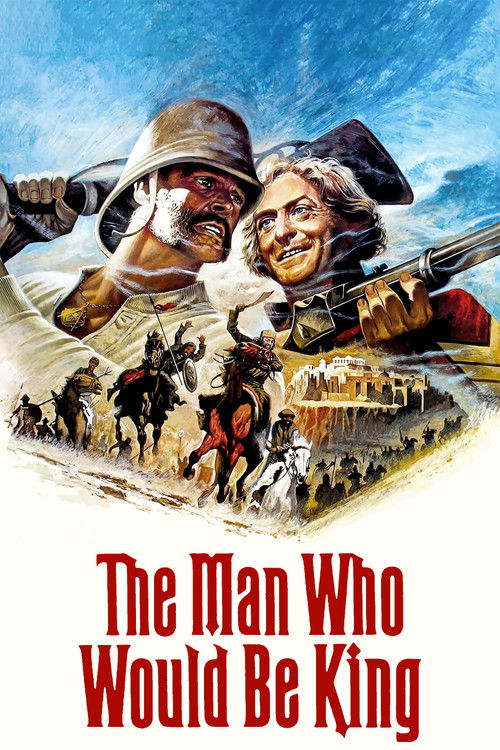
The Man Who Would Be King
1975 · John Huston
For a Sunday-afternoon epic mood: when you want grand landscapes, great banter, and a proper story told with confidence. Comfort viewing with a dark undertow that sneaks up on you.
What it's about
Two roguish ex-soldiers of the British Army in colonial India, Peachy Carnehan and Danny Dravot, hatch the ultimate con: march beyond the maps into remote Kafiristan, use their rifles and drill-sergeant know-how to install themselves as rulers, and loot the place. The scheme works better than they ever dreamed — the locals come to believe Danny is a god — and the two friends discover that being worshipped is a far more dangerous game than being shot at.
The experience
A rollicking, big-hearted adventure that keeps turning the screws — funny and swashbuckling for long stretches, then unexpectedly moving as the con curdles into hubris. It has the sweep of an old-fashioned epic and the sting of a cautionary tale.
Performances
Sean Connery and Michael Caine are one of the screen's great double acts — Connery swelling magnificently with delusion, Caine all cockney pragmatism and loyalty — and Christopher Plummer brings quiet warmth as the writer Rudyard Kipling who hears their tale.
The craft
John Huston, who had dreamed of filming Kipling's story for decades, gives it the full epic treatment: vast mountain vistas, rich production design, and a screenplay that balances comedy, adventure, and tragedy in perfect proportion. It's a film built for the biggest screen you can find.
Why it matters
A late masterpiece from one of Hollywood's legendary directors and a high-water mark of the classic adventure film — beloved as one of the great two-hander buddy movies and a clear-eyed farewell to the imperial adventure yarn.
Snapshot
John Huston's penultimate major adventure film and one of the most accomplished literary adaptations of 1970s Hollywood: a bravura two-hander in which Sean Connery and Michael Caine play a pair of rogue ex-soldiers who bluff their way to divinity in the unmapped mountains of Kafiristan. Faithful in spirit to Rudyard Kipling's 1888 short story while expanding its frame narrative into something at once funnier and more tragic, the film arrives as a late flowering of the classic adventure epic — knowing, elegiac, and sharply aware of the imperialism it depicts even as it indulges its romance. Structurally a buddy film before that genre had been theorized, thematically a meditation on hubris and the corrupting grammar of empire, it stands as one of Huston's richest achievements and a testament to what two actors and a masterful director can build from pure performance and landscape.
Industry & production
The film's production history is nearly as novelistic as its subject matter. Huston had coveted Kipling's story since at least the late 1950s, famously intending to cast Humphrey Bogart as Peachy Carnehan and Clark Gable as Daniel Dravot. Bogart's death from esophageal cancer in January 1957 effectively killed that configuration, and the project languished for nearly two decades, during which Huston considered and discarded a succession of pairings — among them Burt Lancaster and Kirk Douglas, and later Richard Burton and Peter O'Toole. It was only in the early 1970s, with Allied Artists providing financing and the project finding backing alongside Columbia Pictures for international distribution, that the film became viable again. Huston himself has said he always understood the story as requiring a specific quality of camaraderie that could not simply be directed into existence; discovering that Connery and Caine shared genuine friendship and comic timing gave the project its final rationale.
Shooting took place primarily in Morocco — the Atlas Mountains and the walled city of Marrakech standing in for the North-West Frontier and the invented Kafiristan — with some sequences completed in the United Kingdom. The production was physically demanding; the mountain terrain required logistical effort typical of large location shoots of the period. Producer John Foreman, who had previously collaborated with Huston, managed the practical challenges of recreating British India and a Bronze Age mountain kingdom under harsh conditions. The screenplay was co-written by Huston and his long-time collaborator Gladys Hill, whose partnership with him extended through the later decades of his career.
Technology
The film was photographed in Panavision, exploiting the full anamorphic widescreen frame to accommodate the Moroccan landscape's scale without losing the faces at its center. Eastmancolor negative stock was used under the supervision of cinematographer Oswald Morris, whose experience with location work in harsh and varied light conditions was essential. There is no technical novelty of historical significance attached to the production — no breakthrough in process or apparatus — but the technology was deployed with uncommon discipline and elegance. The Panavision lenses, at their widest, make the mountains feel geological and indifferent; at their narrowest, they press against the two lead faces with an intimacy that belongs properly to chamber drama. That oscillation between scales is the film's most sustained technical statement.
Technique
Cinematography
Oswald Morris had been Huston's preferred cinematographer since Moulin Rouge (1952), and this late collaboration distills everything economical and intelligent about their working method. Morris resists the tourist-postcard temptation that traps many films shot in Morocco, insisting instead on exposing the landscape as genuinely alien: bleached, vertical, and indifferent to the narrative unfolding before it. The high-altitude sequences — the mountain passes, the rope bridge, the snow-bound approaches to Kafiristan — are shot with a consistent quality of harsh top-light that ages the men on screen even as it makes the scenery majestic. Within Kafiristan itself, Morris shifts toward warmer ochre tones as the men consolidate power, a subtle chromatic movement that reads, in retrospect, as the film heating toward its inevitable combustion. The frame narrative sequences in British India are shot in a murkier, more congested palette — dust and heat and the bureaucratic press of empire — against which Kafiristan registers as both paradise and trap.
Editing
Russell Lloyd, another recurring Huston collaborator, cut the film with an instinctive sense of when to let a scene breathe and when to drive it forward. The film's most technically demanding editing problem is the management of tonal register: the early sequences are essentially comic adventure, the middle section shifts into something mythic and ceremonial, and the final act collapses into tragedy with considerable speed. Lloyd makes these shifts feel earned rather than lurching. The transition from the two men's initial acceptance by the Kafirs to their installation as rulers is handled through a series of ellipses that compress months without sacrificing the sense that real time and real power have accumulated. The final return to the frame narrative — Carnehan in the railway waiting-room, broken and ancient — is cut to land with maximum weight against the heroic vitality of what has preceded it.
Mise-en-scène / staging
Huston's staging throughout is theatrical in the best sense: he trusts his actors to fill space and does not fuss. The durbar sequences, in which Dravot receives tribute and pronounces judgment over the Kafiri people, are blocked with a formal pageantry that reads as both comic — two Cockney soldiers in improvised ceremonial dress — and genuinely imposing. The film's most discussed staging achievement is the rope bridge sequence near the end, in which Carnehan watches Dravot pushed to his death. Huston shoots it at sufficient distance to make the geography legible — the void, the bridge, the crowd — while keeping the emotional focus on Carnehan's face as witness. The Masonic regalia and iconography that run through the film's visual grammar are integrated into the set decoration with real care: when Dravot identifies the Masonic mark on an ancient idol and understands he can claim divinity through it, the staging makes the leap of recognition feel both plausible and fateful.
Sound
Maurice Jarre composed the score, deploying a broad, rhythmically assertive orchestral palette against which occasional gestures toward North Indian and Central Asian musical idiom are placed. The score is functional and well-judged rather than memorable in the way that Jarre's most celebrated work — his collaborations with David Lean — tends to be; it amplifies the adventure register without undercutting the film's darker intelligence. Huston and his sound editors made deliberate use of environmental silence in the mountain passages, allowing the absence of music to register the two men's isolation. The film's most emotionally direct sound design involves Carnehan's broken narration in the frame sequences, where his voice — physically ruined — places the film's adventure in the past tense from which it can never escape.
Performance
The film lives or dies on its two central performances, and both Connery and Caine are working at the height of their powers. Connery, in one of the roles most closely identified with his post-Bond career, plays Dravot's ambition and eventual self-deception with escalating conviction: the scene in which he decides to take a wife, against Carnehan's desperate counsel, is a masterclass in the actor communicating a man who has begun to believe his own mythology. Caine plays the subordinate register with equal intelligence — Carnehan is quicker-witted and more self-aware than Dravot, and Caine modulates this throughout without ever letting it flatten into superiority. The friendship between the two is palpable and unforced, a quality that Huston and both actors attributed partly to the genuine warmth the men had for each other off-screen. Christopher Plummer brings an appropriately literary self-consciousness to the Kipling figure: he plays a man who knows he is receiving a story but cannot protect himself from being destroyed by it.
Narrative & dramatic mode
Kipling's original story is a brief, intensely compressed first-person narrative told to a journalist by a wreck of a man who has been to the edge of the world and returned as its debris. Huston and Gladys Hill's adaptation preserves the frame and its structural irony — we know from the opening minutes that everything will end in catastrophe — while expanding the central adventure into something nearer the scale of classical epic. The choice to cast Kipling himself as the frame narrator, rather than an anonymous journalist, has the effect of reflexively implicating the empire's literary imagination in the story's tragedy: Kipling, who made his reputation from exactly the kind of frontier mythology Dravot and Carnehan embody, is made to watch that mythology consume the men who lived it.
The dramatic mode oscillates with unusual fluency between picaresque comedy — the two men's brazen deceptions of Indian colonial officials, their improbable march into the mountains — and something closer to Greek tragedy in its final act. This tonal range is the film's greatest narrative achievement and its central demand on the audience. Huston never condescends to the comedy, which earns the tragedy; the tragedy, in turn, does not retroactively ironize the comedy into mere setup.
Genre & cycle
The film belongs to the adventure epic tradition that runs through Hollywood from the 1930s — the prestige location film, the adaptation of canonical literary adventure, the test of male friendship against historical extremity. In its direct lineage sit films like Huston's own The African Queen (1951), the imperial adventure films of the British 1950s, and the David Lean epics (Lawrence of Arabia, The Man Who Would Be King is sometimes positioned as the film that most nearly matches Lean's scale in the early 1970s). It arrives, however, at a moment when the adventure epic's assumptions about empire and masculinity are under sustained cultural pressure, and the film's willingness to let those assumptions collapse under the weight of their own logic — Dravot's divinity is not merely a lie but an internalized lie — places it at the more self-conscious end of the cycle.
As a buddy film, it anticipates the genre's systematic development in the late 1970s and 1980s. The pairing of two complementary male protagonists — one impulsive and visionary, one sardonic and pragmatic — whose bond is tested to destruction by the ambitions of the first, is a structural template that the subsequent decade would develop in many registers.
Authorship & method
By 1975, Huston had been directing for thirty-four years. His method was by this point fully settled: a deep investment in literary sources, an unusual willingness to cede space to his actors, a preference for practical locations over studio construction, and a characteristic tone that balanced irony and genuine feeling without allowing either to overwhelm. The film is in many respects a summation of his thematic preoccupations: the futility of quests that succeed beyond their ambition, the fragility of male self-deception, the elegy for a world whose romance is inseparable from its violence.
Gladys Hill's contribution to the screenplay is difficult to isolate from Huston's own, as was typically the case in their collaborations, but the dialogue's quality — brisk, specific, alive to the comedy of class and ambition — represents their partnership at its best. Oswald Morris, operating in what would prove to be the last of his Huston films, brought to the photography the same rigorous attention to available light and location texture that had characterized their earlier work together. Maurice Jarre, working in a mode somewhat more restrained than his Lean collaborations, provided a serviceable and occasionally arresting score.
Movement / national cinema
The film is properly a Hollywood production — American financing, a director who had long since migrated between the American and British industries — but its British creative DNA is pronounced. Connery and Caine are quintessentially British working-class actors who had each used their physicality and accent to disrupt Hollywood's inherited hierarchies of stardom; their casting here is in part a statement about where the energies of adventure cinema had migrated by the mid-1970s. The material is British colonial literature, and the film is in sustained conversation with the British imperial romance tradition even as it subjects that tradition to skeptical pressure.
The Moroccan production is notable for the degree to which Huston and Morris engaged seriously with the physical environment rather than using it as backdrop; whether the film belongs to any tradition of Moroccan or North African cinema is a question it does not raise for itself.
Era / period
The film arrives precisely at the intersection of Hollywood's New Wave consolidation and the beginning of the blockbuster era. 1975 is the year of Jaws; the classical adventure epic, which Huston is here refining rather than transforming, is about to be displaced by a new spectacular mode. In retrospect, The Man Who Would Be King can be read as a late and dignified instance of the literary prestige film — the adaptation of a recognized canonical text by a major director working at scale — before that mode was marginalized by event cinema's commercial dominance. Its tone of ironic romanticism, its patience with performance, and its willingness to end in failure are all qualities that would become harder to find in mainstream adventure cinema after the late 1970s.
Themes
Empire and its interior machinery occupy the film at every level. Dravot and Carnehan are not villains but operators who understand that colonialism runs on the successful performance of superiority and that this performance, sufficiently committed, becomes indistinguishable from belief. The film's central dramatic movement is Dravot's transition from calculated imposture to genuine self-deception: he does not merely pretend to be a god but comes to require it. The Masonic thread — both men are Freemasons, and the fraternal sign they share with the Kafiri religious iconography is the hinge on which the whole adventure turns — gives the film a specific historical texture; Freemasonry was a real mechanism of colonial network and self-organization in British India, and Huston uses it here as a figure for the way empire constructs fictional solidarities across unbridgeable distances.
Friendship as the film's most durable value is established early and maintained throughout: Carnehan's loyalty to Dravot survives the latter's catastrophic vanity and ends only in his physical destruction. The film does not sentimentalize this loyalty — Carnehan is clear-eyed about Dravot's failings from the beginning — but insists on its reality as the one non-deceptive thing in a story saturated by deception. Kipling as frame narrator functions as a figure for the cost of witnessing: he survives the story, but the encounter with Carnehan leaves its mark.
Reception, canon & influence
Influences on the film: Kipling's source story (1888) is the primary literary predecessor. Huston's own career in the adventure mode — most directly The African Queen, which shares the two-hander structure and the African location epic — shapes the approach. The David Lean epics, particularly Lawrence of Arabia (1962) and The Man Who Would Be King's nearest formal comparison, Ryan's Daughter (1970), set the standard against which any mid-1970s literary epic would be measured. Classical Hollywood adventure films of the 1930s and 1940s, the tradition Huston had helped to create, are also the film's genetic inheritance.
Critical reception: The film was received warmly on release, with critics responding to the quality of the two central performances and to Huston's evident mastery of tone. It was nominated for four Academy Awards — Best Adapted Screenplay (Huston and Hill), Best Film Editing, Best Costume Design, and Best Art Direction — without winning in any category. Whether this represented undervaluation or simply the competitive field of a strong year is a matter of record. Over time, critical opinion has solidified toward the film's placement among Huston's finest achievements; it is regularly cited as a demonstration that the classical literary adaptation could accommodate both genuine comedy and genuine tragedy without diluting either.
Legacy: The film's most immediate legacy is the template it provides for the intelligent adventure buddy film: the Connery-Caine pairing established a tonal register — wit, warmth, mutual respect laced with friction — that subsequent genre films would attempt to replicate. More broadly, the film's refusal to romanticize imperialism while remaining formally committed to the adventure epic's pleasures influenced the critical-adventure mode that runs through certain 1980s films and into the prestige adventure productions of later decades. Huston's willingness to end the story in ruins, with the frame narrator's voice broken and the hero literally carrion, set a standard for what literary adaptation could risk that few subsequent adventure films have been willing to match.
A Deleuzian reading
There's a moment when Daniel Dravot, ex-sergeant and full-time chancer, notices that an ancient Kafiri idol bears the same mark he wears on a cheap Masonic medallion — and the priests, astonished, notice it too.
The full Deleuzian reading of The Man Who Would Be King →
Reception
Well-reviewed in 1975 (four Oscar nominations) but only a modest hit, it has steadily grown into 'one of the last great old-fashioned adventure films' — now routinely ranked among Huston's very best late works.
How The Man Who Would Be King was received, from release to now →
Influences: the films it descends from and the films it influenced
- Treasure of the Sierra Madre (1948) — Provides Huston's exact structural template: picaresque adventure grammar in which three men's ambition escalates from comedy to hubris to self-destruction, gold-madness (Dobbs) directly prefiguring divinity-madness (Dravot), both films ending with the protagonist's literal decapitation as punishment for overreach.
- The African Queen (1951) — Establishes Huston's two-hander method — mismatched leads generating genuine chemistry through shared location duress — which Connery and Caine inherit directly, including the tonal architecture of comic incongruity giving way to mortal stakes without losing the comedy's earned goodwill.
- Moulin Rouge (1952) — Inaugurates the Huston–Oswald Morris collaboration and their shared technique of chromatic register shifts to signal psychological state: the trajectory Morris employs in TMWWBK — warm ochre as power consolidates in Kafiristan, murky gray-brown in the frame narrative's aftermath — descends from methods first developed here.
- Gunga Din (1939) — Provides the visual and narrative grammar for Kipling-derived NW Frontier adventure that Huston consciously inherits and ironizes: the durbar ceremony staging, the trio-buddy camaraderie structure (compressed to a duo), and the military pageantry that renders colonial authority as simultaneously spectacular and farcical.
- Lawrence of Arabia (1962) — Established the British prestige production's use of Panavision anamorphic widescreen to render desert terrain as a psychological protagonist, and the template of a white protagonist's self-deification in an alien landscape — a structure Huston inherits wholesale and subjects to ironic frame-narrative deflation; Maurice Jarre scored both films.
- Fiddler on the Roof (1971) — Morris's immediately preceding major work, where he developed diffusion-filter and warm color-correction techniques to create images that read as heightened-real rather than documentary — a process he adapted for TMWWBK's Kafiristan sequences to achieve the same simultaneously mythic and material visual register.
- The Deer Hunter (1978) — Deploys the same frame-narrative irony architecture — a community ritual opening separated by ellipsis from a broken, diminished aftermath — with Vilmos Zsigmond's harsh top-lit location cinematography in extreme terrain, and the same tonal register management between working-class comedy and mythic tragedy that Lloyd's cutting establishes.
- Apocalypse Now (1979) — Directly inherits the frame narrative of a survivor recounting a journey toward a figure who made himself king-god in unmapped territory; the tonal shift from military picaresque to mythic horror replicates Huston's structural arc, with Coppola explicitly acknowledging the shared literary lineage through Conrad as common ancestor of both films' hubris-and-empire project.
- Reds (1981) — Beatty's survivor-witness frame narrative device — real historical figures narrating the heroic story from its diminished present-tense aftermath — creates precisely the ironic distance between adventure and tragedy that Carnehan's broken frame provides: the audience holds the heroic arc and its human cost simultaneously, never permitted the adventure's full romance.
- Fitzcarraldo (1982) — Herzog stages the same narrative of a deluded Western man imposing his grandiose project on indigenous terrain, with the set-piece of impossible physical endurance — the ship hauled over the mountain — structured as a rope-bridge-like witness sequence in which the camera observes hubris enacting itself in real time rather than cutting away from the spectacle.
- The Mosquito Coast (1986) — Traces the exact Dravot arc from a new literary source: a charismatic visionary drags companions into unmapped jungle, installs himself as lord of a self-invented civilization, and is destroyed by the gap between his divine self-image and material reality; John Seale's harsh equatorial location cinematography directly descends from Morris's refusal of tourist-postcard beauty.
- The Last Emperor (1987) — Bertolucci's durbar and coronation pageantry staging — a man installed as divine ruler who will be deposed by history — inherits Huston's formal vocabulary for depicting ceremonial power as simultaneously comic and imposing; Vittorio Storaro's chromatic trajectory from warm imperial gold to cold institutional gray mirrors Morris's ochre-to-ash movement as power collapses.
- Master and Commander: The Far Side of the World (2003) — The two-hander of competing temperaments — command-hubris versus rational counsel — in an adventure-epic frame, with John Seale's harsh top-lit anamorphic cinematography in extreme oceanic terrain and the ellipsis editing of extended voyages, inherits Huston's template directly; Weir also shares TMWWBK's elegiac relationship to a genre its maker knows is obsolescent.
- The King's Man (2021) — Kipling-esque template of the gentlemanly adventurer entangled in imperial intrigue, anchoring the 'secret hands steering documented history' conceit.
- Jeremiah Johnson (1972) — Mountain landscape as geological antagonist framing the identical arc of a man whose picaresque comic episodes accumulate into mythic legend-formation, with ellipsis editing compressing years of accumulated power; Pollack's two-part structure — apprenticeship to isolation — anticipates Huston's comic-adventure-to-tragic-divinity movement by three years.
- Barry Lyndon (1975) — Direct contemporary literary prestige adaptation deploying the identical picaresque-to-tragedy arc — a man rises through imposture, is installed as a quasi-royal figure, and is destroyed by the gap between self-image and reality — with temporal ellipsis editing (Tony Lawson) compressing years of accumulated status with the same aristocratic economy as Russell Lloyd's work here.
- Patton (1970) — Oswald Morris's wide-format compositions — figures progressively diminished against landscape as their grandiose self-mythology scales upward — and Huston's elegiac treatment of warriors whose ambition outpaces their judgment extend Patton's anachronism-warrior-obsolescence structure into a colonial register, both films ending in ruins that the protagonist's hubris made inevitable.
Similar films
- Master and Commander: The Far Side of the World (2003) — influence & lineage
- Lawrence of Arabia (1962) — influence & lineage
- Barry Lyndon (1975) — influence & lineage
- The Last King of Scotland (2006) — shared sensibility
- The African Queen (1952) — shared sensibility
- The King's Speech (2010) — shared sensibility
- Ben-Hur (1959) — shared sensibility
- The Bridge on the River Kwai (1957) — shared sensibility
All the films related to The Man Who Would Be King →