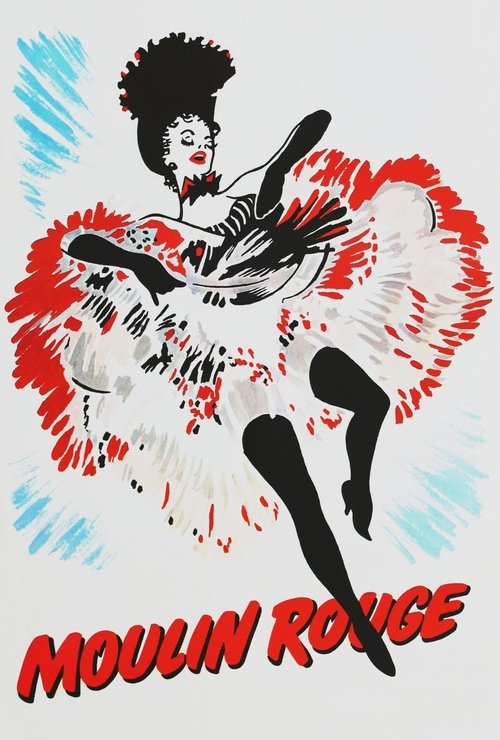
Moulin Rouge
1952 · John Huston
For a rainy-evening watch when you want beauty with a lump in its throat — an artist story to sink into rather than a pick-me-up. Comfort viewing for anyone who loves painted Paris, with a sadness that stays.
What it's about
Paris, 1890s. Henri de Toulouse-Lautrec — an aristocrat whose legs were stunted by a childhood injury — finds his real home in the Moulin Rouge, sketching the dancers, singers, and night people of Montmartre who accept him as the salons never will. Between absinthe and canvases, two very different women offer him a shot at the love he's convinced his body disqualifies him from.
The experience
A melancholy, gorgeous wallow — the cancan sequences burst with life while the story underneath aches with loneliness. It moves at the unhurried pace of a novel, warm on the surface and bruised at the center.
Performances
José Ferrer plays Lautrec largely on his knees, and never lets the physical stunt swallow the man — his Lautrec is proud, wounded, and wickedly witty. He also doubles, briefly, as Lautrec's father.
The craft
John Huston and cinematographer Oswald Morris deliberately muddied and softened Technicolor — smoke, filters, gaslight haze — so the film looks like it was shot inside Lautrec's own posters. The Moulin Rouge scenes are the payoff: color used not to dazzle but to paint, and they sing on a big screen.
Why it matters
Its smoky, painterly color work broke the rules of glossy Technicolor and showed a generation of filmmakers that a biopic could borrow its subject's own eyes. It remains a touchstone for how movies picture Belle Époque Paris.
Snapshot
Moulin Rouge is John Huston's Technicolor portrait of Henri de Toulouse-Lautrec, the aristocratic Post-Impressionist painter and poster artist whose legs were stunted by childhood injury and whose adult life unfolded in the dance halls, brothels, and café-concerts of Belle Époque Paris. Adapted from Pierre La Mure's 1950 best-selling novel, the film is at once a biographical melodrama of thwarted love and a sustained experiment in using color photography to evoke a painter's own palette. José Ferrer plays Lautrec (and, in a brief dual role, his father), performing much of the part on his knees to approximate the artist's height. The picture is most consequential not for its rather conventional dramatic arc but for its visual ambition: working with cinematographer Oswald Morris, Huston deliberately muted and "dirtied" Technicolor's famously saturated emulsion to summon the smoky, gaslit world Lautrec painted. It won Academy Awards for art direction and costume design and helped license a more expressive, less naturalistic use of color in mainstream filmmaking.
Industry & production
Moulin Rouge was a British production financed by Romulus Films, the London company run by brothers John and James Woolf, with John Huston's own Moulin Productions involved and release handled by United Artists. The arrangement was characteristic of the early 1950s, when American directors and stars increasingly worked abroad — partly to access frozen overseas earnings and favorable financing, partly to escape the pressures of the Hollywood studio system and the political climate of the blacklist era. Huston had recently relocated his base of operations to Europe and would soon settle in Ireland; Moulin Rouge belongs to this expatriate phase of his career, following The African Queen (1951), another Romulus-backed venture.
Principal photography took place largely in England (Shepperton Studios) with location work in Paris. The production assembled a notably international, art-forward crew: French painter and designer Marcel Vertès oversaw costumes and the pictorial recreation of Lautrec's milieu, art director Paul Sheriff designed the sets, and French composer Georges Auric — a veteran of the avant-garde "Les Six" and of Cocteau's films — wrote the score. The casting reflected the same cosmopolitan reach, pairing the American Ferrer with French dancer-actress Colette Marchand and Hungarian-American Zsa Zsa Gabor. The film was a commercial success on release, and its theme song became a popular hit, extending the picture's reach well beyond cinemas.
Technology
The film was shot in three-strip Technicolor, and its central technological story is one of working against the format's defaults. Standard Technicolor practice favored bright, high-key, fully saturated color — the "glorious Technicolor" of musicals and costume spectacle. Huston wanted the opposite: the diffused, desaturated, smoke-veiled tonalities of Lautrec's posters and oils. To get there, the production employed heavy diffusion and fog filtration, colored smoke and gels on set, and careful control of lighting to soften and gray the image. The standard accounts of the film's making hold that the Technicolor company's technical consultants resisted these manipulations, which violated their house standards; the conflict between filmmaker and the format's institutional gatekeepers is itself part of the film's historical significance. The achievement was as much a matter of negotiating an industrial process as of artistry, and it stands as an early, prominent demonstration that Technicolor could be bent toward atmosphere and mood rather than chromatic display.
Technique
Cinematography
Oswald Morris's photography is the film's most enduring contribution. The celebrated opening — a long sequence inside the Moulin Rouge itself, sweeping through the crowd, the can-can dancers, and the gaslit haze — functions as an overture, establishing both the period world and the visual program: warm ambers, dusty reds, and smoke-softened edges that consciously recall Lautrec's own compositions. Morris and Huston used diffusion and filtration to pull the color away from postcard brightness toward something closer to pastel and lithograph. The strategy was not uniform; the film modulates between the heightened theatricality of the dance hall and the cooler, drabber registers of Lautrec's domestic and emotional life, so that color tracks mood. Morris, who would go on to a major career (including the deliberately muted Moby Dick with Huston and much later Fiddler on the Roof), later regarded the film as a formative experiment in expressive color, and it is routinely cited in histories of cinematography as a landmark in non-naturalistic color design.
Editing
Ralph Kemplen's editing earned an Academy Award nomination, and its most discussed passages are the bravura set pieces rather than the dramatic connective tissue. The opening music-hall sequence depends on editing to choreograph spectacle into legibility, cutting among dancers, spectators, and Lautrec's observing eye. Elsewhere the film uses montage to compress the passage of time and the rhythm of Lautrec's working life and decline. The dramatic scenes are cut in a relatively classical, unobtrusive manner consistent with early-1950s prestige filmmaking, so that the editing's visibility is concentrated in the spectacle sequences and transitions.
Mise-en-scène / staging
The film's design is its argument. Vertès and Sheriff reconstructed Belle Époque Paris not as documentary fact but as Lautrec saw and drew it, so that sets, costumes, and framing frequently echo specific pictorial conventions of his work. The recurring motif is the tableau: characters and crowds are arranged to rhyme with the flattened, poster-like compositions of Lautrec's lithographs, and the film repeatedly stages Lautrec as an observer positioned at the edge of the frame, looking in on a gaiety he records but cannot fully share. Costume functions here as more than period dressing; the silhouettes of Jane Avril and the dance-hall women are staged to become the images Lautrec would immortalize. This integration of décor, costume, and composition is why the picture's art direction and costume design, rather than its screenplay, carried off its Oscars.
Sound
Georges Auric's score grounds the film in period idiom while supplying its emotional commentary, moving between the brassy energy of the dance hall and a more melancholy lyricism for Lautrec's private suffering. The film's best-remembered musical element is the song commonly known as "Where Is Your Heart" (the song from Moulin Rouge), with Auric's melody and English lyric by William Engvick, which became a substantial popular hit and gave the film an afterlife on radio and record independent of the picture. The diegetic music and ambient clamor of the Moulin Rouge are integral to the opening's immersive effect, the soundscape working with the imagery to plunge the viewer into the milieu.
Performance
José Ferrer's Lautrec is the film's dramatic center and its most demanding technical feat. To convey the artist's stunted stature, Ferrer performed many scenes on his knees, with concealed apparatus and trick staging substituting for his lower legs — a physically punishing approach that the film deploys without turning it into spectacle. Ferrer underplays where the material might invite self-pity, giving Lautrec a wry, wounded dignity, and he doubles briefly as the artist's imperious father. Colette Marchand, as the streetwalker Marie Charlet whose cruelty scars Lautrec, earned an Academy Award nomination for Best Supporting Actress and supplies the film's hardest emotional edges. Zsa Zsa Gabor appears as the dancer Jane Avril, though her singing voice was dubbed. The surrounding performances honor the conventions of mid-century prestige melodrama; it is Ferrer's restraint that keeps the film from tipping into bathos.
Narrative & dramatic mode
The film operates as a romantic tragedy framed by retrospection: it opens in the Moulin Rouge at the height of Lautrec's nocturnal world and structures his story around two destructive or unfulfilled relationships — the degrading affair with Marie Charlet and the later, gentler but equally doomed attachment to Myriamme. Its dramatic mode is the artist-biopic as melodrama of unrequited love, organizing a life around emotional wounds and the compensations of art. The screenplay by Anthony Veiller and Huston compresses and fictionalizes La Mure's novel, smoothing biography into a clean arc of love sought, love lost, and decline into drink and early death. The result privileges feeling and atmosphere over historical granularity; where the film is thin as biography, it is rich as mood, and it knows it.
Genre & cycle
Moulin Rouge belongs to the mid-century cycle of prestige artist-biopics — films that dramatized the lives of painters and composers as conflicts between genius and personal anguish. Within that cycle it is distinguished by its commitment to translating its subject's visual style into the film's own form, a strategy that links it forward to Vincente Minnelli's Lust for Life (1956). It also sits within the broader category of the lavish period costume drama of the early 1950s, and within the expatriate-American strand of European-financed prestige pictures. Its blending of biographical melodrama with quasi-musical spectacle (the dance-hall numbers) makes it a hybrid that resists neat classification.
Authorship & method
The film is a meeting of strong authorial sensibilities. John Huston had trained and worked as a painter before becoming a filmmaker, and Moulin Rouge is the most direct expression of that vocation in his career — a film about how an artist sees, made by a director consciously chasing painterly effects. Huston's method here was collaborative and experimental, leaning on specialists to realize a unified visual idea. Oswald Morris (cinematographer) was the technical author of the muted-Technicolor look and became, through this and later Huston collaborations, one of the key figures in expressive color photography. Georges Auric (composer) brought a European art-music pedigree and supplied both period color and the hit theme. Ralph Kemplen (editor) shaped the spectacle sequences. Marcel Vertès and Paul Sheriff translated Lautrec's pictorial world into three dimensions. The screenplay was credited to Anthony Veiller and John Huston, adapting Pierre La Mure. The film's authorship is thus genuinely distributed, but unified by Huston's painter's eye.
Movement / national cinema
The film does not belong to a formal movement; it is a transatlantic prestige production rather than the product of a national school. It is best understood within two contexts: the early-1950s migration of American directors to European production (the "runaway" or expatriate phase that also produced The African Queen), and the British film industry's mid-century capacity, through companies like Romulus, to mount internationally ambitious pictures with imported talent. Its subject and much of its design sensibility are French, its financing and crew largely British, and its director and star American — a hybrid typical of the period's cross-border filmmaking rather than of any single cinema's stylistic program.
Era / period
Moulin Rouge arrived in 1952, at a moment when Hollywood was contending with television's rise and reaching for spectacle, scale, and color to differentiate the cinematic experience. Its embrace of Technicolor fits that competitive context, even as its specific use of color runs against the era's high-saturation grain. The film also reflects the period's appetite for tasteful, literary-sourced prestige drama and for the artist-genius narrative. Its expatriate financing reflects the economic and political pressures of early-1950s Hollywood. As a representation of the 1890s, it participates in a mid-century nostalgia for the Belle Époque as a lost world of bohemian glamour and decadence.
Themes
The film's governing theme is the relationship between suffering and art: Lautrec's physical deformity and emotional humiliations are figured as the source of both his isolation and his vision, his canvases the transmutation of pain into beauty. Closely bound to this is the theme of the outsider-observer — Lautrec belongs to the Moulin Rouge precisely because, as a misfit, he can see and record it without being of it. Unrequited and degrading love recurs as the engine of his decline, set against the gaiety of the dance hall in a persistent irony of public spectacle masking private misery. The film also touches the gulf between aristocratic birth and bohemian life, and the self-destructive refuge of drink. Underlying all of it is the question of how the world is seen — a theme the film answers formally as much as dramatically, by making us look at Paris through Lautrec's palette.
Reception, canon & influence
On release the film was a critical and commercial success and a strong awards contender, receiving seven Academy Award nominations — including Best Picture, Best Director (Huston), Best Actor (Ferrer), Best Supporting Actress (Marchand), and Best Film Editing — and winning two, for Art Direction and Costume Design in the color categories. Contemporary praise centered on its visual splendor and Ferrer's performance; the most durable critical reservation, voiced then and since, is that the drama is conventional and sentimental relative to the dazzle of its surfaces, so that the film is admired more as a feat of color and design than as biography or storytelling.
The influences on the film run principally through art history: the posters, lithographs, and paintings of Toulouse-Lautrec himself, and behind him the conventions of French Post-Impressionist art, which the production directly mimicked in composition, costume, and color. Huston's own background as a painter is the personal channel through which that influence reached the screen, and La Mure's novel supplied the narrative armature.
Looking forward, the film's most concrete legacy is its demonstration that color cinematography could be a vehicle for painterly, non-naturalistic expression. Its desaturated, mood-driven Technicolor anticipated and helped license the approach Minnelli and cinematographer would take in Lust for Life (1956), the other great painter-biopic of the decade, and it secured Oswald Morris's reputation as a master of expressive color, a line that continues through his later work. The film made Lautrec and the iconography of the Moulin Rouge fixtures of cinematic Belle Époque imagery; Baz Luhrmann's wholly different Moulin Rouge! (2001) shares the setting and the mythos, if not the method. Within Huston's own filmography, it stands as the fullest expression of his painter's sensibility. Its standing in the canon is secure but specific: it is remembered and studied above all as a landmark in the art and technology of color, the moment a major film proved that the camera could be made to paint.
A Deleuzian reading
Start with the can-can, but watch it the way the film makes you watch it.
The full Deleuzian reading of Moulin Rouge →
Reception
A hit in 1952 — seven Oscar nominations and a Best Picture nod — it's now remembered less as a great biopic than as a landmark in color: cinephiles today praise Oswald Morris's smoky, Lautrec-palette Technicolor while shrugging at the stately story around it.
How Moulin Rouge was received, from release to now →
Influences: the films it descends from and the films it influenced
- Becky Sharp (1935) — The first three-strip Technicolor feature, it pioneered using color symbolically and dramatically rather than as naturalistic record — the founding license for Morris's mood-driven palette.
- Blood and Sand (1941) — Mamoulian keyed each sequence's Technicolor to specific Spanish painters (Velázquez, Goya, El Greco), the direct precedent for subordinating color photography to a painter's palette instead of realism.
- Black Narcissus (1947) — Jack Cardiff's studio-bound Technicolor treated light and saturation as emotional instruments over matte-painting compositions — the expressive-color method Morris extends into desaturation.
- The Red Shoes (1948) — Pairs expressive Technicolor with an extended dance 'spectacle sequence' that dramatizes the artist consumed by art — the exact fusion of theme and pictorial set-piece Huston builds his Lautrec around.
- Henry V (1944) — Stages Technicolor scenes as deliberately flat pictorial tableaux imitating period painting and illuminated manuscript, the strategy of composing the frame as a canvas.
- Lust for Life (1956) — The decade's other painter-biopic explicitly licensed by Moulin Rouge — its Ansco/CinemaScope color was desaturated and graded to match Van Gogh's actual canvases.
- Moby Dick (1956) — Huston and Morris pushed the muted experiment further, printing Technicolor over a black-and-white layer to mute hues toward a whaling-print look — a direct technical sequel to the Moulin Rouge palette.
- The Agony and the Ecstasy (1965) — A prestige artist-biopic (Michelangelo) that frames the act of seeing and making art as spectacle, inheriting Moulin Rouge's 'how an artist sees' premise rendered in widescreen color.
- Reflections in a Golden Eye (1967) — The culmination of the Huston–Morris color collaboration: a deliberately desaturated golden-monochrome tint, extending the expressive-color line Moulin Rouge began.
- Fiddler on the Roof (1971) — Morris used fog and diffusion filters to key the entire film's color to Marc Chagall's paintings, continuing his signature of grounding a film's palette in a named painter.
- Moulin Rouge! (2001) — Inherits the Lautrec/Moulin Rouge iconography and montage-driven spectacle Huston fixed as cinematic Belle Époque, executed through an opposite hyperkinetic editing method.
- Mr. Turner (2014) — Dick Pope's cinematography keys light, color and composition to J.M.W. Turner's own canvases, the late descendant of the painter-biopic that photographs in the subject's pictorial idiom.
- The Man Who Would Be King (1975) — Inaugurates the Huston–Oswald Morris collaboration and their shared technique of chromatic register shifts to signal psychological state: the trajectory Morris employs in TMWWBK — warm ochre as power consolidates in Kafiristan, murky gray-brown in the frame narrative's aftermath — descends from methods first developed here.
- Oliver! (1968) — Cinematographer Oswald Morris first devised his technique of stretching nylon stocking material over the lens to distress and warm the color image at Huston's request, evoking Toulouse-Lautrec's palette; he reprised this exact gauze-diffusion method for Oliver!'s muted-amber period palette, aging the Technicolor image toward painterly authenticity.
- The Great Muppet Caper (1981) — Morris's early experiments with fog filters and heavily colored, expressionist light established the palette-as-mood method he continued to deploy for Henson.
- The Wiz (1978) — Oswald Morris's fog filters and colored smoke pumped onto set to bend Technicolor toward Toulouse-Lautrec lithography — the origin of his practice of keying an entire film's palette to a prior visual source, applied here to graffiti-era New York.
- An American in Paris (1951) — Its climactic ballet is staged as a series of living French paintings (Dufy, Renoir, Toulouse-Lautrec), the same year demonstrating cinema reconstructing Post-Impressionist canvases in three dimensions.
- The Tales of Hoffmann (1951) — A 'composed film' that builds operatic spectacle entirely from painterly Technicolor tableaux, sharing the impulse to dissolve narrative into designed pictorial set-pieces.
- French Cancan (1955) — Renoir (son of the painter) renders the same Belle Époque Moulin Rouge milieu in an Impressionist palette and builds to a can-can finale staged as kinetic spectacle.
- The African Queen (1952) — Cardiff and Huston's same-year Technicolor collaboration, using desaturated impressionist color to simulate Toulouse-Lautrec's palette — the two 1952 releases form a paired demonstration of what Cardiff could achieve across opposite registers under one director-cinematographer partnership.
Similar films
- Moulin Rouge! (2001) — influence & lineage · same viewing thread
- The Red Shoes (1948) — influence & lineage
- Black Narcissus (1947) — influence & lineage
- Jules and Jim (1962) — shared sensibility
- The African Queen (1952) — shared sensibility
- Le Plaisir (1952) — shared sensibility
- The Artist (2011) — shared sensibility
- Looking for Langston (1989) — shared sensibility
All the films related to Moulin Rouge →
Watch it with: curated runs of related films
- Love as a Wrecking Ball — Watch these when you want desire pushed all the way to self-destruction — affairs and infatuations that leave nothing standing.