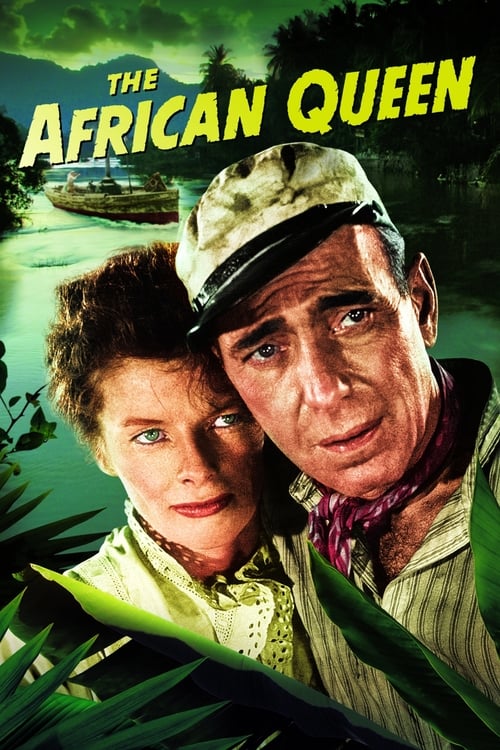
The African Queen
1952 · John Huston
For a cozy night in when you want banter, romance, and an old-fashioned adventure that actually delivers — pure comfort, zero homework.
What it's about
At the outbreak of the First World War, deep in the African interior, a gin-soaked riverboat captain gets talked into an absurd mission by a prim, iron-willed missionary: take his leaky little steam launch down a dangerous river and strike a blow against a German warship. What starts as a mismatched partnership of convenience — he's all sweat and bluster, she's all starch and scripture — turns into something neither of them saw coming, with rapids, insects, and an empire's navy in the way.
The experience
Warm, funny, and genuinely adventurous — you spend most of it grinning at two stubborn people slowly discovering they like each other, then gripping your seat when the river turns mean. It's a comfort watch with real stakes.
Performances
Humphrey Bogart, scruffy and endearing as the captain Charlie Allnut, won his only Oscar for this, and Katharine Hepburn matches him beat for beat as the missionary Rose — the whole film is basically the two of them sparring and softening on a tiny boat, and it never gets old.
The craft
John Huston shot it on location in equatorial Africa when almost nobody did that, and you can feel it — the heat, the mud, the real river are all on screen in rich Technicolor photographed by Jack Cardiff. The production itself was famously grueling, and that hard-won authenticity gives every scene texture a backlot never could.
Why it matters
It's the definitive template for the bickering-couples adventure — two opposites thrown together on a journey who fall for each other — and it cemented Bogart and Hepburn as legends while proving location shooting could be worth the misery.
Snapshot
John Huston's The African Queen is a late-classical Hollywood adventure-romance shot almost entirely on location in equatorial Africa, pairing two of the era's most distinctive screen presences — Humphrey Bogart and Katharine Hepburn — as an unlikely couple who navigate a leaky steam launch down a German-patrolled river during the opening weeks of the First World War. Shot in Technicolor by Jack Cardiff and produced independently by Sam Spiegel under the Horizon Pictures banner, the film is simultaneously a studio-era genre picture and a document of production heroism: the cast and crew endured dysentery, insects, heat, and logistical near-collapse in what was then the Belgian Congo and Uganda. It earned Bogart his only Academy Award and lodged itself permanently in the canon as the definitive template for the bickering-couple adventure romance. Its downstream influence extends into the blockbuster era and beyond.
Industry & production
The project originated with C.S. Forester's 1935 novel, which passed through several hands — including Warner Bros., which held the property for a period — before producer Sam Spiegel secured the rights and partnered with Huston to make it through their independent company, Horizon Pictures. The deal was structured for release through United Artists, placing the film squarely in the postwar independent-production movement that was restructuring Hollywood's relationship between studios and talent. Huston and Spiegel (who at this point was still occasionally billing himself as "S.P. Eagle") operated with a producer-director partnership that gave Huston unusual creative latitude while Spiegel navigated financing, which was precarious throughout.
The decision to shoot almost entirely on location in Africa was commercially risky and logistically punishing. Principal photography took place in the Belgian Congo (present-day Democratic Republic of Congo) and Uganda in 1951, supplemented by studio work at Shepperton in England. The African river sequences required transporting equipment, cast, and crew into remote jungle terrain with inadequate infrastructure. Nearly the entire company fell seriously ill with dysentery and gastrointestinal infections; Huston's celebrated boast that he and Bogart remained healthy by subsisting primarily on Scotch and bourbon is well-documented in Hepburn's own account of the production, though the epidemiology should be taken with appropriate skepticism. Katharine Hepburn later wrote a memoir about the shoot — The Making of The African Queen: Or, How I Went to Africa with Bogart, Bacall and Huston and Almost Lost My Mind (1987) — that remains one of the most candid first-person accounts of classical Hollywood location filmmaking.
The film's budget was constrained, and Spiegel's fundraising improvisations were a constant background drama. The production stands as an early proof of concept that prestige adventure cinema could be made outside the major studio system with the right stars and a willingness to endure physical hardship.
Technology
Jack Cardiff shot The African Queen in three-strip Technicolor, the dominant color system of the period and the one with which Cardiff had already earned his reputation on Powell and Pressburger's Black Narcissus (1947) and The Red Shoes (1948). Three-strip Technicolor demanded large, cumbersome cameras and specific lighting ratios that were extraordinarily difficult to manage in the field; the fact that Cardiff achieved the film's rich, humid visual texture under jungle conditions is a significant technical accomplishment.
The boat sequences posed particular challenges: the Queen herself was a real steam-powered vessel operating on actual rivers, requiring the camera crew to work on a moving, rocking platform with no capacity to control ambient light. Some of the more intimate two-shot coverage was achieved with the boat on a tank or through supplementary studio work at Shepperton, but the location material imparts a textural authenticity — the river's surface, the encroaching vegetation, the quality of equatorial light — that studio approximation could not have replicated.
The film also sits at an early moment in what would become a sustained shift toward location shooting in the 1950s, as wide-screen formats and television competition pushed Hollywood to offer spectacles of genuine geographical difference. The African Queen predates CinemaScope (introduced in 1953) and was shot in the standard 1.37:1 Academy ratio, but its emphasis on exotic environment as commercial selling point anticipates the logic of location spectacle that would define the decade.
Technique
Cinematography
Cardiff's work on The African Queen is less overtly painterly than his Powell-Pressburger collaborations — the material demands documentary-adjacent directness rather than stylized expressionism — but it is no less considered. He uses the lush green of the riverine jungle as a saturated, almost suffocating backdrop against which the battered steel of the boat and the weathered faces of the two leads register with clarity. The light is warm and directional in the open-river sequences, creating a quality of equatorial glare that feels physically accurate; in the overhanging vegetation sections, he moves into cooler, dappled shadow. Cardiff's handling of the two-shot compositions on the boat is particularly accomplished: the confined deck becomes an intimate arena in which small shifts in physical proximity register as emotional events.
Editing
Ralph Kemplen edited the film. The editing approach is classical in the strongest sense — invisible cutting in the service of performance and narrative momentum, with pacing calibrated to Huston's preference for letting scenes breathe rather than cutting for artificial rhythm. The rapids sequences are cut with more urgency, but even there the editing serves spatial clarity over kinetic stimulation. The film's rhythm is fundamentally governed by its dialogue scenes, and Kemplen's cutting respects the actors' work rather than fragmenting it.
Mise-en-scène / staging
Huston's staging method on The African Queen is defined by spatial constraint turned to expressive advantage. The boat's deck is tiny; nearly the entire central section of the film unfolds in a space that could fit in a modest living room. Rather than disguising this, Huston foregrounds it, letting the physical proximity of Allnut and Rose enact the narrative of enforced intimacy and gradual attachment. He is attentive to the hierarchy of foreground and background — who occupies which position, who moves and who is still — as a continuous dramatization of the power dynamic between the characters. His staging is also notably untheatrical in its avoidance of conventional shot-reverse-shot patterns in favor of two-shot compositions that keep both characters in frame simultaneously, a choice that honors the film's essential subject: the negotiation between two specific people.
Sound
The film's sound design makes active use of the river environment — the churn of the engine, the rush of water, the ambient noise of the jungle — as a kind of continuous underscore beneath the dialogue. The mechanical sounds of the African Queen herself acquire a quasi-characterological function over the course of the film. Allan Gray composed the orchestral score, which is applied sparingly and tends toward the conventionally romantic in the film's later sections; the score is not the film's strongest element, and the more memorable moments of the soundtrack are often the location ambience rather than the composed music.
Performance
Humphrey Bogart's Charlie Allnut won him the Academy Award for Best Actor, and the performance merits the recognition. It is a significant departure from the existential cool that characterized his iconic Warner Bros. roles: Charlie is physically ungainly, socially uncertain, emotionally transparent in ways Bogart's persona had previously never permitted. The performance is calibrated to the comic-romantic register without losing the character's underlying dignity. Hepburn's Rose Sayer, for which she received a nomination, is the film's moral and dramatic engine — rigid, principled, ultimately transformative of Charlie and transformed by him. The actresses' own account suggests that she and Huston clashed over the interpretation, with Hepburn drawing on Eleanor Roosevelt as a model for Rose's particular brand of high-minded conviction. The chemistry between Bogart and Hepburn is not sexual in any heated sense but is grounded in mutual respect and amusement — an adult register that the film's romantic arc ultimately earns rather than assumes.
Narrative & dramatic mode
The film follows a classic journey structure — a bounded itinerary with escalating obstacles — overlaid on a conversion narrative: the rough man refined, the prim woman loosened, both changed by proximity and shared ordeal. The dramatic mode is essentially comedic in the Shakespearean sense, moving toward integration and union despite initial incompatibility. The war plot provides the external stakes (the Louisa, the German gunboat), but the central conflict is entirely interpersonal and internal. Forester's novel is somewhat darker and more ironic in its resolution; Huston and James Agee's screenplay pushes toward a warmer, more affirmative ending that fits the Hollywood genre context without entirely abandoning the material's undertow of mortality and chance.
The narrative's unusual quality is its willingness to take time — extended sequences of the boat navigating river obstacles, long passages of conversation, a courtship that unfolds through argument and compromise rather than romantic declaration. This deliberate pacing was characteristic of Huston's trust in his material and his actors.
Genre & cycle
The African Queen belongs to the romantic adventure, a genre whose roots in Hollywood reach back through the 1930s to the swashbuckler and the screwball comedy. Its specific configuration — two mismatched adults, exotic setting, journey structure, comedy of manners in extremis — occupies a particular niche: the prestige romantic adventure aimed at adult audiences rather than the more kinetically juvenile adventure pictures of the period. It belongs to a postwar cycle of location-shot adventure films that includes King Solomon's Mines (1950) and anticipates the British-inflected adventure productions of the mid-1950s, including The Bridge on the River Kwai (1957), which Sam Spiegel also produced.
The film can also be placed within a cycle of independent productions circulating through United Artists in the late 1940s and early 1950s that were leveraging star power and distinguished source material to compete with the major studios without studio overhead. This cycle includes several Huston films and was a significant force in restructuring the industry before the full consolidation of the package-unit system.
Authorship & method
John Huston is the film's dominant creative force, and The African Queen is central to any account of his authorship. Huston's career was defined by literary adaptation — he was consistently drawn to novels and stories with strong narrative and moral architecture — and by a preference for location shooting that verges on adventurism. His method with actors was to cast well and then trust them; his rehearsal approach was relatively minimal by the standards of the period, and he was disinclined toward the kind of psychological actor-coaching associated with Method directors. His co-authorship of the screenplay with James Agee is significant: Agee was among the most respected film critics in America (he wrote for The Nation and Time), a poet, and a novelist (A Death in the Family), and his work on the screenplay brings a literary sensibility to the dialogue that is essential to the film's tonal achievement. Agee's health deteriorated seriously during the collaboration, and the extent of his contribution versus Huston's is a matter that accounts differ on.
Jack Cardiff is as much a co-author of the film's visual identity as any director of photography in the period. Cardiff brought to the project not only technical mastery of Technicolor under adverse conditions but a painter's intuition about color as an expressive rather than merely documentary medium. Sam Spiegel's producing role should not be underestimated: his ability to hold the production together financially and logistically, and his subsequent career producing some of the most ambitious films of the 1950s and 1960s, suggests a producing intelligence of the first order, however opaque the specifics remain.
Movement / national cinema
The African Queen is neither straightforwardly American nor British, which is part of what makes it a useful marker of the early 1950s transition in transatlantic production. It was financed through an Anglo-American independent arrangement, shot largely in Africa and at a British studio (Shepperton), with a British cinematographer and British crew members alongside American stars and director. Its release through United Artists placed it in the American distribution market as essentially a Hollywood film, but its production context is better understood as part of the growing postwar traffic in Anglo-American co-productions that would define prestige cinema through the 1950s and into the 1960s.
The film's relationship to colonial Africa is worth noting critically: the African landscape is rendered as spectacle and obstacle, and African characters are marginal to absent from the narrative's imaginative attention. This is consistent with the period's conventions, but it is a genuine limitation that later scholarship has appropriately addressed.
Era / period
The film arrives at a transitional moment in Hollywood history: the studio system's vertical integration was being dismantled by the 1948 Paramount antitrust decision, television was beginning to erode theatrical audiences, and the industry was experimenting with wide-screen, 3D, and location spectacle as countermeasures. The African Queen anticipates several of these responses — it is in color when much of television was not, it offers a geographical spectacle unavailable to the small screen, and its star-driven package-unit production model was becoming the template for how the industry would operate in the decade to come.
Themes
The film's central thematic concern is transformation through adversity and intimacy — specifically the mutual civilizing-and-liberating dynamic between its two leads. Rose's rigid moralism is not mocked but gradually complicated; Charlie's slovenliness is not merely corrected but enlivened and directed. The film proposes that genuine character change is possible between adults, and that it occurs through the particular friction of close quarters and shared purpose rather than through declaration or desire. War provides the backdrop but is essentially instrumental: it is what puts Charlie and Rose in the same boat and gives their journey an external rationale. The film is not seriously interested in the ethics or history of the First World War in Africa.
Beneath the romantic comedy surface runs a quieter interest in mortality and improbability: the plan to torpedo the Louisa is objectively suicidal, and the film does not entirely suppress this awareness. The ending's providential rescue has the quality of a lucky accident rather than earned triumph, which gives the film's affirmation a slightly rueful undertone consistent with Huston's broader worldview.
Reception, canon & influence
Backward influences: C.S. Forester's novel is the primary source and shapes the film's narrative architecture. The romantic-comedy tradition — particularly the screwball couple dynamic as refined through films like It Happened One Night (1934) — provides the genre grammar. Huston's own prior adventure films, including The Treasure of the Sierra Madre (1948), establish thematic preoccupations with male character under pressure that The African Queen reframes in a romantic key.
Critical reception: The film was a significant critical and commercial success on release. Bogart's Oscar was widely regarded as belated recognition of a career achievement as much as a reward for this specific performance. Hepburn's nomination confirmed the film's standing as serious adult entertainment rather than mere genre product. Huston received a directing nomination, and James Agee received one for adapted screenplay — the combination of nominations signaling that the industry recognized the film across multiple dimensions of achievement.
Legacy and forward influence: The African Queen established or consolidated several templates that persist into contemporary cinema. Its configuration of the bickering-couple adventure romance — physical comedy, enclosed space, gradual attraction through argument — can be traced forward through Romancing the Stone (1984), elements of the Indiana Jones cycle, and numerous subsequent adventure-romance hybrids. Its demonstration that location authenticity in an exotic setting could be both commercially viable and artistically valuable helped prepare the ground for the ambitious location productions of the 1950s and 1960s, including Sam Spiegel's own subsequent productions (Kwai, Lawrence of Arabia). Cardiff's Technicolor work in the field contributed to a body of practice that influenced cinematographers working in color through the decade.
The film occupies a stable place in the critical canon — regularly cited in discussions of Huston's career, of Bogart's range, of Cardiff's cinematography, and of the Hollywood adventure genre — without generating the kind of intense scholarly controversy that attaches to more formally radical films. It is, in the most honorable sense, a film that does exactly what it intends, does it with exceptional skill, and repays repeated viewing. Its position in the cultural memory is reflected in the frequency with which its central image — the battered little boat, the unlikely couple, the vast indifferent river — is invoked as an archetype of adventure-romance cinema.
A Deleuzian reading
Picture the deck.
The full Deleuzian reading of The African Queen →
Reception
A hit on release — it won Bogart his only Oscar — and it never really fell out of favour; the shift is that the legend of its hellish location shoot has grown so large it now competes with the film itself.
How The African Queen was received, from release to now →
Influences: the films it descends from and the films it influenced
- Black Narcissus (1947) — Jack Cardiff developed his core Technicolor methodology here — saturated color fields against which faces register intimately, simulated directional natural light, and two-shot compositions in confined spaces — techniques he carried directly into The African Queen four years later.
- It Happened One Night (1934) — Capra established the bickering-couple conversion narrative: a prim, self-possessed woman and a rough, competent man forced into a shared physical journey, their antagonism converting to love through proximity and mutual testing — the exact generic template Huston transplants to the African river.
- Treasure of the Sierra Madre (1948) — Huston's immediate precursor: location shooting in arduous foreign terrain (Mexico), a small ensemble under physical and moral duress, and his preference for performance that registers against the environment rather than against studio artifice — the methodology that made The African Queen logistically conceivable.
- Stagecoach (1939) — Ford's template for the prestige adventure using a moving vehicle as crucible for ensemble character — spatial constraint of the coach as intimate arena, classical invisible cutting achieving both action clarity and emotional intimacy, UA independent-release model — all inherited wholesale by Huston.
- The Philadelphia Story (1940) — Hepburn's against-type performance model: the rigid, controlled woman whose self-possession is exposed as a defensive posture by external pressure, then rebuilt on more generous terms — the arc Huston explicitly recruited by casting her as Rose Sayer.
- To Have and Have Not (1945) — Hepburn's Rose performs the Hawksian woman's structural function — using moral insistence rather than erotic pressure to transform the reluctant male professional — and Bogart's Charlie Allnut extends Harry Morgan's arc of the cynical loner drawn into heroism by a woman who refuses to accept his self-presentation as a limitation.
- Moby Dick (1956) — Huston's direct continuation of the location-literary-adaptation methodology: shooting on real ocean water with practical vessels off Ireland and the Canaries, against-type casting (Gregory Peck as Ahab), and physical crew suffering as mythologizing production element — the aesthetic of difficulty descended from African Queen.
- The Bridge on the River Kwai (1957) — Sam Spiegel produced both films; the craft debt is structural — the Anglo-American independent prestige model, UA release, location shooting in difficult tropical terrain (Ceylon), and wartime engineering as narrative spectacle. Spiegel applied the African Queen blueprint at expanded scale.
- Apocalypse Now (1979) — The river-journey structure aboard a practical military vessel through increasingly strange jungle terrain, with the confined boat crew as character crucible and the river as spatial metaphor for moral descent — and a production mythology of location suffering that explicitly echoes African Queen's legacy.
- Fitzcarraldo (1982) — Herzog shot on real Amazon tributaries with a functional steam vessel, citing African Queen's production methodology by name; the craft debt is direct — practical river craft on actual jungle waterways, with the vessel's operation under extreme conditions as both subject and method, and the director's own physical endurance as authenticating gesture.
- Romancing the Stone (1984) — The bickering-couple adventure romance template transplanted to Colombia: a prim woman and a rough competent man forced through jungle terrain, their hostility converting to romance through shared physical danger — Zemeckis deploys African Queen's genre grammar self-consciously as the film's structural premise.
- Out of Africa (1985) — The African colonial prestige romance with a self-possessed woman transformed by experience in foreign terrain; David Watkin's cinematography treats the landscape with the same documentary-adjacent directness Cardiff used in equatorial Africa, and the female character arc through colonial adversity inherits African Queen's model directly.
- The Mission (1986) — South American jungle rivers as both practical location and symbolic terrain for moral transformation; Chris Menges's cinematography extends the African Queen tradition of treating extreme tropical environments with documentary directness, while the prestige literary-historical subject requiring real jungle logistics follows the same Anglo-American coproduction template Spiegel pioneered.
- The Man Who Would Be King (1975) — Establishes Huston's two-hander method — mismatched leads generating genuine chemistry through shared location duress — which Connery and Caine inherit directly, including the tonal architecture of comic incongruity giving way to mortal stakes without losing the comedy's earned goodwill.
- The Quiet Man (1952) — Ford's contemporaneous Technicolor location romance — prestige stars in an exotic foreign setting, bickering courtship under spatial constraint, and three-strip Technicolor used for saturated landscape as commercial spectacle — an exact generic and technological parallel released the same year.
- Moulin Rouge (1952) — Cardiff and Huston's same-year Technicolor collaboration, using desaturated impressionist color to simulate Toulouse-Lautrec's palette — the two 1952 releases form a paired demonstration of what Cardiff could achieve across opposite registers under one director-cinematographer partnership.
- Beat the Devil (1953) — The immediate companion piece: Bogart again under Huston, location shooting in Italy, Truman Capote replacing Agee as literary collaborator, and the same template of mismatched characters forced into comic complicity by a picaresque adventure — made with much of the same creative team directly after.
Similar films
- Out of Africa (1985) — influence & lineage
- Moulin Rouge (1952) — influence & lineage
- The Bridge on the River Kwai (1957) — influence & lineage
- It Happened One Night (1934) — influence & lineage
- Fitzcarraldo (1982) — influence & lineage
- The Philadelphia Story (1940) — influence & lineage
- To Have and Have Not (1945) — shared sensibility
- The Treasure of the Sierra Madre (1948) — shared sensibility