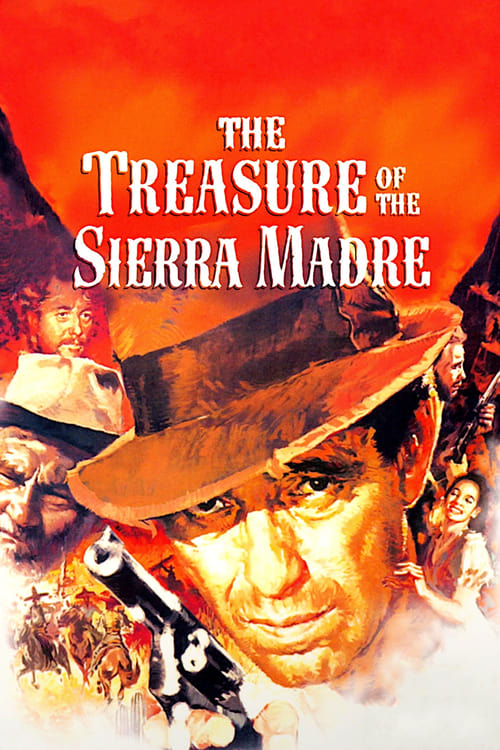
The Treasure of the Sierra Madre
1948 · John Huston
For when you want a classic adventure with real teeth — a campfire story about money and trust that you'll be arguing about at breakfast. Comfort-food filmmaking on the surface, moral gut-punch underneath.
What it's about
Two broke Americans drifting through 1920s Mexico team up with a grizzled old prospector and head into the Sierra Madre mountains to dig for gold. The mountains give them what they came for — and then the real trouble starts, as bandits circle the camp and the three partners begin eyeing each other over the growing pile of dust. Humphrey Bogart plays Dobbs, the drifter whose luck finally turns, for better and worse.
The experience
It starts as a rousing adventure and tightens, almost imperceptibly, into something much darker — you watch a man talk himself into paranoia one campfire at a time. Tense, ironic, and grimly funny, with an ending note that lands like a verdict.
Performances
Humphrey Bogart goes further against his own charm than he ever did, curdling from likable underdog into a man eaten alive by suspicion. Walter Huston, the director's father, won an Oscar as the wiry old prospector who's seen it all before — his jig of delight is one of the most infectious moments in classic Hollywood.
The craft
John Huston shot much of it on rough location in Mexico when studio pictures rarely left the backlot, and the dust and heat get into everything. The screenplay (also Oscar-winning) is a machine of escalating irony — every stroke of luck sets up the next disaster — and Huston directs it with a fable-teller's patience.
Why it matters
Won three Academy Awards, all to Hustons — the first time a director steered a parent to an Oscar — and became the template for stories where treasure destroys the people who find it. Its lines and its arc have been echoed and parodied for seventy years.
Snapshot
John Huston's adaptation of B. Traven's novel is one of American cinema's most searching moral fables — a three-man study in the pathology of greed set against the unforgiving landscape of Mexico. Humphrey Bogart plays Fred C. Dobbs, a down-and-out American drifter in Tampico who talks his way into a gold-prospecting venture with fellow vagrant Curtin (Tim Holt) and the weathered old sourdough Howard (Walter Huston, John's father). What begins as an adventure narrative dissolves, methodically and almost cruelly, into psychological portrait of a man consumed by suspicion until nothing remains of him but the fear itself. The film won three Academy Awards — Best Director, Best Supporting Actor, and Best Adapted Screenplay — all going to Hustons, making John the first filmmaker to direct a parent to an Oscar. It remains a touchstone of Hollywood classicism at its most morally ambitious, a film that wears the clothes of a genre adventure while quietly dismantling every consolation that genre provides.
Industry & production
Warner Bros. produced the picture under Henry Blanke, a producer who had shepherded several of the studio's prestige literary adaptations. Huston had been a rising force at Warners since The Maltese Falcon (1941) and wielded sufficient clout to insist on extensive location filming in Mexico — an unusual decision for the period and one that gave the film a textural authenticity rare in Hollywood productions of the era.
The source novel had a peculiar history. B. Traven published Der Schatz der Sierra Madre in German in 1927; the English translation appeared in 1935 and attracted Huston's attention sometime thereafter. Traven was himself a figure of deliberate obscurity — his identity was never definitively established, though he was widely believed to be a German-born anarchist writer. During production, a man named Hal Croves appeared on location claiming to be Traven's agent and representative; most who met him suspected he was Traven himself, but he never confirmed it. This shadow over the film's origins — a major Hollywood production made from a novel by a man who may not have existed under that name — lends the enterprise a faint strangeness that feels appropriate to the material.
Humphrey Bogart's casting was itself a calculated risk. By 1947 he was one of Hollywood's biggest stars, his persona firmly established through the Warners crime cycle and his collaborations with Howard Hawks. Dobbs is a profoundly unglamorous role: vain, paranoid, morally corrosive. Bogart accepted the challenge with apparent relish.
Technology
The decision to shoot substantially on location in Mexico — primarily in the Durango highlands and around the town of San José Purúa — placed real technical demands on the production. The altitude, the heat, and the unfamiliar terrain required the crew to adapt equipment and workflow to conditions outside the controlled studio environment. Natural light sources were exploited rather than fought, contributing to a sun-scorched visual register that studio photography would have been hard-pressed to replicate. The production also incorporated sequence work at Warner Bros. in Burbank for interior and night scenes, creating a composite geography that, at its best, reads as seamless.
The period had no lightweight cameras, no portable synchronous-sound rigs, no fast film stocks suited to harsh exteriors. That the film achieves the sustained naturalism it does under those conditions is a testament to the logistical and technical ingenuity of both cinematographer Ted McCord and the Warners production infrastructure.
Technique
Cinematography
Ted McCord's work on the film is systematic and restrained — functional in the deepest sense, designed to subordinate visual flourish to environment and character. The Mexican locations are rendered in a high-contrast monochrome that turns sunlight into a presence of its own: bleaching the landscape, throwing faces into relief, stripping the world of softness. McCord keeps the camera relatively close to his actors in moments of psychological pressure, and pulls back to wide shot at moments of ironic or cosmic distance — a pattern that reaches its terminal expression in the final sequence, where the camera watches from a remove as the gold dust disperses into the air. This spatial grammar of proximity and distance reflects the film's central argument: that human greed is both intimate and absurd, micro and panoramic at once.
The film avoids the expressionist chiaroscuro associated with contemporaneous noir, opting instead for a harder-edged, documentary-influenced realism. Shadows do not pool decoratively; they fall where the sun puts them.
Editing
Owen Marks edited the film, working in the invisible classical style then dominant at Warners. The editing's chief contribution is temporal — it manages pace across a film structured in three distinct registers. The Tampico opening is relatively brisk, establishing character and situation efficiently; the mining sequence develops in something closer to real time, accumulating detail and routine; the final third accelerates as Dobbs's paranoia takes hold, cutting becoming more anxious, scene durations shortening. Marks and Huston do not call attention to this modulation, but it is the structural spine of the audience's growing unease.
Mise-en-scène / staging
Huston's staging is rooted in theatrical precision — he prepared his films carefully, storyboarding key sequences and blocking in detail before shooting. Yet the performances rarely look blocked. His method with actors was to rehearse extensively until the intended behavior felt discovered rather than directed, then photograph it simply. The scene in which Dobbs first voices his suspicions of Curtin is staged around a campfire, the men at different elevations in the frame, the firelight creating a warm unreliability — the visual warmth and the moral chill in pointed contrast. Howard's celebrated jig, performed by Walter Huston after the gold is found, is staged in wide shot with almost no cutting, letting the old man's physical joy become its own argument: here is what the treasure looks like before it becomes what it becomes.
The geography of the camp — the hiding places, the watching positions, the lines of sight between men who no longer trust each other — becomes the visual vocabulary of the film's final act. Huston and McCord map paranoia onto physical space.
Sound
Max Steiner composed the score, working in his characteristically full-throated Hollywood idiom. The music is arguably the least original element of the film — Steiner's scoring is serviceable and occasionally effective, particularly in the more overtly adventurous passages, but it belongs to a convention the film elsewhere subverts. The Tampio scenes, the mountain silences, the physical exhaustion of the mining work — these would have carried considerable dramatic force scored more sparingly or not at all. The record does not, to this writer's knowledge, document significant disputes between Huston and Steiner over the approach, though Huston's later career suggests an increasing preference for musical restraint.
The naturalistic sound design — pickaxes against rock, wind, the dry crackle of the desert — is used with more imagination than the score, and does more to locate the audience in the landscape.
Performance
The film contains three central performances of marked and different quality. Walter Huston's Howard is a performance of pure physical intelligence: the old man is wiry, amused, knowing, with a rangy body language that speaks of decades of outdoor life. His is the film's moral center, occupying a position beyond the illusions that destroy Dobbs, and Huston père embodies this wisdom without sentimentality. The Oscar was not a son's favoritism; it was earned.
Tim Holt as Curtin is, by design, the film's steady norm — honest, decent, the audience surrogate. Holt holds his own competently in a role that requires him to be less interesting than the men on either side of him.
Bogart's performance is the most consequential and the most deliberately anti-star. He enters as a familiar type — the Bogart tough — and systematically dismantles that persona. The paranoid speeches in the film's final third, where Dobbs argues with himself and the night, strip away every vestige of cool; what remains is something smaller and sadder than a villain. Bogart understood the risk and took it without apparent vanity. It is among the two or three best things he did.
Alfonso Bedoya's Gold Hat, the bandit leader, delivers the film's most famous line — some variant of "We don't need no stinking badges" — in a performance calibrated to be menacing precisely because it is cheerful. The line has been quoted, misquoted, and parodied into abstraction, but in context it is a small, sharp sketch of violence wearing a grin.
Narrative & dramatic mode
The film's narrative architecture is a moral parable structured as an adventure. It proceeds in three phases corresponding to the three stages of the gold: the quest for it, the finding and extraction of it, and what it does to the men who hold it. Each phase has a different emotional key — aspiration, provisional satisfaction, dissolution — and Huston maintains the forward pressure of genre plotting while allowing the interior deterioration of Dobbs to advance in something approaching real time.
The decisive structural choice is to make Dobbs's paranoia legible to the audience before it is legible to Curtin or Howard: we see him reasoning toward violence, and we cannot intervene. This gap between the audience's knowledge and the characters' is classical dramatic irony deployed not for comedy but for dread. The ending — the gold dust blown to nothing, the Mexican villagers who recover the bags thinking them worthless, Howard remaining behind to tend to the village that has adopted him, Curtin returning north — is among cinema's definitive ironic cadences. The joke is cosmic and the laughter is Howard's, and it is not exactly comfortable.
Genre & cycle
Sierra Madre sits at the intersection of the Hollywood adventure film, the Western, and the moral fable, while fully belonging to none. It is not a Western in the strict generic sense — there are no range wars, no frontier myth — yet it inherits Western landscapes and the genre's long preoccupation with masculinity, solitude, and the limits of individual will. It is an adventure film whose adventure framework is progressively hollowed out by psychological realism until the genre's structural promises — that enterprise and courage will be rewarded — are explicitly revoked.
The film has also been extensively analyzed in relation to film noir, and there is something to this: the paranoid protagonist, the fatal flaw that defeats the hero, the sense that the world is rigged. But noir is primarily an urban, nocturnal form, and Sierra Madre unfolds in harsh daylight and open country. It is better understood as a cousin of noir — sharing certain psychological preoccupations and postwar disillusionment — than as a member of it. Huston would return to noir proper with The Asphalt Jungle (1950), and the comparison illuminates the family resemblance.
Authorship & method
Huston wrote the screenplay himself, as he had for The Maltese Falcon — an auteur practice unusual enough among Hollywood directors of the period to define him. His adaptation of Traven is faithful in situation and theme while tightening Traven's episodic structure into the three-part shape described above. The addition of the lottery ticket scene, in which Dobbs wins a small sum that seeds the expedition, is a screenwriting invention that economically establishes both Dobbs's character (he surrenders part of his winnings to the boy selling tickets) and the film's controlling irony about luck.
Huston's career-long thematic preoccupations are all present: the obsessive quest that ends in failure or absurdity, the male group that coheres under pressure and fractures under temptation, the gap between what men want and what they are capable of sustaining. The Maltese Falcon, Key Largo (1948), The Asphalt Jungle, The Man Who Would Be King (1975), Wise Blood (1979) — the whole filmography circles these materials. Sierra Madre is the first time Huston states them without ironic detachment, and it remains perhaps the starkest expression of his pessimism.
Ted McCord's contribution has already been discussed; it bears adding that his collaboration with Huston was practical and unflashy, a working relationship of mutual subordination to the material rather than a creative tension between director's vision and cinematographer's style.
Movement / national cinema
The film belongs to the late-classical period of the Hollywood studio system, and it is also, in retrospect, an early symptom of the post-studio-era sensibility that would eventually destabilize it. The location shooting, the anti-heroic protagonist, the refusal of generic resolution, the interest in moral psychology over plot mechanics — these are characteristics that align Sierra Madre with Italian neorealism (which was reaching American critics and filmmakers in precisely these years) and with the European art cinema that would reshape American film in the 1960s. Huston himself was not a programmatic modernist; he was a classical craftsman with nihilist convictions. But the film reads, from a later vantage, as a bridge: one foot in the classical Hollywood of Warners genre product, the other pointing toward the New Hollywood that Bonnie and Clyde and Easy Rider would announce twenty years later.
Era / period
1948 was a transitional year for American cinema. The Paramount Decree (issued the same year, following years of antitrust proceedings) would force studios to divest their theater chains, beginning the slow dismantling of the vertically integrated studio system. Television was becoming a genuine competitive threat. Wartime consensus was giving way to Cold War anxiety. The film's mood — its mistrust of aspiration, its portrait of American men abroad as corrosive rather than heroic — resonates against this context. The men in Sierra Madre are not GIs on a mission; they are unemployed drifters in a foreign country, and their enterprise ends in nothing. The postwar interrogation of masculine heroism runs throughout the film.
Themes
Greed is the film's explicit subject and its least interesting theme. The more penetrating argument concerns the relationship between desire and self-knowledge: Dobbs cannot see what he is becoming because he cannot distinguish his fears from the reality around him. The gold does not corrupt him so much as it accelerates what was already present. Howard diagnoses this early: "I know what gold does to men's souls." The film's moral geometry is more fatalist than moralistic — Dobbs is not presented as uniquely wicked, but as a man whose ordinary weaknesses have been given, by circumstance, exceptional power to destroy.
The film is also a meditation on futility in the mode of bitter comedy. The ending — Traven's, faithfully rendered by Huston — is designed to produce a laugh that catches in the throat. All that labor, all that suffering, all those deaths, and the product disperses in an afternoon wind. Howard laughs because he has lived long enough to find this funny. The audience laughs and then sits with what it has laughed at.
A third theme concerns the land itself. Mexico in the film is not an exotic backdrop but an active antagonist and, finally, a kind of judge. The mountain gives up its gold reluctantly and reclaims it without ceremony. Howard's adoption by the indigenous village — his skills as a healer earning him a place the gold could never have purchased — is the film's quietly radical counterproposal to the treasure-hunt narrative: the only fortune that holds is the one that doesn't come from extraction.
Reception, canon & influence
Influences on the film (backward): Traven's novel is the primary source, and its anarchist-inflected critique of capitalism underlies Huston's adaptation. The Western literary tradition of the quest narrative — inflected through Conrad's Heart of Darkness — shapes the psychological deterioration arc. Huston's own Maltese Falcon is a direct predecessor in its anatomy of obsession over a valuable object; the two films make a diptych on the theme. The influence of postwar Italian neorealism — particularly Rossellini's location-realist approach — is a matter of scholarly discussion rather than documented influence; it is plausible that Huston absorbed these methods in the air of the period, but specific documented influence is not firmly established.
Critical and commercial reception: The film received wide critical praise on release, though it was not the commercial phenomenon the studio hoped. Its Academy Awards performance (three Oscars, including the director-parent-to-Oscar feat) solidified its prestige. Subsequent decades have only enhanced its reputation. It was among the early selections to the Library of Congress National Film Registry in 1990, recognizing it as "culturally, historically, or aesthetically significant." AFI placed it consistently on its century-polling lists. Pauline Kael wrote extensively and admiringly about Huston's work in this period, though assessing her precise assessment of Sierra Madre specifically without access to the text is not possible; the film was central to mid-century critical discussions of Huston as a serious auteur.
Legacy (forward): The film's influence runs in several directions simultaneously. The "stinking badges" line — itself a slight misquotation of what Bedoya actually says — became one of the most quoted and parodied lines in cinema, a marker of the film's cultural saturation. More substantively, the film's portrait of American men destroyed by their own acquisitiveness became a template: Paul Thomas Anderson has cited There Will Be Blood (2007) in relation to American obsession narratives that share the film's DNA; Sam Peckinpah's Treasure of the Sierra Madre-adjacent Westerns about men undone by greed and the Mexican landscape owe it a clear debt; the Coen Brothers' work — particularly No Country for Old Men (2007) and Blood Simple (1984) — returns repeatedly to the film's model of greed, fate, and cosmic irony. More broadly, any Hollywood film serious about depicting the corruption of masculine virtue in an adventurous frame works in the shadow of what Huston accomplished here. It is the definitive American film about what wanting too much does to a man.
A Deleuzian reading
The wind gets the gold first.
The full Deleuzian reading of The Treasure of the Sierra Madre →
Reception
Critics raved in 1948 and it won three Oscars, but audiences stayed away — Bogart playing a paranoid heel wasn't what they'd paid for, and it underperformed at the box office. Now it's bedrock canon, routinely called one of the greatest American films ever made.
How The Treasure of the Sierra Madre was received, from release to now →
Influences: the films it descends from and the films it influenced
- Greed (1924) — Stroheim's insistence on filming in actual Death Valley at lethal heat established hostile-environment-as-moral-correlative as a formal strategy — the landscape's physical toll made visible on the body as the outward sign of avarice's interior damage — the direct precursor to Huston's use of the Mexican highlands as both setting and protagonist.
- The Informer (1935) — Ford's portrayal of Victor McLaglen's guilty paranoia through physical performance — spatial discomfort, eye movement, and bodily deterioration carrying psychological weight before any dialogue — establishes the technique Huston applies to Bogart's Dobbs: emotion rendered as comportment, not confession.
- Stagecoach (1939) — Ford's compositional grammar of wide shots dwarfing human figures within vast landscape at moments of moral or physical crisis — the visual argument that individual drama is simultaneously urgent and cosmic — gives Huston the logic he deploys at Sierra Madre's conclusion when the camera watches from distance as gold dust disperses without editorial comment.
- The Grapes of Wrath (1940) — Ford and Toland's adaptation of a literary moral fable into a three-phase journey — departure, struggle, systematic stripping of hope — without sentimentalizing the outcome provides the structural blueprint Huston follows, including the restraint of ending on ironic wide distance rather than cathartic close-up.
- The Maltese Falcon (1941) — Huston's own debut establishes the screenplay architecture Sierra Madre inherits: a triangle of competing desires held together by a MacGuffin, Bogart's heroic persona actively undercut through moral compromise, and a final ironic cadence that denies every consolation the genre appeared to promise.
- The Asphalt Jungle (1950) — Huston applies Sierra Madre's ensemble-greed architecture directly to the heist genre: the same ironic cadence in which each man's particular weakness becomes the mechanism of collective failure, the same anti-star casting strategy (Sterling Hayden playing against his physicality), and the same wide-shot restraint that observes destruction from narrative distance without editorializing.
- The Wages of Fear (1953) — Clouzot adopts Sierra Madre's three-register pacing — a slow ethnographic opening accumulating character detail, a methodical procedural middle, an accelerating final act as solidarity dissolves — applying it to four men transporting nitroglycerin through hostile terrain, arriving at the same structural argument: collective enterprise destroyed by individual fear the moment pressure exceeds a threshold.
- The Wild Bunch (1969) — Peckinpah explicitly cited Sierra Madre as the model for his Mexico-set Western dissolution, inheriting the adventure-western hybrid structure, the wide-shot/intimate-closeup spatial grammar, and the campfire-blocking stagings in which men reveal themselves around a shared light source — then amplifying each element through montage violence that pushes Huston's formal logic to its catastrophic extreme.
- McCabe & Mrs. Miller (1971) — Altman extends Sierra Madre's anti-star strategy — Beatty deliberately undermining his glamour as Bogart did — and its naturalistic sound design philosophy: Vilmos Zsigmond's 'flashed,' desaturated photography and the overlapping ambient audio track pursue the same documentary-realist logic as McCord's location work, using environmental texture to deny the consolations of genre.
- Aguirre, the Wrath of God (1972) — Herzog applies Sierra Madre's three-phase expedition parable to the Amazon, where production constraints — real river, cast pushed to exhaustion, uncontrolled environment — become expressive tools themselves, and Thomas Mauch's documentary-influenced camera records the same dissolution: group solidarity fracturing under a leader's paranoid megalomania until a final wide shot leaves one man alone amid nature's absolute indifference.
- Deliverance (1972) — Boorman inherits Sierra Madre's method of using location production as authenticating force: shooting the real Chattooga River required genuine physical performance from the actors, producing a physical intelligence in Voight and Reynolds that studio conditions would have denied, while the same three-phase adventure structure strips men of their self-image through the environment's indifference to their urban pretensions.
- Bring Me the Head of Alfredo Garcia (1974) — Peckinpah's most concentrated Sierra Madre descendant — a single man in Mexico whose obsessive pursuit of a bounty strips him of all social connection — ending in the exact inversion of the gold-dust dispersal: the prize obtained at total cost, the act of retrieval rendering the object of desire worthless, the ironic cadence compressed to its most desolate form.
- The Man Who Would Be King (1975) — Huston's own late auteur recurrence of Sierra Madre's architecture — two men whose partnership in an exotic location collapses under hubris and greed, ending in an ironic cadence that makes death absurd through the very ambition that drove the enterprise — with Oswald Morris's Morocco location work applying the same sun-bleached wide landscape grammar as McCord's Mexico.
- There Will Be Blood (2007) — Anderson makes the most precise craft claim on Sierra Madre: Robert Elswit's sun-scorched Panavision compositions with faces in high-contrast relief echo McCord's proximity-distance grammar directly; Daniel Day-Lewis's physical intelligence extends Bogart's strategy of enacting psychological dissolution through bodily comportment rather than dialogue; and the three-register pacing mirrors Sierra Madre's structure at epic scale.
- No Country for Old Men (2007) — The Coens inherit Sierra Madre's systematic denial of genre consolation through the same compositional device: wide shots that observe characters from cosmic distance at moments of ironic finality, withholding editorial comment as Huston's camera watches the gold dust scatter, and a three-phase moral parable in which relentless pursuit leads not to resolution but to an ironic sermon on futility delivered from narrative distance.
- The African Queen (1952) — Huston's immediate precursor: location shooting in arduous foreign terrain (Mexico), a small ensemble under physical and moral duress, and his preference for performance that registers against the environment rather than against studio artifice — the methodology that made The African Queen logistically conceivable.
- Three Kings (1999) — The foundational gold-quest-as-moral-corrosion narrative, where greed for buried treasure decays a small crew of men.
- Out of the Past (1947) — Tourneur's and Nicholas Musuraca's contemporaneous noir provides the clarifying contrast to McCord's Sierra Madre work: where Out of the Past deploys expressive chiaroscuro pools as psychological correlative, McCord casts shadows where the sun places them — both films externalizing moral states through cinematography, but through opposed techniques that define the boundary between noir and documentary realism.
- Red River (1948) — Bogart's Dobbs and Wayne's Dunson are structural twins produced in the same moment: authority figures whose obsession curdles into paranoid tyranny within a male working group under sustained material pressure, each film grounding psychological disintegration in location naturalism.
Similar films
- The Maltese Falcon (1941) — influence & lineage
- No Country for Old Men (2007) — influence & lineage
- The Wages of Fear (1953) — influence & lineage
- Stagecoach (1939) — influence & lineage
- Greed (1924) — influence & lineage
- The Asphalt Jungle (1950) — influence & lineage
- High Sierra (1941) — shared sensibility
- The Good, the Bad and the Ugly (1966) — shared sensibility
All the films related to The Treasure of the Sierra Madre →