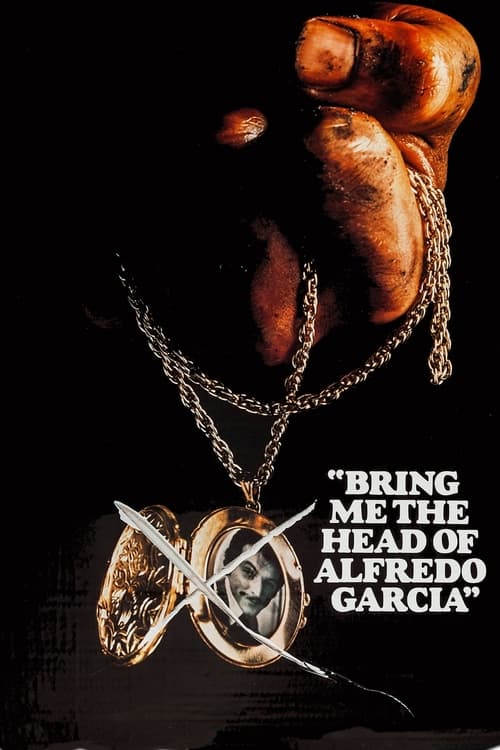
Bring Me the Head of Alfredo Garcia
1974 · Sam Peckinpah
For when you want cinema with the safety off — something raw, obsessive, and totally uncompromising. Strictly a challenge watch: reach for it when you're in the mood to be shaken, not soothed.
What it's about
A powerful Mexican patriarch puts a million-dollar bounty on the head of Alfredo Garcia, the gigolo who dishonored his daughter — and the man is already dead. Bennie, a washed-up American piano player grinding out a living in a Mexico City tourist bar, sees his one shot at escape and hits the road with his girlfriend to dig up the prize. The trip through the Mexican underworld costs more than either of them planned, and the film rides shotgun the whole way down.
The experience
Sweaty, squalid, and strangely tender before it turns savage — a road movie that curdles from get-rich scheme into fever dream. It's abrasive and despairing and, in its ruined way, weirdly romantic; you come out feeling like you've been on a bender with a doomed friend.
Performances
Warren Oates gives the performance of his life as Bennie — rumpled, desperate, talking to a head in a burlap sack — a character actor finally handed a lead and pouring everything into it, reportedly channeling Peckinpah himself.
The craft
Peckinpah shot it cheap and fast in Mexico with total creative control, and it shows in the best way: no studio polish, just dust, glare, cantinas, and violence staged with his signature slow-motion fatalism. It feels less directed than confessed — the most personal film of a famously embattled career.
Why it matters
Trashed on release as a career low, it has been fully reclaimed as one of Peckinpah's masterpieces and a holy text of grindhouse-to-arthouse rediscovery, beloved by filmmakers drawn to its go-for-broke nerve.
Snapshot
Bring Me the Head of Alfredo Garcia is the most personal, most reviled, and most fervently reclaimed film in Sam Peckinpah's career — a squalid, sun-blasted road picture about a small-time American piano player who drags a rotting head across Mexico in pursuit of a bounty and, along the way, loses everything that made the money worth having. Warren Oates plays Bennie, a lounge musician in a Mexico City tourist bar who learns that a fortune has been placed on the head of a dead seducer, Alfredo Garcia. What begins as a scheme to escape poverty curdles into a descent through the country's underworld, a meditation on machismo and futility, and finally a suicidal act of revenge. Made cheaply in Mexico with a cast of Peckinpah regulars and Mexican actors, it was dismissed on release as a nadir of grindhouse ugliness, then gradually recognized — by Peckinpah himself, and by a growing body of critics — as one of his purest and most uncompromised statements. Peckinpah repeatedly claimed it was the only one of his films released exactly as he intended, and the picture carries the raw, unbuffered signature of that control.
Industry & production
The film arrived at a turbulent point in Peckinpah's trajectory. Coming off the studio interference that had scarred Pat Garrett and Billy the Kid (1973), whose MGM cut he disowned, Peckinpah sought a project small and cheap enough to shoot beyond the reach of studio supervision. The story originated with Frank Kowalski, a longtime Peckinpah associate, and was developed into a screenplay credited to Peckinpah and Gordon T. Dawson, another trusted collaborator. It was produced by Martin Baum and released by United Artists, with production based largely in Mexico — a country that had shaped Peckinpah's imagination since The Wild Bunch (1969) and Major Dundee (1965).
The modest budget was, paradoxically, the source of the film's freedom: shooting away from Hollywood on relatively low stakes gave Peckinpah a latitude he rarely enjoyed. This is the material basis for his famous claim of authorship over the final cut. The production was not without the chaos that trailed Peckinpah in this period — his alcoholism was well documented by the mid-1970s, and the shoot's low-budget, semi-improvised character is visible in the finished film's rough textures. On release the picture failed commercially and was savaged critically; precise box-office figures are not something I can responsibly cite here, but the consensus is that it was a financial disappointment and, for a time, a byword for a director in decline.
Technology
Technologically the film is unremarkable by design, and that plainness is part of its meaning. It was shot on 35mm color stock in the standard practices of the early-to-mid 1970s, without the large-scale multi-camera slow-motion apparatus Peckinpah had orchestrated for the great set pieces of The Wild Bunch. Where that earlier film had marshaled banks of cameras running at varied frame rates to shatter violence into balletic fragments, Alfredo Garcia works closer to the ground, with a leaner package and a grittier, grainier image. The zoom lens — a defining tool of 1970s cinematography — is used freely, and the location shooting relies on available Mexican light rather than elaborate lighting rigs. The technology serves an aesthetic of immediacy and decay rather than spectacle.
Technique
Cinematography
The photography is credited to Alex Phillips Jr., a leading Mexican cinematographer, and the images bear the marks of location realism: dust, heat haze, the harsh contrast of exterior sun against dim cantina interiors. The camera favors a handheld looseness in the road sequences and an unglamorous, sweat-soaked palette. Peckinpah's characteristic use of the zoom — snapping in on a face, pulling focus across a crowded room — is present throughout, and the film's visual register is deliberately grubbier than the burnished compositions of his Westerns. The most infamous images are the simplest: Bennie driving with the burlap sack beside him, flies swarming, the landscape flattening into an emblem of futility.
Editing
Editing was handled by a team — the credits list several hands, including Garth Craven, Robbe Roberts, Sergio Ortega, and Dennis Dolan — rather than the single defining collaborator (Lou Lombardo) associated with The Wild Bunch. The cutting retains Peckinpah's signature grammar of the violent montage: bursts of accelerated, multi-angled cutting that fracture gunfights into disorienting shards, intercut with slow-motion accents. But the film also spends long stretches in a slower, more dilated rhythm — the road, the waiting, the drinking — so that the editing alternates between torpor and shock. This oscillation is central to the film's emotional design.
Mise-en-scène / staging
The staging is grounded in real Mexican locations — bars, brothels, dirt roads, a cemetery — and Peckinpah stages his scenes to emphasize squalor and physical wear. The recurring visual motif is the head itself, first as a hidden object of value and then as a grotesque, buzzing companion in the passenger seat. Peckinpah loads the frame with markers of death and decay: flies, dust, sweat, cheap liquor. The film's most celebrated staging conceit is Bennie's growing intimacy with the severed head, which he addresses aloud as "Al," a piece of blocking that turns a horror-movie prop into the vehicle for the film's philosophical grief.
Sound
The score is by Jerry Fielding, Peckinpah's frequent composer (their collaboration includes The Wild Bunch and Straw Dogs), whose music threads Mexican idioms and mournful motifs through the action. The soundscape leans on diegetic sources — cantina music, Bennie's own piano playing — that root the film in its milieu. The buzzing of flies around the head becomes an almost sonic character in its own right. I'd note that the fine detail of specific song cues is something I won't assert precisely from memory; what is secure is that Fielding's work and the film's Mexican musical texture are integral to its tone.
Performance
The film belongs to Warren Oates, and his performance is widely regarded as the finest of his career. Oates plays Bennie as a shabby, self-deluding romantic in cheap sunglasses — an appearance and manner that Oates and Peckinpah understood as a deliberate echo of Peckinpah himself, making Bennie a kind of authorial surrogate. Isela Vega gives the film its wounded heart as Elita, Bennie's lover, whose presence supplies the tenderness the surrounding violence keeps destroying. Gig Young and Robert Webber play a pair of predatory bounty agents; Helmut Dantine and Emilio Fernández — the great Mexican director "El Indio," himself — appear as figures of criminal power, with Fernández's El Jefe presiding over the story's engine of vengeance. Kris Kristofferson and Donnie Fritts turn up in smaller roles. The performances collectively pitch toward a raw, unpolished naturalism suited to the film's degraded world.
Narrative & dramatic mode
The narrative is a quest structure hollowed out and turned against itself: a MacGuffin — the head — is pursued across a landscape, but each step of acquisition costs the protagonist more than the prize can repay. The dramatic mode is tragic and increasingly absurdist. Bennie's monologues to the head shift the film from crime thriller into something closer to a fever-dream elegy, an interior drama externalized as a conversation with a corpse. The trajectory is one of moral and physical disintegration: the closer Bennie gets to the money, the more thoroughly he is stripped of dignity, love, and finally life. Where a conventional heist or bounty plot builds toward payoff, this one builds toward annihilation, converting genre momentum into existential inevitability.
Genre & cycle
The film sits at the crossroads of several genres and cycles. It belongs to the early-1970s American crime film and its vein of downbeat, morally exhausted protagonists. It draws heavily on the road movie, a form central to New Hollywood. And it is inflected by the Western — specifically the "south of the border" Western Peckinpah had made his own, with its mythology of Mexico as a zone of freedom, danger, and death. It also carries traces of the revenge thriller and even the horror film in its central image of the severed head. Rather than settling comfortably into any single cycle, the picture fuses their conventions into something deliberately disreputable, closer in spirit to grindhouse exploitation than to prestige cinema — a positioning that partly explains its hostile initial reception.
Authorship & method
Alfredo Garcia is the strongest candidate for Peckinpah's most personal film, and his authorship saturates it. The recurring Peckinpah themes — masculine codes tested to destruction, the seductive freedom and lethal romance of Mexico, violence as both spectacle and moral reckoning, loyalty and betrayal among the marginal — are all present in concentrated form. Crucially, the identification of Bennie with Peckinpah (via Oates's mimicry of the director's dress and manner) makes the film a kind of self-portrait, an artist watching his own compromises and self-destruction played out on screen.
His method here was collaborative but tightly controlled: the screenplay written with Gordon T. Dawson from a Frank Kowalski story; the photography by Alex Phillips Jr.; the score by longtime partner Jerry Fielding; the editing distributed across a team executing Peckinpah's montage grammar. The casting drew on his repertory company (Oates above all) and on Mexican talent, including the symbolically potent presence of Emilio Fernández. The freedom afforded by the low budget and Mexican location is inseparable from the film's method — Peckinpah's insistence that he got the picture he wanted is the clearest expression of authorship in his body of work.
Movement / national cinema
The film is a product of New Hollywood — the auteur-driven, downbeat, genre-revising American cinema of roughly 1967–1976 — and specifically of its darker, more nihilistic late phase. But it is also a genuinely transnational object, shot in Mexico with substantial Mexican creative participation (Phillips's cinematography, Vega and Fernández among the cast). Peckinpah's career-long fascination with Mexican culture places the film in dialogue with Mexican cinema without being of it; Mexico functions as both real location and mythic screen. The picture thus straddles a border in more than the literal sense, belonging to American film history while drawing its lifeblood from south of the Rio Grande.
Era / period
The film is unmistakably a document of the mid-1970s: post-Wild Bunch, post-Straw Dogs, made in the shadow of a national mood soured by Vietnam and Watergate, when American movies were at their most disenchanted. Its exhaustion, its moral squalor, and its refusal of catharsis are period-defining traits. It also captures a specific moment in Peckinpah's own arc — a director at the height of his notoriety, his personal deterioration accelerating, seizing a rare pocket of autonomy. The film's texture of grime and dissolution reads as both an aesthetic choice and an unintended record of its era's, and its maker's, condition.
Themes
At its core the film meditates on the futility of the pursuit of money and the corrosion of masculine honor. Bennie's quest literalizes the idea that chasing a "prize" costs the seeker his soul: the head is worth a fortune and nothing at all. Death saturates the film — carried, addressed, decaying — until the boundary between the living and the dead dissolves. Machismo is anatomized and found hollow: the codes of vengeance that set the plot in motion (El Jefe's outrage over his violated daughter) generate only more death. Love, embodied in Elita, is the film's fragile counterweight, and its destruction is the true tragedy beneath the genre mechanics. Dignity, betrayal, and the search for meaning in a degraded world round out a thematic field that is unusually bleak even by Peckinpah's standards.
Reception, canon & influence
On release the film was, by broad consensus, a critical and commercial failure — widely condemned as ugly, incoherent, and gratuitously violent, and taken by many as evidence of Peckinpah's decline. Yet it also found early defenders; Roger Ebert, notably, championed it, and over the following decades the critical tide turned decisively. It is now frequently cited as one of Peckinpah's essential works and, by some, as his masterpiece — the rare instance where his uncompromised vision reached the screen intact. The reversal is one of the more dramatic rehabilitations in American film criticism.
Looking backward, the film draws on Peckinpah's own prior work (especially the Mexican Westerns), on the noir tradition of doomed protagonists, and on the existential currents of European art cinema filtered through New Hollywood sensibilities. Looking forward, its influence runs through the cinema of transgression and cult admiration: it became a touchstone for filmmakers drawn to its fusion of grindhouse extremity and genuine pathos, its willingness to follow a debased premise to a place of real feeling. Its imagery — a man alone in a car, talking to a head wrapped in burlap — has entered the iconography of cult cinema, and its reputation among directors and critics who prize uncompromised authorship has only grown. It stands today less as the disaster it was first called than as a defiant, self-lacerating summit of its maker's art.
A Deleuzian reading
A man drives across Mexico with a burlap sack riding shotgun.
The full Deleuzian reading of Bring Me the Head of Alfredo Garcia →
Reception
Savaged on release in 1974 — critics called it sleazy and it even landed in the Medveds' 'Fifty Worst Films' book — while Roger Ebert stood almost alone in defending it. It's since been fully rehabilitated as maybe Peckinpah's most personal film, the grimy masterpiece hiding inside the grindhouse title.
How Bring Me the Head of Alfredo Garcia was received, from release to now →
How to watch Bring Me the Head of Alfredo Garcia: what to notice on a first viewing
- Watch the burlap sack riding on the passenger seat. Bennie drives across Mexico with the sack beside him, flies gathering on it, and eventually starts talking to it as though it could answer. An object that is only supposed to have value starts to behave like a character in its own right.
- Notice how often the camera zooms sharply into faces. Alex Phillips Jr.'s camera snaps into close-ups and pulls focus across crowded rooms, a rougher, sweatier version of Peckinpah's usual visual grammar. The zoom keeps yanking your attention toward a face right when the moment turns uncomfortable.
- Watch Bennie keep his sunglasses on in nearly every scene. Warren Oates plays Bennie behind dark glasses almost throughout, a shabby, self-deluding romantic modeled visibly on Peckinpah's own dress and manner. Hiding his eyes keeps you from reading him clearly, which is exactly what the performance wants.
- Notice how the film alternates long quiet stretches with sudden violence. Peckinpah's editors let the road, the waiting, and the drinking run long and slow, then break it with bursts of fast, multi-angled cutting. The film trains you to relax and then punishes that relaxation, again and again.
- Listen for cantina music and Bennie's own piano playing. Jerry Fielding's score leans on Mexican idioms and mournful motifs, but much of the music you hear comes from inside the scenes themselves. The music belongs to the world on screen, not to a score commenting from outside it.
The whole guide to watching Bring Me the Head of Alfredo Garcia, with the keys for a rewatch →
Influences: the films it descends from and the films it influenced
- The Treasure of the Sierra Madre (1948) — Establishes the on-location Mexican greed-parable whose futile-pursuit-of-money ends in an ironically worthless reward — Bennie chasing a bounty that costs him everything is Dobbs's gold blown to the wind, re-staged as a severed head.
- Pat Garrett & Billy the Kid (1973) — The immediate self-descendant, extending the doomed-protagonist sun-blasted fatalism and Coquillon-school dusk imagery into an even more dissolute, personal key.
- El Infierno (2010) — Bequeaths the seedy Mexican-underworld road picaresque in which a small man chases cartel-style money toward doom amid corrido-scored squalor.
- The Outlaw Josey Wales (1976) — Direct Fielding-collaboration link: the same composer's sound of doomed, exhausted violence carried straight from this film into Josey Wales's folk-inflected scoring.
- Revenge (1990) — The direct tonal and geographic template: a Mexican road picture organized around a patrón whose hospitality is a form of ownership, in which the avenger's journey returns him nothing — Scott lifts the structure of degradation-without-restitution and the sun-hammered compound-and-cantina geography wholesale.
- Out of the Past (1947) — Provides the noir template of the doomed protagonist who walks knowingly toward his own death for a woman and a payoff, the fatalistic drive Bennie inherits wholesale.
- Kiss Me Deadly (1955) — Its nihilistic MacGuffin — the 'great whatsit' everyone kills for — is the direct ancestor of the head-in-the-burlap-sack as an obsessively pursued object emptied of real value.
- Vera Cruz (1954) — Seeds the south-of-the-border western of cynical American mercenaries partnering for cash amid Mexican revolution, the amoral gringo-adrift template Peckinpah pushes to squalor.
- Ride the High Country (1962) — Peckinpah's own founding statement of aging men clinging to a personal code amid loyalty and betrayal — the moral architecture Bennie carries into debasement.
- Major Dundee (1965) — His first full immersion in Mexican-location texture and gringos-lost-south-of-the-border staging, the location-realism grammar reused here.
- The Wild Bunch (1969) — Source of the multi-camera, multi-speed slow-motion violent-montage editing grammar and the elegiac code-of-men, which Alfredo Garcia quotes and turns inward as self-portrait.
- Le Samouraï (1967) — The European art-cinema ritual of the solitary professional performing his own doom with fatalistic calm, filtered into Bennie's resigned march toward death.
- Two-Lane Blacktop (1971) — Warren Oates's stripped, muttering naturalism inside an existential anti-quest — the same actor's method of hollow searching that anchors Bennie.
- Fat City (1972) — New Hollywood naturalism of down-and-out men in unglamorous, sun-bleached location texture, the deglamorized loser-milieu Alfredo Garcia shares.
- El Topo (1970) — The grindhouse-meets-art-cinema fusion set in a surreal violent Mexican desert — sibling 'acid western' pushing exploitation extremity toward metaphysical pathos.
- Cockfighter (1974) — Same-year Warren Oates vehicle built on grubby location realism and a debased, obsessive quest, a direct performance-and-tone sibling.
- Sorcerer (1977) — Extends the vision of sweaty, doomed men hauling a payoff across Latin America that annihilates them — futile-labor fatalism and location extremity descended from Peckinpah's Mexico.
Similar films
- The Wild Bunch (1969) — influence & lineage
- Ride the High Country (1962) — influence & lineage
- No Country for Old Men (2007) — influence & lineage
- The Treasure of the Sierra Madre (1948) — influence & lineage
- Sorcerer (1977) — influence & lineage
- Kiss Me Deadly (1955) — influence & lineage
- Pulp Fiction (1994) — influence & lineage
- El Topo (1970) — influence & lineage
All the films related to Bring Me the Head of Alfredo Garcia →