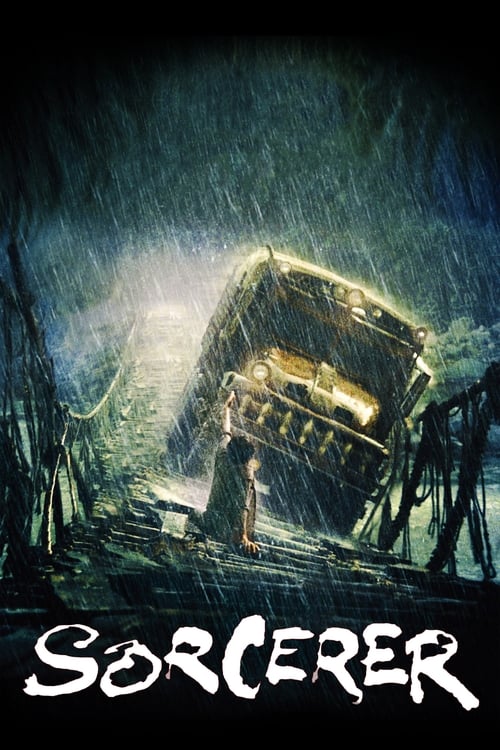
Sorcerer
1977 · William Friedkin
For when you want to be put through it — white-knuckle tension with real existential weight, best taken on when you have the stamina for something grim and relentless. Absolutely not a casual watch.
What it's about
Four men from four corners of the world, each running from something unforgivable, wash up in the same squalid South American oil town with no way out. When a distant well fire needs smothering, they take the one job desperate enough to pay for an escape: driving trucks loaded with decayed dynamite — sweating unstable nitroglycerin — over two hundred miles of mountain and jungle, where a single hard bump ends everything.
The experience
Pure sustained dread. Once the trucks roll, every rut, rope bridge, and rainstorm becomes an instrument of torture, and the film grinds you down with a fatalism that feels almost cosmic. Punishing, hypnotic, unforgettable.
Performances
Roy Scheider leads with a stripped-down, haunted intensity — barely any speeches, just a man's face deciding whether fate can be outdriven.
The craft
Friedkin, coming off his two biggest hits, mounted a legendarily punishing physical production: real trucks, real jungle, sequences of jaw-dropping practical danger, all pulsing to an eerie electronic score by Tangerine Dream. It demands the biggest screen and loudest sound you can give it.
Why it matters
A famous flop in 1977 that has been slowly, decisively rehabilitated into one of the most admired American thrillers of its decade — the cautionary tale and the vindication of New Hollywood ambition in one film.
Snapshot
Sorcerer is William Friedkin's jungle-fatalist thriller about four fugitives who, marooned in a squalid South American oil town, take a suicidal contract to haul truckloads of sweating, decayed dynamite over two hundred miles of mountain and rainforest to smother an oil-well fire. Conceived at the peak of Friedkin's commercial power — immediately after The French Connection (1971) and The Exorcist (1973) — it was a lavish, punishing production that returned an ambivalent verdict at the box office and a long, slow rehabilitation in critical memory. The film reworks the same source that produced Henri-Georges Clouzot's The Wages of Fear (1953), but Friedkin insisted it was a new adaptation rather than a remake, and the result is less a suspense machine than a metaphysical endurance test: a study of chance, guilt, and the indifference of the physical world. Friedkin repeatedly named it, in later interviews, as his own favorite among his films.
Industry & production
Sorcerer is a textbook case of a hit director's leverage overreaching the economics of his moment. Friedkin had two of the defining commercial and critical successes of the early 1970s behind him, and Sorcerer was the project on which he chose to spend that capital. The budget escalated sharply during a grueling international shoot — enough that financing had to be split between two studios, Universal and Paramount, an unusual arrangement that spread the risk of a production whose costs had outrun a single studio's appetite.
The shoot itself became part of the film's legend. Principal photography ranged across multiple countries — the Dominican Republic supplied the central jungle location, with additional work in Mexico, and the prologue vignettes were shot on location in Jerusalem, Paris, and Elizabeth, New Jersey. Conditions were arduous: illness among cast and crew, logistical breakdowns, and the sheer difficulty of moving heavy trucks and camera rigs through rainforest. The most notorious episode concerns the rope-bridge sequence, an enormously expensive practical set-piece; accounts long in circulation hold that a river location dried up or became unusable and that the bridge apparatus had to be rebuilt at a second site, compounding the cost. The film was, in short, the kind of production whose difficulty entered its reputation before the finished work could.
Its commercial fate is the other half of the legend. Sorcerer opened in the summer of 1977, weeks after Star Wars had transformed the marketplace and audience appetite. The prevailing narrative — repeated by Friedkin himself in later years — is that a somber, subtitled-in-spirit, star-light existential thriller was simply overwhelmed by the arrival of a new blockbuster idiom. Whether one credits that single cause or a broader mismatch between the film and its audience, Sorcerer underperformed relative to its cost and its director's track record, and it came to be filed among the emblematic financial disappointments of the New Hollywood's turn.
Technology
The film's most consequential technological choice is aural rather than visual: its electronic score by the German group Tangerine Dream. Friedkin, having encountered the band in Germany, commissioned a synthesizer-based score at a time when electronic scoring for a major American studio picture was still novel. The decision aligns Sorcerer with a small vanguard of late-1970s films that used the synthesizer not as a gimmick but as a primary emotional and textural instrument, and it is one of the clearest ways the film reads as ahead of its release date.
On the production side, the film is defined by its commitment to physical, in-camera spectacle. The trucks, the deteriorating jungle roads, the bridge crossing, and the pyrotechnics of the oil-well fire were realized as practical challenges rather than optical tricks, which is precisely why the shoot was so costly and dangerous. The bridge sequence in particular depended on mechanical rigging to make the structure heave and sway under the trucks' weight in torrential simulated rain — an engineering problem solved on set rather than in post-production.
Technique
Cinematography
The photography is grimy, saturated, and physically immersive, favoring the sweat, rot, and muck of its locations over any picturesque treatment of the tropics. The film had a troubled camera department — the cinematography is credited across more than one hand, with Dick Bush associated with the earlier stages and John M. Stephens completing the work, a change consistent with the production's overall turbulence. The visual signature is Friedkin's characteristic documentary-inflected realism pushed to an extreme: the jungle is not exotic but oppressive, and the camera stays close to the trucks and the men, emphasizing weight, friction, and the constant threat of the nitroglycerin's instability.
Editing
The cutting is patient by the standards of the modern thriller and audacious in structure. The film withholds its central engine — the dynamite run — for a long opening movement composed of four separate prologues, each shot in a different country and language, that establish the four protagonists before converging them in the oil town. This front-loaded, deferred-payoff architecture is a genuine risk, and its editorial confidence (the film was cut by Bud Smith with Robert K. Lambert) is part of what makes Sorcerer feel severe rather than crowd-pleasing. Within the set-pieces, by contrast, the editing tightens to sustain almost unbearable suspense, most famously across the bridge crossing.
Mise-en-scène / staging
Friedkin stages the world as hostile matter. The oil town (the fictional Porvenir) is a place of mud, corrugated metal, and human desperation, and the film's production design refuses any romance of exile — the men are trapped in squalor before they are trapped on the road. On the journey, the staging turns the trucks themselves into the central objects of drama: their bulk, their vulnerability on rotten planks and crumbling switchbacks, the physics of their cargo. The two vehicles are given names — Sorcerer and Lazaro — and the film treats them almost as characters, extensions of the men's fate.
Sound
Sound is one of Sorcerer's major achievements. Beyond the Tangerine Dream score, the film builds a dense, oppressive sound field from engines, rain, insects, and the groan of stressed materials, so that tension is carried as much by the aural environment as by the image. The near-wordless bridge sequence is the clearest demonstration: dialogue recedes and the scene is governed by the roar of water, straining wood, and revving motors, with the synthesizer score threading through as an anxiety made audible.
Performance
The ensemble is deliberately international and, by Hollywood standards, star-light. Roy Scheider anchors the film as the American fugitive (living under the alias Juan Dominguez), and his performance is stripped of charm — haggard, cornered, and increasingly hollowed out. He is surrounded by a genuinely multinational cast: Bruno Cremer as the disgraced French financier, Francisco Rabal as the Latin assassin Nilo, and Amidou as the Arab bomber Kassem. The casting is pointedly not built around a single marquee hero, which is both an aesthetic strength and, in the marketplace of 1977, a commercial liability. (Well-documented pre-production accounts hold that Friedkin pursued Steve McQueen for the lead and that the two could not reach terms; the precise details are best treated as production lore rather than settled fact.)
Narrative & dramatic mode
The dramatic mode is existential fatalism rendered as physical thriller. The four-prologue structure establishes that each man is fleeing a specific ruin — political violence, financial crime, terrorism, organized crime — and that all roads have led them to the same dead end. The dynamite run is thus not an adventure but a wager against death made by men who have nothing left to lose, and the film's suspense is inseparable from its philosophy: any pothole, any tremor, can end everything, so the narrative dramatizes contingency itself. The ending is bleakly ironic, denying its survivor any redemptive escape and closing the circle of doom the prologues opened.
Genre & cycle
Sorcerer sits at the intersection of the men-on-a-mission adventure and the existential thriller, and it belongs squarely to the darker New Hollywood cycle of the 1970s — films that took genre frameworks and drained them of heroism and uplift. It is also, unavoidably, part of the lineage of The Wages of Fear, and it participates in a small tradition of "cursed" survival dramas about human bodies pitted against implacable nature and machinery. Its refusal of the reassurances that were about to define the post-Star Wars blockbuster makes it, in retrospect, a kind of last statement of the decade's pessimist mode.
Authorship & method
Sorcerer is a director's film in the fullest sense, and Friedkin's method here is one of physical extremity: he pursued realism and difficulty as ends in themselves, exposing cast and crew to real jungle, real weight, and real risk in pursuit of an authenticity that could not be faked. The screenplay is credited to Walon Green, a writer associated with tough, unsentimental material (best known for co-writing The Wild Bunch), and the adaptation reframes Georges Arnaud's source novel — the same book Clouzot filmed — as a global parable rather than a purely European one. The score by Tangerine Dream is the other decisive authorial collaboration, giving the film a sonic identity that is arguably its most influential single element. The cinematography (Dick Bush, then John M. Stephens) and editing (Bud Smith, Robert K. Lambert) served Friedkin's commitment to grit and duration. The title itself has been the subject of much discussion; Friedkin explained it as referring to fate or an evil wizard as well as to the name painted on one of the trucks — a gloss that, fairly or not, contributed to audience confusion about what kind of film they were being sold.
Movement / national cinema
The film is a product of American New Hollywood, but it is unusually transnational in texture. Its multinational cast, its polyglot prologues, its European source and German score, and its Latin American and Middle Eastern locations make it a deliberately un-provincial American picture — a Hollywood film straining against the boundaries of a national cinema. In that ambition it belongs to the moment when American auteurs, briefly empowered by the studios, tried to make world cinema on Hollywood budgets. It stands in explicit dialogue with French cinema through the shadow of Clouzot, even as Friedkin worked to distinguish his version.
Era / period
Sorcerer is a definitively late-1970s artifact, and its release date is central to its story. Arriving in 1977, it landed at the exact hinge between the director-driven, downbeat New Hollywood and the arrival of the modern blockbuster. Its commercial failure has often been read as a symbolic marker of that transition — an expensive, uncompromising, star-light auteur film swept aside by a new commercial order. Whether or not one accepts that tidy periodization, the film is inseparable from the anxieties of its moment: post-Watergate disillusion, energy-crisis-era attention to oil, and a pervasive cinematic pessimism.
Themes
The governing theme is fate and contingency — the sense that the universe is indifferent and that survival is a matter of luck rather than virtue. Alongside it runs the theme of guilt and flight: four men defined by what they have done and cannot outrun, seeking anonymity only to find that geography offers no absolution. The film is also pointedly about economic exploitation and a form of American corporate imperialism: the men risk their lives so that a US-owned oil operation can resume production, and the town's misery is the human backdrop to distant profit. Underneath all of it is a stark existentialism — the dignity, and futility, of continuing to drive when the road guarantees nothing.
Reception, canon & influence
Contemporary reception was mixed to poor, and the film's disappointing performance overshadowed its artistry at release; it became, for a long time, better known as a famous failure than as a work in its own right. Its influences run backward through Clouzot's The Wages of Fear and the shared Arnaud novel, and through the broader tradition of grueling survival and jungle-ordeal filmmaking — a lineage it shares, in spirit and in production hardship, with the era's other into-the-jungle epics.
Its forward legacy has grown steadily. The Tangerine Dream score helped legitimize synthesizer scoring in American cinema and is frequently cited as ahead of its time. The film's uncompromising practical spectacle and its bleak fatalism have made it a touchstone for later directors drawn to physically demanding, morally unsparing filmmaking. Crucially, Sorcerer underwent a genuine critical reappraisal in subsequent decades, culminating in a restoration overseen by Friedkin and a theatrical and home-video reissue in the 2010s that reintroduced the film to audiences and cemented its standing as an underrated masterwork of the 1970s. The arc from flop to rehabilitated classic is now a settled part of its story — and Friedkin's own insistence that it was his finest film has been increasingly echoed by critics. Where specific figures for its budget, gross, or losses are concerned, the historical record is repeated inconsistently across sources, and precise numbers are best treated with caution rather than asserted as fact.
A Deleuzian reading
Rain, a rope bridge, and a truck's front wheels feeling for the first plank.
The full Deleuzian reading of Sorcerer →
Reception
A notorious 1977 flop — a punishing shoot, a $20M+ budget, and the misfortune of opening weeks after Star Wars buried it. Decades later, championed by critics and a 2013 restoration Friedkin fought in court to make happen, it's now widely called one of the great American films of the '70s.
How Sorcerer was received, from release to now →
Influences: the films it descends from and the films it influenced
- The Wages of Fear (1953) — The direct source template: Friedkin adapts the same Georges Arnaud novel and inherits its central engine of suspense-through-duration, extracting terror from the physical mechanics of trucking nitroglycerin over impossible terrain rather than from a human antagonist.
- The Treasure of the Sierra Madre (1948) — Establishes the location-shot, greed-driven survival parable whose ironic-fatalist arithmetic — men grind through hell for money that evaporates at the end — is the moral shape Friedkin's four desperados retrace.
- The Wild Bunch (1969) — Screenwriter Walon Green carries the same unsentimental ethos into Sorcerer — expendable outlaws bound by a job, no redemption offered — plus a taste for kinetic, hard-cut violence that shapes the truck-crossing set pieces.
- The French Connection (1971) — Friedkin's own prior film supplies the documentary-realist grammar he transplants to the jungle: handheld verité coverage, available-light grit, and set pieces staged as physical events rather than choreographed spectacle.
- The Exorcist (1973) — Friedkin's self-authored method of immersive, sourced-and-layered sound design and pursuit of unfakeable practical effect carries directly into Sorcerer's assaultive audio and real-jungle production risk.
- Fitzcarraldo (1982) — Extends Sorcerer's practical, in-camera spectacle to its logical extreme by physically hauling a real steamship over a mountain, refusing the fake in favor of documented, back-breaking effort.
- Thief (1981) — Directly cashes in Sorcerer's legitimization of synth scoring by commissioning Tangerine Dream to score a laconic, existential professional's doomed job — the same pulsing electronic fatalism.
- The Keep (1983) — Another Tangerine Dream commission that treats the synthesizer as the film's primary atmospheric author, extending the sonic identity Sorcerer proved American cinema could sustain.
- Blade Runner (1982) — Vangelis's fully electronic score inherits the cultural permission Sorcerer's Tangerine Dream work established — synth as prestige-film emotional spine rather than novelty texture.
- No Country for Old Men (2007) — Carries forward the bleak, ironic fatalism and near-scoreless reliance on immersive ambient sound, staging violence as an indifferent mechanism of chance the characters cannot outrun.
- Sicario (2015) — Jóhann Jóhannsson's droning, sub-bass score weaponizes electronic sound to build dread over duration — the immersive tension-through-synth grammar Tangerine Dream pioneered here.
- Mad Max: Fury Road (2015) — Rebuilds blockbuster credibility on practical, in-camera vehicular spectacle and hostile materiality — real trucks, real desert, real stunts — the same insistence that physical risk on screen cannot be faked.
- The Revenant (2015) — Revives Friedkin's realism-as-ordeal method — natural light, remote wilderness, a cast pushed to genuine physical extremity — to make survival read as documented endurance rather than staged drama.
- Manhunter (1986) — Friedkin's pairing of a Tangerine Dream synthesizer score with sustained dread demonstrates electronic scoring as suspense architecture, a method Manhunter's needle-drop and synth cues extend (notably the In-A-Gadda-Da-Vida climax).
- Sirāt (2025) — Fuses near-abstract immersive sound design and a percussive electronic (Tangerine Dream) score to a doomed convoy through wilderness, modeling Sirāt's marriage of techno scoring and sensory dread.
- The Plague Dogs (1982) — Tangerine Dream's synthesizer score demonstrated electronic sound as the register for bleak survival-against-indifferent-nature narratives, prefiguring Gleeson's chilly instrumentation.
- Kaithi (2019) — Grimy, kinetic night-driving of a doomed cargo scored to engine drone and percussion — the sweat-and-machinery realism Kaithi's truck sequences echo over glamour.
- Aguirre, the Wrath of God (1972) — Shares the into-the-jungle production ethic of courting real danger and hostile materiality on location, extracting authenticity from an actual river and rainforest that punish the cast rather than a controlled set.
- Deliverance (1972) — Puts modern men against a genuinely hostile natural environment shot with documentary immediacy — real rapids, real exhaustion — the same wager that physical ordeal on camera reads as truth.
- Apocalypse Now (1979) — The other era-defining jungle epic whose grueling on-location shoot and enveloping, mix-forward sound design pursue the same immersion-through-hardship Friedkin gambled on.
- Midnight Express (1978) — Contemporary pairing of a Tangerine Dream electronic score with a sweat-soaked foreign-set ordeal — parallel proof that synth scoring could underscore Third-World peril and dread.
- Bring Me the Head of Alfredo Garcia (1974) — Extends the vision of sweaty, doomed men hauling a payoff across Latin America that annihilates them — futile-labor fatalism and location extremity descended from Peckinpah's Mexico.
Similar films
- The Wages of Fear (1953) — influence & lineage · same viewing thread
- Aguirre, the Wrath of God (1972) — influence & lineage · same viewing thread
- Apocalypse Now (1979) — influence & lineage · same viewing thread
- Deliverance (1972) — influence & lineage · same viewing thread
- Fitzcarraldo (1982) — influence & lineage
- The French Connection (1971) — influence & lineage
- No Country for Old Men (2007) — influence & lineage
- The Exorcist (1973) — influence & lineage
All the films related to Sorcerer →
Watch it with: curated runs of related films
- Into the Heart of Darkness — A run of grueling journeys into hostile country — jungle, ice, desert, occupied forest — where the ordeal strips men down to something primal, hallucinatory, and often unrecoverable.