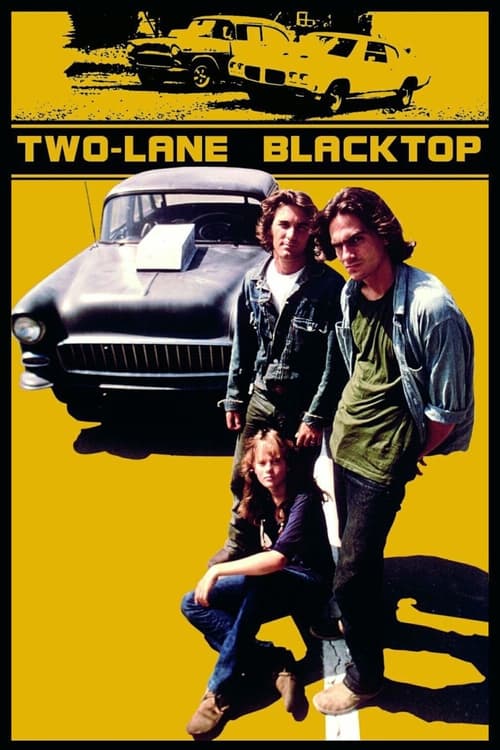
Two-Lane Blacktop
1971 · Monte Hellman
For a late night when you want atmosphere over plot — something to sink into rather than follow. A slow-cinema road trip; bring patience and it repays you with a mood few films ever find.
What it's about
Two young drifters — a driver and his mechanic — cross the Southwest in a stripped-down '55 Chevy, hustling drag races for gas money. A girl slips into their back seat, a talkative middle-aged man in a factory-fresh GTO latches onto them, and someone proposes a cross-country race to Washington for the cars' pink slips. Then the road does what roads do, and the race starts to matter less than the drifting.
The experience
Hypnotic and spare — long silences, engine noise, gas stations at dawn. It has the pace of an actual road trip: unhurried, moody, quietly sad, with an ending that stays with you.
Performances
Warren Oates is the heart of it as the GTO driver, spinning a new life story for every hitchhiker — funny, needy, and heartbreaking, one of the great character-actor performances of the decade. Musicians James Taylor and Dennis Wilson, non-actors both, give the leads an authentic blankness that works.
The craft
Monte Hellman shoots the real two-lane highways of the Southwest in widescreen, letting landscape and engine sound carry scenes most films would fill with dialogue. Its ending is one of the boldest formal gambles of its era, and the whole thing rewards a dark room and good sound — the Chevy is practically a character with a voice.
Why it matters
A commercial orphan in 1971 that became a defining cult object of the New Hollywood era — the purest expression of the existential road movie, quietly influential on decades of American independent film.
Snapshot
Two-Lane Blacktop is the great existential road film of the New Hollywood moment — a movie about a cross-country race in which the race almost ceases to matter. Two nameless young men, "The Driver" (James Taylor) and "The Mechanic" (Dennis Wilson), travel the back highways of the American Southwest in a stripped, primer-gray 1955 Chevrolet built only to go fast. A drifting "Girl" (Laurie Bird) slips into their back seat without invitation, and a garrulous middle-aged man in a new Pontiac GTO (Warren Oates) attaches himself to them, proposing a race to Washington, D.C., for pink slips. The wager is set; the film then lets it dissolve into a series of meandering encounters, mechanical rituals, and inarticulate longing, until the celluloid itself appears to jam in the projector and burn away. Released by Universal in 1971 to commercial failure and divided reviews, it has since been recognized as one of the most rigorous American films of its era — a minimalist, near-Antonioni-ish meditation on speed, emptiness, and the inability of its characters to say what they feel.
Industry & production
The film was a direct product of Hollywood's brief, anxious courtship of the counterculture. After Easy Rider (1969) returned a fortune on a tiny outlay, the major studios scrambled to bankroll low-budget pictures by young or unconventional filmmakers in hopes of capturing the same youth audience. Universal, under this impulse, funded a small slate of director-driven projects, and Two-Lane Blacktop was among them. Monte Hellman, a veteran of Roger Corman's low-budget assembly line who had made two admired existential Westerns (The Shooting and Ride in the Whirlwind, both 1966), was an unlikely beneficiary of studio money, and he used the relative freedom to make an aggressively uncommercial film.
The screenplay's history is twofold: an original script by Will Corry was substantially rewritten by the novelist Rudolph "Rudy" Wurlitzer, whose spare, deadpan sensibility shaped the finished film. The picture is also notable for the prominence of its producers within later film history — Michael Laughlin produced, and Gary Kurtz, who would go on to produce American Graffiti and Star Wars, was among the production team.
The most famous episode in the film's release concerns Esquire magazine, which published Wurlitzer's screenplay in full ahead of the premiere and trumpeted it on its cover as the movie of the year. The prediction proved badly wrong commercially: the film did poor business and slipped quickly out of circulation. For decades it was difficult to see — entangled, by reputation, in rights complications — which only deepened its underground mystique until its restoration and home-video reissue (notably the Criterion Collection edition in 2007) returned it to wide critical view.
Technology
Two-Lane Blacktop belongs to a transitional moment in American production technology, when lighter equipment and faster film stocks made extensive location shooting practical and stylistically attractive. Hellman shot the picture almost entirely on real highways, gas stations, diners, and desert roadsides along an essentially west-to-east route, abandoning studio sets in favor of available American landscape. This documentary impulse — natural light, real interiors, the texture of actual Route 66-era roadside America — was enabled by the same portable, sync-sound location filmmaking that the French and American New Waves had normalized over the preceding decade.
The cars are themselves a kind of technology foregrounded by the film. The "Driver" and "Mechanic" pilot a 1955 Chevrolet 150 that has been gutted and rebuilt purely as a drag machine; the GTO is a then-current 1970 Pontiac muscle car, glossy and stock. The film treats the internal-combustion engine with near-liturgical attention — the long passages of tuning, listening, and tinkering are presented as the characters' true language. (The same primer-gray '55 Chevy was subsequently used as the hot rod in American Graffiti, a small but telling thread connecting two of the decade's defining car movies.)
The single most discussed technological gesture is the ending, in which the image seems to slow, stick in the gate, and ignite — the illusion of the film strip catching fire and whiting out. It is an effect that calls attention to the medium itself, a reflexive acknowledgment that we have been watching a strip of celluloid pass through a machine, mirroring the film's preoccupation with engines and motion.
Technique
Cinematography
The film was photographed by Jack Deerson in widescreen, and its visual style is one of deliberate flatness and patience. Compositions favor the horizontal — long, low horizons, cars receding to vanishing points, figures dwarfed by sky and asphalt. The camera tends to observe rather than dramatize: it holds, it watches, it declines to underline. Interiors of the moving cars are shot to emphasize confinement and the characters' separateness from the landscape sliding past the windows. The palette is muted and naturalistic, dominated by the gray of the primer Chevy, the dun of the desert, and the worn color of roadside America. There is little of the kinetic, montage-driven excitement one might expect from a racing picture; the cinematography instead renders speed as something curiously static and lonely.
Editing
The cutting is unhurried and anti-sensational, refusing the conventions of the race genre. Where a commercial film would build the cross-country wager into mounting suspense, Hellman's editing lets the race diffuse — scenes drift, the contest is repeatedly forgotten, and the rhythm follows mood rather than plot mechanics. The film's most audacious editorial decision is its non-ending: rather than resolve the race, the picture arrives at its image of the burning film strip and simply stops, denying the viewer the catharsis of a winner. Hellman, who came up partly as an editor and was known for his control over the cutting of his films, here uses editing as a tool of withholding.
Mise-en-scène / staging
Hellman stages the film around routine and ritual: the loading of fuel, the listening to an engine, the wordless choreography of two men who communicate through mechanical labor rather than speech. Human figures are frequently placed at the edges of the frame or with their backs to the camera, and conversation is staged to emphasize non-communication — people fail to connect even when sharing the cramped front seat of a car. The roadside settings (filling stations, drive-ins, motel rooms) are presented with an almost ethnographic plainness. The overall effect is of a world reduced to its essentials: road, machine, body, and the spaces between.
Sound
The soundtrack is dominated by the diegetic — engine noise, road hum, the ambient sound of gas stations and diners — rather than by a conventional orchestral score. Music appears largely as source music (radios, jukeboxes) rather than as non-diegetic underscoring, a choice that reinforces the film's documentary austerity and refuses to tell the audience how to feel. The relative silence is itself expressive: in a film whose protagonists can barely speak, the absence of a swelling score leaves their inarticulacy fully exposed.
Performance
The casting is one of the film's boldest strokes. Two of the four leads were musicians, not actors — James Taylor, then an emerging singer-songwriter, as the Driver, and Dennis Wilson, the Beach Boys' drummer, as the Mechanic. Both deliver flat, affectless, near-mute performances entirely in keeping with the film's design; their non-professionalism reads as authenticity, two laconic young men whose interior lives are sealed. Laurie Bird, also a non-professional, plays the Girl with a similar opaque drift. Against these three, Warren Oates' GTO is a tour de force of garrulous loneliness — the one character who talks, compulsively, spinning a different invented life story for each hitchhiker he picks up. Oates' performance, widely regarded as among the finest of his career, supplies the film's emotional center precisely because his torrent of words so plainly fails to fill his emptiness.
Narrative & dramatic mode
Two-Lane Blacktop is structured as a deliberate frustration of narrative expectation. It sets up the most propulsive of premises — a high-stakes coast-to-coast race for ownership of the cars — and then systematically refuses to deliver it as plot. The race is proposed, then neglected; the characters stop to help one another, wander off course, and lose interest. The dramatic mode is modernist and elliptical, closer to the existential European art cinema of Antonioni or early Wenders than to the American genre film. Causality is loosened; psychology is withheld rather than explained; the characters have no backstory, no names, and no articulated goals beyond motion itself. The famous burning-frame ending is the logical endpoint of this mode — a narrative that does not conclude so much as combust, leaving the question of who wins permanently and pointedly unanswered.
Genre & cycle
The film is a road movie, and it belongs squarely to the post-Easy Rider cycle of late-1960s and early-1970s American pictures in which the highway became a stage for disaffection and the search for an authentic life. Within that cycle it sits beside films such as Vanishing Point (also 1971) and, more distantly, Five Easy Pieces (1970), which likewise paired aimless drifting with a critique of American emptiness. But Two-Lane Blacktop is also a deliberate deconstruction of the car-racing and hot-rod genres: it borrows their iconography — the muscle car, the drag strip, the pink-slip wager — while draining them of the kinetic thrill and triumphalism the genre normally provides. It is a racing film that refuses to be exciting, a road movie about the inability to arrive anywhere.
Authorship & method
The film is the fullest expression of Monte Hellman's authorial sensibility: austere, existential, patient, and resistant to conventional payoff. Hellman's method — formed in the cost-conscious discipline of the Corman school and refined in his minimalist Westerns — favored location realism, withheld emotion, and a refusal to dramatize. He worked closely with non-professional performers and trusted long, unforced takes to yield truth.
His key collaborators shaped the result decisively. Screenwriter Rudy Wurlitzer, rewriting Will Corry's original, supplied the spare, deadpan, near-Beckettian dialogue and the anti-narrative architecture that define the film; his contribution is central enough that the picture is often discussed as a Wurlitzer-Hellman work. Cinematographer Jack Deerson translated Hellman's reticence into images of flat, lonely widescreen space. The decision to forgo a traditional composed score in favor of diegetic and source music was itself an authorial stroke, reinforcing the film's refusal to guide the audience's feeling. And in Warren Oates, a frequent Hellman collaborator, the director found the actor capable of embodying the film's one eruption of human need.
Movement / national cinema
Two-Lane Blacktop is a touchstone of the American New Wave, or "New Hollywood" — the period roughly bracketing 1967 to the late 1970s in which a generation of directors, emboldened by the collapse of the old studio system and the influence of European art cinema, made personal, formally adventurous films within (or at the edges of) the major studios. Hellman's picture is among the most uncompromising products of that movement, importing the contemplative pace and existential concerns of European modernism directly into the most American of subjects — cars, highways, and the open road. It demonstrates how thoroughly the New Hollywood had absorbed the lessons of Antonioni, Godard, and the documentary realism of the various national new waves.
Era / period
The film is inseparable from its moment: the early 1970s, the morning after the 1960s, when the utopian energy of the counterculture had curdled into drift and disillusionment. Its mute, rootless young men and its sense of aimless motion across an emptied-out American landscape register the deflation that followed the decade's idealism. It captures, too, a specific material America — the pre-interstate two-lane highways, the independent gas stations and diners, the muscle-car culture — at the very moment that landscape was beginning to vanish, lending the film a quality of elegy it likely did not consciously intend.
Themes
At its core the film is about inarticulacy and alienation: characters who can express themselves only through machinery and motion, and who fail repeatedly to connect with one another. Speed functions as both a substitute for and an evasion of feeling — the race is a structure that lets the men avoid the question of what they actually want. The GTO's compulsive, contradictory storytelling dramatizes the theme of identity as performance and invention, a self with no stable center. Beneath these runs a pervasive existential emptiness: the road leads nowhere in particular, the wager means nothing, and the literal burning-up of the film at the end suggests that the entire pursuit may dissolve into void. The picture is, finally, a meditation on American restlessness — the national myth of the open road exposed as a circuit with no destination.
Reception, canon & influence
Critical reception in 1971 was sharply divided and the commercial response was poor; despite the Esquire hype, the film failed to find its audience and was soon withdrawn from view. For years it was hard to see, which paradoxically nurtured a strong cult reputation among cinephiles and filmmakers. Its critical fortunes rose steadily over subsequent decades, culminating in its restoration and prestige home-video release (the Criterion Collection edition in 2007), after which it was widely re-evaluated as a masterpiece of the New Hollywood and one of the essential American films of the 1970s.
The influences on the film run backward to European modernism — most often the cinema of Michelangelo Antonioni, whose detached observation of alienated figures in landscape Two-Lane Blacktop clearly echoes — and to Hellman's own existential Westerns and his Corman-school training in economical location filmmaking. Wurlitzer's spare, absurdist literary sensibility is the other major upstream current.
The influence of the film runs forward through the lineage of the contemplative American road movie and the independent cinema of mood and minimalism. Directors associated with character-driven, dialogue-light, atmosphere-rich work — Richard Linklater, Quentin Tarantino (a noted admirer of Hellman, whom he would later help by lending his name as a producer to Hellman's Road to Nowhere), and others in American independent film — have cited or echoed it. Its example helped legitimize a cinema in which texture, duration, and inarticulate longing matter more than plot, and Warren Oates' GTO has become a benchmark performance of voluble loneliness. Today the film stands as a canonical New Hollywood object — proof of how strange, austere, and personal an American studio picture could briefly be at the start of the 1970s.
A Deleuzian reading
Watch the two of them lean over the engine.
The full Deleuzian reading of Two-Lane Blacktop →
Reception
Esquire hyped it as 'the movie of the year' before anyone had seen it — then it flopped and Universal quietly buried it. Decades of cult devotion and a Criterion rescue later, it's routinely called one of the great American road movies.
How Two-Lane Blacktop was received, from release to now →
Influences: the films it descends from and the films it influenced
- L'Avventura (1960) — Establishes the dead-time grammar Hellman adopts wholesale — characters stranded as small figures within deep landscape, dramatic 'events' (a disappearance) deliberately left unresolved so duration and absence carry the meaning a plot would.
- L'Eclisse (1962) — Its closing montage of emptied, human-less spaces is the direct model for Two-Lane's refusal to supply a climax — an ending that withdraws from the protagonists rather than resolving them.
- The Shooting (1966) — Hellman's own prototype: elliptical Western built on withheld motivation, minimal dialogue, and an abrupt anti-cathartic ending — the austere existential method he then transplants from desert to highway.
- Ride in the Whirlwind (1966) — Corman-school economy applied to location realism — long unforced takes, naturalistic underplaying, refusal to dramatize — the cost-conscious discipline that shapes Two-Lane's shooting style.
- Easy Rider (1969) — Codifies the American counterculture road movie with location shooting and a wall-to-wall source-music soundtrack standing in for score — the template Two-Lane strips down and de-romanticizes into anti-spectacle.
- Il Grido (1957) — Dedramatized, affectless drift across American road-space, long-lens flattening of figures into landscape and a deliberate withholding of dramatic payoff.
- Kings of the Road (1976) — Extends the two-men-in-a-vehicle, inarticulate-communion road film into European art cinema — sync-sound location shooting, long takes, and silence between men who cannot speak their need, Two-Lane's ritual non-communication made into structure.
- Stranger Than Paradise (1984) — Builds an entire indie aesthetic from Two-Lane's premises — deadpan minimalism, dialogue-light drift across blank American geography, where texture and duration replace plot and 'nothing happens' is the point.
- Walker (1987) — Wurlitzer's screenwriting carries the lineage forward — the same absurdist, anti-naturalistic deadpan and refusal of conventional dramatic payoff driving an anti-genre demolition.
- Dead Man (1995) — A journey film of elliptical episodes and withheld affect, using diegetic sparseness and an anti-heroic non-arrival ending — the contemplative drift toward dissolution Two-Lane pioneered, in Western dress.
- Gerry (2002) — Two men, near-zero dialogue, figures dwarfed in landscape across punishingly long takes ending in unresolved erasure — an explicit revival of the Antonioni-via-Hellman austerity Two-Lane embodies.
- Old Joy (2006) — American minimalism of mood and inarticulate male longing — a small road trip where landscape texture, duration, and the unsaid carry everything, directly inheriting Two-Lane's anti-dramatic patience.
- The Mastermind (2025) — American minimalism's foundational text — deadpan non-performance, anti-narrative drift, withheld payoff — the lineage Reichardt's whole register belongs to.
- Paris, Texas (1984) — Road-movie subversion in which driving expresses existential suspension rather than forward momentum; character backstory is withheld and destination refused — the closest American antecedent to Paris, Texas's anti-arrival narrative logic.
- Y Tu Mamá También (2001) — Hellman's road film substitutes existential drift for destination logic, ending not with arrival but dissolution — the structural argument that the genre's promise of self-discovery is itself a fiction — which Cuarón inherits and executes through the boys' invented beach, Boca del Cielo, that doesn't exist as named.
- Down by Law (1986) — Hellman cast recording musicians (James Taylor, Dennis Wilson) as leads in a road film whose narrative deliberately refuses resolution, establishing the precedent for using an artist's extradiegetic persona—the known voice, the mythologized biography—as a layer of performance that the film's spare long-take style can neither explain nor exhaust; Jarmusch does exactly this with Tom Waits and John Lurie.
- No Country for Old Men (2007) — Hellman's scoreless, ambient-only soundtrack and structural refusal of resolution—the narrative dissolves without closure, the film literally burns—establish the neo-western anti-cathartic grammar that NCFOM inherits as its organizing formal principle.
- Inside Llewyn Davis (2013) — Hellman cast musicians (James Taylor, Dennis Wilson) as leads to secure an uncommunicative authenticity, then drove the road-movie genre to deliberate dissolution — the film literally burns out before arriving anywhere — establishing narrative incompleteness as a formal option that Llewyn Davis's Chicago arc directly exercises.
- Five Easy Pieces (1970) — Same BBS-era New Hollywood register of inarticulate male alienation and rootless travel, trusting a star performance (Nicholson) to leak emotion the script withholds — Two-Lane's Oates is the kin to that voluble loneliness.
- Vanishing Point (1971) — Released the same year, treats the car-on-highway as existential abstraction with a deliberately self-annihilating non-victory ending, paralleling Two-Lane's anti-race-film inversion of the muscle-car movie.
- Badlands (1973) — Pursues the same flat-affect drift across American landscape, using deadpan distance and detached widescreen composition to render emotion unreadable rather than underlining it.
- Pat Garrett and Billy the Kid (1973) — Shares Rudy Wurlitzer's screenwriting hand — the same spare, deadpan, near-Beckettian dialogue and fatalistic anti-narrative drift that defines Two-Lane's literary architecture.
- Cockfighter (1974) — Hellman and Warren Oates reprise the method directly — a near-mute protagonist, withheld interiority, and documentary-flat location observation of a subculture, this time with self-imposed silence as the structuring device.
- McCabe & Mrs. Miller (1971) — Made the same year, Hellman's anti-genre road film shares McCabe's elliptical continuity editing, anti-star performance deflation (casting musicians James Taylor and Dennis Wilson as leads), and refusal of narrative resolution — two films arriving simultaneously at the same rejection of conventional dramatic satisfaction.
- Duel (1971) — Shares Duel's near-wordless lead and minimalist, machine-centered road aesthetic, draining psychology to foreground driving as pure behavior.
- Bring Me the Head of Alfredo Garcia (1974) — Warren Oates's stripped, muttering naturalism inside an existential anti-quest — the same actor's method of hollow searching that anchors Bennie.
Similar films
- Easy Rider (1969) — influence & lineage
- Stranger Than Paradise (1984) — influence & lineage
- Five Easy Pieces (1970) — influence & lineage
- Gerry (2002) — influence & lineage
- Dead Man (1995) — influence & lineage
- Paris, Texas (1984) — shared sensibility
- The Driver (1978) — shared sensibility
- Duel (1971) — shared sensibility
All the films related to Two-Lane Blacktop →
Watch it with: curated runs of related films
- Misfits on the American Backroads — A run of journeys across the American map, each hauling someone who doesn't fit — a con man and his maybe-daughter, a losing family in a yellow bus, two outlaws outrunning the century, and a pair of lovers who eat people — watch them near each other and the road itself starts to feel like the family.