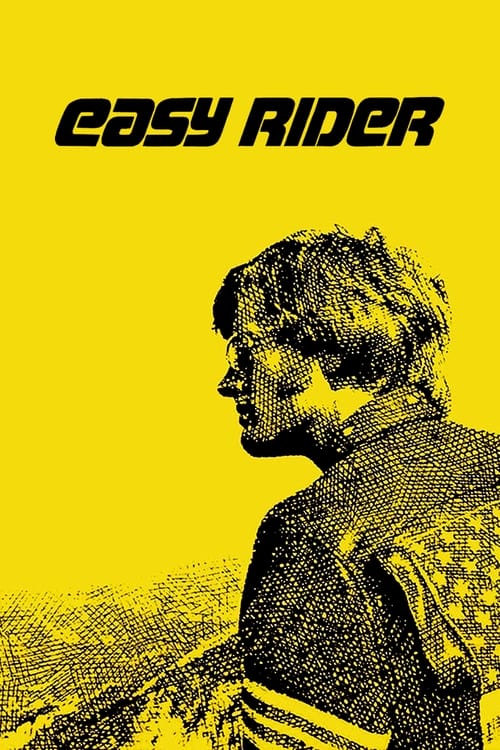
Easy Rider
1969 · Dennis Hopper
For when you want to hit the road without leaving the couch — a hangout movie with a slow-burning edge. It starts as an easy ride and ends up as something to sit with, so save it for a night when you're open to being unsettled.
What it's about
Two long-haired bikers, Wyatt and Billy, close a drug deal in Southern California, stash the cash, and ride their Harleys east toward Mardi Gras in search of something like freedom. Along the way they drift through communes, small towns, and jail cells, picking up strangers and colliding with an America that doesn't want them around. It's a road movie where the road itself — desert highways, campfires, gas stations — is most of the story.
The experience
Loose and sun-baked, it rambles like the trip it depicts: long stretches of rock music and open landscape broken by flashes of hostility that get harder to shake off. The freedom feels real, and so does the growing sense that it can't last.
Performances
Jack Nicholson, as a boozy small-town lawyer who hitches along, walks off with the movie in a handful of scenes — funny, loose, and suddenly piercing; it's the role that made him a star.
The craft
Shot cheap and largely on real locations, with jump-cut transitions, improvised scenes, and a soundtrack of existing rock songs — Steppenwolf, The Byrds — used the way films now take for granted. The Southwest landscapes are genuinely beautiful, and the needle-drop-over-highway sequences still play great loud.
Why it matters
Its runaway success on a tiny budget convinced the studios that young filmmakers and young audiences were the future, helping open the door to the American cinema of the 1970s. It remains the defining film of the counterculture's collision with the country around it.
Snapshot
Easy Rider is the film most often credited with detonating the old Hollywood and clearing ground for the "New Hollywood" of the 1970s. Two long-haired bikers, Wyatt (Peter Fonda) and Billy (Dennis Hopper), sell a cache of cocaine in Los Angeles, stash the proceeds in a Stars-and-Stripes gas tank, and ride east toward Mardi Gras and an inchoate idea of freedom. What begins as a picaresque travelogue across the American Southwest curdles into a parable of national self-destruction: the open road that promises liberation delivers, in the final reel, a shotgun blast from a passing pickup truck. Made for a small budget by a cast and crew working largely outside studio supervision, it returned a windfall that made the major studios suddenly desperate to understand the youth audience they had ignored. Its blend of improvisation, location shooting, drug-culture authenticity, and a wall-to-wall rock soundtrack rewrote the commercial and aesthetic rules of American cinema almost overnight. Whatever its unevenness as a finished object — and it is uneven — Easy Rider is a genuine hinge in film history, a low-budget independent that the industry could neither ignore nor easily replicate.
Industry & production
The film emerged from the orbit of Roger Corman's American International Pictures, the low-budget exploitation house where Fonda, Hopper, and producer Bert Schneider's collaborators had cut their teeth. Fonda and Hopper had already appeared together in AIP biker and LSD pictures (The Wild Angels, The Trip), and the new project was conceived partly as a more personal, more ambitious extension of that cycle. Crucially, financing and production were handled not by AIP but by Raybert Productions — Bert Schneider and Bob Rafelson, fresh from the success of the Monkees — which soon became BBS Productions, with Columbia Pictures distributing. This arrangement, in which a youthful independent company delivered a finished film to a major for distribution, became a template for the next decade.
Fonda is generally credited as producer and originator of the concept, Hopper as director, and the two of them plus Terry Southern as the screenwriters, though the precise division of authorial credit has been disputed for decades, with Hopper and Fonda offering competing accounts of who contributed what. The shoot was famously chaotic: Hopper, directing his first feature, clashed with cast and crew, and the production is widely reported to have been disorganized and tense, particularly during early filming around the Mardi Gras sequences. The budget was small by studio standards — figures in the low hundreds of thousands of dollars are commonly cited, though exact accounting varies across sources — and the film's eventual gross was enormous relative to that outlay, a disproportion that became the stuff of industry legend. I won't assign a specific box-office number here, because the figures quoted in the literature differ and several are unreliable; the durable, verifiable fact is that the return-on-cost was spectacular and that the major studios read it as proof that the counterculture was a vast, untapped market.
Technology
Easy Rider was shot on 35mm color film and is, in technical terms, a fairly conventional production stretched by unconventional circumstances. Its significance lies less in any single new tool than in how cheap, portable equipment and location work were marshaled for a road movie shot largely on real highways and in real towns across the Southwest and South. The camera registers actual desert light, actual motel rooms, actual faces of non-professional locals, lending the film a documentary surface quite unlike studio-bound product of the period. The much-discussed acid-trip sequence in the New Orleans cemetery was achieved with available in-camera and post techniques of the era — fragmentary editing, distorted sound, handheld disorientation — rather than any novel optical process; its power comes from juxtaposition and rhythm more than from technological innovation. The film's most consequential "technology" was arguably commercial and legal rather than photochemical: its use of pre-existing, licensed rock recordings as a wall-to-wall score, which I discuss under Sound and Reception.
Technique
Cinematography
László Kovács, the Hungarian-émigré cinematographer who would become one of the defining image-makers of the New Hollywood, shot the film, and his work is its most consistently admired technical achievement. Kovács photographs the American landscape with a lyricism that the screenplay's hippie mysticism only gestures at: long lenses flattening riders against mesas, lens flares deliberately left in rather than corrected out, low sun raking across the highway. The flares and the embrace of "imperfect," naturalistic light became hugely influential, helping to legitimize a looser, more documentary-inflected photographic style in American features. Kovács alternates this expansive landscape work with cramped, grainier handheld coverage in the threatening human spaces — the small-town café, the jail — so that the visual grammar itself enacts the film's argument that open country is free and settled America is hostile.
Editing
The editing, credited to Donn Cambern, is the element most often singled out as transformative, and it carries much of the film's reputation as a stylistic landmark. Two devices stand out. First, the music-driven montage: long passages of riding set to rock tracks, cut for rhythm and mood rather than narrative information, effectively importing the logic of what would later be called the music video into the feature film. Second, the "flash-forward" transitions between scenes — brief, stuttering bursts of the upcoming shot intercut with the present one before the cut fully lands. These transitions, reportedly arrived at partly through experimentation in the cutting room, gave the film a nervous, anticipatory pulse that felt strikingly modern and was widely imitated. The famously sprawling first assembly is part of the film's lore; the discipline imposed in editing is a large part of why the finished film works at all.
Mise-en-scène / staging
The film's staging oscillates between the carefully iconographic and the frankly improvised. Wyatt's "Captain America" chopper — the stars-and-stripes tank, helmet, and leather — is a deliberately loaded image, an American flag turned into a vehicle and a body, and the film stages its hero as a kind of secular martyr from the outset (the nickname "Captain America," the laying-on of the flag). Against this iconographic precision sits a great deal of loose, semi-documentary staging: the commune sequence, the campfire conversations, the encounters with real townspeople. The commune scenes in particular have the texture of observed reality, peopled with figures who seem to belong to the place rather than to the script.
Sound
Sound is central to the film's identity and to its influence. Easy Rider used a soundtrack of pre-existing rock recordings — including Steppenwolf's "Born to Be Wild" and "The Pusher," The Band, The Byrds, Jimi Hendrix, and others — rather than a composed orchestral score. This was not unprecedented, but the film deployed licensed pop music so extensively and so integrally that it helped establish the compiled rock soundtrack as a commercial and artistic norm, with consequences for both film scoring and the music industry. The choice also tied the film's meaning to a specific cultural moment: the songs are not decoration but argument, carrying the counterculture's voice into a medium that had largely excluded it. Elsewhere the sound design turns expressionist — the fractured audio of the cemetery trip — but it is the songs that listeners remember and that the industry rushed to imitate.
Performance
The performances divide along a deliberate axis. Peter Fonda's Wyatt is interior, watchful, almost beatific — a near-silent center whose stillness invites the audience to read him as a seeker. Hopper's Billy is his volatile opposite, jittery, paranoid, comic and exhausting by turns. The film's single most celebrated performance, however, belongs to Jack Nicholson as George Hanson, the alcoholic small-town ACLU lawyer who joins the pair midway. Nicholson's George — generous, articulate, doomed — gives the film its warmth and its clearest moral voice, and his campfire speech about freedom and how Americans fear it in others is the script's most quoted passage. The role is widely regarded as Nicholson's breakthrough and is the performance that most reliably survives the film's datedness; much of Easy Rider's enduring watchability rests on the stretch of the film that George is alive to inhabit.
Narrative & dramatic mode
Structurally, Easy Rider is a picaresque road movie: an episodic eastward journey strung along a series of encounters — a rancher's family, hitchhikers, a commune, a jail, a café, a brothel — with little conventional plot mechanics and no real antagonist until the anonymous violence of the ending. The dramatic mode is elegiac and increasingly fatalistic. The famous exchange near the end — Wyatt's flat verdict, "We blew it" — refuses to specify what was blown, and the film's refusal to explain itself is part of its method: it offers moods, images, and a sense of foreclosed possibility rather than argument or resolution. The narrative withholds backstory, motivation, and psychological interiority almost entirely, trusting landscape, music, and gesture to carry meaning. This loose, associative construction — closer to European art cinema than to classical Hollywood storytelling — was itself part of the film's novelty for American audiences.
Genre & cycle
The film sits at the intersection of two cycles and effectively transforms both. It descends directly from the AIP biker movie (The Wild Angels and its progeny) and the LSD picture (The Trip), exploitation genres trading on outlaw motorcyclists and drug experience. But Easy Rider sublimates that exploitation material into something closer to art cinema, and in doing so it helped inaugurate the modern American "road movie" as a vehicle for national self-examination — a lineage that runs forward through Two-Lane Blacktop, Vanishing Point, Badlands, and beyond. It also belongs to the brief, intense cycle of late-1960s/early-1970s "youth pictures" that the studios greenlit in its wake, hoping to bottle the same lightning. Its generic significance, then, is double: it is a culmination of the biker-exploitation cycle and the origin point of a more reflective road-movie tradition.
Authorship & method
Authorship of Easy Rider is genuinely contested, and honesty requires saying so plainly. The screenplay is credited to Peter Fonda, Dennis Hopper, and Terry Southern, but the three principals and later commentators have given conflicting accounts of who contributed the concept, the structure, and the key lines, and these disputes have never been fully resolved. What can be said with confidence: Fonda generated and produced the project and embodied its iconography; Hopper directed it, shaping its improvisational, location-driven method and its editing experiments, and Easy Rider launched his erratic, legendary career as a filmmaker. The method itself was loose and collaborative to the point of chaos — improvised dialogue, real locations, non-professional performers, footage shot in volume and disciplined later in the cut.
The key collaborators are essential to the film's quality. Cinematographer László Kovács supplied the landscape lyricism and the legitimized lens flare. Editor Donn Cambern shaped the music montages and the flash-forward transitions that define the film's rhythm. There is no traditional composer; the "score" is a curated compilation of licensed rock recordings, a choice as consequential as any single creative decision in the film. Behind the camera, producer Bert Schneider and the Raybert/BBS structure gave Hopper the freedom — and the studio cover — to make the film his way.
Movement / national cinema
Easy Rider is a foundational text of the New Hollywood (or "Hollywood Renaissance"), the late-1960s-to-1970s period in which a generation of younger filmmakers, emboldened by the collapse of the Production Code and the studios' financial desperation, made personal, formally adventurous, often pessimistic films for a mass audience. The film is frequently bracketed with Bonnie and Clyde (1967) and The Graduate (1967) as the breakthroughs that opened this period, and its commercial success in particular is credited with convincing studios to fund youthful, director-driven projects. It is unmistakably American in subject — its very theme is the American promise and its betrayal — but its formal DNA is partly European, absorbing the freedoms of the French and broader international new waves into a domestic idiom.
Era / period
The film is inseparable from its precise historical moment: 1969, near the end of a decade defined by Vietnam, civil-rights struggle, assassinations, the counterculture, and a widening generational rupture. It arrived in the same cultural season as Woodstock and shortly before the disillusionments — Altamont, Manson, the grind of the war — that are often said to have ended the 1960s' utopian phase. The film's darkening arc, from the euphoria of the open road to murder by reactionary strangers, reads now as an almost uncannily timed elegy for the counterculture's hopes, registering the souring of the moment even as that moment was still underway. Its drug use, its long hair, its rock soundtrack, and its rural-American hostility were all immediately legible cultural signs in 1969, which is part of why the film landed with such force and why some of it has dated.
Themes
The film's governing theme is freedom and its impossibility in America — the gap between the nation's mythology of liberty and its violent intolerance of those who actually try to live freely. George's campfire monologue states the thesis directly: people talk about freedom but are frightened and made murderous by the sight of someone who is genuinely free. Adjacent themes cluster around this core: the road and the frontier myth, reworked so that westward (here, eastward) movement leads not to renewal but to death; the commodification of the counterculture, hinted at in the drug money that funds the journey; community versus rootlessness, dramatized in the ambivalent commune sequence; and a strain of inarticulate spiritual seeking that the film treats with sincerity even as it refuses to fulfill it. "We blew it" condenses the film's self-critique: the dream was available and was somehow squandered, by the seekers as much as by their killers.
Reception, canon & influence
Critical reception in 1969 was strong and the cultural impact immediate; the film was a sensation, particularly among young audiences, and it received recognition at Cannes and in awards season, with Nicholson's performance singled out for acclaim. Critics were not uniformly admiring — some found the film self-indulgent, its mysticism vague, its structure slack — and that mixed quality has carried into later reassessment, where the film is often praised as a landmark while being judged less than fully achieved as a work of art. It is, in other words, more secure as a historical hinge than as a masterpiece, and the better criticism has long acknowledged both facts at once.
Influences on the film (backward): the AIP biker and LSD cycles (The Wild Angels, The Trip) that gave it its raw material and personnel; the European art cinema and new waves whose episodic, associative construction it absorbed; the documentary impulse of 1960s direct cinema, visible in its location work and non-professional faces; and the counterculture itself, whose music, drug experience, and iconography it imported wholesale.
Legacy (forward): the influence is hard to overstate. Commercially, Easy Rider persuaded the major studios that low-budget, youth-oriented, director-driven films could be enormously profitable, accelerating the New Hollywood and the careers of the filmmakers who defined it; BBS Productions went on to produce key films of the period. Aesthetically, it normalized the compiled rock soundtrack, the lens flare and naturalistic location photography, and music-montage and flash-cut editing, all of which became part of the standard vocabulary of American film and, later, of advertising and music video. Generically, it fathered the reflective American road movie. It launched Jack Nicholson toward stardom and gave Hopper a directorial legend he spent decades complicating. The film has since been inducted into the canon of essential American cinema and preserved as a culturally significant work. Its deepest legacy may be paradoxical: a scrappy independent that taught the studios how to absorb the counterculture — and, in doing so, helped end the very moment of independence it embodied.
A Deleuzian reading
Start with the flares.
The full Deleuzian reading of Easy Rider →
Reception
A shock smash in 1969 — a $400k biker picture that outgrossed studio behemoths and helped kick off New Hollywood — it's now viewed less as a living masterpiece than as a founding document: essential history that some modern viewers find more fascinating as a time capsule than as a movie.
How Easy Rider was received, from release to now →
Influences: the films it descends from and the films it influenced
- Scorpio Rising (1963) — Cut biker iconography to a wall-to-wall jukebox of licensed pop records, inventing the needle-drop montage-as-score that Easy Rider industrialized into the compiled rock soundtrack.
- The Wild Angels (1966) — Established the AIP biker-exploitation template and supplied Fonda plus the real-Harley, real-location, semi-documentary staging Easy Rider lifted wholesale.
- The Trip (1967) — Was the LSD-montage workshop for Nicholson (writer), Hopper and Fonda — its fragmented, superimposed psychedelic cutting becomes the New Orleans acid sequence.
- Breathless (1960) — Modeled the elliptical jump-cut grammar, location improvisation, and picaresque looseness Easy Rider absorbed from the nouvelle vague.
- Bonnie and Clyde (1967) — Proved the youth box office for director-driven New Hollywood and codified the abrupt ambush death and elegiac fatalism Easy Rider's ending echoes.
- Faces (1968) — Pioneered the improvised dialogue, non-professional faces, and handheld semi-documentary intimacy that shaped Hopper's loose, shoot-in-volume method.
- The Searchers (1956) — Supplied the long-lens Western landscape iconography — the lone figure dwarfed by monumental American space — that Kovács restages on motorcycles.
- Five Easy Pieces (1970) — BBS follow-up reuniting Nicholson and cinematographer László Kovács to extend the rootless, episodic picaresque into character study.
- Two-Lane Blacktop (1971) — Strips the road movie to existential abstraction with non-actors and an ending that literally burns through the film, deepening Easy Rider's elegiac fatalism.
- Vanishing Point (1971) — Carries the compiled-rock, long-lens-landscape road movie to its purest form, ending in the same self-destructive fatal crash.
- The Last Movie (1971) — Hopper pushes Easy Rider's improvisational shooting and associative, anti-continuity editing to a deliberately fractured extreme.
- Badlands (1973) — Extends the Kovács magic-hour, long-lens landscape lyricism over a picaresque fugitive drive, pairing it with detached voiceover.
- Mean Streets (1973) — Builds its scenes around a wall-to-wall jukebox of licensed rock records, inheriting Easy Rider's compiled-soundtrack-as-score directly.
- Thelma & Louise (1991) — Reworks the open-road movie of freedom-and-its-betrayal into a fatal final leap, the road as escape that can only end in death.
- My Own Private Idaho (1991) — Revives the picaresque road structure with long-lens empty-highway landscapes and time-lapse lyricism over a wandering, marginal protagonist.
- Almost Famous (2000) — The first American fiction film to structure a road narrative through a curated pre-existing rock catalog as its primary compositional score, establishing the template Almost Famous inherits: licensed songs that constitute rather than merely illustrate the emotional logic of the journey.
- Fear and Loathing in Las Vegas (1998) — Hopper deploys Steppenwolf, the Byrds, and Hendrix not as score but as cultural timestamp whose recognizability renders visible the countercultural myth it can no longer sustain — the needle-drop-as-elegy strategy that Thompson's wave-speech voiceover and Gilliam's soundtrack directly inherit.
- Blow (2001) — Blow's opening California marijuana-trade sequences draw on Easy Rider's cinematographic vocabulary: wide-angle, sun-drenched 35mm images framing counterculture drug commerce as American freedom, establishing the precise visual grammar through which Kuras codes Jung's 1960s years.
- McCabe & Mrs. Miller (1971) — Hopper's decision to build the film's emotional architecture from pre-existing rock songs rather than commissioned scoring — treating recorded cultural artifacts as a formal vocabulary — is the direct precedent for Altman's appropriation of three Leonard Cohen songs, a choice that works identically: the songs arrive pre-loaded with associations that exceed what any original score could carry.
- Midnight Cowboy (1969) — Same-year counterculture picaresque using flash-forward inserts and music-montage cutting to fracture a doomed cross-country drift.
- Butch Cassidy and the Sundance Kid (1969) — Hopper assembled the film from wall-to-wall contemporary rock and folk songs played non-diegetically over road-movie imagery, extending the anachronistic-pop-score approach Goldman and Bacharach introduced simultaneously — both films treating popular song as elegiac commentary on doomed American outlaw freedom.
- The Graduate (1967) — The Graduate's deployment of Simon and Garfunkel's pre-existing tracks as a replacement for composed underscore directly licensed Hopper's decision to score attitude and movement entirely through pre-existing rock recordings, establishing the template that replaced Hollywood orchestral scoring for a generation.
- The Pawnbroker (1965) — Its premonitory flash-forward inserts and flash-frame scene transitions adopt The Pawnbroker's subliminal-cut vocabulary as a marker of New Hollywood editing freedom.
- Il Sorpasso (1962) — Independently codifies the modern road movie's fusion of pop-soundtracked freedom-on-the-highway with an abrupt fatal highway ending — the same structural bet Sorpasso made on the automobile plus a shock death.
- Targets (1968) — Kovács's other 1969 landmark: the same telephoto compression of highway and small-town Americana, and the same sudden roadside shooting delivered without musical warning or a reaction shot to soften it.
Similar films
- Five Easy Pieces (1970) — influence & lineage · same viewing thread · often watched together
- Bonnie and Clyde (1967) — influence & lineage
- Two-Lane Blacktop (1971) — influence & lineage
- Midnight Cowboy (1969) — influence & lineage
- Breathless (1960) — influence & lineage
- My Own Private Idaho (1991) — influence & lineage
- Faces (1968) — influence & lineage · same viewing thread
- American Graffiti (1973) — shared sensibility
All the films related to Easy Rider →
Watch it with: curated runs of related films
- New Hollywood Unravelings — Watch these together for the rawest strain of New Hollywood — loose, lived-in character studies of Americans who can't hold the shape their lives demand.