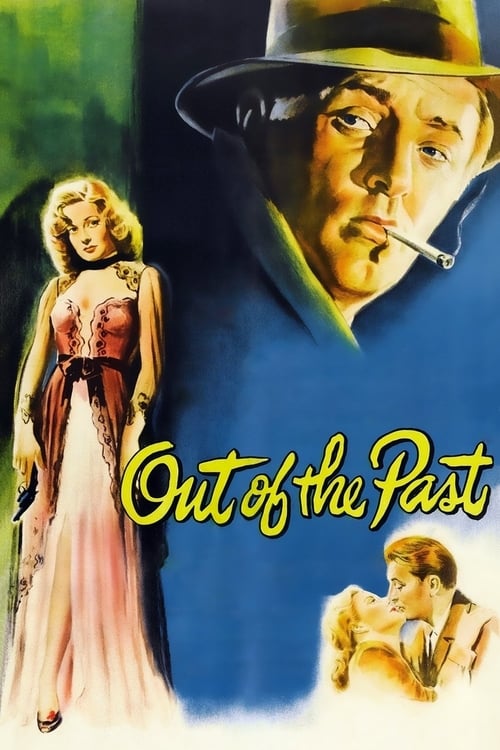
Out of the Past
1947 · Jacques Tourneur
For a rainy night when you want smoke, shadows, and razor-sharp talk — the definitive 'pour a drink and watch a classic' pick. Comfort viewing for anyone who likes their comfort laced with fatalism.
What it's about
A gas-station owner in a sleepy mountain town has built a quiet life and a sweet romance — until a stranger drives in and calls him back to the man he used to be. Years earlier he was a private detective hired by a gangster to find the mistress who shot him and ran with his money; what he found instead was trouble he never escaped. Now the old debt comes due, and he's pulled into one last job rigged against him.
The experience
Cool, fatalistic, and endlessly quotable — the dialogue crackles, the plot coils through double-crosses, and the whole thing moves with an unhurried confidence that makes the doom feel inevitable. It's tense but also purely pleasurable, the kind of film you sink into like a booth in a dark bar.
Performances
Robert Mitchum defines laconic cool as the detective who knows he's doomed and lights a cigarette anyway; Jane Greer is one of the screen's great femme fatales, angelic and lethal in the same glance; Kirk Douglas radiates smiling menace as the gangster.
The craft
Nicholas Musuraca's black-and-white photography is a masterclass in shadow — cigarette smoke, venetian blinds, and night-for-night menace — while Tourneur directs with an elegance that lets the fatalism seep in rather than shout. The flashback structure and world-weary narration became the template everyone else borrowed. Gorgeous on a big screen.
Why it matters
Now ranked among the two or three defining films noir ever made, it set the standard for the doomed-detective story and turned Mitchum into an icon of the genre.
Snapshot
Out of the Past is among the most fully realized films of the American noir cycle — a picture whose reputation has only deepened since its modest 1947 release. Adapted by Daniel Mainwaring from his own novel Build My Gallows High (published under the pseudonym Geoffrey Homes), it traces Jeff Bailey, a small-town gas-station proprietor whose buried history as a private detective resurfaces when a former employer summons him back into a web of betrayal, murder, and obsessive desire. The film distills noir's essential proposition — that the past is not behind a man but ahead of him, waiting — into an almost geometrically perfect plot of double- and triple-crosses. Directed by Jacques Tourneur, photographed by Nicholas Musuraca, and anchored by Robert Mitchum, Jane Greer, and Kirk Douglas, it is a work in which fatalism is not merely a theme but a structural principle. If a single American film is to stand as the genre's emblem, Out of the Past is the most frequently nominated candidate, prized for the suavity of its menace, the density of its dialogue, and the cool, doomed glamour of its leads.
Industry & production
Out of the Past was produced by RKO Radio Pictures, the smallest and most financially precarious of the major Hollywood studios, and the one whose house style — economical budgets, atmospheric lighting, a tolerance for the morbid and the strange — proved unusually hospitable to noir. The studio had already incubated the form through Val Lewton's horror unit (on which Tourneur, Musuraca, and editor associates had honed a low-key visual language) and through Murder, My Sweet (1944) and The Stranger (1946). The source was Mainwaring's 1946 novel; Mainwaring, writing as Geoffrey Homes, adapted it himself, and the screenplay's literate, epigrammatic dialogue is one of the film's signatures. The historical record indicates additional uncredited script work — James M. Cain and Frank Fenton are commonly named in accounts of the production — though the precise division of labor is not firmly documented, and any apportioning of specific lines should be treated with caution.
The casting reflected RKO's roster and ambitions. Robert Mitchum, recently nominated for The Story of G.I. Joe (1945), was being groomed as a leading man, and Out of the Past consolidated the laconic, heavy-lidded persona that would define him. Jane Greer was an RKO contract player whose career had been shadowed by Howard Hughes's controlling interest in the studio and in her; her Kathie Moffat became the role of her life. Kirk Douglas, on loan and near the start of his screen career, played against his later heroic image as the smooth gangster Whit Sterling. The film was shot in part on location — Bridgeport and the eastern Sierra around the Lake Tahoe and Mexico-substitute exteriors lend the picture a documentary breath of fresh air against its nocturnal interiors. Box-office figures from the period are not reliably available here; the film performed respectably without being a sensation, and its canonization came later.
Technology
The film was produced in black-and-white on the standard Academy ratio (roughly 1.37:1) using the orthochromatic-to-panchromatic 35mm stocks and the studio camera and lighting technology standard to late-1940s Hollywood. Its technological interest lies not in novelty but in the expressive exploitation of mature tools: fast lenses and sensitive panchromatic film stock that could register detail in near-darkness; tungsten lighting instruments capable of hard, directional throws and crisp shadow edges; and optical printing for the dissolves that stitch its flashback structure together. Sound was recorded and reproduced via the optical-track systems universal to the studio system. There were no process innovations on the order of a new format or color system; rather, Out of the Past represents the point at which the German-derived, Lewton-refined low-key idiom had become a fully portable studio craft — reproducible, controllable, and economical enough for an RKO budget.
Technique
Cinematography
Nicholas Musuraca's photography is the film's most celebrated technical achievement and a foundational document of noir style. Musuraca favored a single dominant, often low and raking key light, allowing large portions of the frame to fall into genuine black rather than the softly modeled grays of conventional studio glamour. Faces are repeatedly split by shadow; venetian-blind and window-frame patterns striate walls and bodies; lamps and practicals within the frame motivate pools of light surrounded by encroaching dark. Crucially, Musuraca alternates these claustrophobic nocturnes with luminous, high-key exteriors — the Sierra daylight, the Acapulco sun — so that the visual scheme dramatizes Jeff's oscillation between a possible clean life and the darkness that reclaims him. The camera is typically poised and classical rather than flamboyant, trusting composition and light over movement; when it does move, it tends to consolidate a trap rather than open a space.
Editing
The editing (credited to Samuel E. Beetley) serves a famously intricate narrative architecture. The film's long central flashback — Jeff narrating his original assignment to find Kathie — is bridged by dissolves and threaded by voice-over, and the cutting maintains exceptional clarity across a plot whose reversals could easily bewilder. The rhythm is patient in the romantic and expository passages and tightens in the set-pieces of violence and entrapment. The flashback's return to the present is managed so that the audience, like Jeff, feels the past close over the present rather than simply end. The film's coherence under such plot density is itself an editorial accomplishment.
Mise-en-scène / staging
Tourneur stages for entrapment. Doorways, staircases, fishing nets, café interiors, and the cramped offices of the crime plot are composed so that characters are boxed by architecture and by one another. The contrast between the open, sunlit small town of Bridgeport — with its deaf-mute boy, its trout streams, its wholesome girlfriend Ann — and the shadowed urban and resort interiors of the past is a sustained spatial argument about which world is real and which is borrowed time. Tourneur, schooled in the Lewton unit's principle that the unseen frightens more than the shown, stages key turns with restraint: violence is often glancing, off-center, or implied, and the most charged moments are exchanges of glances and lines rather than action.
Sound
Roy Webb's score, in the RKO house manner he had refined on the Lewton films, leans on romantic-fatalistic themes that swell around Kathie and recede into unease elsewhere; it underscores the doomed eroticism without commenting on it cynically. Equally important is the film's prized dialogue, delivered as a kind of verbal music — the clipped, allusive, double-edged speech that has been endlessly quoted. The sound design's restraint (ambient quiet, the report of a single shot, the click of a lighter) lets the words and Webb's themes carry the atmosphere. As with much studio-era sound, granular technical documentation is thin, but the aesthetic effect — language as both seduction and weapon — is unmistakable.
Performance
The performances established or redefined three careers. Mitchum's Jeff Bailey is the template for the noir protagonist as fatalist: outwardly relaxed, inwardly resigned, his minimalism reading as a man who already knows how the story ends. Jane Greer's Kathie Moffat is one of the cinema's definitive femmes fatales precisely because she is not a stylized vamp but a soft-voiced, seemingly vulnerable woman whose treachery is bottomless; Greer reportedly played her on a directive to be neither plainly good nor plainly bad, and the resulting ambiguity is lethal. Kirk Douglas's Whit is genially menacing, the velvet over the threat. The supporting playing — Rhonda Fleming, Paul Valentine, Dickie Moore as the deaf-mute "Kid" whose final gesture supplies the film's ambiguous grace note — is calibrated to the same key of understatement.
Narrative & dramatic mode
The film is a paradigm of noir's retrospective, confessional structure. Its present-tense frame — Jeff dragged back into Whit's orbit — encloses a long first-person flashback in which Jeff recounts his fall, narrated to Ann as they drive toward Whit's. This architecture makes the plot a machine of doom: because the past is narrated, the protagonist's destruction is foreordained from the first reel, and the suspense lies not in whether he will escape but in watching the trap articulate itself. The dramatic mode is tragic-ironic. Jeff is neither innocent nor master of events; his fatal flaw is less greed than a susceptibility to Kathie and an inability to keep the clean life he has improvised. The dialogue's epigrammatic wit functions as a stay against despair — a way of narrating one's own damnation with style. The plotting is intricate to the point of legend, layering crosses and counter-crosses, and the film trusts the viewer to stay slightly behind, which is itself a thematic stance: knowledge always arrives too late.
Genre & cycle
Out of the Past sits at the high-classical center of the American film noir cycle, conventionally dated from the early 1940s to the late 1950s. It draws together the cycle's defining elements: the private eye, the femme fatale, the flashback-and-voice-over structure, the doomed romance, the corrupt money behind the violence, and the visual rhetoric of low-key lighting and unstable space. It belongs to the hardboiled-detective strain descended from Hammett and Chandler — its source novelist worked the same vein — but transposes the detective's cynicism into something closer to romantic tragedy. Within the cycle it is often paired with Double Indemnity (1944) and The Maltese Falcon (1941) as a touchstone, and it is frequently invoked when critics define noir's essence rather than its margins. It also exemplifies the "small studio" noir, where budget constraint and a tolerance for fatalistic endings combined to produce some of the cycle's purest work.
Authorship & method
Out of the Past is best understood as the convergence of an unusually coherent group of craftsmen. Jacques Tourneur, the French-born son of director Maurice Tourneur, brought from the Lewton horror unit a method founded on suggestion, atmosphere, and the expressive power of shadow and restraint; his direction is elegant, unhurried, and trusting of the audience, eschewing flamboyance for an accumulating sense of inevitability. Nicholas Musuraca, RKO's master of low-key photography and Tourneur's collaborator on Cat People (1942), supplied the visual signature. Roy Webb, the studio's prolific composer and another Lewton-unit veteran, provided the romantic-fatalistic score. Daniel Mainwaring (Geoffrey Homes) furnished both the story and the celebrated screenplay, with likely uncredited contributions that remain imperfectly documented. Samuel E. Beetley edited. The film is thus a studio-system "authorship" in the truest sense — not the imprint of a single auteur imposing vision on resistant material, but a house style, perfected across a series of pictures, finding its ideal vehicle. Tourneur's relative modesty as a self-promoter long left his contribution undervalued; later auteurist and noir scholarship restored him as a major stylist precisely on the evidence of this film.
Movement / national cinema
The picture belongs to American studio filmmaking but is unthinkable without European antecedents. Film noir as a whole drew on German Expressionism's chiaroscuro and distorted, psychologized space, carried to Hollywood by émigré directors and cinematographers; on French poetic realism's fatalistic romanticism; and on the American hardboiled literary tradition. Tourneur, raised partly in France and the son of a French director, was himself a conduit between European pictorial sensibility and American genre material, as was the broader Lewton unit's transatlantic culture. Out of the Past nationalizes these inheritances into something distinctly American — its geography of California small towns, Mexican resorts, San Francisco, and Lake Tahoe; its idiom of wisecrack and understatement — while retaining the European tonality of doom. It is, in this sense, a model instance of how a transnational set of influences was synthesized into a native genre.
Era / period
Released in November 1947, the film is a product of the immediate postwar moment that gave noir its fullest flowering. The cycle's preoccupations — disillusion, moral exhaustion, the impossibility of returning to an uncomplicated civilian peace, the corrosive power of money and desire — answered a national mood beneath the official optimism of victory. Jeff Bailey's attempt to bury a violent past under a placid small-town present, and the past's refusal to stay buried, can be read against a culture of veterans trying to reassemble ordinary lives. The film also arrives at the threshold of the Hollywood blacklist era; several noir personnel, including Mainwaring, would later run afoul of the period's politics. Without overstating a direct topical allegory — the film makes no explicit political argument — its fatalism is legibly of its postwar instant.
Themes
The governing theme is the inescapability of the past: not as memory but as agency, an active force that hunts the man who fled it. Around this orbit several others. Fate and complicity: Jeff is doomed less by external malevolence than by his own choices and desires, which the flashback structure renders as already-sealed. The duplicity of desire: Kathie embodies an eroticism inseparable from danger, and the film refuses to sentimentalize romantic love, presenting it as the very mechanism of destruction. Two Americas: the luminous, redeemable small town set against the shadowed world of money and crime, with the deaf-mute Kid — who cannot speak the corrupting words — as a figure of innocence and, in the ending, of a mercy that may be a lie told to protect the living. Knowledge and belatedness: truth in this world always arrives too late to save anyone. Style as resistance: the characters meet their fates with wit, as if the only freedom left is the manner of one's ruin.
Reception, canon & influence
On release, Out of the Past was received as a competent, well-made entry in a crowded field — admired for its atmosphere and stars but not immediately singled out as a masterpiece. Its towering reputation is a product of later reappraisal: the French critical rediscovery of American noir, the rise of auteurist and genre criticism in the 1960s and 1970s, and the subsequent scholarship that made the film a fixed point in any account of the form. It has since been widely regarded as one of the supreme examples of film noir and was selected for preservation in the United States National Film Registry by the Library of Congress, a marker of its canonical standing.
Influences on the film (backward): the hardboiled detective fiction of Hammett and Chandler and Mainwaring's own kindred novel; the visual grammar of German Expressionism as filtered through émigré Hollywood; French poetic realism's romantic fatalism; and, most proximately, the Val Lewton RKO horror unit, whose principles of suggestion, shadow, and economy Tourneur, Musuraca, and Webb carried directly into the picture.
Legacy (forward): the film became a template for the noir protagonist and the femme fatale, and a touchstone for the genre's later students and revivers. Its DNA is visible across neo-noir, and it was explicitly honored by the 1984 remake Against All Odds, in which Jane Greer appeared in a new role — a direct line from the original. More diffusely, its fatalistic structure, its cool epigrammatic dialogue, and Mitchum's template of resigned masculinity shaped how subsequent filmmakers imagined the doomed investigator and the deadly woman. Tourneur's own standing as a major American stylist rests substantially on this film, and its frequent appearance on critical and institutional lists of the greatest noirs has made it, for many, the genre's definitive single work.
A Deleuzian reading
A man in a clean shirt pumps gas in a mountain town.
The full Deleuzian reading of Out of the Past →
Reception
In 1947 it was just another well-made RKO crime picture, respectfully reviewed and quickly forgotten; decades of revival screenings and noir scholarship turned it into the film many now call the definitive film noir, sealed by a National Film Registry induction in 1991.
How Out of the Past was received, from release to now →
Influences: the films it descends from and the films it influenced
- Le Jour se lève (1939) — Carné's flashback architecture — a trapped man reconstructing the chain of events that condemned him — is the poetic-realist template for the film's dissolve-bridged retrospective and inevitability.
- Double Indemnity (1944) — The defining noir machine of confessional flashback-voiceover plus the destroying femme fatale, establishing the doomed-narrator structure Out of the Past refines into pure fatalism.
- Murder, My Sweet (1944) — RKO's Chandler adaptation pioneered first-person detective voiceover and subjective expressionist lighting on the same lot, the house style Out of the Past perfects.
- The Killers (1946) — A sibling built on fractured flashback testimony and a man passively accepting his fate, with Siodmak's deep-shadow émigré lighting echoing Musuraca's.
- The Postman Always Rings Twice (1946) — Extends the voiceover-confession fatalism and the deadly-couple-on-the-run structure, with a femme fatale whose white-bright introduction echoes Cora's calculated wardrobe entrance.
- The Mask of Dimitrios (1944) — Extends the nested-flashback recounting of a doomed criminal past narrated to a listener, wrapped in the same low-key shadow photography.
- Night of the Demon (1957) — Tourneur's own later masterpiece reasserts the suggestion-over-showing doctrine — dread built from shadow and the half-glimpsed — confirming it as his signature method, not a Lewton accident.
- Body Heat (1981) — Explicitly revives the Out of the Past template: a passive, sardonic man destroyed by a manipulating femme fatale, with sun-and-shadow lighting consciously quoting classic chiaroscuro.
- Blood Simple (1984) — Neo-noir descendant extending the entrapment-composition and fatalist machinery — characters ensnared by their own schemes in low-key, shadow-carved frames descended from Musuraca.
- Touch of Evil (1958) — Nicolas Musuraca's deep-shadow night-for-night exterior photography — pooling blacks, hard key lights bleaching faces near-abstract — codified the noir chiaroscuro grammar that Touch of Evil absorbs wholesale and then pushes to terminal formalization, treating the visual style itself as a moral system being exhausted.
- Le Samouraï (1967) — Tourneur's use of long focal lenses to isolate the noir protagonist within wide, emptied location frames — the professional as lone figure against urban indifference — directly prefigures Decaë's framing strategy for Costello; the fatalistic professional trapped within a system that requires his elimination is Tourneur's structural bequest to Melville.
- Memento (2000) — Supplies the chiaroscuro lighting grammar and the doomed protagonist whose own narrated past is the trap closing on him, the moral universe Memento transplants into neo-noir.
- Mona Lisa (1986) — Establishes the romantic-fatalist femme fatale template — the smitten man who reads tenderness into a woman's deception — that Jordan revises by making George's idealization, not the woman's treachery, the engine of doom.
- The Friends of Eddie Coyle (1973) — Establishes Mitchum's hooded, minimalist underplaying — the weary, already-defeated fatalist who speaks softly and expects the worst — the exact persona Yates exploits in Coyle's resignation.
- Shutter Island (2010) — Flashback-narration noir in which a doomed man reconstructs his own undoing, the unreliable-retrospective architecture underlying Teddy's investigation.
- Invasion of the Body Snatchers (1956) — Screenwriter Daniel Mainwaring's own noir; its hardboiled fatalism and doomed narration are the sensibility he transplants into Bennell's voice.
- Le Doulos (1962) — Models noir fatalism delivered through flashback architecture and a doomed protagonist narrating his way to a death already decided — the structural fatalism Le Doulos inherits.
- House of Games (1987) — Provides noir's fatalist moral economy and the femme fatale who out-maneuvers the protagonist — the visual palette and the structure of a mark doomed by his own desire.
- Cat People (1942) — The direct predecessor: same Tourneur-Musuraca-Webb Lewton unit, establishing the method of low-key shadow and off-screen suggestion (the unseen menace) that Out of the Past transposes from horror to noir.
- I Walked with a Zombie (1943) — Tourneur's Lewton-unit fatalism and atmospheric restraint — narration carrying a doomed mood across moonlit, shadow-pooled exteriors — prefigures the film's romantic-fatalistic voiceover and rural lyricism.
- The Leopard Man (1943) — Tourneur/Musuraca's economy of terror through sound and what is withheld from frame — the principle of suggestion over showing — is the same staging grammar applied to noir menace.
- Stranger on the Third Floor (1940) — Musuraca's earlier RKO experiment in expressionist nightmare lighting — distorted shadow as psychological state — is the visual seedbed of his low-key signature here.
- M (1931) — The German Expressionist grammar of menacing shadow, entrapping geometry, and the predator framed by his own darkness — filtered through émigré Hollywood into the film's chiaroscuro.
- Pépé le Moko (1937) — French poetic-realist fatalism — the doomed man who cannot escape his past or the woman who undoes him — supplies the romantic-fatalistic structure Mainwaring's script inherits.
- The Maltese Falcon (1941) — The hardboiled detective idiom of Hammett — terse, distrustful epigrammatic dialogue as a weapon and the duplicitous woman — codifies the verbal style Mitchum's Jeff inherits.
- The Big Sleep (1946) — A sibling in the Chandler hardboiled mode — labyrinthine plotting subordinated to mood and the duel of seductive, weaponized dialogue between detective and dangerous woman.
- Gilda (1946) — A contemporaneous sibling crystallizing the femme fatale as erotic trap, the deadly woman whose allure is inseparable from the protagonist's ruin.
- Chinatown (1974) — Neo-noir descendant inheriting the fatalistic detective structure — an investigator drawn ever deeper toward a doom he cannot avert — and the cool, doomed epigrammatic register.
- Against All Odds (1984) — The literal remake — re-staging Mainwaring's plot of the hired man undone by the woman he's sent to retrieve, with Jane Greer recast as a direct genealogical link.
- The Treasure of the Sierra Madre (1948) — Tourneur's and Nicholas Musuraca's contemporaneous noir provides the clarifying contrast to McCord's Sierra Madre work: where Out of the Past deploys expressive chiaroscuro pools as psychological correlative, McCord casts shadows where the sun places them — both films externalizing moral states through cinematography, but through opposed techniques that define the boundary between noir and documentary realism.
Similar films
- Double Indemnity (1944) — influence & lineage
- The Maltese Falcon (1941) — influence & lineage
- Murder, My Sweet (1944) — influence & lineage
- Chinatown (1974) — influence & lineage
- The Big Sleep (1946) — influence & lineage
- Daybreak (1939) — influence & lineage
- The Killers (1946) — influence & lineage
- Laura (1944) — shared sensibility
All the films related to Out of the Past →