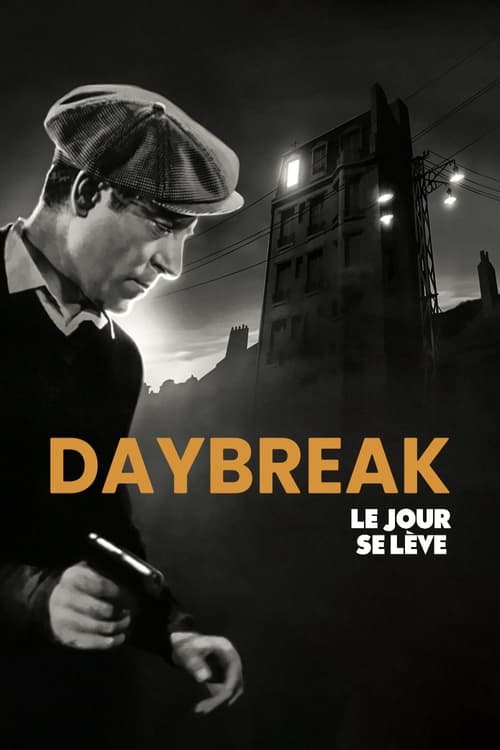
Daybreak
1939 · Marcel Carné
For a late night when you want something moody and fated — a doomed-love picture to sink into rather than escape from, more haunting than fun.
What it's about
A factory worker has just shot a man dead. Barricaded in his top-floor room with police massing in the street below, he smokes, paces, and remembers — and through one long night of flashbacks the film pieces together how a decent, ordinary man and a tangled romance brought him to this locked door, with daybreak coming whether he's ready or not.
The experience
Fatalistic and hypnotic — you know from the first minutes where this is headed, and the film turns that certainty into slow-tightening dread. It's romantic and doomed in equal measure, heavy with prewar shadow.
Performances
Jean Gabin is the whole tragedy in one weary face: the definitive doomed working-man of prewar French cinema, tough and tender at once, and heartbreaking without ever raising his voice.
The craft
Marcel Carné builds the film around a single besieged room and a flashback structure that was bold for 1939 and became a template for crime cinema after. The studio-built street, the smoke, the shadows — everything is designed toward one mood of entrapment, and the poetic dialogue gives ordinary people the weight of tragedy.
Why it matters
The culminating masterwork of French poetic realism, made on the eve of the Second World War, and a direct ancestor of film noir — its flashback-driven fatalism echoed through decades of crime movies.
Snapshot
Le Jour se lève — released in France in June 1939 and known to Anglophone audiences as Daybreak — is the culminating masterwork of French poetic realism and, with Le Quai des brumes (1938), the film that fixed Jean Gabin forever as the doomed proletarian hero of prewar French cinema. Its premise is deceptively simple: a factory worker named François has just shot a man dead and has barricaded himself in his top-floor room while police mass in the street below. Over one sleepless night he smokes, paces, and remembers; through his memories the film reconstructs how an ordinary decent man was driven to murder. As the title promises, day breaks — and with it comes the film's fatal reckoning. Made on the very eve of the Second World War, the film distills an entire national mood of entrapment and foreboding into a single besieged room, and it remains one of the most admired French films of the sound era.
Industry & production
Le Jour se lève was produced by Productions Sigma, an independent French outfit, at a moment when the French industry was a patchwork of small production companies rather than vertically integrated studios on the Hollywood model. It reunited the creative nucleus that had made Carné a leading director in barely three years: producer-side backing for a Carné–Prévert–Trauner collaboration, with Gabin — by then the single most bankable dramatic star in France — as the anchor. Gabin's participation was itself a form of production insurance; his screen persona guaranteed both financing and audience.
The picture was shot largely in the studio, as was the poetic-realist norm, with its entire world essentially built rather than found — a decision inseparable from Alexandre Trauner's designs (see below). The exact budget and box-office returns are not something I can state with confidence; precise financial figures for French productions of this period are unevenly documented, and I will not invent them. What is securely established is the film's afterlife as a commodity: RKO acquired remake rights and produced The Long Night (1947), and in doing so the American studio reportedly attempted to withdraw and suppress prints of Carné's original to protect its remake — a notorious episode of commercial vandalism from which the film was fortunately recovered and later restored.
The film also collided directly with history. Released weeks before the outbreak of war, Le Jour se lève was banned by French authorities during wartime mobilization as demoralizing — a judgment that testifies to how acutely contemporaries felt its pessimism to mirror the national predicament.
Technology
The film was made with the standard sound-on-film apparatus of the late-1930s French studio: 35mm black-and-white photography, orthochromatic-to-panchromatic stock lit for deep tonal contrast, and post-synchronized and direct sound recording typical of the period. There is no technological novelty of the flashy kind here — no color, no widescreen, which lay far in the future — and the film's importance lies not in apparatus but in the refinement of existing tools. The one domain where technology and art fuse is the studio-built environment: the entire apartment block, street, and factory milieu were constructed to allow total control of light, atmosphere, and camera placement, the enabling condition for the film's chiaroscuro and its claustrophobic geometry.
Technique
Cinematography
The photography is credited principally to Curt Courant, a German émigré cinematographer whose career had already taken in work with Fritz Lang, Alfred Hitchcock (The Man Who Knew Too Much, 1934), and Jean Renoir (La Bête humaine, 1938); he was assisted, by the standard accounts, by Philippe Agostini and André Bac. Courant brought a Central-European sensibility for expressive, sculptural lighting to the French poetic-realist idiom. The visual signature of Le Jour se lève is the isolation of Gabin's room high in the building — a pool of lamplight surrounded by darkness — and the recurrent motif of the man framed at his window, caught between the private cell and the hostile street. Smoke, the glow of a cigarette, the searchlight-like intrusions of the world outside: the camera makes the room simultaneously a refuge and a trap. This émigré-inflected chiaroscuro is one of the concrete channels through which poetic realism would later feed into American film noir.
Editing
The editing (credited to René Le Hénaff, per the standard filmographies) is central rather than incidental, because the film's whole architecture is a matter of temporal montage. Le Jour se lève is built as a present-tense siege interrupted by three principal flashbacks, and the transitions between the besieged room and the remembered past — realized through dissolves that move from François's face into and out of memory — are the film's defining formal gesture. Flashback was not invented here, but Le Jour se lève is routinely cited as one of the earliest films to organize its entire narrative around sustained flashback structure with such deliberateness, using editing to bind the inevitability of the present (a man who will die at dawn) to the contingency of the past (the choices that brought him there). The cutting inside scenes is restrained; the boldness is structural.
Mise-en-scène / staging
Alexandre Trauner's production design is as responsible for the film's meaning as its direction. His set for the apartment building — a tall, narrow tenement with François's room perched at the summit — is a piece of dramatic architecture: verticality becomes destiny, the hero literally elevated above and cut off from the crowd that will not save him. The room is furnished with the ordinary objects of a working life — a mirror, a wardrobe, a bicycle, the plush teddy bear associated with the young woman he loves, the brooch, the cigarettes — and Carné stages the drama so that these props accrue emotional weight through repetition. The staging exploits thresholds and enclosures constantly: doorways, the window, the barricaded door. In the memory scenes, Trauner's greenhouse and workshop spaces open the film outward, so that the flashbacks breathe where the present suffocates.
Sound
Sound is used with unusual precision for atmosphere and irony. The score by Maurice Jaubert — of which more below — threads through the film without smothering it, and Carné leaves room for pointed diegetic effects: the shot that opens the film, the crowd's murmur in the street, and, most memorably, the alarm clock that rings out over the film's ending, a mechanical summons to a working day the hero will not live to see. The collision of that banal domestic sound with the tear-gas and the coming dawn is one of the great ironic sound cues of 1930s cinema.
Performance
Jean Gabin gives what many consider the definitive performance of his prewar persona: contained, weary, capable of sudden violence, and finally broken — a working man whose dignity is inseparable from his doom. Jules Berry, as the sardonic, insinuating dog-trainer Valentin, plays the corrupt principle that destroys him; Berry's fluent, theatrical malice is the perfect foil to Gabin's granite reticence. Arletty, as Clara, Valentin's discarded partner, brings a knowing, bruised worldliness, and Jacqueline Laurent as Françoise, the young flower-seller, embodies the fragile innocence the two men fight over. The ensemble's chemistry — Gabin's stillness against Berry's slipperiness — is the engine of the drama.
Narrative & dramatic mode
The film's dramatic mode is tragic fatalism rendered through structural irony. By opening on the murder and then unwinding its causes, Carné and his writers convert suspense into inevitability: we never ask whether François will be undone but only how, and the flashback form makes the audience complicit in his entrapment, always knowing more than the remembered self on screen. This is classical tragedy relocated to a factory town — a decent man with a fatal situation rather than a fatal flaw, destroyed less by his own error than by a corrupt antagonist and an indifferent order. The single-night, single-room framing gives the film an almost unity-of-place austerity, against which the flashbacks provide expansion and relief. The result is a drama of memory and doom in which the mechanism of storytelling — the withheld and gradually revealed past — is itself the source of the pathos.
Genre & cycle
Le Jour se lève sits at the intersection of crime melodrama and social tragedy, but it belongs most precisely to the cycle of French poetic realism (roughly 1934–1939). The cycle's hallmarks are all present in concentrated form: working-class milieux, doomed love, atmospheric studio-built settings, a fatalistic worldview, and lyrical, aphoristic dialogue. Within Gabin's own run of poetic-realist vehicles — Pépé le Moko (Duvivier, 1937), La Bête humaine (Renoir, 1938), Le Quai des brumes (Carné, 1938) — Le Jour se lève is frequently regarded as the culmination, the film in which the cycle's fatalism reaches its purest and most claustrophobic expression just as the historical moment that produced it was about to end.
Authorship & method
The film is the product of one of the most fertile collaborative units in French cinema, and its authorship is genuinely shared. Marcel Carné directs with his characteristic control of atmosphere and rhythm, orchestrating rather than improvising. Jacques Prévert, the poet and screenwriter who was Carné's essential partner, supplied the dialogue and dramatic shaping; the original story/scenario is credited to Jacques Viot, with Prévert adapting — the record consistently distinguishes Viot's underlying idea from Prévert's verbal texture. Alexandre Trauner, the Hungarian-born designer who built the worlds of nearly all the major Carné films, is a co-author in all but name, his sets doing the work of theme. Curt Courant photographed it; Maurice Jaubert composed the score; René Le Hénaff is credited with the editing. Jaubert's contribution carries a special poignancy: one of the finest film composers of the era, he was among the last projects of his career before he was killed on active service in 1940, making Le Jour se lève effectively a valediction. The Carné "method" on display is that of the studio auteur as coordinator of specialists — a director whose signature emerges from the disciplined fusion of design, writing, music, and star.
Movement / national cinema
The film is a defining artifact of interwar French national cinema at its artistic height, and specifically of poetic realism, the loose movement that gave French film of the 1930s its international prestige. That movement was itself enriched by emigration — Courant and Trauner were both Central-European émigrés who brought Weimar visual culture into a French idiom — so the film is also a document of the cosmopolitan, refugee-inflected Paris film industry of the late 1930s. It stands as one of the works that later critics, above all at Cahiers du cinéma and among the historians of the movement, would treat as the benchmark of a distinctly French cinematic sensibility before the war ruptured it.
Era / period
Le Jour se lève is inseparable from its moment: the last months of the Third Republic, the exhausted aftermath of the Popular Front's collapse, and the immediate approach of war. Its pessimism was read at the time — and has been read ever since — as premonitory, a national mood of impending catastrophe crystallized in the image of a trapped man awaiting an inevitable end. The wartime ban confirms how directly contemporaries connected the film's fatalism to their own circumstances. It is, in a real sense, the film with which a whole era of French cinema closed; the poetic-realist cycle did not survive the war intact, and Carné himself would move toward the historical allegory of Les Visiteurs du soir (1942) and Les Enfants du paradis (1945) under the Occupation.
Themes
The governing theme is fatalism — the sense of a life closed off in advance, dramatized by a narrative that begins at its own end. Around it cluster the film's other preoccupations: the dignity and vulnerability of working-class life; entrapment, figured spatially in the besieged room and the vertical building; the corruption of innocence by a cynical, manipulative worldliness (Valentin as the film's principle of rot); and the impotence of love against social and psychological forces. Memory itself is a theme, not merely a device: the film is about a man trying to understand his own ruin, and the objects of his room — the bear, the mirror, the brooch — become the relics of a self he is losing. Underlying all of it is a critique, muted but real, of a social order that offers the decent man no exit but violence.
Reception, canon & influence
Critically, Le Jour se lève was recognized quickly as a major achievement and has never lost that standing; it appears regularly in surveys of the greatest French films and in international canon lists, and it was a touchstone for the postwar critics — André Bazin among them — who theorized the poetic-realist tradition. Its immediate reception was shadowed and amplified by the wartime ban, which paradoxically underscored its cultural force.
Looking backward, the film draws on the poetic-realist idiom Carné and Prévert had already forged in Le Quai des brumes, on the fatalistic Gabin persona built across Pépé le Moko and La Bête humaine, and — through Courant and Trauner — on the expressive lighting and constructed-set traditions of German silent and early sound cinema. Looking forward, its legacy is substantial. Its émigré chiaroscuro, doomed protagonist, and flashback-driven fatalism are commonly identified as tributaries of American film noir, and its structural use of flashback influenced later narrative filmmaking. Most concretely, Hollywood remade it directly as Anatole Litvak's The Long Night (1947), with Henry Fonda in the Gabin role — the remake whose production notoriously threatened the survival of the original before the French film was restored to circulation. That near-loss and recovery have themselves become part of the film's story, a reminder that Le Jour se lève endures as both a supreme example of a vanished national style and a living influence on the cinema that followed it.
A Deleuzian reading
A plush bear sits on top of the wardrobe in a room where a man has just shot someone dead.
The full Deleuzian reading of Daybreak →
Reception
A hit in 1939, it was banned within a year by France's wartime censors as 'demoralizing' — then spent decades climbing to its current perch as the summit of poetic realism and a founding text of film noir.
How Daybreak was received, from release to now →
Influences: the films it descends from and the films it influenced
- Le Quai des brumes (1938) — The immediately preceding Carné–Prévert–Trauner–Gabin production that codified the fog-and-fatalism idiom Le Jour se lève refines: doomed working-class hero, poetic vernacular dialogue, and studio-built harbor atmosphere standing in for the world.
- Pépé le Moko (1937) — Established Gabin's trapped-animal persona inside a single enclosed labyrinth (the Casbah), the spatial-entrapment logic Carné compresses into one besieged room.
- La Bête humaine (1938) — Built the Gabin fatalist-worker archetype — a decent laborer driven to violence by forces inside him — that François inherits, complete with the sense of a mechanized environment closing in.
- Der letzte Mann (The Last Laugh) (1924) — Kammerspielfilm precedent for confining a whole tragedy to constricted studio-built space and telling it through pantomime and set rather than intertitle — the constructed-world grammar Trauner and Courant carry into Carné.
- M (1931) — Expressionist chiaroscuro portrait of the hunted man surrounded by a closing crowd; the German lighting school Courant photographs from directly, translated to a single-room siege.
- Sunrise (1927) — Defined the fully studio-fabricated emotional landscape lit in expressive light-and-shadow, the 'technology/studio-built-world' tradition Trauner's sets and Courant's camera extend.
- L'Atalante (1934) — Maurice Jaubert's lyrical, motif-driven scoring here — melody woven against realist milieu — is the same composer's method that gives Le Jour se lève its elegiac musical texture.
- Underworld (1927) — Early template for the sympathetic doomed criminal whose fate is sealed from the first reel, the fatalistic crime-melodrama arc Prévert's flashback structure formalizes.
- Les Enfants du paradis (1945) — The Carné–Prévert–Trauner unit at full scale, extending the studio-auteur-as-coordinator method where Trauner's constructed boulevard does the dramatic work of theme.
- The Long Night (1947) — The direct Hollywood remake — Fonda in the Gabin role — preserving the single-room siege framed by flashbacks, the clearest one-to-one transmission of the film's structural device.
- Double Indemnity (1944) — Builds noir on the same confessional flashback-to-doom architecture — a trapped man reconstructing how he got here — and Wilder later made Trauner his own designer, closing the craft circuit.
- The Killers (1946) — Reconstructs a dead man's fate through interlocking flashbacks lit in émigré chiaroscuro, the dissolve-to-memory structure and German shadow-play inherited into American noir.
- Out of the Past (1947) — French-inflected noir whose doomed protagonist narrates his own entrapment in extended flashback, carrying poetic-realist fatalism into Hollywood's idiom.
- Detour (1945) — Strips the flashback-fatalism device to its poverty-row essence — a narrator recounting an inescapable descent — the same 'trap already sprung' narration Prévert engineered.
- Scarlet Street (1945) — Transposes the ordinary man destroyed by love and crime into expressionist American melodrama, extending the crime-melodrama-of-the-doomed-everyman that Gabin embodied.
- Elevator to the Gallows (1958) — Carné's flashback structure physically traps Gabin in his room while parallel timelines close the narrative vise; Malle inherits this double-entrapment architecture — man imprisoned by space while the night outside dismantles his arrangements — and transposes it from retrospective flashback into simultaneous parallel intercutting.
- Look Back in Anger (1959) — Carné seals his protagonist inside a single attic room for the entire film, externalizing class fate through physical architecture — the locked space as social determinism made literal; Richardson inherits this single-domestic-interior-as-trap grammar for the flat, where the ironing board, the gas stove, and the low ceiling perform the same enclosure.
- Diabolique (1955) — Poetic-realist entrapment framing and tradition-of-quality studio austerity — characters boxed by architecture and shadow — that Clouzot adopts to make the boarding school feel like a closing trap.
- Rififi (1955) — French poetic-realist fatalism told through a doomed working-class man's flashback, a structural and tonal template for Rififi's tripartite fatalism.
- Obsession (1943) — Carné's marriage of working-class entrapment to a destiny that closes in scene by scene informs Ossessione's durational drift toward inevitable catastrophe.
- Hôtel du Nord (1938) — Trauner's meticulously reconstructed Parisian working-class quarter — a canal, a facade, a milieu built whole on the soundstage — is the same set-as-theme design practice deployed the same year.
- The Man Without a Past (2002) — French poetic realism's fusion of fatalistic working-class romance with meticulously controlled studio atmosphere and pooled artificial light is the mood-lighting tradition Kaurismäki distills into his nocturnal harbor tableaux.
Similar films
- Children of Paradise (1945) — influence & lineage
- Out of the Past (1947) — influence & lineage
- Elevator to the Gallows (1958) — shared sensibility
- Grand Illusion (1937) — shared sensibility
- Le Corbeau (1943) — shared sensibility
- Shoot the Piano Player (1960) — shared sensibility
- The 400 Blows (1959) — shared sensibility
- Mr. Klein (1976) — shared sensibility