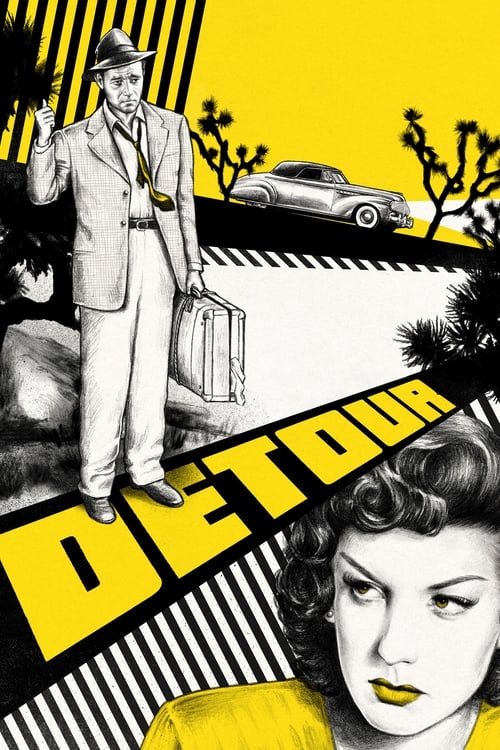
Detour
1945 · Edgar G. Ulmer
For a late night when you're craving pure pulp fatalism — a short, nasty, hypnotic ride you can finish before midnight and think about long after. Perfect entry point if you've been meaning to get into classic noir.
What it's about
Al Roberts, a nightclub pianist in New York, sets out to hitchhike across the country to rejoin his girlfriend in Los Angeles. On the road, a ride from a stranger and a chance encounter with a woman named Vera pull him into a nightmare of bad luck and worse decisions, which he narrates from a roadside diner, insisting the whole way that none of it was his fault. Fate, as he tells it, keeps sticking out its foot to trip him.
The experience
Lean, feverish, and doom-soaked — 68 minutes with no fat on it, narrated by a man you can't fully trust and can't stop listening to. It plays like a bad dream you recognize from somewhere.
Performances
Ann Savage's Vera is one of the most ferocious characters in all of film noir — abrasive, unpredictable, genuinely frightening — and Tom Neal's beaten-down self-pity is the perfect foil.
The craft
Shot fast and dirt-cheap on Hollywood's poorest lot, it turns poverty into style: fog, shadow, rear-projected highways, and a camera that leans in like an interrogation. Ulmer proves how little a film actually needs — the constraints become the atmosphere.
Why it matters
Made as disposable double-bill filler, it outlived nearly everything it was designed to support, earning a spot in the National Film Registry and a full 4K restoration. It's the standing proof that a masterpiece can come from no money at all.
Snapshot
Sixty-eight minutes long, shot on the poorest lot in Hollywood, and narrated by a man who cannot stop explaining himself: Detour is the film noir reduced to its irreducible core. Al Roberts (Tom Neal), a New York nightclub pianist, hitchhikes west toward his girlfriend and arrives instead at a total dissolution of self — two corpses he insists he did not mean to make, a stolen identity, and a highway that runs only one direction. Produced by Producers Releasing Corporation, the least of the Poverty Row outfits, and directed by the Viennese-born émigré Edgar G. Ulmer, the film was designed as bottom-half-of-the-double-bill filler. It has outlived nearly everything it was made to support. Selected for the National Film Registry in 1992 and restored in 4K by the Academy Film Archive with international archival partners (released by the Criterion Collection in 2019), Detour is now the standard case study for the proposition that severe material constraint can produce, rather than merely permit, a distinctive aesthetic.
Industry & production
PRC occupied the lowest rung of the American exhibition economy. Formed in 1939 from the wreckage of Producers Distributing Corporation, operating out of a modest facility on North Gower Street, and run during this period under production chief Leon Fromkess, it existed to feed the second half of double bills with pictures made on schedules and budgets that the majors would have considered rounding errors. Ulmer had arrived there in 1942 after more than a decade of exile from the studio system, and became its most valuable asset precisely because he could deliver something watchable under those conditions.
The production legend around Detour is famous and unreliable, largely because Ulmer himself supplied it. In interviews late in life — most influentially with Peter Bogdanovich, later published in Who the Devil Made It — he described a six-day shoot and a budget so small it barely qualified as financing. Archival work by later scholars, particularly Noah Isenberg in Edgar G. Ulmer: A Filmmaker at the Margins, indicates a longer schedule (closer to two weeks) and a negative cost meaningfully higher than the figures Ulmer circulated, though still a small fraction of an A-picture's. This matters less as trivia than as method: Ulmer's autobiography was itself a kind of production design, and the myth of the six-day masterpiece was part of how he survived professionally. The corrective is not that Detour was comfortably made — it plainly wasn't — but that we should not take its director's arithmetic as documentary.
The source was Martin Goldsmith's 1939 novel of the same name; Goldsmith wrote the screenplay, which compresses the book's alternating dual narration into Al's single voice. Ulmer's uncredited contribution to the script is generally assumed by scholars but is not precisely documentable. No reliable box-office figures survive for the film; PRC's records are fragmentary, and trade notice on release in late 1945 was modest and unremarkable. The company itself was absorbed into Eagle-Lion in 1947, and the resulting corporate discontinuity contributed to the lapse of the film's copyright — which is why Detour spent decades circulating in wretched public-domain prints on television and videotape. That accident of neglect made it ubiquitous, and its ubiquity made it a cult object.
Technology
Standard 35mm black-and-white nitrate, Academy ratio (1.37:1), optical soundtrack — the unremarkable technical baseline of 1945 American production. What is remarkable is how little of the available technological apparatus the film uses, and how aggressively it converts absence into style.
There is essentially no location shooting of consequence. The cross-country hitchhike, the film's entire spatial premise, is executed almost wholly through rear projection, with process plates and a stationary car body on a soundstage. The plates are visibly grainy and mismatched; the light behind the actors rarely agrees with the light on them. Most notoriously, one process setup was optically flipped — evidently to make the car appear to travel westward — leaving the steering wheel on the wrong side of a 1940s American convertible, an error that generations of viewers have noticed and that has become part of the film's folklore. Fog and pooled darkness serve as set extension throughout, hiding the edges of sets that simply do not exist beyond frame line. The technology of Detour is largely the technology of concealment.
Technique
Cinematography
Benjamin H. Kline, a veteran of serials and programmers, shot the film, and his work under Ulmer is far better than his ordinary assignments suggest. The visual grammar is Weimar expressionism run through a B-unit filter: hard key light, deep unmodulated blacks, faces isolated in narrow pools while the surrounding space vanishes. The most-cited passage is the flashback transition at the roadside diner, where the light contracts to a single beam across Neal's eyes as the narration takes over — an effect that costs nothing and functions as an entire psychological thesis. Low angles and cramped framing keep Al hemmed in; the two-shots with Vera are staged in oppressive proximity, the camera close enough that the actors seem to be sharing insufficient air. Ulmer had trained as a designer, and the compositions consistently prioritize graphic clarity over spatial coherence — we frequently do not know where a room's fourth wall is, and are not meant to.
Editing
George McGuire's cutting is functional in the B tradition but structurally decisive. The film's economy is brutal: the entire New York prologue — the club, Sue's departure, the argument — occupies only a few minutes. Ellipsis does the work that coverage cannot afford. Crucially, the flashback structure permits Ulmer to skip almost the whole continent; dissolves over process plates, a montage of thumbed rides and a few signposts, and the geography is done. Both of Al's killings are handled elliptically and off-axis: Haskell's death occurs largely out of frame in rain and confusion, and Vera's strangulation is staged behind a closed door with the telephone cord as the only visible instrument. In each case the cut withholds precisely the evidence that would confirm or refute Al's account.
Mise-en-scène / staging
The sets are few and reused: a nightclub, a car, a motel room, a rented apartment, a used-car lot, a diner. Ulmer stages nearly everything in limbo — a table, a lamp, a bed, and blackness. What survives is the arrangement of objects and bodies within a rectangle: the placement of a telephone, a bottle, a doorway. The apartment sequence with Vera is the film's most sustained achievement of staging, a domestic hell in which two people who despise each other circle a single small room while drinking, and the room's meanness becomes indistinguishable from theirs. Ulmer's design instincts, honed in the German theater and film industry of the 1920s, are visible in his willingness to let a single well-chosen prop carry a scene.
Sound
The voice-over is close to continuous, one of the densest narrations in the noir cycle, and it is the film's true formal system: image is subordinated to testimony throughout. Leo Erdody, PRC's house composer, supplies a score that leans on dissonance and unresolved figures, thin in orchestration and all the more anxious for it. Music also operates diegetically and thematically: Al's showpiece is a boogie-woogie assault on Chopin's Fantaisie-Impromptu, high art beaten into nightclub commerce — an economical statement of his grievance about talent unrewarded. Ambient sound is sparse to the point of vacancy; rain, an engine, a radio. The silence around the voice is part of the claustrophobia.
Performance
Tom Neal plays Al with a heavy, self-pitying doggedness that some contemporaries read as limitation and later criticism has read as characterization — a man permanently aggrieved, permanently reasonable-sounding, permanently wrong. Ann Savage's Vera is the film's astonishment: hoarse, unbeautiful by design, contemptuous, physically aggressive, entirely without the glamour that the femme fatale archetype had already codified. Savage attacks the role at a pitch that would be unsustainable at feature length and is exactly right at sixty-eight minutes. Her most quoted line — "You're making noises like a husband" — lands as pure derision. Claudia Drake's Sue and Edmund MacDonald's Haskell are functional, which is what the structure requires: they are things that happen to Al.
Narrative & dramatic mode
Detour is a confession delivered in a diner, and its dramatic mode is retrospective self-justification. Al tells us everything, and everything he tells us exculpates him: Haskell simply died and fell out of the car; the door was locked and the cord was in the way. Both deaths are staged as accidents witnessed by no one and narrated by the only interested party.
Andrew Britton's essay on the film in The Book of Film Noir (ed. Ian Cameron, 1992) made the decisive critical move of taking this seriously — reading the images not as what happened but as what Al says happened, which turns the film into a study of a murderer's alibi. Roger Ebert later popularized a version of this reading. The film neither confirms nor forecloses it; the ellipses at both killings are structurally identical, and that symmetry is the argument. Al's closing meditation on fate — "Fate, or some mysterious force, can put the finger on you or me for no good reason at all" — is either a cosmology or a defense brief, and the film's power lies in refusing to say which. The final beat, in which a police car takes him in, has long been read as a Production Code obligation grafted onto a narrative that otherwise ends in open, unpunished drift; it registers as arbitrary in a way that oddly reinforces the film's fatalism.
Genre & cycle
Detour arrived in the middle of the cycle that French critics would name the following year, when Nino Frank applied film noir to the American crime pictures that reached Paris after the wartime embargo lifted, and that Borde and Chaumeton would map in Panorama du film noir américain (1955). It belongs to the loser strand rather than the detective strand: no investigation, no professional, no competence. Its innovations within the cycle are threefold. It relocates noir from the city to the road, making the transcontinental highway — the great emblem of American self-reinvention — into a trap. It replaces the glamorous fatale with a sick, broke, furious woman whose power over the protagonist is purely evidentiary. And it puts the entire film inside a narrating consciousness so completely that the genre's characteristic voice-over (Double Indemnity, 1944; later Sunset Boulevard, 1950) becomes not a frame but the whole architecture.
Authorship & method
Ulmer (1904–1972) is the auteurist test case: a director whose personal style is legible across films made with no resources, in five languages, for audiences that barely existed. Born in Moravia under the Habsburgs, trained in the Vienna and Berlin theater and film worlds, he co-directed Menschen am Sonntag (1930) alongside Robert Siodmak, with Billy Wilder writing and Fred Zinnemann and Eugen Schüfftan on the crew — a startling concentration of future Hollywood talent. His American career peaked early with The Black Cat (1934) at Universal and collapsed immediately afterward over a personal scandal involving the family of the studio's leadership; the woman in question, Shirley, became his wife and worked as script supervisor on his pictures for the rest of his career. Exiled from the majors, he made Yiddish-language features (Green Fields, 1937; The Light Ahead, 1939), a Ukrainian-language film, and a picture with an African American cast, before settling at PRC in 1942 for the run that includes Bluebeard (1944), Strange Illusion (1945), and Detour.
His collaborators here are all PRC regulars — Kline, Erdody, art director Edward C. Jewell, editor McGuire — which is part of the point. Ulmer's method was to know precisely what a poor crew could deliver and to design shots that concealed everything they could not. Goldsmith, the novelist-screenwriter, supplied the double-accident structure and the narrating voice; Ulmer supplied the darkness that makes both plausible. Myron Meisel's essay "Edgar G. Ulmer: The Primacy of the Visual," in Kings of the Bs (1975), remains the foundational statement of the case for him as an author; Isenberg's later biography is the necessary correction to Ulmer's own storytelling.
Movement / national cinema
The film sits at the intersection of two currents in American cinema. The first is the émigré transmission of Weimar visual technique — Lang, Siodmak, Preminger, Wilder, Ophüls, Ulmer — which supplied noir with its chiaroscuro and its fatalism. Ulmer is the strand's extreme case, carrying German expressionist grammar not into prestige productions but into the cheapest available context, where its abstraction became a budgetary asset rather than an aesthetic luxury. The second is the American B film as an autonomous tradition: Poverty Row's speed, brevity, and indifference to respectability produced a body of work that has aged far better than much of the contemporaneous prestige output. Detour is where those currents meet most cleanly.
Era / period
1945: the war ends, and Hollywood's mood darkens rather than lifts. The picture arrives at the moment when displaced men are moving across the country and the promised postwar prosperity has not yet materialized for everyone. Al's grievance — talent unrecognized, mobility promised and withdrawn, a girl gone west to be discovered — is period-specific in its details and mordantly out of step with 1945's official optimism. Industrially, it belongs to the last years of a system that would soon end: the 1948 Paramount consent decrees dismantled the exhibition structure that made double bills necessary, and outfits like PRC vanished with it. Detour is among the final artifacts of a mode of production that could not survive the decade.
Themes
Fate is the film's stated subject and its unreliable one. Al insists on a hostile universe; the film quietly suggests a hostile man. Around that ambiguity cluster the picture's other concerns: the westward journey as failed pilgrimage, with Los Angeles reached and immediately turned into a prison; identity as something detachable, purchasable, and fatal, since Al survives by becoming Haskell and is destroyed by the same act; class resentment as a governing psychology; and the total absence of legitimate recourse — Al's premise throughout is that no institution will believe him, an assumption the film never tests and he never abandons. Misogyny is present both in the narration and, arguably, as the film's object: Vera is described in terms of unrelenting cruelty by a narrator with every reason to defame her. Above all, contingency: two people die by accident in this film, or so we are told, and the difference between accident and murder turns out to be exactly the width of a closed door.
Reception, canon & influence
Contemporary reception was slight. As a PRC release it received routine trade coverage and little critical attention; no dependable box-office record survives. Its rehabilitation came from outside the American mainstream and from below — from French critics attentive to the B film, from the 1970s revaluation of Poverty Row in publications like Kings of the Bs, from Bogdanovich's interviews with Ulmer, and, decisively, from the film's copyright lapse, which put it into constant circulation on television and cheap video for decades. Britton's 1992 essay reframed it as a formally sophisticated study of narrative unreliability; the same year, the Library of Congress added it to the National Film Registry, an unusual honor for a Poverty Row production. The 4K restoration and Criterion release in 2019 completed the canonization, finally allowing audiences to see Kline's photography as shot rather than as sixth-generation dupe.
Looking backward, the film draws on German expressionist lighting and the Weimar street film's pessimism, on the hard-boiled fiction tradition by way of Goldsmith's novel, and on the immediate model of Double Indemnity (1944) for the confessional flashback. Looking forward, its inheritance runs along two lines. The first is the road noir: the desert as moral vacuum and the highway as trap, a lineage traceable through Gun Crazy (1950) and The Hitch-Hiker (1953) and into the sun-blasted fatalism of later American independent crime films. The second, and larger, is Detour's standing as the permanent proof text for filmmakers working without money — the film invoked whenever the argument is made that style is a function of decision rather than budget. Direct homages are rarer than the film's reputation suggests, but the most touching is unambiguous: Guy Maddin cast Ann Savage, decades after her career had ended, as his mother in My Winnipeg (2007), returning that voice to the screen a year before her death. Tom Neal's own later life — a ruinous 1951 public brawl, a 1965 conviction for involuntary manslaughter in his wife's death, and a death in 1972 shortly after release — has fed a persistent temptation to read the film biographically, a temptation worth naming and then resisting. A 1992 remake directed by Wade Williams, with Neal's son in the lead, exists and is a curiosity rather than a contender.
A Deleuzian reading
A man sits in a roadside diner and the light goes out around him.
The full Deleuzian reading of Detour →
Reception
In 1945 it was just another Poverty Row programmer, shot for pocket change at PRC and dumped onto the bottom half of double bills. Decades of critics — Andrew Sarris championing Ulmer, Errol Morris calling it a favorite — turned it into the consensus pick for the greatest B-movie ever made, and it entered the National Film Registry in 1992.
How Detour was received, from release to now →
How to watch Detour: what to notice on a first viewing
- Listen for the narration running through nearly the whole film. Al Roberts explains himself in voiceover almost continuously, so the images arrive already filtered through one man's account rather than standing as neutral fact. You are hearing a story being told, not just watching one happen.
- Watch faces isolated in narrow pools of hard light. Benjamin Kline lights the film with deep unmodulated blacks and tight beams, so a face can be lit while the room around it disappears entirely. The style comes from Weimar expressionism, squeezed through a budget with almost nothing to spend.
- Notice the obviously fake background behind the driving scenes. The cross-country hitchhike is shot almost entirely on a soundstage against rear-projected footage, grainy and visibly mismatched to the actors in the foreground. The fakery isn't hidden. It's part of how cheaply and quickly this whole world gets assembled.
- Watch how hoarse and unglamorous Ann Savage plays Vera. Savage plays Vera as contemptuous and physically aggressive, entirely without the glamour that the femme fatale role usually came with in this era. She attacks the part at a pitch that would exhaust a longer film and is exactly right here.
- Listen for Chopin turned into nightclub boogie-woogie piano. Al's big piano number takes a classical piece and beats it into a boogie-woogie tip-jar tune, a small joke about talent going nowhere. The mangled Chopin is Al's whole grievance about his own life, compressed into one song.
The whole guide to watching Detour, with the keys for a rewatch →
Influences: the films it descends from and the films it influenced
- Menschen am Sonntag (1930) — Ulmer's own co-directed début established his working economy — nonprofessionals, available light, real locations standing in for sets, coverage designed around what a tiny crew can actually deliver — which is exactly the method he brings to a six-day PRC schedule.
- M (1931) — Lang removes the murder from the frame entirely (the rolling ball, the balloon caught in wires), the elliptical-killing grammar Detour reuses twice: both deaths happen off-screen and reach us only as sound plus aftermath, leaving the narrator free to supply the version the image withheld.
- The Black Cat (1934) — Ulmer's Universal peak is the template he later strips down: near-continuous classical scoring running under dialogue (the model for Erdody's wall-to-wall cues) and figures isolated in featureless architectural voids, which at PRC becomes the limbo set — one hard key, one prop, and blackness where the walls should be.
- Bluebeard (1944) — The immediate PRC dry run: Carradine keyed by a single hard source against undefined dark, with Ulmer designing every setup around what the art department cannot build — proof that darkness is a construction material, not an absence of one.
- You Only Live Once (1937) — Lang's fog-bound flight of a doomed couple invents the American fatalist road picture in which the highway is a tightening trap rather than an escape route, and the arriving headlights at the end are a structural certainty, not a plot turn.
- Stranger on the Third Floor (1940) — RKO's B unit proved that first-person interior monologue plus Musuraca's painted shadow could replace sets outright — an expressionist nightmare built from cast light on empty stage space, the precise budget-to-style conversion Ulmer performs five years later at a fraction of even that cost.
- Double Indemnity (1944) — The direct structural model: the entire picture as a retrospective confession spoken by a man already condemned, so every scene is heard through a narrator's self-exculpation — Detour keeps the device but withdraws the guarantee that the confessor is telling the truth.
- Daybreak (1939) — Strips the flashback-fatalism device to its poverty-row essence — a narrator recounting an inescapable descent — the same 'trap already sprung' narration Prévert engineered.
- Gun Crazy (1950) — Lewis extends road noir by making the car interior the principal set — the unbroken back-seat take through the Hampton bank robbery — solving on location what Ulmer solved with a rear-projection plate: the automobile as a two-hander stage that moves.
- The Hitch-Hiker (1953) — Lupino literalizes Detour's premise — a driver held hostage by his passenger across desert nothing — and turns the eye-light into a whole-film device with Talman's undroppable eyelid, a single glint sustained where Ulmer used one beam on Savage's face.
- Killer's Kiss (1955) — Self-financed on New York streets, Kubrick frames the picture as a retrospective voiceover from a railway platform and lets location expressionism (bare bulbs, wet brick, a mannequin warehouse) substitute for the studio interiors he could not afford.
- Blast of Silence (1961) — Baron finances his own noir and carries it on relentless narration — second-person, hectoring, running nearly wall-to-wall — the most extreme heir to Detour's use of voice as the cheapest available production value and as the film's true unreliable protagonist.
- Carnival of Souls (1962) — An industrial-film crew and a Kansas pavilion produce the limbo-set principle at its purest: a dissociated protagonist adrift in unlit, unbounded space, style generated entirely from what the production cannot show.
- Badlands (1973) — Sissy Spacek's flat magazine-prose narration runs continuously against images that contradict it, extending Detour's unreliable retrospective voice from self-exculpation to outright dissociation — and the killings are clipped to a shot and a sound, never dramatized.
- Blood Simple (1984) — Independently financed, opening on a rain-streaked night highway with confessional narration, and built around the panicked disposal of a body whose death we do not witness — Detour's compressive ellipsis around the corpse, expanded into an entire second act.
- Red Rock West (1993) — A broke drifter is mistaken for another man and, fatally, does not correct the error — the exact engine of Detour's Haskell impersonation — replayed on the same desert highway where every attempt to leave town returns him to it.
- My Winnipeg (2007) — The unambiguous direct homage: Maddin casts Ann Savage as his mother and restores that voice to the screen, wrapping it in a fabricated memoir carried by unbroken first-person narration and deliberately degraded Poverty Row image texture.
- Shoot the Piano Player (1960) — Ulmer's formulation of the passive male protagonist whose fate is shaped by external forces rather than will — shot in cramped, shadow-choked locations on a poverty-row budget — establishes the B-movie noir grammar for the doomed-innocent archetype that Truffaut transposes to Paris, keeping the fatalism while stripping away expressionist stylization in favor of available-light realism.
- Nightmare Alley (2021) — Ulmer's German-expressionist American noir demonstrates that chiaroscuro can achieve expressionist monumentality through framing and light placement alone, without production resources; the doom-as-given-condition structure — fate decided before the film begins, the narrative tracing only its mechanics — is the narrative model del Toro applies at prestige scale.
- Invasion of the Body Snatchers (1956) — Model for the trapped-narrator confessional — a man recounting his own entrapment in flashback — the imposed-frame device the studio forced onto the picture.
- Scarlet Street (1945) — Released months later, Lang's film performs the same Production Code arithmetic — the mandatory punishment redirected into something worse than arrest — and builds its violence out of a woman's verbal contempt, the register Ann Savage's Vera weaponizes into an unbroken assault.
- D.O.A. (1950) — Opens with the narrator walking into a police station to report his own murder: the identical gambit as Detour's diner frame, an ending announced before the story starts so that suspense is replaced by the spectacle of a man arranging his own account.
- Murder, My Sweet (1944) — Poverty-row distillation of the retrospective first-person noir — a bitter voice-over narrator recounts his own entrapment, the bruised-fatalist confession mode Powell's Marlowe helped codify.
- The Woman in the Window (1944) — The everyman swept to ruin by a chain of chance, told through unreliable first-person narration and poverty-row chiaroscuro — the same fatalist objects-and-circumstance grip on a passive protagonist.
Similar films
- Double Indemnity (1944) — influence & lineage
- Gun Crazy (1950) — influence & lineage
- Scarlet Street (1945) — influence & lineage
- Kiss Me Deadly (1955) — shared sensibility
- Out of the Past (1947) — shared sensibility
- Sunset Boulevard (1950) — shared sensibility
- Murder, My Sweet (1944) — shared sensibility
- Criss Cross (1949) — shared sensibility