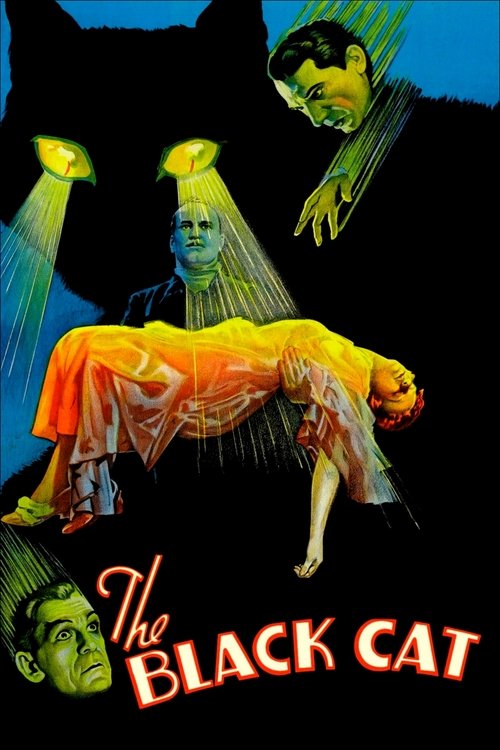
The Black Cat
1934 · Edgar G. Ulmer
For when you want old-school horror with a genuinely weird edge — something short, stylish, and stranger than you expect from a 1930s studio film. More unsettling than cozy, but an easy single-evening watch.
What it's about
An American couple honeymooning in Hungary is stranded by a road accident and takes shelter in the gleaming modernist house of Hjalmar Poelzig, a famous architect who built it on the ruins of a wartime fortress. Traveling with them is Dr. Vitus Werdegast, a psychiatrist just released from fifteen years in a prison camp, who has old and bitter business with their host. Over one stormy night, the newlyweds become pawns in a duel between the two men.
The experience
Dreamlike and genuinely perverse for 1934 — the mood is less jump-scare horror than a slow, elegant nightmare, with menace humming under every polite exchange. At 65 minutes it moves fast, and its strangeness lingers longer than its runtime.
Performances
Boris Karloff and Bela Lugosi, paired for the first time, play against their monster images: Karloff is all silky, satanic composure as Poelzig, while Lugosi gets a rare sympathetic role as the haunted, vengeful Werdegast. The pleasure is watching two horror icons circle each other like chess players.
The craft
Edgar G. Ulmer swaps the usual cobwebbed castle for sleek modernist architecture — glass, steel, and clean lines — which makes the evil feel disturbingly contemporary. The film is driven by near-continuous classical music and prowling camerawork, and its pre-Code daring lets it go to darker places than most horror of its era.
Why it matters
The first and strangest of Universal's Karloff–Lugosi pairings, and a cult touchstone that showed horror could be about the psychic wreckage of the First World War rather than monsters. It also made Ulmer's name as a master of doing much with little.
Snapshot
The Black Cat is the first of Universal's horror films to pair Boris Karloff and Bela Lugosi, and it is the strangest film of the studio's classic horror cycle. Its credits say it was "suggested by" Edgar Allan Poe, but it uses almost nothing from Poe beyond the title and a feline motif. Instead, Edgar G. Ulmer, a young Austro-Hungarian émigré trained in the Central European theatre and silent cinema, made a compact, 65-minute film about the aftermath of the First World War. An American honeymoon couple is stranded in a gleaming modernist house built on the ruins of a fortress where thousands of men died. The house belongs to Hjalmar Poelzig (Karloff), an architect and Satanist who betrayed that fortress. His guest is Dr. Vitus Werdegast (Lugosi), who spent fifteen years in a prison camp and has come back for his wife and daughter. What follows is a series of games, all of them rigged: chess for the fate of the bride, a black mass, embalmed women displayed in glass cases, and a flaying shown in shadow. Its Bauhaus-inspired sets, almost continuous classical score, and willingness to go into necrophilia, Satanism and sadism made it one of the most audacious American films of the pre-Code years. Today it is widely regarded as a high point of 1930s horror and as the key early work of a director who spent most of his career on Poverty Row.
Industry & production
The film was made at Universal under Carl Laemmle Jr., who had run production since 1928 and had bet the studio on horror with Dracula and Frankenstein (both 1931), followed by The Mummy (1932) and The Invisible Man (1933). After the success of Karloff and Lugosi separately, putting them together was an obvious commercial idea, and Poe's name gave the project a ready-made literary label. Ulmer later said he developed the story with the screenwriter Peter Ruric, the pen name of the hard-boiled novelist Paul Cain (Fast One). Ruric received the screenplay credit, and the original story was credited to both men. The film's associate producer was E. M. Asher.
The production was quick and cheap even by Universal's standards for a mid-level programmer. It was shot in early 1934 on a schedule of a few weeks, and its budget is commonly reported as under $100,000, which was modest for a film with two star names. Film historians, notably Gregory William Mank, have documented that Laemmle Jr. and studio executives objected to how far the first cut went. Retakes and cuts followed. They reportedly softened Werdegast into a more sympathetic, avenging figure and toned down some of the sexual and sadistic material. The surviving version still shows signs of this tension: Werdegast is noble and monstrous at the same moment. The film was released in May 1934, weeks before the Production Code Administration began strict enforcement that July. It belongs to the last stretch of the pre-Code era, which partly explains how much it was able to show. It was retitled The House of Doom for British release and ran into censorship problems in several territories. The film is often described as one of Universal's most profitable releases of its season, though detailed grosses are not reliably documented in the sources available here.
For Ulmer the film was both a breakthrough and an ending. During or shortly after production he began a relationship with Shirley Kassler, who was then married to a nephew of Carl Laemmle Sr. The couple later married, and the scandal is traditionally said to have shut Ulmer out of the major studios. His later career moved through independent, ethnic-language and low-budget production.
Technology
The Black Cat is a conventional sound film of 1934, shot on 35mm black-and-white stock at the Academy ratio, but it pushes the studio's resources in particular directions. The most important is set construction. Instead of reusing the Gothic castles and Middle European village sets from earlier Universal horror films, it built a modernist interior for Poelzig's house, credited to the supervising art director Charles D. Hall: illuminated glass panels, steel and chrome fittings, a curving staircase, sliding doors, and an electric clock. Ulmer had worked as a set designer and always claimed a large share of the design. The exact division of credit cannot be settled from the record, but the look is consistent with Ulmer's training and interests.
A second technical feature is the sound mix. For an American film of 1934 it is unusually full of music. At the start of the sound era, Hollywood often used non-diegetic music sparingly. The Black Cat runs an almost continuous score, closer to the accompaniment of a silent film than to the dialogue-driven early talkies. The film also uses practical lighting effects, such as backlit glass and the bluish, otherworldly look of the preserved women in their vitrines. Its effects are restrained: an explosion at the end, and a black cat that has to be handled and photographed on cue.
Technique
Cinematography
John J. Mescall, who later shot Bride of Frankenstein (1935), gives the film a cool, polished surface that differs from the heavy shadows of Dracula. The house is lit to shine: polished floors, translucent walls, and hard geometric lines. Mescall and Ulmer then use that clarity to make the horror stand out. The most famous passage is a long, gliding camera movement through the cellars of Fort Marmaros, where the camera seems to wander on its own past gun emplacements and down corridors while Poelzig leads Werdegast to his dead wife. The camera moves independently of the characters in a way that recalls the "unchained camera" of German silent cinema. The framing is often symmetrical and architectural. Karloff is repeatedly posed upright, centred and backlit, as when he sits up in bed beside the sleeping Karen, his silhouette rising behind the translucent bedroom wall. The flaying of Poelzig near the end is shown only as a shadow on the wall, a choice that is both a concession to censorship and an Expressionist technique.
Editing
Ray Curtiss edited the film, which moves fast and compresses a lot of action into a short running time. The bus crash, the arrival at the house, the chess game, the black mass and the destruction take place over what amounts to a single night and the next day. Because of the retakes, the film is sometimes uneven, and some motivations, especially Werdegast's sudden shifts between protector and avenger, seem to have been cut down. At the same time the editing produces strong effects through ellipsis and juxtaposition. Ulmer often cuts away from explicit violence to reaction shots, shadows or architecture, and the score continues across these cuts, smoothing transitions that the story leaves rough.
Mise-en-scène / staging
The house is the film's central idea. Poelzig has built a monument to cleanliness and rational modern design directly on top of a mass grave. This distinguishes the film from every other Universal horror picture of the period: the evil is located in modernism itself, not in a decaying Gothic past. Poelzig's name almost certainly refers to Hans Poelzig, the German architect whose work included the set designs for Der Golem, wie er in die Welt kam (1920). Ulmer claimed to have worked on that film, a claim that, like many of his memories of the German industry, cannot be fully confirmed. Within the house Ulmer arranges oppositions: the light upper floors against the cellar fortress, the glass cases of women against the steel and concrete of the dead fortifications, and the chessboard against the altar. The black mass is staged as a formal pageant, with robed, upper-class congregants and an inverted double-cross altar. The Latin of Poelzig's invocation has often been noted as largely a string of familiar Latin tags, which suggests either a private joke or the limits of the production's research.
Sound
Heinz Roemheld, credited as musical director, assembled a score largely from adapted classical repertoire, with pieces drawn from Liszt, Schubert, Tchaikovsky, Schumann, Brahms, Chopin and Bach among others. Poelzig plays Bach's Toccata and Fugue in D minor on the organ, an early and influential case of that piece becoming a signal of cinematic menace. Because the score runs almost from start to finish, it shapes the film's rhythm: scenes move like movements of a piece, and dialogue is often heard over music instead of in silence. The effect is formal, slightly unreal and operatic, which suits a story told almost entirely through rituals. Dialogue is spoken in a heightened, often stilted register. Some lines have become famous for their dry cruelty, such as Poelzig's remark that "even the phone is dead" and his question to Werdegast, "Are we not both the living dead?"
Performance
Karloff, billed by surname alone in the period's manner, plays Poelzig with a stillness that contrasts with his physically demanding monster roles. He has a severe widow's-peak haircut and wears dark, high-collared costumes, and he speaks softly and with total self-possession. He turns evil into good taste. Lugosi, by contrast, gives one of his most emotional and sympathetic performances. Werdegast is grieving, ailurophobic, courteous and in the end capable of terrible vengeance, and Lugosi's trademark Hungarian accent fits the setting naturally for once. The film depends on the two acting in different keys, with Karloff cold and Lugosi warm. David Manners and Jacqueline Wells (later known as Julie Bishop) play the American couple as likeable, somewhat oblivious tourists. Their stock conventionality is part of the point. Lucille Lund plays Karen, Egon Brecher the majordomo, and Harry Cording Werdegast's servant Thamal. John Carradine appears uncredited among the cultists.
Narrative & dramatic mode
The story follows the pattern of the "old dark house" film, in which travellers are stranded and forced to accept a stranger's hospitality, but turns it into a closed duel. The Americans become pawns, literally, when Poelzig and Werdegast play chess for Joan's fate. The past, the war, the betrayal at Marmaros and the fate of the two Karens, is revealed gradually through dialogue and through the descent into the cellars, giving the plot an archaeological structure. The tone moves between Grand Guignol, chamber drama and dry irony. In the coda, Peter reads a review on the train that calls his own mystery novel far-fetched. It is a self-aware joke that recognises the film's excesses while letting the Americans leave as untouched as they arrived. The narrative is elliptical and sometimes illogical, partly because of the retakes, and its mode is closer to a dark fairy tale or a morality play than to realism.
Genre & cycle
The film belongs to Universal's first horror cycle (1931–36) but stands apart from its usual focus on a single supernatural or scientific monster. Nothing here is supernatural. Its horrors are human ones: cults, murder, sexual obsession, the preservation of bodies, and the memory of war. It shares the "old dark house" setup with James Whale's The Old Dark House (1932), and it belongs with the pre-Code horror films, such as Island of Lost Souls (1932) and Murders in the Rue Morgue (1932, also a loose Poe adaptation starring Lugosi), that used the genre to explore perversity before the Code took hold. Its success led to further Karloff–Lugosi pairings: The Raven (1935, again under Poe's name), The Invisible Ray (1936), and later Son of Frankenstein (1939) and Black Friday (1940). Universal reused the title for an unrelated 1941 mystery-comedy. The film is also an early example of the Satanic-cult subgenre in sound cinema, a tradition that would revive strongly decades later.
Authorship & method
Edgar G. Ulmer (1904–1972), born in Olmütz, Moravia, and raised in Vienna, described an apprenticeship with Max Reinhardt's theatre and work on many German silent productions, including films by F. W. Murnau, and said he came to Hollywood with Murnau's team for Sunrise (1927). Some of these claims are documented and others rest on his own later accounts. He co-directed People on Sunday (Menschen am Sonntag, 1930) with Robert Siodmak. The Black Cat was his first major studio assignment and remained his only high-budget film of the decade. It shows what became his method: strong visual design applied to tight constraints, a European outsider's view of modernity, and a taste for fate, guilt and entrapment. These concerns return in Bluebeard (1944), Strange Illusion (1945) and above all Detour (1945). He also directed Yiddish-language films (Green Fields, 1937; The Light Ahead, 1939) and later genre work such as The Man from Planet X (1951).
John J. Mescall (cinematography) brought a fluid, polished style that he developed further in Bride of Frankenstein. Peter Ruric/Paul Cain (screenplay) brought hard-boiled brevity, visible in the clipped and ironic dialogue. Heinz Roemheld (music) used the compilation-score approach of the silent era and went on to a long career in studio scoring. Charles D. Hall (art direction) was Universal's leading designer of the period, responsible for the look of Dracula, Frankenstein and The Old Dark House. Ray Curtiss edited. Carl Laemmle Jr. was producer, and his interventions affected the final shape of the film.
Movement / national cinema
The film is a Hollywood studio production made by émigrés. Its sensibility comes from Weimar cinema and Central European modernism: the stylised design of German Expressionism, the moving camera associated with Murnau, and the architectural thinking of the Bauhaus and the German New Building movement. Universal was a natural home for this transfer. The Laemmles were German-born, and the studio had employed German and Central European talent since the 1920s. Paul Leni's The Cat and the Canary (1927) is a direct ancestor in the "old dark house" form. The Hungarian setting, with its Hungarian star, a destroyed Austro-Hungarian fortress and the memory of the Eastern Front, gives the film an unusually specific Central European geography for Hollywood horror. The Black Cat is therefore an important case of the Weimar-to-Hollywood migration that later fed into film noir.
Era / period
The Black Cat was made in the depths of the Depression and in the final months before the Production Code was strictly enforced, and both conditions shaped it. The Depression explains the low budget and the commercial logic of two stars and a famous author's name. The pre-Code window explains how far it could go into necrophilia, implied incest (Poelzig has married his late wife's daughter), Satanism, sadism and torture. The film is also haunted by the First World War, fifteen years after its end. Poelzig's betrayal of Marmaros and Werdegast's imprisonment evoke the collapse of the Austro-Hungarian Empire and the European memory of mass death. It was released one year after Hitler came to power, and critics have read the cold, aestheticised evil in Poelzig's modernist house as an anxiety about a new European barbarism. This reading is interpretive, not documented as Ulmer's stated intention, but it is widely held.
Themes
- The war that will not end. The house is literally built on the dead, and the two men are veterans still fighting over the same ground. "Are we not both the living dead?" sums up the film's view of the postwar generation.
- Modernity as cover for barbarism. The film turns the clean lines of modernist architecture into a disguise for atrocity, an idea that later reads as darkly prophetic.
- Possession and display. Poelzig preserves women as collectible objects in glass. His control is erotic, aesthetic and necrophilic, which links sexual domination to the curatorial instinct.
- Games and fate. Chess, ritual and timing structure the drama. Human lives are moves in a game played by men who already know how it ends.
- The American innocent abroad. Peter and Joan pass through European catastrophe without understanding it, and Peter's fatal misreading of Werdegast's actions shows that innocence does harm too.
- Vengeance and its cost. Werdegast's final revenge is justified and monstrous at once, and the film refuses to separate the two.
Reception, canon & influence
Critical reception. Contemporary reviews were mixed. The film was generally noted as a commercial draw for its star pairing, while some critics found the story confusing or lurid. It did not enjoy the prestige of Frankenstein at the time. Its reputation grew after the war, when French critics associated with Cahiers du cinéma took up Ulmer as an auteur working under severe constraints. In the United States, Andrew Sarris included him in The American Cinema (1968), and Peter Bogdanovich's interviews with Ulmer encouraged reassessment. Since then, horror historians including Gregory William Mank, David J. Skal and Kim Newman have placed The Black Cat among the most important and adventurous films of Universal's cycle. It is now often considered the most artistically ambitious Karloff–Lugosi collaboration.
Backward influences. The film draws on German Expressionist cinema, especially its stylised sets and shadow play; on Murnau's moving camera; on Reinhardt's theatrical staging; on modernist architecture, with the name Poelzig pointing to Hans Poelzig; on the "old dark house" tradition of Leni's The Cat and the Canary and Whale's The Old Dark House; and only loosely on Poe. The occultist Aleister Crowley is frequently cited as a model for Poelzig. That attribution circulates widely in later literature, but it should be treated as plausible tradition, not documented fact.
Forward legacy. Its immediate legacy was the series of Karloff–Lugosi films and Universal's continued use of Poe's name. In the longer term, it helped define a type of film horror based on cults and human evil, not monsters, which later Satanic-cult films developed. Its pairing of modernist architecture with refined villainy anticipates the recurring screen figure of the cultured villain in a sleek modern lair, though direct lines of influence there are hard to prove. Its use of Bach's Toccata and Fugue on the organ contributed to that piece's long association with screen menace. Within Ulmer's career, it is the essential reference point for critics who see a consistent vision running through his studio and Poverty Row work, most notably Detour. The film is now treated as a classic of pre-Code cinema and as a central example of Weimar émigré artistry inside Hollywood.
Influences: the films it descends from and the films it influenced
- The Cabinet of Dr. Caligari (1920) — Its stylised sets, which give a mental state an architectural shape, and its showman-villain who controls a sleepwalking instrument lie behind Poelzig's house, a set built to express a mind, and his hold over the people inside it.
- The Cat and the Canary (1927) — Leni brought Expressionist shadow-staging into a Universal old-dark-house plot: stranded guests, an inheritance, and gliding camera moves through corridors. The Black Cat turns that template into a rigged duel between two hosts.
- Sunrise (1927) — Ulmer said he worked on Murnau's crew. Murnau's unchained camera, which tracks through space independently of the actors, is the source of the slow cellar tracking shot past the women preserved in glass cases.
- Metropolis (1927) — Lang's modernist design and his rationalist sorcerer Rotwang, who keeps an occult chamber inside a technological city, anticipate Poelzig's Satanic cult hidden beneath clean Bauhaus surfaces.
- Dr. Mabuse the Gambler (1922) — It created the Weimar type of the cultured, hypnotic mastermind who runs a hidden network from elegant rooms. Karloff's Poelzig plays this figure as a cult leader.
- The Old Dark House (1932) — Charles D. Hall designed both films and Karloff appears in both. Whale's set-up, travellers stranded in a storm and held by a host with a sick secret, is the narrative frame Ulmer inherits and updates into modernist architecture.
- Faust (1926) — Ulmer, who assisted on Faust and Sunrise, transplants Murnau's architectural set-as-character and satanic-pact design into a Hollywood horror.
- Bride of Frankenstein (1935) — John J. Mescall carried over the polished light, glossy blacks and fluid crane and tracking moves he had developed on The Black Cat, refining Universal horror into a high-gloss style.
- The Raven (1935) — Universal's direct follow-up reunites Karloff and Lugosi under a Poe title and keeps the structure of a cultured sadist in a house rigged with mechanical torture devices. This time Lugosi plays the aesthete-tormentor.
- The Invisible Ray (1936) — It continues the paired-keys casting The Black Cat established: Karloff as the obsessive, damaged figure against Lugosi's measured, civilised rival, set up as an intellectual duel that ends in vengeance.
- The Seventh Victim (1943) — Lewton's unit places a polite, bourgeois Satanist cult in modern Manhattan and builds horror from social menace and suggestion rather than a monster. This is the cult-of-human-evil line The Black Cat started.
- Bluebeard (1944) — On a Poverty Row budget, Ulmer again gives an artist-killer a refined sensibility (puppetry, painting) and expresses obsession through stylised settings and lighting rather than gore.
- Detour (1945) — Ulmer applies the same entrapment-by-fate design to a minimal budget, using fog, rear projection and a closed visual world to make a trap. Critics treat this continuity as the core of his auteur case.
- Night of the Demon (1957) — Karswell is a genteel, Crowley-modelled cult master who duels a rationalist rival. This continues the figure of the urbane occultist that The Black Cat introduced to studio horror.
- The Raven (1963) — Corman's Poe cycle reuses the loose-Poe title and turns the Karloff–Lugosi rigged duel into a duel between rival sorcerers, with Karloff himself playing the cultured, treacherous host.
- The Devil Rides Out (1968) — Charles Gray plays Mocata, a soft-spoken, Crowley-styled Satanist, and the film builds to a staged Black Mass with a sacrifice that is interrupted. These are the ritual set-pieces Poelzig's cult ceremony first brought to Hollywood.
- Rosemary's Baby (1968) — Polanski hides a Satanic coven behind modern urban gentility and deadpan everyday surfaces. He extends The Black Cat's central idea: evil inside a well-appointed modern home, run by courteous elders.
- Dr. Jekyll and Mr. Hyde (1931) — It opens with Jekyll playing Bach's Toccata and Fugue in D minor on the organ. That pre-Code precedent links the piece to a cultured man's dark side, and Poelzig's organ playing completes the association.
- Murders in the Rue Morgue (1932) — Universal's other Poe-in-name-only Lugosi vehicle replaces the source with a modern Expressionist horror plot built on human cruelty and torture, with Karl Freund's cinematography. It set the loose-Poe formula that The Black Cat followed.
Similar films
- Bride of Frankenstein (1935) — influence & lineage
- The Cabinet of Dr. Caligari (1920) — influence & lineage
- Night of the Demon (1957) — influence & lineage
- Rosemary's Baby (1968) — influence & lineage
- Nosferatu (2024) — shared sensibility
- Nosferatu (1922) — shared sensibility
- Nosferatu the Vampyre (1979) — shared sensibility
- Black Sabbath (1963) — shared sensibility