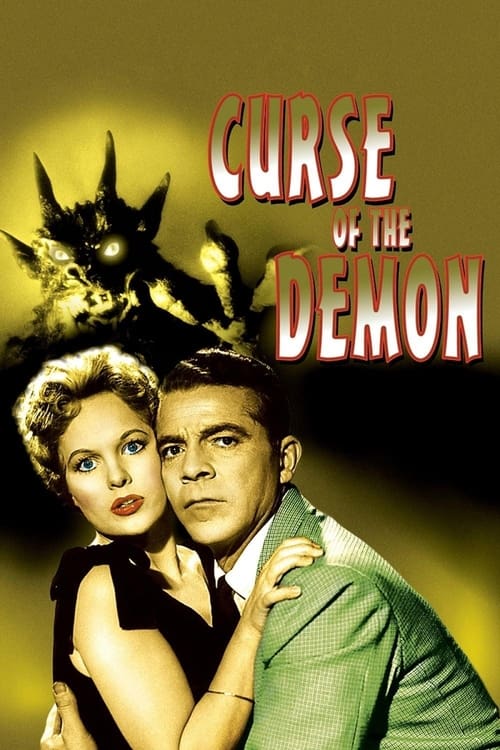
Night of the Demon
1957 · Jacques Tourneur
For a night when you want a proper old-fashioned chill — candlelight-and-storm horror that unnerves you rather than assaults you. Comfort-horror for skeptics: spooky enough to raise the hairs on your arm, civilized enough to watch with someone who hates gore.
What it's about
An American psychologist who has made his name debunking the supernatural flies to London for a conference — and learns the colleague he came to meet died the night before in a bizarre accident. The dead man had been investigating Julian Karswell, the courtly leader of a devil-worshiping cult, and the skeptic soon finds himself following a trail of runic manuscripts and polite, smiling threats. The question the film keeps turning is simple and terrible: what if the thing you've spent your career disproving is real, and it's coming for you on a schedule?
The experience
A slow tightening of the screws — dread built from shadows, silences, and the creeping suspicion that rational explanations are running out. It's more eerie than gory, the kind of black-and-white chill that gets under your skin through suggestion, with a few jolts that land harder because of all the restraint around them.
Performances
Dana Andrews plays the skeptic with a stubborn, sweating conviction that makes his slow unraveling believable, and Niall MacGinnis's Karswell is one of horror's great villains — a genial children's-party magician whose warmth never quite conceals the menace underneath.
The craft
Jacques Tourneur was the master of horror by suggestion, and this is a clinic in it: menace conjured from wind in trees, a corridor of light, a hand hesitating over a slip of paper. The black-and-white photography turns ordinary English settings — a country estate, a train compartment, Stonehenge — into places where something might be waiting just outside the frame. Watch it in the dark; the sound design does half the haunting.
Why it matters
A touchstone of intelligent supernatural horror, endlessly cited by later filmmakers as proof that what you don't show can terrify more than what you do — and the capstone of Tourneur's run as the genre's great craftsman of shadow.
Snapshot
Night of the Demon — released in the United States as Curse of the Demon in a shortened cut — is a British-produced supernatural thriller adapted from M. R. James's 1911 story "Casting the Runes." It is the last unambiguously major film of Jacques Tourneur's career, and the one that most explicitly restages the argument he had already made in the Val Lewton unit at RKO fifteen years earlier: that the horror film is a machine for producing doubt, and that its most powerful effects arise from what the frame withholds.
The plot is a duel of epistemologies. John Holden (Dana Andrews), an American psychologist who has built a career debunking supernatural claims, arrives in England for a conference and finds that his colleague Professor Harrington has died in a grotesque accident. Harrington had been investigating Julian Karswell (Niall MacGinnis), the leader of a devil-worshipping sect who kills by passing his victims a slip of parchment inscribed with runes; once the runes are passed, a demon comes for the bearer within a set number of days. Holden refuses to believe it, and the film's tension derives from the widening gap between his refusal and the accumulating evidence — including a deadline he is himself now living under.
The film's notoriety rests on a production dispute. Tourneur and screenwriter Charles Bennett intended the demon to remain unseen, its existence sustainable as either literal fact or collective hysteria. Producer Hal E. Chester had a demon built and inserted it in the opening minutes and again at the climax. The result is a film that argues with itself, and the argument has become inseparable from its reputation: it is simultaneously cited as one of the finest atmospheric horror films ever made and as a textbook case of a producer damaging his own picture. Both readings are defensible, and the film's continuing critical life owes something to the fact that it accommodates them at once.
Industry & production
The film was made in Britain in 1956 by Sabre Film Productions, an independent outfit, with Columbia Pictures distributing. The financing and packaging reflect a specific mid-1950s arrangement: American producers working in Britain, using British studio facilities, crews, and supporting casts, with an imported American lead to secure U.S. distribution. Dana Andrews was that import. His presence in the film also carries an unhappy production-history footnote — Andrews's drinking during this period is part of the documented record of his career, and accounts of the shoot have long noted its effect, though the specific incidents are best treated as the sort of anecdote that has hardened through retelling.
Hal E. Chester, an American producer whose earlier career included the Joe Palooka series and the Ray Harryhausen-animated The Beast from 20,000 Fathoms (1953), was the driving commercial intelligence behind the project. Charles Bennett — a screenwriter of real pedigree, having written for Hitchcock on The Man Who Knew Too Much (1934), The 39 Steps (1935), Sabotage (1936), and Foreign Correspondent (1940) — had written a treatment of the James story years earlier. Bennett's later public statements about Chester were bitter and frequently repeated; the substance of the complaint was that Chester rewrote material he was not equipped to rewrite and insisted on showing the monster. Chester's own account differed, and the two men's versions of who did what to the script cannot be fully reconciled from the surviving record.
The production shot at Elstree, drawing on the British studio infrastructure that in the same years was being redirected toward horror by Hammer. Night of the Demon was in production and released in the same window as The Curse of Frankenstein (1957), and the coincidence matters: two British horror films arriving simultaneously, one in saturated Eastmancolor with explicit gore, the other in black-and-white with almost nothing shown. Hammer's model won the commercial argument decisively; Tourneur's film is the road British horror did not take.
Columbia's American release cut the film by roughly thirteen minutes and retitled it Curse of the Demon, apparently to avoid confusion with an unrelated release. The cuts thinned exposition and some of the connective character material. For decades the shorter version was the more widely circulated in the U.S., and the film's critical rehabilitation ran partly on the recovery and re-circulation of the longer British cut.
Technology
The film was shot in black-and-white, in the standard 1.85:1 widescreen ratio that had become normal for British and American features by 1957. The choice of monochrome in 1957 was not simply economic conservatism: it was, by then, a legible aesthetic decision, particularly against Hammer's simultaneous embrace of color. Black-and-white gave Tourneur the tonal range on which his entire method depends — the ability to sink parts of the frame into unreadable darkness and let the audience populate them.
The demon itself is the film's most-discussed technical element and its weakest. Realized as a physical creature — a horned, fanged figure with smoke and glowing eyes — it was created after Tourneur's principal photography and composited into the picture. The construction combined a built creature with optical work; accounts of exactly how the effect was achieved vary in their particulars, and the production paperwork has not been comprehensively published. What is not in dispute is that the demon was not Tourneur's, that its insertion happened over the director's objection, and that its visual idiom — a lumbering, over-lit, over-detailed monster — belongs to a completely different film from the one surrounding it. The famous shots of it emerging from smoke on the railway line at the climax are, depending on the viewer, either a genuinely alarming eruption or a bathetic collapse. The film's structure, which spends ninety minutes cultivating uncertainty, makes the second reading hard to avoid.
More successful is the film's use of atmospheric effect on set — smoke, wind machines, and practical light sources shaped to produce the sense of something moving through the air rather than something standing in front of the camera. The sequence in which Holden is pursued through woods at night by a shape that reads as cloud, luminescence, and displaced air is the film's demonstration of what the unbuilt demon would have been.
Technique
Cinematography
Ted Scaife photographed the film, and his work is the primary vehicle of its effects. The method is inherited from Tourneur's RKO period with Nicholas Musuraca: a low-key scheme in which large regions of the frame are given over to darkness that the audience must interpret. Tourneur's principle, articulated across interviews throughout his life, was that a dark corner is more frightening than anything you can put in it, because the viewer supplies a fear calibrated to their own capacity.
Scaife's compositions repeatedly place Holden — an upright, rational American figure — in frames that are structurally unstable: doorways that open onto blackness, corridors with unresolved depth, exteriors where the treeline dissolves rather than terminates. The camera is generally patient and often mobile in long, unhurried movements rather than aggressive cutting. Where Hammer's contemporaneous horror pushes the camera toward the horrific object, Tourneur's tends to hold at a distance that keeps the object ambiguous.
The most celebrated single passage is the pursuit through the woods, in which light, smoke, and the movement of foliage generate a presence with no fixed form. It is a direct descendant of the "bus" sequence and the swimming-pool sequence in Cat People (1942) — Tourneur reworking his own most durable invention.
Editing
Michael Gordon's cutting sustains a controlled, gradually tightening rhythm. The film's structure is a countdown, and the editing exploits it: as Holden's deadline approaches, sequences shorten and the intervals between supernatural intrusions compress. Crucially, the film cuts away at the moments a later horror film would cut in — a habit that becomes conspicuous precisely because the inserted demon footage violates it. The seams around the demon inserts are visible to any attentive viewer, and the tonal discontinuity is as much an editorial fact as a design one.
The British and American cuts differ meaningfully in pacing. The shorter U.S. version moves faster but flattens the intermediate scenes in which Holden's skepticism is given room to be reasonable rather than merely stubborn, which weakens the central argument.
Mise-en-scène / staging
The film's staging works by contrast between institutional and domestic space. Conference halls, libraries, a hotel, the British Museum reading room, a police station — the apparatus of rational modernity — are rendered as brightly lit, orderly, and slightly airless. Against them: Karswell's country house at Lufford Hall, a séance in a suburban parlor, a farmhouse where a family of frightened cultists lives, a children's party on a lawn.
The most valuable staging decision in the film is that Karswell is not visually coded as a villain's lair-dweller. He lives comfortably with his mother, entertains children, and performs conjuring tricks in a clown costume at a Halloween party — a sequence in which magic-as-entertainment and magic-as-fact are held in the same frame and the film declines to separate them. The windstorm Karswell summons at that party is staged in broad daylight on an open lawn, and this may be the film's single most effective supernatural set-piece precisely because it discards every convention of darkness and enclosure.
Stonehenge appears as a location, and its use is characteristic: the ancient site is filmed plainly, in daylight, as a research site rather than a Gothic prop.
Sound
Clifton Parker's score works largely through orchestral texture rather than melody — sustained strings, low brass, and a recurring choral effect associated with the demon's approach. The music is used sparingly enough that its arrivals register as events.
The film's most sophisticated sound design concerns the runes and the demon's approach: a sound-signature of wind and low rumble that precedes any image, so that the audience learns to fear an auditory cue rather than a visual one. The parchment sequences — the paper trying to escape the hands that hold it, moving as if animate — are constructed as much through sound as through the wire-work visible in some shots. Karswell's line about the passing of the runes, delivered by MacGinnis with the reasonableness of a man explaining a tax provision, is the film's most quoted piece of dialogue.
Performance
Dana Andrews plays Holden with a stolidity that has divided critics for seventy years. One reading holds that the performance is flat, its detachment a symptom of the actor's condition during the shoot. The other, more persuasive on repeat viewing, holds that a certain unyielding blankness is exactly right for a man whose defining trait is refusal — Holden is not on a journey of enlightenment for most of the film; he is a wall that reality has to break.
Niall MacGinnis's Karswell is the film's great performance and one of the most interesting villains in fifties horror. MacGinnis plays him as genial, faintly petulant, a mother's son with a dangerous hobby he did not fully choose and cannot now escape. He is frightened of his own patron. The character's charm is not a mask over menace; the charm and the menace coexist, and MacGinnis refuses to let the audience resolve them. Peggy Cummins as Joanna Harrington, the dead professor's niece, supplies the film's belief where Holden supplies its doubt; Athene Seyler as the medium Mrs. Karswell and Reginald Beckwith as the séance-hosting Mr. Meek provide comic-eccentric texture that the film treats as genuinely English social observation rather than caricature.
Narrative & dramatic mode
The film's mode is investigative-procedural laid over supernatural inevitability. Holden operates as a detective: he reads Harrington's notes, consults archives, interviews witnesses, attends a séance in order to expose it. The narrative supplies him with evidence at a rate that a rational man could plausibly discount, one item at a time. This is the film's central formal achievement — it maintains a genuinely double reading for most of its length, in which every event admits a psychological explanation (suggestion, hysteria, coincidence, the power of belief).
The countdown structure — a fixed number of days until the demon comes — imports a thriller mechanism into the ghost story, and it is Bennett's Hitchcockian inheritance showing. So is the film's use of exchange and transfer: the runes must be passed, accepted by the recipient, which turns the climax into a problem of sleight-of-hand rather than confrontation. The final sequence on the railway platform is a pickpocket scene that happens to end in damnation.
The film's tragedy — and the reason the visible demon costs it so much — is that the inserted opening shot resolves the double reading before the film has begun. The audience knows the demon is real; Holden's skepticism becomes error rather than position, and the film's argument becomes a matter of waiting for a man to catch up.
Genre & cycle
Night of the Demon sits at a junction between several cycles. It belongs to the tradition of the English literary ghost story, with M. R. James as its most influential practitioner — antiquarian scholars, cursed objects, malice attached to documents and manuscripts. It belongs equally to the 1940s American atmospheric horror associated with Val Lewton, whose principles Tourneur was transplanting to a British setting. And it arrives at the exact moment when British horror was being redefined by Hammer's Technicolor Gothic, against which it reads as a deliberate counter-proposal.
The film also participates in a fifties cycle of rationalist-confronts-the-inexplicable narratives, adjacent to the era's science-fiction films but inverted: where the SF cycle typically vindicates the scientist, Night of the Demon humiliates him. Its treatment of parapsychology as a live academic field, complete with conference and professional rivalries, gives it a specificity that most supernatural films of the period lack.
Authorship & method
Tourneur's method was consistent across three decades: suggestion over demonstration, ambiguity as a formal principle, and a refusal to grant the audience the relief of a clear look. He had developed it under Val Lewton at RKO on Cat People (1942), I Walked with a Zombie (1943), and The Leopard Man (1943), then carried it into film noir (Out of the Past, 1947) and the western (Stars in My Crown, 1950; Wichita, 1955). He was, by temperament and training, a director of atmosphere rather than incident, and his best work depends on being allowed to withhold.
Charles Bennett's script supplies structure — the ticking clock, the transferred object, the innocent-abroad protagonist — from a Hitchcockian grammar he had helped invent. Hal E. Chester's credited co-writing is the disputed element, and the disagreement between Bennett and Chester over what each contributed remains unresolved in the documentary record.
Ted Scaife's photography and Clifton Parker's score both operate in registers Tourneur could use. Ken Adam, a few years before his Bond work made him the most influential production designer of the sixties, served as art director; Lufford Hall and the séance interiors bear a designed specificity that rewards attention.
Movement / national cinema
The film is a British production with American authorship at its head, and it sits in the transitional period between the postwar British cinema of restraint and the Hammer-led horror boom. Its Englishness is not incidental: the film is attentive to class, to the social manners of the séance circle, to the institutional texture of British academic and police life. The Halloween party, the farmhouse, the British Museum, the country house — these are located observations, not backdrops.
At the same time, Tourneur's sensibility is not British. It is the product of a French-born director raised in the American studio system, and the film's visual grammar comes from RKO rather than Ealing or Gainsborough. The combination — English material and setting, American-industrial technique, French-inflected patience with atmosphere — is much of what makes the film distinctive.
Era / period
1957 is a hinge year. The Hollywood studio system was in structural decline; runaway production to Britain and Europe was routine; television had absorbed much of the audience for modest genre pictures. Horror in this moment was splitting between the American teenage-audience cycle, the atomic-anxiety science fiction of the decade, and the newly arrived British Gothic. Night of the Demon fits none of these comfortably. It is an adult film about professional adults, made in monochrome, at the moment the genre was moving toward color, youth, and explicitness.
Its rationalism-versus-belief theme also belongs to a specific postwar intellectual moment in which parapsychology retained a foothold in university psychology departments and the question of whether such phenomena were empirically testable was still being publicly argued.
Themes
The film's central theme is the limit of skepticism as a posture. Holden's rationalism is presented sympathetically — he is right about the séance, right about the credulity of the cult's followers, right that belief can kill without any demon's help. The film never mocks him for being a scientist. It undoes him for treating skepticism as a conclusion rather than a method: he stops investigating when the evidence becomes uncomfortable.
A second theme is contagion and transfer. The runes work by being passed; the curse is a communicable object, and the only escape is to give it to someone else. This makes the film's moral situation genuinely unpleasant — survival requires condemning another person — and gives its ending a chill that the visible demon partly dissipates.
A third is the domesticity of evil. Karswell is not Faust; he is a middle-aged man in a comfortable house with his mother, who took on power he now serves rather than commands. The film's suggestion that occult malice can be a matter of ordinary social entanglement, mild vanity, and being unable to get out of a contract is more disquieting than any horned figure.
Finally, the film is about reading — manuscripts, notes, runes, library catalogs. Its James inheritance is precisely this: that scholarship is dangerous, that the archive contains things which act on the person who finds them.
Reception, canon & influence
Contemporary reviews in 1957 were mixed and generally treated the film as a competent genre item; it did not arrive as an event, and it was overshadowed commercially and in press attention by Hammer's The Curse of Frankenstein the same year. Its reputation was built slowly, through repertory and television circulation, through the rise of auteurist criticism in the 1960s and 70s that reassessed Tourneur, and through the specific advocacy of critics and filmmakers who identified it as a peak of suggestive horror. Martin Scorsese has repeatedly named it among the horror films he most admires. The British Film Institute and horror-critical literature now treat it as canonical; it appears routinely in surveys of the best British horror films and the best horror films of the 1950s.
Backward influences. M. R. James's "Casting the Runes" is the direct source and supplies the runes, the deadline, the passing-back device, and the antiquarian-scholar frame. Beyond James, the film draws on the English ghost-story tradition broadly and on the Lewton-unit horror Tourneur himself had helped create — Cat People above all, whose method of the unseen predator the woods sequence explicitly reprises. Bennett's Hitchcock scripts supply the thriller architecture. There is also a documented real-world reference point in Aleister Crowley, whose public persona informs the figure of a modern English occultist with a following, though the film makes Karswell a far more domestic and sympathetic creation than Crowley's reputation would suggest.
Forward influences. The film's DNA is visible across later horror in several distinct lines. The transferable-curse-with-a-deadline structure recurs in works as far apart as Ringu (1998) and its American remake, Sam Raimi's Drag Me to Hell (2009) — which is explicitly and affectionately in debt to it — and It Follows (2014). The folk-horror strain in British cinema, running through Blood on Satan's Claw (1971) and The Wicker Man (1973), inherits its interest in surviving pre-Christian practice embedded in the modern English countryside. Later M. R. James adaptations, particularly Lawrence Gordon Clark's BBC Ghost Stories for Christmas films of the 1970s, work in a register of restraint that Night of the Demon had demonstrated was viable on screen. The film's line "It's in the trees! It's coming!" was sampled at the opening of Kate Bush's "Hounds of Love" (1985), which gave it an afterlife in popular culture entirely outside film.
Its most lasting influence, though, is argumentative. Night of the Demon is the standard example in critical writing about horror of the case against showing the monster — a film whose damaged climax made the theoretical point more forcefully than an intact version could have. Nearly every serious discussion of restraint in horror since has cited it, which is a strange kind of immortality: the film is canonical partly because of the thing that went wrong with it.
A Deleuzian reading
Holden is running through woods at night and the thing behind him has no edges.
The full Deleuzian reading of Night of the Demon →
Reception
Shipped as a trimmed-down B-picture double-biller in the US (retitled Curse of the Demon), it's since been reappraised as one of the greatest British horror films ever made — a masterclass in suggestion that horror directors and critics now cite constantly.
How Night of the Demon was received, from release to now →
How to watch Night of the Demon: what to notice on a first viewing
- Watch how much of the frame stays in darkness. Scaife's low-key lighting gives whole regions of the image over to shadow, doorways opening onto black and corridors whose depth never resolves. What the film refuses to light is scarier than anything it could show you directly.
- Listen for wind and low rumble arriving before any image does. A sound signature precedes the demon's approach every time, so the audience learns to fear what it hears before it ever sees anything. Your ear gets trained to dread a cue long before your eye has anything to confirm it.
- Watch Karswell explain his beliefs as calmly as a man discussing taxes. MacGinnis plays him as genial and faintly petulant, a mother's son with a hobby he seems almost frightened of himself, never letting charm and menace separate. You can never quite decide whether this man is dangerous or merely pitiable, and the film won't decide for you.
- Notice the party held in broad daylight on an open lawn. Karswell performs conjuring tricks for children at a Halloween party, and the film stages its supernatural set piece with every convention of darkness discarded. The scariest moment in the film happens in full sunshine, at a children's party.
- Notice how bright and orderly the libraries and conference halls look. Institutional spaces stay airless and well lit against Karswell's countryside séances and farmhouses, and the two settings keep trading places as the safer one. Rational modernity looks safe here, and the film keeps quietly testing whether it actually is.
The whole guide to watching Night of the Demon, with the keys for a rewatch →
Influences: the films it descends from and the films it influenced
- Cat People (1942) — The woods pursuit in Night of the Demon restages the Central Park walk beat for beat — receding footsteps, wind rising in branches, a light source that reveals nothing — reusing the 'Lewton bus' substitution of an aural shock for a visible predator.
- I Walked with a Zombie (1943) — Tourneur's practice of refusing to adjudicate between rational and supernatural explanation across an entire feature — the nocturnal cane-field walk as a procession of unreadable signs — is the fantastic hesitation Holden's skepticism is built on.
- The Leopard Man (1943) — Killings staged wholly off-screen, the attack registered only as a scream and blood seeping under a locked door, is the withheld-attack grammar the demon sequences were shot to obey before Chester's inserts.
- Out of the Past (1947) — Tourneur's noir low-key scheme — figures dissolving into unlit space, faces raked by a single practical, rooms lit as pools rather than fields — is imported intact into Karswell's study and the séance, along with the fatalism of a man walking a countdown he half-understands.
- The 39 Steps (1935) — Charles Bennett's innocent-abroad architecture — a rational outsider handed a document he cannot read and pursued across an unfamiliar British landscape — is the exact chassis on which the runic parchment operates as MacGuffin.
- Sabotage (1936) — Bennett's ticking-clock construction, an ordinary person unknowingly carrying a lethal object toward a fixed hour, supplies the countdown editing logic of the runes' 'allowed three days' and the train-carriage climax.
- Night of the Eagle (1962) — Effectively a structural remake: an academic who lectures against superstition (chalking 'I do not believe' on the board) is targeted by a colleague's witchcraft on a deadline, with a stone eagle animated as the film's own compromised monster-reveal.
- The Haunting (1963) — Wise, a Lewton-unit alumnus, builds an entire feature on the un-shown entity — the bulging door, wide-angle spatial distortion, sound as the sole evidence — demonstrating at feature length the withholding Tourneur was denied in the final cut.
- Whistle and I'll Come to You (1968) — Adapts M. R. James in the register Night of the Demon proved viable: an antiquarian rationalist, a carelessly pocketed cursed object, and a pursuing figure realized as nothing but wind, bedding and a long-lens smear on a beach.
- The Devil Rides Out (1968) — Richard Matheson's script rebuilds Karswell's specific invention — the socially respectable English occultist with a devoted, well-mannered following on the Crowley template — and stages the same collision of drawing-room civility with protective ritual.
- A Warning to the Curious (1972) — The Ghost Stories for Christmas house style makes doctrine of Tourneur's daylight horror: a buried pre-Christian object, a pursuing presence held at the far edge of flat English fields and coastline, never brought into focus.
- Blood on Satan's Claw (1971) — Takes the film's stone-circle premise literally — pre-Christian survival unearthed from working English farmland and shot in open daylight — extending the runes-and-Stonehenge staging into a full folk-horror idiom.
- The Wicker Man (1973) — Expands the investigative-procedural frame: a rationalist officer conducts methodical interviews inside a community whose pagan practice is presented as ordinary domestic hospitality, exactly Karswell's cheerful tea-and-conjuring manner scaled to an island.
- Ringu (1998) — Transposes the cursed-object transfer wholesale — a physical artifact carrying a fixed-term death sentence, survivable only by passing it to another person — with the same journalistic-procedural investigation racing a stated deadline.
- Drag Me to Hell (2009) — Explicit homage: a three-day damnation clock, a cursed token that must be returned to its giver to break the curse, a debunking-then-real séance, and a railway-platform death that directly restages Karswell's end on the tracks.
- It Follows (2014) — Makes the pass-it-on curse the whole engine of the film, and adopts Tourneur's staging discipline of forcing the audience to hunt the threat in the deep background of a wide, often daylit frame rather than cutting to it.
- Sleepy Hollow (1999) — Establishes the debunking-rationalist protagonist as a horror engine: a credentialed skeptic with instruments and case files whose method is systematically destroyed by the phenomenon he came to disprove, which is exactly Ichabod's arc from measuring devices to belief.
- Candyman (1992) — Establishes the researcher-becomes-subject mechanism: a debunking academic must submit to the folklore's own procedural rules to survive it, so the curse operates as machinery with conditions rather than as atmosphere — exactly Helen's move from taping interviews to speaking the name five times.
- The Quatermass Xperiment (1955) — Establishes British horror as institutional procedure — inquests, committees, scientists in overcoats treating the impossible as a case file — the same bureaucratic-realist frame Tourneur gives the psychical-research convention and Karswell's dossier.
- The Innocents (1961) — Freddie Francis's black-and-white CinemaScope, deep-focus center with the frame edges vignetted into darkness, sustains an unresolvable question of whether the apparition exists — the widescreen-monochrome case for ambiguity that Ted Scaife's photography had argued a few years earlier.
Similar films
- The Innocents (1961) — influence & lineage
- Cat People (1942) — influence & lineage
- Dead of Night (1945) — shared sensibility
- Hour of the Wolf (1968) — shared sensibility
- The Shining (1980) — shared sensibility
- The Magician (1958) — shared sensibility
- The Ritual (2017) — shared sensibility
- Cure (1997) — shared sensibility