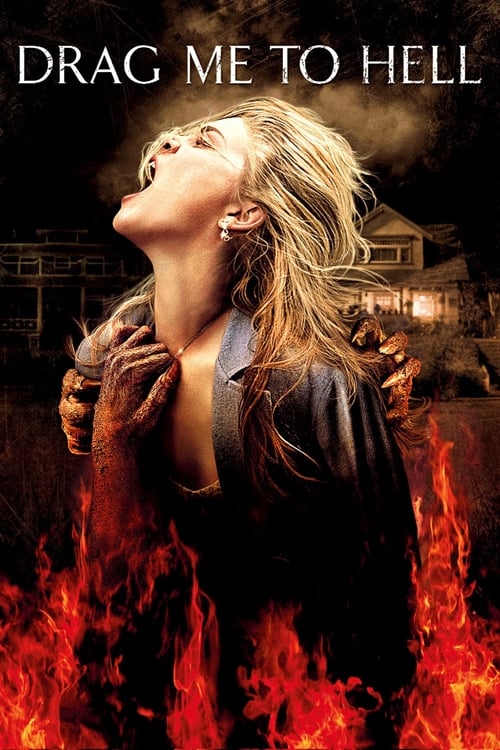
Drag Me to Hell
2009 · Sam Raimi
When you're craving a real scare that's also a riot — the perfect crowd-pleaser for a group that wants to shriek and laugh all the way through.
What it's about
Christine Brown is a sweet-natured Los Angeles loan officer angling for a promotion, so she makes the hard call: she denies an elderly woman the mortgage extension that would save her home. The old woman curses her. For three days a demon torments Christine with escalating ferocity, and unless she can lift the curse — with the help of a psychic who's seen this before — her soul is bound for hell.
The experience
A funhouse ride: huge jump scares, disgusting sight gags, and slapstick so broken-bones funny you laugh and scream in the same breath. It's relentless but never grim — the film is having a blast scaring you.
Performances
Alison Lohman takes an astonishing amount of punishment with total commitment, and Lorna Raver makes Mrs. Ganush one of modern horror's great nightmare figures.
The craft
Sam Raimi directs like a man let off a leash — whip-pans, shock cuts, geysers of fluids, a séance that goes magnificently wrong — proving a PG-13 rating can't declaw a filmmaker who scares with craft instead of gore. The sound design does half the terrorizing; see it loud.
Why it matters
Raimi's triumphant return to horror after his blockbuster superhero years, instantly embraced as proof the genre's wildest showman hadn't lost a step, and a modern model of the moral-comeuppance horror tale.
Snapshot
Drag Me to Hell is Sam Raimi's return to horror after the Spider-Man trilogy (2002–2007). It is a deliberately small, fast, PG-13 shocker in which a Los Angeles loan officer, Christine Brown (Alison Lohman), refuses a mortgage extension to an elderly woman, Sylvia Ganush (Lorna Raver). Ganush places a curse on her. For three days Christine is tormented by a demon, the Lamia, and if the curse is not lifted the demon will take her soul to hell. Raimi co-wrote the film with his brother Ivan, and it plays out as a series of escalating set pieces: a car-park brawl, a nosebleed that turns into a geyser, a séance with a possessed goat, and a graveside struggle in the rain. Each one mixes real fright with the knockabout slapstick of Raimi's Evil Dead films. The structure is a moral fable in the tradition of EC horror comics. One small act of ambition-driven cruelty is punished out of all proportion, and the ending is famously merciless. The film premiered as a midnight screening at the 2009 Cannes Film Festival, was widely praised as a return to form, and is now generally ranked among the best mainstream American horror films of its decade.
Industry & production
The Raimi brothers wrote the script, originally called The Curse, in the 1990s, around the time of Army of Darkness (1992). They then shelved it while Sam Raimi moved into mainstream studio filmmaking: The Quick and the Dead, A Simple Plan, For Love of the Game, The Gift, and finally Sony's Spider-Man films. The project was revived through Ghost House Pictures, the genre label Raimi and his longtime producer Robert Tapert founded in 2002. Ghost House had mostly produced other directors' horror films (The Grudge, Boogeyman, The Messengers). Drag Me to Hell was the first feature Raimi himself directed under the banner. Universal Pictures distributed it.
The budget was modest by Raimi's recent standards; it is commonly reported at about $30 million. The film grossed roughly $90 million worldwide, a solid profit though not a breakout. Ellen Page was originally announced in the lead and withdrew over a scheduling conflict, and Alison Lohman was cast in her place. Justin Long plays Christine's boyfriend, Clay Dalton, a psychology professor. Dileep Rao plays the storefront psychic Rham Jas, David Paymer plays the bank manager Mr. Jacks, Reggie Lee plays Christine's rival Stu Rubin, and Adriana Barraza plays the medium Shaun San Dena. The film was shot in and around Los Angeles and Pasadena in 2008. The release date of 29 May 2009, after the Cannes midnight slot, set it up as a summer counter-programming option for genre audiences.
Raimi chose a PG-13 rating rather than the R that his early work and most contemporary horror carried. He said in interviews that he wanted a "spook-show" ride a broad audience could enjoy. The rating shaped the film's methods: it relies on gross-out fluids, jump scares and comic shock instead of graphic gore. An unrated cut was later released on home video, but it differs only marginally.
Technology
The film combines practical makeup and puppetry with digital effects in a way that is closer to the hand-made feel of Raimi's 1980s work than to the polished CGI of Spider-Man. Ganush's decaying appearance, her toothless gumming of Christine's chin, and the corpse in the cemetery climax were done largely with prosthetics and practical effects. The film is associated with makeup effects artists Greg Nicotero and Howard Berger's KNB EFX Group, longtime veterans of Raimi's world. Mass-produced bodily fluids (embalming fluid, vomit, maggots, blood) were applied on set and often sprayed directly into the actors' faces, a gag inherited from Evil Dead II.
Digital effects handle what physical effects cannot: the shadow-form of the Lamia, the flames and grasping arms of the final descent, the flying handkerchief, and a few compositing tricks. Some reviewers found the CG elements weaker than the practical ones, and the film is sometimes cited as an example of a director choosing slightly artificial digital effects for a cartoonish, comic-book quality. Precise credits for individual digital shots are not well documented in the general critical record.
Technique
Cinematography
Peter Deming shot the film. He had worked with Raimi on Evil Dead II (1987) and was by then known for his work with David Lynch (Lost Highway, Mulholland Drive). The photography is bright and clean in the bank scenes, an almost banal corporate daylight that works as an ironic baseline, and turns heavily shadowed and wind-blown in the supernatural sequences. Raimi's signature camera moves come back in force. There are rushing subjective tracking shots that stand in for the unseen demon, as in the Evil Dead films. There are extreme low and high angles, sharp dutch tilts, and sudden push-ins on faces at the moment of shock. The camera often swoops toward a character just before a scare, so the audience feels the hit physically. Close-ups of mouths, eyes and fingernails dominate the confrontations, which are staged at grotesque, uncomfortable proximity.
Editing
Bob Murawski cut the film. He had edited the Spider-Man trilogy and Army of Darkness, and he later won an Academy Award for The Hurt Locker, which was released the same summer. The editing is built around comic-horror timing: long, quiet build-ups break into rapid, percussive montage. In the car-park fight, the cutting alternates between wide shots that keep the geography clear and very short inserts of a stapler, a ruler, or a mouth clamping onto a chin, which give the sequence its punchline rhythm. Sudden smash cuts to silence or to a mundane scene (dinner with Clay's parents, an office meeting) follow peaks of terror, a tactic Raimi and Murawski use to keep the audience off balance. The film runs about 99 minutes and has little slack.
Mise-en-scène / staging
The production design sets the corporate world of glass, polished desks and beige banking against the ornate, cluttered spaces of the occult: Rham Jas's storefront, the San Dena séance room with its candles and old furniture, and Ganush's relatives' home. Christine's small house in the hills, with its sunny kitchen and kitten, is a fragile domestic space that the demon invades in stages: wind, shadows, the flies, the furniture. The staging of the major set pieces is pure Raimi, in which objects become weapons and slapstick props. Examples include the anvil in the barn-like garage, the hanging gooseberry pie-tin chandelier in the séance room, and the falling stapler. The film also turns ordinary spaces (a car, a bathroom, a dinner table, a train station) into stages for shock and humiliation.
Sound
Christopher Young composed the score. He had earlier scored Raimi's The Gift (2000) and contributed to Spider-Man 3, and he is a horror specialist going back to Hellraiser (1987). The score is unapologetically gothic and orchestral. It is built on a lush, almost romantic main theme with a lilting violin line and wordless voices, which sits against shrieking dissonances, clusters and pounding percussion in the set pieces. Its old-fashioned grandeur fits the film's pastiche of the classic supernatural film. The sound design does a great deal of the work. Whispers, the wind, the clattering of objects, buzzing flies and above all exaggerated "wet" body sounds are pushed to the front of the mix. Silence followed by a sudden burst is the basic unit of the scare.
Performance
Alison Lohman carries the film. Christine is in nearly every scene, and her arc runs from timid people-pleaser to a desperate, aggressive survivor who considers passing the curse on to someone else. Lohman plays the escalating violence with conviction, takes the physical punishment with something like a silent-comedy actor's commitment, and keeps the character sympathetic while revealing her ambition and insecurity. Lorna Raver's Ganush is a remarkable horror performance: pitiable in the bank scene, then terrifying and grotesquely funny in the fights. Justin Long plays the skeptical boyfriend with a light, likable touch. Dileep Rao gives Rham Jas a calm sincerity that grounds the occult exposition, and Adriana Barraza brings intensity to the séance as the medium who has faced the Lamia before. David Paymer and Reggie Lee give the bank scenes a satirical edge as figures of corporate pressure and petty office rivalry.
Narrative & dramatic mode
The film is built on the "cursed object and deadline" framework: a curse with a set time limit, a series of increasingly violent attacks, attempts at exorcism, and a final effort to transfer the curse. The structure is cumulative and episodic. Each day brings a confrontation, a consultation with an expert, and a new rule of the curse. Exposition comes through Rham Jas and San Dena, who explain the Lamia, the three days of torment, and the possibility of passing the cursed object (a coat button) to another person.
The dramatic mode is the morality fable, specifically in the style of EC Comics (Tales from the Crypt), where a small sin brings a disproportionate and ironic punishment. Christine's sin is denying Ganush's extension to impress her boss and win a promotion, and the film makes a point of the gap between the act and its consequences. The tone moves freely between terror, disgust and broad comedy, which Raimi's admirers see as his particular gift and his detractors as a lack of seriousness. The ending is a twist built on mistaken identity. Christine believes she has passed the button to Ganush's corpse, but she has actually given away her own coin, and she is dragged into hell at Union Station in front of the horrified Clay. It refuses the redemption the story seems to promise, which is the logic of the EC ironic finale.
Genre & cycle
Drag Me to Hell is a supernatural horror film with strong elements of horror comedy. Its main lineage is the cursed-victim story, and its clearest single ancestor is Jacques Tourneur's Night of the Demon (1957; US title Curse of the Demon). That film's runic parchment can be passed to another person, a deadline is fixed, and a demon arrives to take the victim. Critics noted this parallel widely when the film was released. It also belongs to the slapstick horror tradition Raimi helped define with Evil Dead II (1987) and Army of Darkness (1992). That tradition goes back to Three Stooges comedy and the American spook-show, and it sits alongside the work of Peter Jackson (Braindead) and Stuart Gordon (Re-Animator).
In 2009 the dominant mainstream horror cycles were the "torture porn" of Saw and Hostel, a wave of remakes of 1970s and 1980s horror, and the early found-footage revival (Paranormal Activity was released later that year). Drag Me to Hell was widely received as a deliberate counter-move, an old-fashioned "fun" horror film with no gore. Many reviewers welcomed it on exactly those grounds.
Authorship & method
The film is a concentrated statement of Raimi's personal style. It brings together the hyperkinetic camera, the cartoon logic of objects and bodies, the mix of horror and comedy, and the American folk morality of punishment and grace that run through his work. After a decade of large studio productions, Drag Me to Hell looks like a deliberate return to the scale and spirit of his first films, and many critics read it as such.
Ivan Raimi co-wrote the script; he had earlier co-written Army of Darkness and the Darkman screenplays. Robert Tapert produced, as he has for Raimi since the original The Evil Dead. Raimi's usual technical collaborators formed the core crew: Peter Deming on cinematography, Bob Murawski on editing, Christopher Young on music, and makeup effects artists from his circle. As in most Raimi films, the 1973 Oldsmobile Delta 88 he has used since The Evil Dead makes an appearance, here as the car Ganush first drives. The authorial continuity is strong and tightly controlled, and the film reads as a personal project rather than a hired job.
Movement / national cinema
This is American studio-backed genre filmmaking. It belongs to no formal movement, but it is part of a recognizable lineage of American horror auteurs who started out in low-budget independent production in the 1970s and 1980s and then moved into the industry: Raimi, Wes Craven, John Carpenter, Joe Dante. Ghost House Pictures was one of several companies set up in the 2000s by established filmmakers to produce horror for the mainstream market. Ghost House did this partly by remaking Japanese horror (The Grudge), which in turn fed the J-horror cycle in American film. In that context, Drag Me to Hell stands as an assertion of a native American horror idiom: EC comics, drive-in shockers and slapstick.
Era / period
The film was released in late spring 2009, in the immediate aftermath of the 2008 financial crisis, which had been driven largely by the American subprime mortgage market and the wave of foreclosures that followed. Because the story starts with a bank employee denying a mortgage extension to an elderly woman about to lose her home, critics immediately read it as an allegory of the crisis. The script had in fact been written well before, and Raimi did not present the film as topical. The coincidence nonetheless gave the film a resonance it would not otherwise have had, and the reading has become a standard part of its critical reputation.
The film also comes at the end of an era of high-budget superhero franchise filmmaking for Raimi personally. His next feature would be Oz the Great and Powerful (2013), and he would not return to directing a horror-inflected film until Doctor Strange in the Multiverse of Madness (2022). Drag Me to Hell thus marks a brief interval in which a director of blockbusters made a deliberately modest genre picture, which was becoming rarer as the studio system leaned increasingly on franchises.
Themes
Guilt, ambition and moral economy. At the film's center is a small act of cruelty that comes from ambition: Christine denies the extension to prove to her boss she can make "hard decisions." The film is built on the idea that this is a sin, and it denies her any escape through technicality. The final reversal suggests that her readiness to pass the curse on to another person, even a dead one, was itself enough to condemn her.
Class, self-image and respectability. Christine is a former farm girl and a county-fair "Pork Queen" who has reinvented herself as a polished professional. She is anxious about her accent, her weight, and her acceptance by Clay's wealthy, condescending parents. The curse brings her repressed past to the surface, and the film suggests that her drive to rise socially is part of what makes her vulnerable. The dinner scene with Clay's parents, where an eye appears in her slice of cake, links the horror to her humiliation.
Bodies and abjection. The film is fixated on bodily fluids and the aging, decaying body: dentures, mucus, vomit, embalming fluid, maggots, ear-wax, flies. The horror is less about death than about bodily contamination. Ganush's body is treated as both pitiable and grotesque, and that has been read as both comic and uncomfortable.
The ethnic Other. The curse comes from a Romani woman, and the film draws on the long-standing "Gypsy curse" trope in horror. Some critics and commentators have objected that the film relies on ethnic stereotyping, even if Ganush's grievance is legitimate and the curse is arguably a just response to an injustice. This tension is a recurring point in discussions of the film.
Animal sacrifice and moral compromise. Christine kills her kitten as an offering, an act played partly for shock and partly as a demonstration of how far she will go. Together with her consideration of passing the curse to a colleague, it is part of the moral erosion the film tracks.
Reception, canon & influence
Critical reception. The Cannes midnight premiere was enthusiastically received, and the American reviews were strongly positive. Many critics celebrated the film as Raimi's return to the gleefully nasty spirit of Evil Dead II and as an antidote to the joyless gore of contemporary horror. Reviewers singled out Lohman's and Raver's performances, the car-park fight and the séance, and the ending's refusal to compromise. Reservations centered on some of the digital effects, the cartoonish approach (which some found too light to be frightening), and the depiction of the Romani characters. Commercially it was moderately successful rather than a hit, and its reputation has grown over time.
Influences on the film (backward). The most frequently cited source is Night of the Demon (1957), whose curse-transfer structure and summoned demon the film clearly echoes. Behind that stands the EC Comics tradition, Tales from the Crypt and The Vault of Horror, with their ironic punishments, which Raimi has openly cited as an influence. The slapstick sensibility comes from the Three Stooges, whom Raimi has repeatedly named as a key influence, and from his own Evil Dead films. The spook-show showmanship of William Castle and the folk-horror tradition of curses and hexes also stand behind the film. Critics further noted the influence of the Hammer and Universal gothic traditions on Young's score and the séance sequence.
Legacy (forward). The film has a secure place in surveys of 21st-century American horror and in horror-comedy canons. It is often paired with The Cabin in the Woods (2011) and the work of Edgar Wright and Peter Jackson as an example of exuberant, affectionate genre filmmaking. Its curse-and-deadline structure, a supernatural affliction transmitted from person to person with a time limit, anticipates the later wave of "transmissible curse" horror films. Commentators have often grouped it with It Follows (2014) and Smile (2022), though a direct line of influence is hard to document, and the shared ancestry with Night of the Demon complicates any attribution. Its PG-13 success is sometimes cited as evidence that mainstream horror can scare without gore, a principle later developed by the James Wan and Blumhouse films of the 2010s. In Raimi's own career it established a template he drew on in Doctor Strange in the Multiverse of Madness, whose horror set pieces critics frequently compared to Drag Me to Hell and the Evil Dead films. The ending, with Christine dragged down beneath the tracks at Union Station, has become one of the most cited endings in modern horror and is a regular example of the bleak, ironic finale.
Influences: the films it descends from and the films it influenced
- Night of the Demon (1957) — Gives Drag Me to Hell its plot engine: a runic parchment that passes the curse by hand, a fixed countdown to the demon's arrival, and a final scramble to slip the token back to someone else. Raimi rebuilds that structure around a button and an envelope.
- The Evil Dead (1981) — Origin of the low-slung, unseen-force POV camera rushing at its victims, which Raimi brings back for the Lamia's approaches. Also starts the Raimi–Tapert production partnership and the 1973 Oldsmobile Delta 88 that Ganush drives.
- Evil Dead II (1987) — Sets the model for Raimi's slapstick horror: bodies and household objects treated as cartoon props, gross-out fluids timed like comic punchlines, and shocks timed like a Stooges gag. Drag Me to Hell repeats this in the anvil, stapler and gushing-mouth gags.
- Army of Darkness (1992) — First full Sam and Ivan Raimi co-written script, mixing a sardonic morality tale with comic misfortune piled on the hero. Its brisk, cause-and-effect gag writing carries straight into the 2009 script.
- A Plumbing We Will Go (1940) — A Three Stooges short, Raimi's named source for comic violence. Its chain reactions of household objects turning on their users, with every hit pinned to a sound effect, are the grammar of the car-park fight and the shed brawl.
- Tales from the Crypt (1972) — Amicus's adaptation of EC Comics, built on cruelty that is repaid with a fitting, ironic punishment and a final sting. Drag Me to Hell follows that pattern: a loan officer denies a woman an extension, which seals her fate.
- Creepshow (1982) — Translates EC panels into lurid lighting and crash-zoom punchlines and treats prosthetic gore as gleeful spectacle. That comic-book showmanship is how Drag Me to Hell stages its grotesque payoffs.
- The Tingler (1959) — Castle's spook-show tactic of treating the audience as the target of a prank (sudden jolts, breaking the fourth wall almost as a carnival joke). This lies behind Raimi's direct-to-camera shocks and the film's playful PG-13 approach.
- Spider-Man 2 (2004) — The operating-room sequence is Raimi slipping an Evil Dead set piece into a studio blockbuster: demon-POV tentacles, swooping push-ins on screaming faces, and a staccato shock cut by Bob Murawski. It works as a trial run for the 2009 film.
- Insidious (2010) — Takes up the PG-13, gore-light, mainly-jump-scare model Drag Me to Hell made bankable, including a séance led by a medium and her comic assistants that recalls Raimi's spirit-summoning set piece.
- The Cabin in the Woods (2011) — Extends the corporate-irony horror comedy: office routine in harsh daylight cut abruptly against supernatural slaughter. It is the institutional framing Raimi uses in Christine's bank.
- Evil Dead (2013) — Produced by Raimi and Tapert, it carries on their insistence on practical, hands-on effects (body-splitting prosthetics, physical gore done on set) at a time when digital effects were the default.
- It Follows (2014) — Makes the transmissible curse with a pursuer its full premise: a supernatural affliction passed by contact that can only be survived by giving it to someone else. This follows the line from Night of the Demon through Drag Me to Hell.
- Smile (2022) — Takes up the curse with a deadline as a chain of professional victims, ending with an ironic, uncompromising final twist. It also uses a leering human face as the sign of the haunting, much as the film uses Ganush's grin.
- Doctor Strange in the Multiverse of Madness (2022) — Raimi brings back the demon-POV tracking shots, swooping push-ins, possessed bodies used as slapstick props and a corpse that bursts out of the earth inside a Marvel tentpole. Critics compared these set pieces directly to Drag Me to Hell.
- Send Help (2026) — Raimi's return to small-scale, nasty horror comedy centered on a mistreated office worker and a cruel boss. It reworks Drag Me to Hell's mix of workplace irony, punishing physical gags and a heroine whose morality is in question.
- Thinner (1996) — Same curse-tale mechanism: a middle-class professional wrongs an elderly Romani figure and is hit with a curse that works on the body. Both films build their suspense around the hero's failing attempts to undo or pass the hex on before time runs out.
- Braindead (1992) — The other major film of splatter slapstick: wet, exaggerated body effects and a domestic matriarch turned grotesque, played for Buster Keaton-style physical comedy. This is the mode Raver's Ganush and Lohman's bruised heroine work in.
- Evil Dead Burn (2026) — The franchise originator's own sibling text: kinetic camera-as-attacker staging with gross-out gags detonated by sound-design jolts, the sonic-punchline method Vaniček calls '80%' of the work.
Similar films
- Send Help (2026) — influence & lineage
- Evil Dead II (1987) — influence & lineage
- Smile (2022) — influence & lineage
- Evil Dead (2013) — influence & lineage
- Hellraiser (1987) — shared sensibility
- The Evil Dead (1982) — shared sensibility
- Jennifer's Body (2009) — shared sensibility
- Evil Dead Rise (2023) — shared sensibility