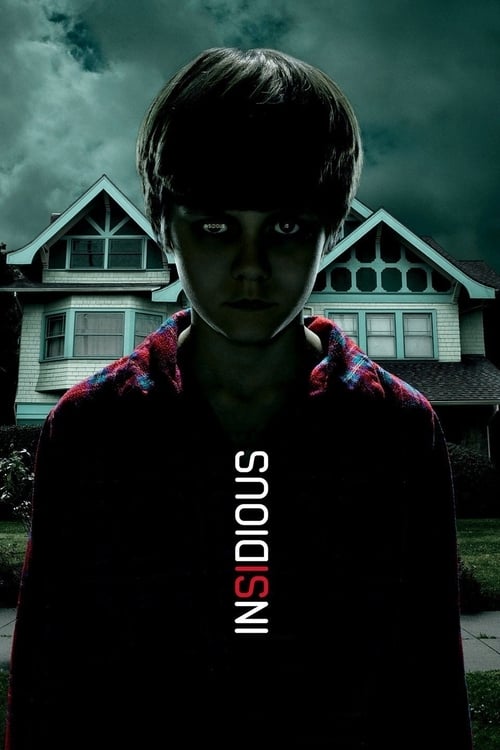
Insidious
2011 · James Wan
When you're craving a real scare — the watch-through-your-fingers, lights-on-afterward kind — without gore. Ideal for a group horror night; it's pure fairground-ride fear, scary but fun.
What it's about
Not long after moving into a new house, Josh and Renai Lambert's young son falls into a coma no doctor can explain, and the house begins to turn on them — sounds, figures, a presence pressing in around the sleeping boy. When they call in a spiritual investigator, they learn the problem is stranger than a haunting, and that it has attached itself to their family.
The experience
An old-fashioned scare machine: dread built slowly through silence and negative space, then detonated with some of the most effective jump scares of its decade. It's genuinely frightening in the moment and eerie in a way that follows you to bed.
Performances
Patrick Wilson and Rose Byrne ground the terror in believable, exhausted parenthood, while Lin Shaye's warm, unflappable medium became an unlikely horror icon.
The craft
James Wan builds fear with classical tools — patient camera moves, deep shadows, a shrieking-strings score, and impeccable timing — proving a tiny budget can outscare any effects showcase. Watch it in the dark with good sound; the film's quiet is where it gets you.
Why it matters
One of the most profitable horror films of its era, it helped swing the genre back from torture and found footage toward supernatural scares, launched a major franchise, and cemented James Wan as the defining horror director of his generation.
Horror · Haunted house & ghost story · Possession & occult. A bloodless haunted-house scare machine: silence and deep shadow build the dread, then jump scares go off with fairground precision.
Snapshot
Insidious is a haunted-house horror film that pivots, halfway through, into a story of astral travel and demonic possession — a structural sleight-of-hand that became its signature. Directed by James Wan and written by his longtime collaborator Leigh Whannell, it follows the Lambert family (Patrick Wilson and Rose Byrne as parents Josh and Renai) after their young son Dalton falls into an inexplicable coma and their home is besieged by presences. A parapsychologist, Elise Rainier (Lin Shaye), reframes the crisis: the boy is not sick and the house is not haunted — Dalton is an unwitting astral projector, adrift in a spectral plane called "the Further," and something wants to use his empty body as a door. Made cheaply and fast in the wake of Paranormal Activity, the film became one of the most profitable horror releases of its era and effectively launched both a durable franchise and the commercial template that would define studio horror for the following decade. It is a landmark less for originality of parts than for the efficiency and craft with which Wan reassembled old machinery into something that frightened audiences anew.
Industry & production
Insidious sits at the origin point of the modern micro-budget-to-blockbuster horror model. It was produced under the Blumhouse Productions banner (Jason Blum) together with Oren Peli — director of Paranormal Activity (2007) — and Steven Schneider, with Wan and Whannell's Alliance-affiliated involvement. The production budget is widely reported at roughly $1.5 million, and principal photography reportedly lasted only about three weeks, shot largely in a single house and controlled interiors. These figures are the ones cited across the trade record; the exact accounting, as with most privately financed genre films, is not fully public, and precise line items should be treated as approximate.
The film premiered at the Toronto International Film Festival in September 2010 and was acquired for distribution by FilmDistrict, then a new theatrical distributor, which released it in the United States in April 2011. Its commercial performance became the story: against its very low cost, Insidious grossed on the order of $97 million worldwide (a widely reported figure), making it one of the highest-return horror films of its generation. That ratio — not the gross alone but the multiple over budget — is what mattered industrially. It confirmed for Blumhouse that a rigorously capped budget, backend-heavy talent deals, and a wide theatrical release could turn genre filmmaking into a reliable business rather than a gamble, and it set the pattern that The Conjuring, Sinister, and the broader Blumhouse slate would follow.
For Wan and Whannell, the film was also a deliberate reinvention. Having become identified with Saw (2004) and its "torture" imitators, the pair used Insidious to move decisively away from gore toward a suggestion-based, atmospheric mode — a strategic repositioning that reshaped both careers.
Technology
Technologically, Insidious is notable for what it refuses. Arriving as digital capture was displacing film and as found-footage aesthetics dominated low-budget horror, Wan pointedly built a film out of classical, largely analog-feeling technique: composed frames, deliberate camera movement, practical lighting, and in-camera scares. The "Further" and its demons are realized primarily through physical means — costume, prosthetic makeup, colored light, fog, and staging — rather than heavy digital effects, a choice dictated as much by budget as by taste but exploited as a virtue. Where compositing and effects are used, they are restrained and serve concealment. The film's most discussed technological gesture is its use of sound and music technology (dissonant string recording, sudden dynamic range) as a scare-delivery system, which is addressed below.
Technique
Cinematography
Cinematography is credited to John R. Leonetti, with additional photography by David M. Brewer. The look is the film's most important formal achievement: Leonetti and Wan reject the shaky, desaturated handheld grammar then fashionable and instead deploy stable, carefully composed frames with pronounced negative space, so that the viewer is invited to search the edges and depths of the image for something wrong. Terror is often withheld in the background of a locked-off shot rather than delivered by a lunging camera. The first half favors cool, naturalistic domestic light; the descent into the Further shifts toward a stylized, saturated palette — reds, blacks, and pooled shadow — that recalls the color logic of Italian horror and of David Lynch's dream spaces. Slow, purposeful dolly and crane moves build dread through duration. This disciplined classicism, executed on a tiny budget, became widely imitated and is a large part of why the film reads as more expensive than it was.
Editing
The editing is credited to Wan himself alongside Kirk Morri. Its central strategy is control of tempo: long, quiet passages that let unease accumulate, punctuated by abrupt cuts synchronized to sound stings. The film is unusually patient about withholding, then ruthless about timing the reveal. The famous "red-faced demon" reveal — the entity appearing directly behind an oblivious Patrick Wilson during an ordinary conversation — works entirely through the coordination of frame, blocking, cut, and score, and has become a textbook example of the composed jump scare as opposed to the cheap one.
Mise-en-scène / staging
Wan's staging is the engine of the film. The Lambert house is organized as a field of thresholds — doorways, windows, the attic, the baby monitor's audio space — across which figures appear and vanish. Scares are frequently placed in the deep or peripheral zones of the frame while the actors' attention is elsewhere, forcing the audience into hypervigilant looking. The second-half production design of the Further externalizes memory and dread as a theatrical dark space, with the Lipstick-Face (Red-Faced) Demon staged in a workshop-like lair. Wan repeatedly uses anachronistic, "wrong" objects — antique dolls, a gas mask, a period gramophone — to unsettle the contemporary domestic setting, and the recurring diegetic use of Tiny Tim's "Tiptoe Through the Tulips" turns a novelty song into a motif of menace.
Sound
Sound is arguably the film's most influential department. Joseph Bishara's score leans on shrieking, dissonant, cluster-chord strings and sudden fortissimo attacks, and the sound design pairs long, near-silent stretches with violent dynamic spikes. This weaponized loud/quiet contrast — the aggressively timed musical "sting" — was widely credited (and later widely blamed) for defining the 2010s jump-scare aesthetic. Diegetic sound is used with equal care: the baby monitor as a channel for intrusion, whispers and static, and the tulips song as a recurring auditory omen.
Performance
Performance is pitched toward sincerity rather than irony, which grounds the escalating supernatural material. Patrick Wilson brings a everyman restraint that pays off when his character must enter the Further himself; Rose Byrne carries the film's early register of maternal panic and exhaustion with conviction. The decisive performance is Lin Shaye's Elise Rainier — warm, matter-of-fact, and authoritative — who converts the film's mid-point exposition dump into its emotional and mythological center; the role made Shaye a horror icon and anchor of the franchise. Whannell and Angus Sampson supply comic relief as the bickering ghost-hunting technicians Specs and Tucker, a tonal valve Wan uses to relax and then re-tighten tension. Notably, composer Joseph Bishara also physically performs the Red-Faced Demon, fusing the film's musical and monstrous identities.
Narrative & dramatic mode
The film's dramatic mode is built on a deliberate genre bait-and-switch. Its first movement follows the conventions of the haunted-house film — new house, escalating disturbances, a mother alone with the fear. Its hinge is the revelation, delivered through Elise, that the "haunting" was a misdiagnosis: the site of horror is not the house but the child, and the threat is not a ghost but a competition among the dead for a living body. This recontextualization retroactively reorganizes everything the audience has seen, and it licenses the audacious second half, in which Josh literally travels into the spirit realm to retrieve his son — shifting the film from domestic realism into dark fantasy and quest. The final twist, in which the rescuer returns carrying something other than himself, closes the film on dread rather than resolution and seeds the sequel. Dramatically, the film is also a family melodrama about inherited affliction and a father's suppressed past.
Genre & cycle
Insidious belongs to the supernatural/haunted-house horror genre but is best understood as a corrective within a specific cycle. It arrived amid two exhausted trends: the "torture" horror that Wan and Whannell's own Saw had helped spawn, and the found-footage boom that Paranormal Activity had ignited. Insidious rejects the aesthetics of both while borrowing the second's economics, reviving instead the classical, PG-13-friendly, atmosphere-first ghost story. In doing so it helped inaugurate a new cycle — the polished, jump-scare-driven studio supernatural film — that Wan himself would consolidate with The Conjuring (2013) and that would dominate mainstream horror through the decade. Within genre history it is a pivot point between the grungy 2000s and the "elevated"/classical revival of the 2010s.
Authorship & method
The film is the product of a tight authorial partnership. James Wan (director, co-editor) is the defining force, and Insidious crystallizes his method: build fear through composition, staging, and sound rather than blood; withhold and then time the reveal; treat the frame as a space to be searched. His fluent, almost showman-like control of dread here established him as horror's premier stylist and launched a trajectory into blockbuster filmmaking (Furious 7, Aquaman). Leigh Whannell (writer, co-star as Specs) supplied the elaborate, mythology-building script and the franchise's connective tissue, later becoming a director in his own right (Upgrade, The Invisible Man, and the fourth Insidious film). Key collaborators define the film's texture: cinematographer John R. Leonetti, whose classical framing shaped the look; composer Joseph Bishara, whose dissonant score and physical demon performance are inseparable from the film's identity; and co-editor Kirk Morri, a recurring member of Wan's team. Producers Jason Blum and Oren Peli contributed the industrial method — extreme budget discipline as an aesthetic and financial engine.
Movement / national cinema
Insidious is an American independent film in origin and sensibility, though its financing and creative team carry an Australian thread — Wan and Whannell both emerged from Australia — and its distribution was routed through independent and international partners. It is not part of a formal movement, but it is a foundational text of an industrial "movement" in all but name: the Blumhouse model of low-budget, high-margin American genre production. Aesthetically it is transnational in its borrowings, drawing on American suburban gothic, Italian giallo color, and Japanese/Asian ghost-film restraint.
Era / period
The film is a document of the early 2010s inflection point in horror. It answers the found-footage saturation of 2007–2011 and the torture cycle of the mid-2000s with a return to classical form, and it does so precisely as the theatrical horror business was being reinvented around capped budgets and wide releases. Its PG-13 rating (in the U.S.), its emphasis on suggestion over explicitness, and its franchise-first construction all mark it as belonging to the post-recession, pre-streaming moment when a cheap, scary, sequel-ready film was the surest bet in Hollywood.
Themes
Beneath the scares, Insidious is about inheritance and denial. Its core turn — that the affliction runs through the father's own repressed childhood, and that the family relocated in vain because the problem travels with the person — dramatizes the idea that trauma is not a place but a lineage; you cannot move away from it. The Further literalizes the unconscious as a space you can be lost in, and astral projection becomes a metaphor for the parts of ourselves that wander and can be colonized. The film also works as an anxiety about parenthood and protection: the terror of a child who is physically present but absent, the helplessness of a mother whose fears are disbelieved, and a father forced to confront his own darkness to save his son. Vision and looking — what waits at the edge of sight, what we refuse to see — are its persistent formal and thematic obsession.
Reception, canon & influence
Critical reception was broadly positive, with reviewers singling out Wan's craftsmanship, the atmosphere and sound design, and Lin Shaye's performance; the most common reservations concerned the second half's shift into overt fantasy, which some found either audacious or tonally excessive. Over time the film's critical standing has been secured less by any single review than by its evident influence.
Influences on the film (backward): Insidious is a knowing synthesis of the classical haunted-house canon — most obviously Poltergeist (1982), with its abducted child and suburban ordinariness violated, and the broader lineage of The Amityville Horror and the "old dark house." Its color and dream logic nod to Italian giallo and to David Lynch; its restraint and its long-haired, threshold-crossing specters absorb the influence of the then-recent J-horror wave (Ringu, Ju-On). Wan has spoken of drawing on iconic screen villain design in shaping the demon's look. Industrially, it descends directly from the Paranormal Activity micro-budget model.
Legacy (forward): The film's influence is outsized. It launched a franchise — Insidious: Chapter 2 (2013), Chapter 3 (2015), The Last Key (2018), and The Red Door (2023) — and, together with the Blumhouse infrastructure it validated, it helped make James Wan the architect of 2010s mainstream horror, a role he extended with The Conjuring and its expansive universe. Its composed jump scare, its loud/quiet sound weaponization, and its classical framing were absorbed across the decade's studio horror, for better and worse: the "Insidious jump scare" became both a template and, for critics of the form, a shorthand for over-reliance on the auditory shock. Its greatest structural legacy may be proving that a rigorously cheap, PG-13, atmosphere-first ghost story could be both artistically respected and a franchise engine — a lesson that reorganized the economics of American horror.
Reception
Critics were lukewarm in 2011 — a fun-but-familiar haunted-house ride — while it quietly became one of the year's most profitable films; a decade on it's credited (with Paranormal Activity) with launching the Blumhouse era and the whole 2010s supernatural-horror boom Wan would cement with The Conjuring.
How Insidious was received, from release to now →
How to watch Insidious: what to notice on a first viewing
- Notice the empty space left at the edges of shots. Wan composes stable, locked-off frames with pronounced negative space, inviting you to search the corners of the image rather than following a moving camera. You start doing the looking the characters aren't doing yet.
- Listen for long quiet stretches before a sudden sting. Joseph Bishara's score sits in near-silence for long passages, then hits with shrieking, dissonant strings timed exactly to a cut. The quiet is doing as much work as the noise that follows it.
- Watch the doorways, windows, and the attic in this house. The Lambert house is staged as a field of thresholds figures keep appearing at and vanishing through, so every opening becomes a place to check. The house's own architecture becomes the source of the dread.
- Notice the antique dolls and other out-of-place objects. Wan dresses the contemporary house with wrong, anachronistic props, a period gramophone, an old gas mask, that unsettle an otherwise ordinary suburban setting. Objects that don't belong are doing quiet work long before anything jumps out.
The whole guide to watching Insidious, with the keys for a rewatch →
Influences: the films it descends from and the films it influenced
- Poltergeist (1982) — Supplies Insidious's core architecture: a child spirited into a spectral 'other side' and a parapsychology squad who arrive mid-film with gear and ritual to retrieve him, restructuring the haunt as a rescue mission.
- Paranormal Activity (2007) — Peli (who produced Insidious) established both the extreme micro-budget model Wan inherited and the locked-off static frame that dares the viewer to scan empty background space for the moment something enters it.
- The Changeling (1980) — Model for patient tempo control and the classically composed, locked-off wide shot that lets dread accrete in a big empty house, plus the mediumistic séance staged as the film's investigative centerpiece.
- The Exorcist (1973) — Bishara's atonal, cluster-chord scoring and the weaponized silence-then-blast sound design descend from Friedkin's use of dissonant avant-garde cues and abrupt aural rupture to signify the demonic.
- Suspiria (1977) — Source of the saturated giallo palette — pooled reds and unnatural color as expressionist threat — married to a wall-to-wall dissonant score, both of which Insidious quotes in its Further/demon sequences.
- Ringu (1998) — J-horror template for the long-haired, threshold-crossing specter and the restraint of withholding the ghost's full appearance, staging terror at the boundary between the mundane frame and the beyond.
- Ju-On: The Grudge (2002) — Perfected the ghost invading ordinary domestic space in locked-off compositions, teaching Insidious to place an apparition quietly within a static frame rather than lunge it at the camera.
- The Amityville Horror (1979) — Canonical suburban haunted-house text whose ordinary family home turned malevolent gives Insidious its opening-act genre grammar before the bait-and-switch into overt fantasy.
- A Nightmare on Elm Street (1984) — Ancestor of the astral-projection conceit: a dream/interstitial realm where a demonic figure with iconic villain design (a debt Wan cites) can reach across into and menace the sleeping body.
- Saw (2004) — Same duo's build-a-cheap-scare-machine method — a low-budget high-concept engineered to launch a franchise — transplanted from gore to supernatural jump-scare craft.
- Drag Me to Hell (2009) — Takes up the PG-13, gore-light, mainly-jump-scare model Drag Me to Hell made bankable, including a séance led by a medium and her comic assistants that recalls Raimi's spirit-summoning set piece.
- The Conjuring (2013) — Wan's own immediate extension of the Insidious method — composed jump scare, patient reveal, period-classical framing and searchable-frame staging — scaled up into a self-contained cinematic universe.
- Hereditary (2018) — Elevates the Insidious toolkit — composed negative space, glacial tempo control, weaponized loud/quiet rupture — and fuses it to the inherited-trauma theme, staging horrors in the deep background of locked-off wides.
- Lights Out (2016) — Produced by Wan and shot by Insidious DP John R. Leonetti's collaborators, it literalizes the threshold-field scare — the figure that exists only in a dark zone at the frame's edge, appearing and vanishing on a light cue.
- The Invisible Man (2020) — Whannell's directorial extension of his own Insidious craft, built on holding the camera on charged empty negative space so the audience polices the frame for an unseen presence.
- Annabelle (2014) — Directed by Insidious's own cinematographer, it transplants his classical, deep-focus framing and composed jump-scare timing directly into the Wan-verse spinoff economy.
- The Conjuring: Last Rites (2025) — Wan's own establishment of the withheld-then-punctuated reveal cut married to Joseph Bishara's dissonant string-cluster stings — the exact sonic-visual jump grammar Chaves executes here.
- Satan's Slaves (2017) — Long, slowly prowling camera moves through domestic hallways set up a jump scare and then hold off on it. The film relies on a ghost simply standing still in the background rather than lunging at the camera.
- Sinister (2012) — Blumhouse contemporary that runs the same playbook: atmosphere-first PG-13-adjacent dread built on Bishara-style abrasive sound stings and quiet-domestic-space-turned-hostile rather than gore.
- It Follows (2014) — Shares the locked-off, slowly-panning composition that plants a distant figure in the background of the frame and lets patient tempo, not the cut, do the frightening.
- The Babadook (2014) — Parallel post-Insidious art-horror that channels the same inherited-trauma-as-monster figuration and threshold staging (the doorway, the space under/beyond) into a domestic haunting.
- The Conjuring 2 (2016) — The immediate prototype of the mobile camera gliding through the house toward negative space, plus Joseph Bishara's dissonant string score and his practice of physically performing the demon on set.
- The Conjuring: The Devil Made Me Do It (2021) — Wan's earlier collaboration establishing composer Joseph Bishara's dissonant, cluster-chord score and his physical performance as demonic figures — the sonic and embodied-demon method Bishara reprises here for continuity across the directorial handoff.
- Malignant (2021) — Same director and same composer: Joseph Bishara's dissonant score and Wan's long gliding tracking shots through a house the camera maps room by room.
- The Orphanage (2007) — It brings back the Poltergeist and Orphanage medium-with-technicians scene: an older female psychic, investigators with monitoring gear, and a parent who has to cross into the spirit world to get a child back.
Similar films
- The Conjuring (2013) — influence & lineage · same viewing thread
- Sinister (2012) — influence & lineage · same viewing thread
- The Babadook (2014) — influence & lineage · same viewing thread
- Ju-on: The Grudge (2002) — influence & lineage
- Hereditary (2018) — influence & lineage · same viewing thread
- The Conjuring 2 (2016) — same viewing thread
- undertone (2026) — same viewing thread
- The Conjuring: The Devil Made Me Do It (2021) — same viewing thread
All the films related to Insidious →
Watch it with: curated runs of related films
- Something in the Family Home — A run of hauntings that go after the family unit itself — watch them together and you'll see the Wan-era jump-scare house turn into Aster's grief-rotted dollhouse and the folk-horror homesteads of Java and Japan.
- The House Remembers Its Grief — A run of family hauntings where the ghost is never just a ghost: watch these together to see the slammed-door haunted house of the multiplex slowly turn into mourning, guilt and things the family won't say.