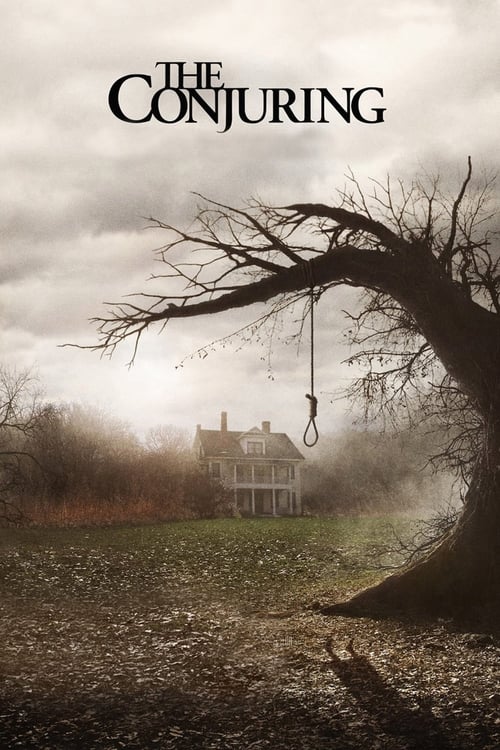
The Conjuring
2013 · James Wan
When you're craving a real scare — the lights-off, check-behind-you kind — delivered with old-fashioned polish. A film to watch with someone else in the room, on purpose.
What it's about
In 1971, a family moves into a Rhode Island farmhouse and finds something in it that will not leave them alone. Paranormal investigators Ed and Lorraine Warren take the case — a married team who've seen plenty of hauntings — and discover this one is different: a presence powerful enough to threaten the family, and eventually the Warrens themselves.
The experience
Classical, patient, and genuinely frightening — it builds dread from creaking doors, dark cellars, and games of hide-and-clap rather than gore, then pays it off with expertly sprung scares. The kind of horror that has the whole room holding its breath.
Performances
Vera Farmiga and Patrick Wilson ground the whole thing as the Warrens — playing them with warmth and total sincerity, so the marriage at the center feels as real as the haunting, which is exactly why the scares land.
The craft
James Wan directs with prowling camerawork and immaculate scare architecture — long, quiet setups where the frame teaches you where to look, then punishes you for looking. It proved atmosphere could beat gore at the box office, and its sound design demands good speakers in a dark room.
Why it matters
It reset mainstream American horror in the 2010s — a modestly budgeted ghost story that grossed hundreds of millions and seeded an entire cinematic universe of sequels and spin-offs, making the restrained, craft-forward studio haunting the dominant template for a decade.
Horror · Haunted house & ghost story · Possession & occult · Suspense & terror. A 1971 farmhouse haunting built from dark cellars, creaking doors and patient silence, then sprung with expertly timed jolts.
Snapshot
The Conjuring is a supernatural haunted-house film that reset the commercial and aesthetic terms of mainstream American horror in the 2010s. Directed by James Wan from a screenplay by twin brothers Chad Hayes and Carey W. Hayes, it dramatizes a case claimed by real-life self-styled demonologists Ed and Lorraine Warren: the 1971 haunting of the Perron family in a Rhode Island farmhouse. Produced by New Line Cinema and released by Warner Bros. in July 2013, it was made for a modest reported budget (in the vicinity of $20 million) and became one of the year's most profitable studio releases, grossing well over $300 million worldwide. Its significance is double: as craft, it demonstrated that a restrained, old-fashioned ghost story built on atmosphere rather than gore could dominate the box office; as industry, it seeded the "Conjuring Universe," the most successful horror franchise ever assembled around an original property. The film is notable, too, for receiving an R rating despite containing almost no graphic violence — reportedly on the grounds that it was simply too frightening, an anecdote that became part of its marketing lore.
Industry & production
The Conjuring arrived at a pivotal moment for New Line, the studio historically associated with horror franchises (A Nightmare on Elm Street, Final Destination) and by 2013 folded into Warner Bros. The project passed through development for several years; the Hayes brothers' script was based on interviews and materials associated with the Warrens and with the Perron family, whose daughter Andrea Perron later wrote a multi-volume memoir about the events. Rights and depiction issues around the Warrens' extensive case archive shaped the production, and Lorraine Warren — still living during production, she died in 2019 — served as a consultant and visited the set, lending the film a claim to first-hand authenticity that its "based on a true story" framing leaned on heavily.
Wan came to the film fresh off the sleeper success of Insidious (2010), which had proven that a low-budget, PG-13-adjacent supernatural film could be enormously profitable. That track record gave him leverage to make The Conjuring on his own terms: practical effects, a period setting, an ensemble of respected actors rather than teen-slasher archetypes, and a deliberate, unhurried pace. Principal photography took place largely in and around Wilmington, North Carolina, using EUE/Screen Gems Studios and standing exteriors dressed to evoke rural New England circa 1971. Reports of eerie on-set occurrences — cast and crew describing unexplained incidents — circulated widely during the press cycle; these should be read as promotional folklore rather than documented fact, though they were embraced by the production. The film's commercial performance was strong enough that sequels and spinoffs were greenlit almost immediately, transforming a one-off haunted-house picture into a franchise engine.
Technology
The Conjuring was made in the era of digital capture that had by 2013 become standard for studio features, yet its entire technological program is oriented toward concealing modernity. Rather than exploit digital sharpness, the production graded the image toward a muted, desaturated, faintly filmic palette meant to summon the look of 1970s horror. The decisive technological choice is Wan's insistence on practical, in-camera effects over computer-generated imagery: doors that swing on rigged hinges, furniture on wires and hidden mechanisms, wardrobe interiors built for a body to fall out of, and old-fashioned makeup rather than digital creatures. Where digital tools are used, they are largely invisible — wire removal, subtle compositing — precisely so the audience registers a physical, present threat rather than a rendered one. This tactile approach is central to the film's credibility and to its influence: it made the case, commercially, that analog craft could out-scare the digital spectacle that dominated the surrounding blockbuster landscape.
Technique
Cinematography
Shot by John R. Leonetti — Wan's regular collaborator, who had also lensed Insidious — the film is a showcase of confident, mobile camerawork that behaves like a character rather than an observer. Leonetti and Wan favor long, gliding takes: sweeping crane and Steadicam moves that travel through the farmhouse's spaces, up staircases, and across rooms, mapping the geography of the house so that the audience knows where danger lives before it strikes. The camera frequently frames negative space and thresholds — doorways, the dark beneath furniture, the mouth of a cellar — inviting the eye to search the frame for something not yet there. The palette is cold and desaturated, all faded wallpaper and overcast light, with pools of deep shadow that the compositions dare the viewer to scrutinize. This is horror cinematography of withholding: the frame promises information and then denies it, and the terror emerges from the gap.
Editing
Kirk M. Morri, another Wan regular, cut the film with a patience that is its own statement. Where much contemporary horror relies on rapid cutting to disorient, The Conjuring holds shots long past comfort, letting dread accumulate before releasing it. The editing is architecturally precise around its setpieces — the "hide and clap" game, the wardrobe sequence, the basement — where the timing of a reveal or a sound is calibrated to land at the moment of maximum vulnerability. The film's celebrated scares work because the cutting refuses to over-cover: it lets a single sustained take do the work, so that when the edit finally comes, it detonates.
Mise-en-scène / staging
Production designer Julie Berghoff built a densely period-specific world: the Perron farmhouse is a lived-in accumulation of early-1970s domestic texture, cluttered enough to hide threats and worn enough to feel real. The staging is deeply spatial — Wan choreographs action so that the audience is aware of off-screen zones, of what lies behind a character or below the floorboards. Recurring objects (the music box, the boarded-up cellar, the Annabelle doll of the prologue) function as staging anchors, focal points that concentrate anxiety. The Warrens' own home, with its "occult museum" of cursed artifacts, provides a counter-space of contained horror against the uncontained haunting of the farmhouse.
Sound
Sound is arguably the film's primary instrument of fear. Joseph Bishara's score is dissonant and percussive, built from stinging strings and low, physical rumbles that press on the listener before any image confirms a threat. Equally important is the sound design's precision with small, diegetic cues — the double clap, creaks, the music box's tune, a voice where none should be. Wan orchestrates long stretches of near-silence so that a single sound carries enormous weight, and he repeatedly baits the audience with the promise of a loud shock only to withhold it, resetting anticipation. The film is a study in how quiet, and the threat of noise, can be more frightening than noise itself.
Performance
The casting of accomplished dramatic actors is a structural decision, not a cosmetic one. Vera Farmiga and Patrick Wilson play Lorraine and Ed Warren with warmth and marital tenderness, grounding the supernatural material in a credible relationship; their sincerity as investigators lets the audience take the haunting seriously. Lili Taylor, as the afflicted mother Carolyn Perron, delivers the film's most harrowing work, her physical and psychological deterioration lending genuine stakes. Ron Livingston plays the father with weary decency. The performances are pitched at emotional realism rather than genre camp, which is precisely what allows the film's more outlandish events to register as terrifying rather than ridiculous.
Narrative & dramatic mode
The film operates in the mode of the investigative supernatural drama, structured as a case study. It opens with a prologue (the Annabelle doll) that establishes the Warrens' expertise and worldview, then introduces the Perron family and their escalating torment, before bringing the two strands together as the Warrens investigate and ultimately intervene. This dual-protagonist structure — the endangered family and the professional investigators — lets the film alternate between visceral haunting and procedural explanation, giving the audience both fear and a framework for understanding it. The dramatic arc culminates in a possession-and-exorcism climax, but the emotional core is domestic: a mother's love weaponized against her family, and a marriage (the Warrens') defined by shared danger. The "based on a true story" framing is itself a narrative device, lending events an evidentiary weight the film exploits at every turn.
Genre & cycle
The Conjuring sits at the confluence of several horror traditions: the haunted-house film, the demonic-possession film, and the 1970s "true-case" supernatural thriller. It is consciously a throwback, rejecting the torture-centered "gorno" cycle of the 2000s — a cycle Wan himself helped inaugurate with Saw (2004) — in favor of atmosphere, restraint, and craft. Within the 2010s, it belongs to a broader revival of classical supernatural horror that Wan led alongside films like Insidious, and it became the tentpole of a spinoff cycle that would define studio horror for a decade.
Authorship & method
James Wan is the film's clear authorial center, and The Conjuring represents the maturation of his method. Malaysian-born and Australian-raised, Wan broke through with Saw but spent the following decade reinventing himself as a maestro of the old-fashioned scare, prizing suspense, camera movement, and practical effect over shock and gore. His signatures are all present: the roving long take, the exploitation of off-screen space, the misdirected jump scare, the affection for vintage horror iconography.
He is supported by a tight repertory of collaborators. Cinematographer John R. Leonetti and editor Kirk M. Morri both carried over from Insidious, giving the film continuity of visual and rhythmic sensibility. Composer Joseph Bishara — who scored Insidious and who has repeatedly performed on-screen as demonic entities in Wan's films — provides the abrasive sonic identity, and the film's performance-driven approach reflects Wan's decision to cast for dramatic credibility. Writers Chad and Carey W. Hayes supplied the case-file structure and the family-centered emotional spine. The result is an unusually unified authorial vision in which direction, image, cut, and sound pull in the same direction.
Movement / national cinema
The film is a product of the Hollywood studio system — a New Line/Warner Bros. release — but its authorship reflects the increasingly transnational character of American genre filmmaking, with Wan's Australian-industry formation informing his craft-first sensibility. It does not belong to a formal movement so much as to a self-conscious revivalist impulse: a deliberate return to the aesthetics of American and British supernatural cinema of the late 1960s and 1970s, filtered through contemporary technique.
Era / period
The Conjuring is doubly period-bound. Diegetically it is set in 1971, and its every design choice — costume, décor, automobiles, grain of light — labors to reconstruct that moment, which is also the golden age of the haunted-house film it emulates. Industrially it is a 2013 film, emerging at the tail end of the found-footage cycle (Paranormal Activity and its imitators) and the exhaustion of torture horror, positioning itself as a polished, star-supported alternative to both. Its success helped define the shape of studio horror for the remainder of the decade.
Themes
At its heart the film is about the family under siege — the home, ordinarily a refuge, turned into a trap, and maternal love perverted into a threat against one's own children. It explores faith and belief: the Warrens' Catholic-inflected worldview, the reality of evil, and the moral authority claimed by those who fight it. Marriage is a sustained theme, with the Warrens' partnership offering a portrait of devotion mirrored against the Perrons' fraying household. The film also meditates on the past's grip on the present — a historical curse (the fictionalized witch backstory) reaching forward to poison a modern family — and on the porousness of the ordinary domestic world to forces beyond reason.
Reception, canon & influence
Critically, The Conjuring was received far more warmly than most studio horror of its era, praised for its craftsmanship, its performances, and Wan's mastery of suspense; reviewers repeatedly singled out its restraint and its old-fashioned command of dread. Commercially it was a phenomenon, its enormous profit-to-budget ratio making it one of the most successful horror films of the decade.
Its influences run backward to a canon of classical supernatural cinema: The Exorcist (1973) for its possession framework and its treatment of faith versus evil; The Amityville Horror — a case in which the real Warrens were involved — and Poltergeist (1982) for the American haunted-house template; and the atmospheric restraint of The Haunting (1963), The Changeling (1980), and Rosemary's Baby (1968). Wan has openly aligned himself with this lineage of scare-through-suggestion.
Its forward influence is immense. The Conjuring launched the "Conjuring Universe," a shared-continuity franchise spanning Annabelle (2014) and its own sequels, The Conjuring 2 (2016) and beyond, The Nun, The Curse of La Llorona, and further spinoffs — collectively the highest-grossing horror franchise built from an original concept. Beyond its own series, the film helped restore atmosphere-driven, practically executed supernatural horror to commercial dominance, demonstrating to studios that patience and craft could out-earn spectacle and gore. It also intensified a broader cultural reckoning with the "based on a true story" claim and with the real Warrens' contested legacy, as skeptics and the Perron family alike publicly disputed the film's version of events. Within a decade of its release, The Conjuring had become both a modern horror touchstone and a template that its many imitators — and its own sprawling franchise — would repeatedly attempt to reproduce.
A Deleuzian reading
A woman ties a blindfold over her eyes and claps twice.
The full Deleuzian reading of The Conjuring →
Reception
A rare horror film that was a critical and box-office smash on arrival — $300M+ on a $20M budget — and a decade on it's only grown in stature as the film that made classical, jump-scare-craftsman horror respectable again and accidentally birthed cinema's biggest horror franchise.
How The Conjuring was received, from release to now →
How to watch The Conjuring: what to notice on a first viewing
- Watch the corners and doorways instead of the faces. Wan and John Leonetti compose thresholds, the dark under furniture, the mouth of the cellar, and then hold. The frame is loaded with places for something to be, and the cut does not come. You finish reading the picture and keep scanning it, which means the film has you doing the frightening.
- Listen for a loud shock that never actually arrives. Joseph Bishara's strings press in before anything is visible, then the track drops to near-silence. Wan builds toward a bang and repeatedly declines to ring it, so the next promise costs more. The film is tuning you rather than scaring you continuously, so your own anticipation does most of the work.
- Follow the camera as it glides through the whole house. Long crane and Steadicam takes travel up the staircase, through doorways, room to room. By the end of the first act you know the farmhouse's floor plan as well as the family does. The film teaches you the geography on purpose, so later you always know which unseen room a sound came from.
- Watch Farmiga and Wilson play the Warrens as a marriage. They touch, they check on each other, they work as colleagues who go home together. Lili Taylor plays Carolyn's state as ordinary exhaustion first. Nobody in the cast plays it as genre. That plainness buys the supernatural material its credit, so the strange events land as frightening rather than silly.
- Look at the objects the film keeps returning to. A music box, a boarded cellar door, a doll behind glass in the Warrens' room. Julie Berghoff dresses the 1971 house so these props sit in ordinary clutter until the film picks them up. Each object arrives already loaded by other horror films, and Wan plays that training on you as an instrument.
The whole guide to watching The Conjuring, with the keys for a rewatch →
Influences: the films it descends from and the films it influenced
- The Exorcist (1973) — Establishes the possession-as-procedure template Wan borrows: clinical, documentary-sober investigation intercut with escalating supernatural events, so the demonic is validated through case-file realism rather than spectacle.
- The Haunting (1963) — The scare-through-suggestion doctrine — never showing the entity and letting a bulging door, breathing, and off-screen pounding carry the terror — is the restraint Wan explicitly aligns himself with.
- The Innocents (1961) — Freddie Francis's deep-focus, negative-space compositions leave a figure lurking at the edge of the widescreen frame, the exact exploitation of empty screen area Wan uses to hide his ghosts in plain sight.
- The Changeling (1980) — The gliding camera prowling an empty period house and the reveal withheld until a single diegetic cue (the bouncing ball, the séance recording) directly model Wan's silence-and-diegetic-cue dread.
- Rosemary's Baby (1968) — Grounds demonic menace in dramatic-realist domestic performance, the naturalistic acting register Wan casts for so the supernatural lands against a credible household.
- The Amityville Horror (1979) — The literal Warren-investigated 'based on a true story' domestic haunting — the case-file source and marketing claim The Conjuring inherits and rebuilds around the Perron house.
- Poltergeist (1982) — Codifies the suburban-American family-under-siege haunted house with practical in-camera effects escalating from benign mischief to violent assault, the structural arc Wan reproduces.
- Insidious (2010) — Wan's immediate self-precursor: assembles the exact repertory — Leonetti's roving camera, Morri's cutting rhythm, Bishara's abrasive score and on-screen demon — and perfects the misdirected jump scare carried straight into The Conjuring.
- The Ring (2002) — Built on the atmosphere-driven, withholding-slow-burn studio-horror model the Ring legitimized — dread-by-accumulation and restrained PG-13-adjacent craft over gore.
- Saw (2004) — Wan's mainstreaming of studio horror grows directly out of the Saw system: franchise-first design, precise camera choreography, and iconic-villain branding scaled to a shared universe.
- Ju-on: The Grudge (2002) — The clap-game and wardrobe-top reveals stage a figure held in a dark corner of a domestic wide shot until the viewer finds it. Wan openly takes that held-shot technique, plus a contorted ghost atop the furniture, from the J-horror wave Ju-on led.
- The Conjuring 2 (2016) — Extends the Warren case-file structure and pushes the gliding long take further, the roaming single-shot camera move through the haunted home becoming the franchise's signature set-piece.
- Annabelle (2014) — The first Conjuring Universe spinoff, directed by the seed film's own cinematographer, transplanting its negative-space framing and practical-doll iconography into a standalone period haunting.
- Ouija: Origin of Evil (2016) — A period-set (1960s) possession-haunting whose gliding long takes and slow reframing around off-screen space directly apply the post-Conjuring playbook to a studio franchise.
- The Nun (2018) — A Conjuring Universe entry expanding the Valak entity introduced by Wan, staging its scares through practical habit-and-shadow effects and negative-space compositions in a period gothic setting.
- The Conjuring: Last Rites (2025) — The foundational template: roaming crane and Steadicam long takes that survey the haunted house, plus the tender, sincere Warren marriage installed as the series' emotional center.
- Satan's Slaves (2017) — A family besieged in a 1970s-period house. Its set pieces are built on repeated sound cues, like the clap game, which Anwar reworks as the dead mother's bell, and on a camera that pans away and back to reveal a figure that wasn't there before.
- The Woman in Black (2012) — Contemporaneous revivalist gothic that, like The Conjuring, resurrects the Hammer-era haunted house through off-screen space and slow-build restraint rather than gore.
- Sinister (2012) — Structures its horror as an investigator sifting a found family archive, pairing long stretches of silence-and-diegetic-cue dread with an abrasive dissonant score in the same register as Bishara's.
- The Babadook (2014) — A parallel-year revivalist haunting that builds its monster from practical in-camera craft and pop-up-book stagecraft, privileging family-under-siege psychology over shock exactly as Wan does.
- Hereditary (2018) — Weaponizes off-screen space and near-static long takes so the demonic reveal is withheld to the edge and depth of the frame, the family-under-siege dread escalated into arthouse register.
- Malignant (2021) — Wan extends his own craft — the overhead gliding long take (the top-down house-plan tracking shot) and a practical body-horror creature — pushing the in-camera camera-choreography of The Conjuring to a formal extreme.
- It (2017) — Defines the New Line house style of engineered jump-scare timing — silence stretched then broken by a synchronized sting and reveal — the grammar Ballantine's cutting deploys throughout It.
- The Autopsy of Jane Doe (2016) — Applies a quasi-clinical investigative method to the paranormal, treating period artifacts as forensic evidence — the procedural-investigator-versus-uncanny structure run in parallel.
- The Conjuring: The Devil Made Me Do It (2021) — The direct parent: supplies the franchise grammar Chaves is custodian of — Wan's gliding, unmoored camera that pans into empty negative space to withhold the scare, plus the Wilson–Farmiga Warrens as period-set paranormal investigators.
- The Orphanage (2007) — Its 'hide and clap' game-turned-haunting is a direct relative of the grandmother's-footsteps scene: a children's game sets the rhythm of the scare, which comes in a single held, rationed beat.
Similar films
- The Conjuring 2 (2016) — influence & lineage · same viewing thread
- Sinister (2012) — influence & lineage · same viewing thread
- Hereditary (2018) — influence & lineage · same viewing thread
- The Haunting (1963) — influence & lineage
- The Exorcist (1973) — influence & lineage
- Malignant (2021) — influence & lineage
- The Babadook (2014) — influence & lineage · same viewing thread
- Insidious (2011) — same viewing thread
All the films related to The Conjuring →
Watch it with: curated runs of related films
- Something in the Family Home — A run of hauntings that go after the family unit itself — watch them together and you'll see the Wan-era jump-scare house turn into Aster's grief-rotted dollhouse and the folk-horror homesteads of Java and Japan.
- The House Remembers Its Grief — A run of family hauntings where the ghost is never just a ghost: watch these together to see the slammed-door haunted house of the multiplex slowly turn into mourning, guilt and things the family won't say.