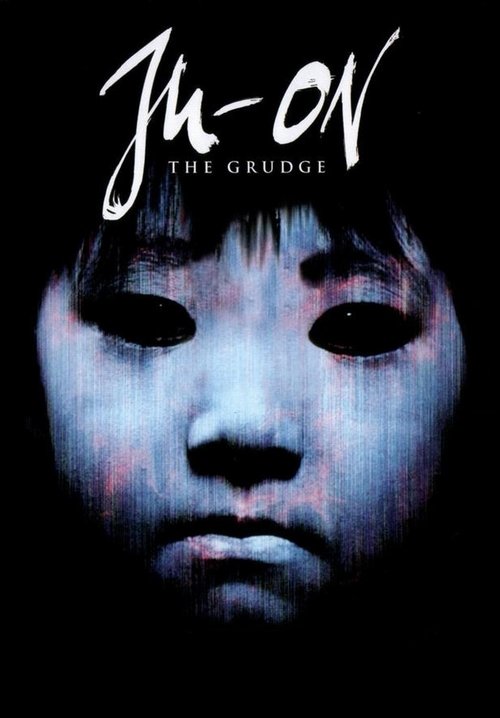
Ju-on: The Grudge
2002 · Takashi Shimizu
When you're craving a real scare — the kind that makes your own hallway feel wrong afterward. Pure challenge, zero comfort; watch with the lights on and a friend nearby.
What it's about
An ordinary suburban Tokyo house holds the rage of a murdered wife and son, and that rage has become a curse that infects anyone who steps inside. A social worker sent to check on an elderly woman living at the site is the first thread in a chain of victims — the film follows them one by one in short, out-of-order chapters, each named for the person about to be touched. There's no detective, no ritual, no way out: just the house, and the people who entered it.
The experience
Dread without relief — the fractured timeline means you're always bracing, never safe, and the scares come in broad daylight, under blankets, in stairwells, places horror isn't supposed to reach. It's less a story than a trap closing, and the croaking sound alone will follow you to bed.
Performances
Takako Fuji's Kayako is a landmark of physical horror acting — the contorted crawl and that guttural death-rattle are hers, and they became the franchise's signature.
The craft
Shimizu builds terror from structure: the jumbled chapter order turns every scene into a question of when you are and who's already doomed. The scares are staged with patient framing and devastating sound design — that throat-click croak does more than any effect budget could. Watch it loud and in the dark.
Why it matters
Alongside Ringu, this is the film that defined J-horror for the world — it launched an American remake directed by Shimizu himself, a sprawling franchise, and a decade of pale, long-haired ghosts in global horror.
Snapshot
Ju-on: The Grudge is the first theatrical feature in Takashi Shimizu's Ju-on franchise, and with Hideo Nakata's Ringu (1998) it became one of the two films that defined "J-horror" for audiences outside Japan. It was made in 2002 and opened in Japanese cinemas in early 2003. It continues and partly re-stages two earlier direct-to-video features, Ju-on and Ju-on 2 (both 2000).
The premise is stark. A man murdered his wife and young son in an ordinary suburban Tokyo house, and their rage has become a curse. The curse attaches to the house and then spreads to anyone who enters it, like an infection. The film follows a chain of victims in short, out-of-order chapters, each titled with a character's name. It has no hero who solves the mystery and no ritual that ends the curse.
Two images from the film became famous worldwide: Kayako, the murdered wife, a pale long-haired figure moving in jerks with a croaking death-rattle; and Toshio, her son, a chalk-white small boy who meows like a cat. The film is best understood as a work of structure and repetition. Its horror comes from the feeling that the same thing keeps happening, everywhere, to everyone.
Industry & production
The Ju-on idea began small. Shimizu was a student at the Film School of Tokyo (Eiga Bigakkō), where Kiyoshi Kurosawa was among his teachers. In 1998 he made two very short segments, "Katasumi" and "4444444444", for the television horror anthology Gakkō no Kaidan G. The first showed a pale, croaking woman; the second, a boy's voice on a mobile phone. Shimizu then expanded the idea into two low-budget features for Japan's V-Cinema market, Ju-on and Ju-on 2, both released in 2000. They were shot quickly and cheaply on video.
Those videos built a strong word-of-mouth reputation. That led to a theatrical version produced under Taka Ichise, a central producer of the J-horror cycle who was also behind Ringu. The theatrical film is not exactly a remake of the videos. It keeps the Saeki family backstory and the house, recasts several roles, and tells a new set of victim stories with larger resources. Shimizu followed it almost at once with Ju-on: The Grudge 2 (2003).
The industrial context matters. At the turn of the millennium, Japanese studios and producers treated horror as a low-cost, high-yield genre. Directors often began in video or television and could move to features if a property did well. Ju-on's journey from TV insert to V-Cinema to theatrical release to Hollywood remake is a clear example of that pipeline. Reliable public figures for the film's budget and Japanese box office are hard to find, and none are given here.
Technology
The film's technology is modest, and that is the point. Its effects rely on make-up, practical staging, and editing more than digital imagery. Kayako and Toshio are created mainly with white-and-grey body make-up, dark eye shadow, and wigs. Their strangeness comes from performance and framing, not effects work. There is some digital compositing: apparitions appearing in shots, ghostly faces, and distorted television and CCTV images. It is used sparingly and often deliberately degraded.
Recording and surveillance devices are woven into the plot. Security-camera footage, a television screen that warps, and a phone line all carry the curse. This connects to a wider late-1990s J-horror interest in media as a carrier of haunting: Ringu's videotape, the internet in Kurosawa's Kairo (2001). The videos had a rough video look, while the theatrical film is cleaner. Specific technical details, such as camera and stock, are not well recorded in English-language sources.
Technique
Cinematography
The photography (credited to Tokusho Kikumura) favours plain, evenly lit domestic interiors. The Saeki house is cramped, ordinary, and a little shabby, not gothic. The camera often holds static, medium-wide frames of rooms, hallways, and stairwells, so the viewer scans the frame for something wrong. Shots in dim natural light, especially in the stairwell and at the attic hatch, set up the film's best-known reveals.
The framing often puts the ghost in plain view, on the edge of the frame or in the background, rather than relying on a sudden cut. Close shots of eyes, of a hand under bedsheets, and of hair are used as punctuation. Low and overhead angles appear around the staircase. They emphasise vertical space, from attic to stairs, as the axis along which the ghosts move.
Editing
The editing is the film's main formal idea. The story is broken into chapters, each introduced by an intertitle naming a character, and the chapters are not in chronological order. A character who seems minor or already dead in one chapter becomes the centre of another. Events glimpsed early are explained, or simply repeated, later.
As a result, viewers gradually realise that the chapters overlap in time. Several of the ending's effects depend on recognising that a later scene was set up much earlier. This replaces the usual investigative arc with a mosaic. The audience understands the pattern of the curse better than any character can.
Within scenes, Shimizu often cuts patiently. He lets a shot run until the apparition appears, then holds on the character's reaction. He uses fewer of the loud musical jump scares that the American remakes would add.
Mise-en-scène / staging
The film's horror is built on ordinary spaces: a family home, an office building, an apartment, a school, a lift. Its most famous set pieces stage the supernatural inside routine settings. A woman hides under her duvet and finds something already there with her. A boy appears on every floor as a lift goes up. A security guard watches a dark figure on CCTV. Kayako crawls down the stairs toward a frozen victim, a broken, angular descent that became the franchise's signature image.
The ghosts' physical presence is central. Kayako does not float or glide. She drags herself, twists, and moves in stuttering jerks. Toshio often just sits or stands, unnaturally still, in places a child should not be. The house is staged as the source of the curse. The cupboard where Toshio hid, the attic, and the stairs keep coming back as places the ghosts appear.
Sound
Kayako's croaking rattle is the film's sound signature. It is a dry, clicking noise from the throat that announces her before she is seen and became an instant marker of the series. Toshio's cat-like meowing comes from the backstory: a cat was killed along with the family.
Shiro Sato's score is sparse and mostly ambient, with low drones and dissonant textures rather than themes. Often the film relies on near-silence and household sound — a television, a ringing phone, footsteps upstairs — so that the croak lands harder. Sound is often how the curse makes contact. Victims hear it before they see it, in a space they think is empty.
Performance
The cast plays the living as ordinary people with little backstory, so that each becomes a figure in a pattern rather than a fully developed person. Megumi Okina plays Rika Nishina, the social worker who comes closest to being the protagonist. Her performance is quiet and dazed, sliding from confusion into dread. Misaki Itō plays Hitomi, whose apartment-and-office chapter contains several of the film's best-known scares.
Takako Fuji's Kayako is the defining performance. It depends almost entirely on body work: the contorted crawl, the slow tilt of the head, the stare through tangled hair. Fuji played the role across several Japanese entries and the first two American films, which made her one of the most recognisable physical performers in modern horror. Yuya Ozeki's Toshio is effective mainly through stillness. Takashi Matsuyama plays the husband, Takeo, briefly, through flashback.
Narrative & dramatic mode
The narrative is episodic and fatalistic. Every chapter shows someone coming into contact with the house or with an earlier victim, and that contact is enough. The curse is not a punishment for wrongdoing and cannot be bargained with or lifted. Social workers, family members, schoolgirls, detectives, and security guards all meet the same end.
This sets Ju-on apart even from Ringu, which still has a deadline, an investigation, and a partial solution. Shimizu's mode is repetitive and cumulative. Suspense comes less from wondering whether someone will survive than from waiting to see how and when the curse will reach them. The opening title defines ju-on as a curse born of a grudge held by someone who dies in powerful rage, which stays in the places that person lived and is passed on to whoever encounters it. That definition works as the film's thesis.
The ending does not resolve anything. It shows the curse spreading further. The time-loops and repeated images suggest that the haunting is a recurring state rather than an event with a beginning and an end.
Genre & cycle
Ju-on: The Grudge belongs to the J-horror cycle that runs roughly from the mid-1990s to the mid-2000s. Its main landmarks include Ringu and its sequels, Kurosawa's Cure (1997) and Kairo, and Nakata's Dark Water (2002). The cycle's shared features are vengeful female spirits, often long-haired and pale; modern settings and technologies as carriers of haunting; restrained, atmospheric staging; and endings that offer no relief.
The figure of Kayako draws on the onryō, the vengeful spirit of Japanese folklore and theatre. The best-known example is Oiwa in the kabuki play Yotsuya Kaidan and its many film versions. White burial garments, long loose hair, and unnatural movement have recognisable roots in that tradition.
Within the cycle, Ju-on stands out for its fragmented structure, its focus on a single haunted house, and its preference for showing ghosts in full view rather than hinting at them. The franchise grew into a long series: Japanese sequels and spin-offs, the American remakes, and a crossover with Ringu, Sadako vs. Kayako (2016).
Authorship & method
Takashi Shimizu (b. 1972) wrote and directed the film. Ju-on is his signature, and he directed most of its first wave: the two videos, the two Japanese theatrical films, and the first two American films. His approach treats horror as a system of variations. He returns to the same house, figures, and scares again and again, recombining them in new orders. The idea that a story can be retold differently on each pass is part of what the films are about.
The influence of his teachers and of earlier Japanese horror is often noted. Kurosawa's interest in empty space, unsettling stillness, and ordinary rooms is clearly relevant. So are the Japanese "true ghost story" videos of the early 1990s, notably Norio Tsuruta's Honto ni Atta Kowai Hanashi (1991–92). Their low-budget, matter-of-fact framing of ghosts is often cited as a source for both Ju-on and Ringu.
Key collaborators:
- Taka Ichise (producer): a central producer of the J-horror boom and a key link between the videos and the theatrical films.
- Tokusho Kikumura (cinematography): restrained, domestic, naturalistic images.
- Shiro Sato (music): an ambient, unobtrusive score.
- Editing: credit information for the editor is inconsistent in readily available English sources and is not stated here. The film's out-of-order structure is part of Shimizu's script.
- Takako Fuji (Kayako): her physical performance is as central to the franchise as the director's work.
Movement / national cinema
The film is a key text of Japanese horror's international moment. In the late 1990s and early 2000s, Japanese horror had a reach overseas that Japanese cinema had rarely had outside the art-house and anime markets. That moment was shaped by an industry of low budgets, video premieres, and producer-driven franchises. It was also shaped by a generation of directors (Nakata, Kurosawa, Shimizu, Norio Tsuruta, Hiroshi Takahashi as writer) who had trained in film schools and television.
J-horror's success overseas was followed quickly by Hollywood remakes, including Gore Verbinski's The Ring (2002) and the American The Grudge. That made the cycle an example of transnational borrowing, in which Japanese motifs were sold back to Japan and the world as global horror. The Korean, Thai, and Hong Kong horror cinema of the same years shared many of its features. That wider grouping is often called "Asian horror", though the label flattens real differences between national cinemas.
Era / period
The film belongs to Japan's period of long economic stagnation after the bubble burst, the so-called "lost decade(s)". Critics often read J-horror as reflecting anxieties of the time: weakening family and community ties, the isolation of urban life, and the uncanny side of ordinary homes and apartment blocks. Ju-on's victims are largely isolated people — a social worker, a housebound elderly woman, an office worker alone at night, teenagers — and the curse finds them in spaces with no community to protect them.
The period was also one of rapid change in home technology. Mobile phones, CCTV, and digital video run through the film and through the cycle as a whole. Readings that link the film directly to specific social trends are interpretations, not documented intentions.
Themes
- Rage and contagion: The curse is rage that outlives its source and spreads without regard to guilt. The film treats violence as something that passes from person to person and place to place.
- Domestic violence and the haunted home: The Saeki murders — a husband killing his wife in a jealous rage and also their child — sit at the centre of the film. The home is a place of danger, not safety.
- The family as the carrier of horror: Mothers, fathers, children, and the elderly all appear among the victims and perpetrators. The ghosts themselves are a mother and child.
- Time as recurrence: The out-of-order structure and the repeated images suggest a world where the past does not end but keeps returning.
- Isolation and indifference: Many victims are alone in sealed or transitional spaces: apartments, offices at night, lifts. The curse thrives where no one is watching, or where watching through a security camera is useless.
- The limits of explanation: The film gives a cause for the curse, not a cure. Knowledge brings no power.
Reception, canon & influence
Critical reception. In Japan, the theatrical film built on the following the videos had earned. Abroad, it became known through festivals, DVD, and the wider J-horror wave. Western critics often praised its imagery and individual scares, especially the stairs, the duvet, and the lift. Some found the fragmented structure confusing or repetitive and its characters thin. That split has lasted: Ju-on is widely regarded as one of the most frightening J-horror films and also as one of the least conventionally satisfying as a story. Its standing in the canon rests largely on its images and its influence.
Influences on the film (backward).
- The onryō tradition of folklore, kabuki, and earlier Japanese ghost films, especially the many versions of Yotsuya Kaidan.
- Low-budget "true ghost story" videos of the early 1990s, notably Tsuruta's Honto ni Atta Kowai Hanashi.
- Kiyoshi Kurosawa's approach to empty rooms and unsettling stillness, and his role as Shimizu's teacher.
- Ringu, which established the commercial template of the vengeful long-haired ghost and the producer networks the film relied on.
- Shimizu's own TV segments and V-Cinema films, which the theatrical film reworks directly.
Legacy (forward).
- The American remake and franchise. Sam Raimi's Ghost House Pictures produced The Grudge (2004), directed by Shimizu, shot in Tokyo, and starring Sarah Michelle Gellar. Takako Fuji returned as Kayako. Its commercial success led to The Grudge 2 (2006), The Grudge 3 (2009), and Nicolas Pesce's The Grudge (2020). Having the original director remake his own film for Hollywood was unusual and drew comment.
- The Japanese franchise. It includes Ju-on: The Grudge 2 (2003), Ju-on: White Ghost and Ju-on: Black Ghost (2009), Ju-on: The Beginning of the End (2014), Ju-on: The Final Curse (2015), the crossover Sadako vs. Kayako (2016), and the Netflix series Ju-on: Origins (2020).
- Iconography. Kayako's crawl and croak, the long-haired ghost moving in jerks, and the pale child have become part of international horror's shared imagery. They have been copied, imitated, and parodied widely.
- Structure. The film's chapter-based, out-of-order storytelling around a single cursed place is a recognisable model for anthology-like horror built around contagion.
- Shimizu's later career. He continued in horror with films such as Marebito (2004) and Reincarnation (2005) and later Japanese features, but Ju-on remains his defining work.
Ju-on: The Grudge lasts less as a fully satisfying narrative film than as a model of horror built through repetition and structure. Few films of its era turned a single low-budget idea into such a lasting global presence.
Influences: the films it descends from and the films it influenced
- Tōkaidō Yotsuya Kaidan (1959) — Fixed the screen look of Oiwa as the wronged wife: disfigured face, falling hair and an implacable domestic haunting. Kayako's design and her husband-murder backstory rework that onryō template directly.
- Kaidan Kasane-ga-fuchi (1957) — Built the karmic curse that is born from one murder and passes to everyone it touches, generation after generation. Ju-on's fatalistic, unbreakable curse is built on the same model.
- Kwaidan (1964) — The 'Black Hair' segment turns a wife's long hair into a living, attacking thing inside a decaying house. Shimizu reuses that hair motif in the shower and in Kayako's tresses.
- Honto ni Atta Kowai Hanashi (1991) — Shot on cheap video, it shows ghosts standing still in ordinary rooms, filmed flatly with no cutaway shock. This is the source of Ju-on's ghost in plain view and its static domestic framing.
- Joyū-rei (Don't Look Up) (1996) — Applied Chiaki Konaka's theory of the half-glimpsed figure placed in the back of a frame and held there unexplained. Shimizu's held-shot reveals turn that rule into a whole system.
- Cure (1997) — Kurosawa was Shimizu's teacher. Cure's long, static wide takes of empty institutional and domestic spaces, and its spread of violence person to person without a solution, shaped Ju-on's camera and its contagion logic.
- Ringu (1998) — Sadako's jerky, unnatural movement came from a kabuki-trained performer and reversed footage. Ringu also made a media object the curse carrier. Both are the templates Kayako's body work and the Ju-on videotapes extend.
- Ju-on: The Curse (2000) — The V-Cinema original set the named-chapter, out-of-order structure, the croak and the attic and stair staging. The 2002 theatrical film reworks these on a bigger budget.
- Onibaba (1964) — Extends the same vocabulary of the woman-turned-vengeful-demon and percussive, rattling sound design used as a pure shock device, the J-horror inheritance of Shindō's kaidan terror.
- Ring (1998) — Built its franchise on Ring's long-haired onryo and foregrounded the death-rattle croak/click vocalization, pushing the weaponized-sound design into a signature aural motif.
- Kuroneko (1968) — Builds its franchise on Kuroneko's core mechanism — a curse born of domestic/gendered violence that clings to a house and destroys anyone who enters — retaining the murdered-woman-and-child spirit pairing.
- Whispering Corridors (1998) — Shimizu builds his set pieces on a ghost that appears in abrupt, discontinuous jumps through ordinary rooms, carrying the jump-cut ghost approach into the domestic J-horror cycle.
- The Grudge (2004) — Shimizu re-shoots his own set-pieces nearly shot for shot in Tokyo, with Takako Fuji's crawl and the achronological chapters kept intact. It became the rare case of a director exporting his own V-Cinema grammar into a Hollywood remake.
- Shutter (2004) — Imports the long-haired onryō who is present in plain view but unnoticed, revealed through photographs and a final held shot of the ghost riding on the protagonist's shoulders. Taking the J-horror grammar across Asia was Ju-on's export model.
- Noroi: The Curse (2005) — Extends Ju-on's mosaic of victims tied by a single curse into faux-documentary video fragments. Shiraishi later fused the two franchises in Sadako vs. Kayako.
- [REC] (2007) — The climax climbs to a sealed attic and reveals Javier Botet's emaciated, contorted Medeiros figure. It inherits Ju-on's attic-as-source staging and the Fuji-style body as the final reveal.
- It Follows (2014) — Wide, static, deep-focus frames make the viewer scan the background for a slowly approaching figure, and the curse passes from victim to victim and cannot be broken. That is Ju-on's ghost in plain view grafted onto a curse passed person to person.
- The Conjuring (2013) — The clap-game and wardrobe-top reveals stage a figure held in a dark corner of a domestic wide shot until the viewer finds it. Wan openly takes that held-shot technique, plus a contorted ghost atop the furniture, from the J-horror wave Ju-on led.
- Hereditary (2018) — An inherited, unbreakable family curse is revealed through ghosts glimpsed in dark corners of static wide interiors. The finale climbs to the attic, Ju-on's vertical axis toward the curse's source.
- Incantation (2022) — Combines Ju-on's achronological, fatalistic curse structure with Ringu-style media contagion. Video fragments and the audience's own act of looking pass the curse on.
- Insidious (2011) — Perfected the ghost invading ordinary domestic space in locked-off compositions, teaching Insidious to place an apparition quietly within a static frame rather than lunge it at the camera.
- Retribution (2007) — Built its fear on a motionless ghost discovered in an ordinary room, with scenes told out of time order and unsignposted, the structure Retribution uses for its flashbacks.
- It Comes (2018) — Splits the story into chapters named after characters, each one moving to a new victim's point of view inside a haunted domestic space. It Comes adapts this into its relay of narrators, all circling one cursed household.
- Kairo (Pulse) (2001) — Pulse has ghosts walking toward the lens in a slowed, dancer-choreographed gait, plus near-silent ambient drone. It is the same post-Ringu Ichise-circle approach to wrong body movement inside dead-still frames.
- Dark Water (2002) — A ghost child is anchored to an apartment block's vertical axis of stairs, lift and rooftop tank. The same year, Ju-on staged its child ghost, Toshio, on the stair-and-lift geometry of Tokyo housing.
- Séance (2004) — Shimizu, Kurosawa's former student, put ghosts plainly into lit domestic rooms, in corners and on stairs. It is the same plain-sight method, applied to the ordinary home just as Séance applies it to the couple's house.
Similar films
- Incantation (2022) — influence & lineage · same viewing thread
- Cure (1997) — influence & lineage
- Noroi: The Curse (2005) — influence & lineage
- The Conjuring (2013) — influence & lineage
- [REC] (2007) — influence & lineage
- Exhuma (2024) — same viewing thread
- When Evil Lurks (2023) — same viewing thread
- Ring (1998) — shared sensibility
All the films related to Ju-on: The Grudge →
Watch it with: curated runs of related films
- Cursed and Contagious — Watch these back to back for how each imagines evil as something that moves — a curse handed off by a smile, a demon incubated in a neighbor, a possession creeping family member by family member.