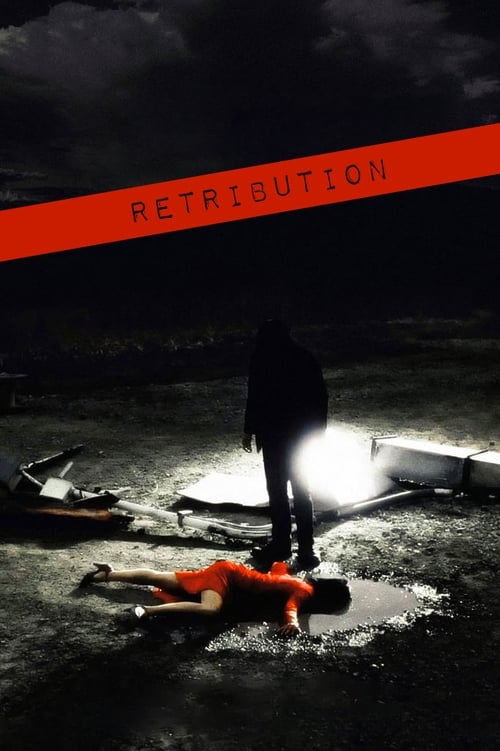
Retribution
2007 · Kiyoshi Kurosawa
The J-horror master's prolific late run (Cloud at Venice, the Serpent's Path self-remake) fuels a "finally getting his flowers in the West" appreciation cycle among genre cinephiles.
When you want a film to chew on for days — a ghost story for a contemplative, slightly haunted evening rather than a popcorn scare night. Challenge over comfort.
What it's about
A Tokyo detective investigates a string of drownings in seawater around the reclaimed land of Tokyo Bay — same method, same area, likely one killer. Then the evidence starts pointing at him, and a woman in a red dress begins appearing where no one else can see her. What looks like a police procedural becomes a reckoning with what the city — and the detective — chose to forget.
The experience
Unnerving in a quiet, creeping way: long takes, empty rooms, a ghost who doesn't jump out so much as simply, horribly, arrive. It leaves you less scared than hollowed out, thinking about guilt and the places we build over.
Performances
Kōji Yakusho anchors it as the detective, letting certainty drain out of a capable man by degrees; Riona Hazuki's woman in red is terrifying precisely because she's so calm.
The craft
Kurosawa stages horror in wide shots and dead industrial space — crumbling buildings, landfill ground, ferries crossing gray water — and lets silence do the frightening. The ghost effects are simple and all the worse for it. It's a film of atmosphere and composition that rewards an undistracted, big-screen viewing.
Why it matters
The last full ghost film of Kurosawa's J-horror run and one of its most self-aware — a capstone that turned the genre's tropes back on the modern city itself, premiering at Venice before its Japanese release.
Snapshot
Retribution (Japanese title Sakebi, 叫, "Scream") is Kiyoshi Kurosawa's last full ghost film of the J-horror boom. It is also one of the most self-aware. Kōji Yakusho plays Noboru Yoshioka, a Tokyo detective investigating a series of drownings in seawater in the reclaimed districts around Tokyo Bay. The evidence starts to point at him, and a woman in a red dress, played by Riona Hazuki, begins to appear to him. On the surface it is a police procedural with a ghost in it. Underneath, it is a film about forgetting: the forgetting of people, of places, and of the landfill ground that modern Tokyo is built on.
The film premiered at the Venice Film Festival in 2006 and opened in Japanese cinemas in early 2007. It came after Kurosawa's international reputation had been built on Cure (1997) and Pulse (Kairo, 2001), and before his move into family drama with Tokyo Sonata (2008). For that reason it is often read as the end of his horror period. It returns to the detective-as-suspect setup of Cure and to the urban emptiness of Pulse, and it starts to turn the genre's tools toward social and historical memory.
Industry & production
Retribution was made as part of the "J-Horror Theater" series. The series was organised by producer Takashige (Taka) Ichise, whose earlier work on Ring (1998) and the Ju-on films had helped create the international market for Japanese horror. The plan was a slate of horror features, each by a director associated with the cycle. The series included Masayuki Ochiai's Infection (2004), Norio Tsuruta's Premonition (2004), Takashi Shimizu's Reincarnation (2005), Kurosawa's film, and later Hiroshi Takahashi's Kyōfu (2010). The brand rested on a cycle that was already commercially past its peak by the mid-2000s. Hollywood remakes such as The Ring (2002) and The Grudge (2004) had brought international attention, but they had also over-saturated the market.
Within that framework Kurosawa seems to have had wide latitude. The film is a modestly budgeted genre production, shot largely on location in Tokyo's bayside districts: vacant lots, industrial waterfronts, ferry terminals, and half-built or abandoned buildings. Detailed figures for budget and box office are not well documented in English-language sources, and none are given here. Its Venice slot, before the Japanese release, shows how Kurosawa's films were by then positioned: as festival and auteur objects as much as domestic genre product.
Technology
The film was shot on 35mm, the standard for Japanese theatrical features at that time, and it does not rely on elaborate digital effects. Its ghost effects are mostly practical and staging-based: an actor placed in a frame, an unexpected entrance, a figure that simply stands there. Kurosawa had already shown this restraint in Pulse, where the most frightening images were people moving slightly wrongly rather than computer-generated creatures. Retribution uses a few optical or digital touches, most noticeably for the ghost's movement in certain scenes, including a much-discussed moment where the woman in red appears to fly or float out of frame. Some viewers have found these touches deliberately crude or awkward. Kurosawa has generally defended the artificial, "unconvincing" ghost as more unsettling than a seamless one. Recurring earthquake tremors are created through camera shake and sound design rather than large-scale effects.
Technique
Cinematography
Kurosawa's cinematographer on Retribution was Akiko Ashizawa, who also shot Loft (2005) and later Tokyo Sonata. The images are typical of Kurosawa's mature style: wide and medium-long shots held at a distance, cool and washed-out colour, and a strong interest in architectural space, especially empty or decaying space. The bayside landfill appears as a flat, grey, unfinished landscape. Puddles of seawater collect in empty lots, and buildings look either half-built or half-ruined.
The woman's red dress is the film's strongest colour accent against this muted palette, and it makes her presence feel like an intrusion into the frame. Kurosawa often places the ghost in the middle or far background of a shot, so the viewer notices her before, or instead of, the characters. Fear comes from seeing, not from cutting to a reveal.
Editing
The editing favours long takes, and the film's frights come from duration and placement more than from montage shocks. Kurosawa has said in many interviews that he distrusts the jump-scare cut. In Retribution the ghost tends to appear inside a held shot, and the cut that follows is often abrupt and flat rather than emphatic. The investigation is also cut elliptically, skipping over procedural detail, so the story feels increasingly unmoored from logic as it moves toward its revelation. Flashbacks to the past, including a ferry crossing and the abandoned building seen from the water, are folded in without much signposting. This fits the film's interest in a memory that keeps coming back uninvited. Credit for editing is not discussed in detail in the English-language critical literature, so this dossier does not name an editor.
Mise-en-scène / staging
Staging is the film's main tool. Kurosawa places figures in deep, open spaces: rooms with gaping doorways, apartments with windows looking onto the bay, derelict institutional interiors. The ghost is often simply present. She sits in a chair, stands in a corner, or waits in a doorway. Her stillness is set against the unsettled world around her: tremors that make objects rattle, water pooling where it should not. Yoshioka's apartment is staged as an anonymous, transitional space, and it slowly becomes a site of buried guilt.
The bayside locations carry much of the film's meaning. Tokyo Bay's reclaimed land, built up through decades of postwar development, is shown as ground with no memory, or rather as ground that is trying to forget what is underneath it. The abandoned building at the centre of the backstory, seen in the past from a passing ferry, turns the landscape into a record of neglect.
Sound
The film's title (Sakebi, "Scream") puts sound at its centre. The ghost's scream is a shrill, piercing, partly unnatural sound, and the film uses it both as a horror effect and as a figure of address, an accusation aimed at the living. The rest of the soundtrack is sparse: ambient city noise, wind, the creak and rumble of the recurring tremors, and long stretches of near-silence. The score is minimal and stays underneath the images rather than steering emotion. Credits for music are inconsistently reported in English-language sources, so the composer is not named here.
Performance
Kōji Yakusho, Kurosawa's most important collaborator, plays Yoshioka with the weary, inward restraint he had brought to Cure, Charisma (1999), Séance (2000), and later Tokyo Sonata. His detective is competent and outwardly calm but increasingly cut off from himself. The film's suspicion of him rests on the audience's trust in Yakusho, and the performance quietly lets that trust drain away. Riona Hazuki's ghost is played with near-total stillness and an expressionless, accusing gaze, broken by the scream. Manami Konishi plays Harue, Yoshioka's companion, whose gentle, slightly hollow presence becomes central to the film's late turn. Tsuyoshi Ihara plays Yoshioka's colleague, whose doubts about him track the audience's own. Joe Odagiri, a star who had worked with Kurosawa on Bright Future (2003), appears in a supporting role as a doctor.
Narrative & dramatic mode
The story starts as a police procedural. A woman is found drowned in seawater in an empty lot. More killings follow by the same method, but they turn out to be committed by different people with no apparent connection. Fingerprints and a coat button point toward Yoshioka himself, who cannot remember committing any crime. As the woman in red haunts him, the procedural gives way to a ghost story and then to a story of repressed guilt.
The film uses Kurosawa's typical structure: a genre premise that dissolves step by step until it shows a more general sickness. As in Cure, the murders are not the work of one killer. They are symptoms of a condition spreading through the city, here linked to a collective act of ignoring someone. The final revelations recast both Yoshioka's private life and his relationship with Harue. They are best left to a viewing, but they confirm that the "retribution" of the English title is both personal and social. The ending refuses closure. It moves into an emptied, almost post-apocalyptic city, a register Kurosawa had used at the end of Pulse.
Genre & cycle
Retribution belongs to the late J-horror cycle that followed Ring. It draws on that cycle's iconography: the vengeful female ghost (onryō), water and drowning, the contaminated urban apartment. It also reflects on those conventions. The woman in red descends from the long-haired white-robed ghost of Ring and Ju-on, and further back from the vengeful women of kabuki and kaidan tradition, such as Oiwa in Yotsuya Kaidan. Kurosawa's choice of a red dress breaks with the white-robed convention while keeping the archetype.
The film also crosses horror with the detective film. Kurosawa had already done this in Cure, and the pairing links Retribution to a wider tradition of procedurals in which the investigator becomes a suspect or turns out to be implicated. Critics sometimes mention Hitchcock's Vertigo (1958) as a broad precedent for the detective haunted by a woman who may be dead, though Kurosawa's film handles the premise very differently. Retribution is usually counted among the last significant works of the J-horror boom.
Authorship & method
Kiyoshi Kurosawa (no relation to Akira Kurosawa) wrote and directed Retribution. He came to features through 8mm amateur filmmaking at Rikkyō University, where he studied under the critic Shigehiko Hasumi, and through the pinku eiga and V-cinema (direct-to-video) industries of the 1980s and early 1990s. His method is consistent: genre frameworks (horror, crime, yakuza film) used as vehicles for exploring social isolation, the breakdown of communication, and the uncanny emptiness of contemporary Japan. He writes extensively about film, and his criticism shows a strong affection for American genre directors such as Tobe Hooper, Richard Fleischer, and Don Siegel.
Kōji Yakusho is the key collaborator. Their partnership, from Cure through Tokyo Sonata, is one of the defining actor–director pairings of modern Japanese cinema. Akiko Ashizawa's cinematography helped shape the colder, more architecturally exact look of Kurosawa's mid-2000s films. Producer Taka Ichise's J-Horror Theater series provided the commercial context. Kurosawa's script recycles and reconfigures his own motifs: the contagious crime of Cure, the empty city of Pulse, the guilt-haunted protagonist of Séance and Loft.
Movement / national cinema
Retribution belongs to the Japanese cinema of the 1990s and 2000s that won international recognition through festival films and genre exports. Kurosawa is often grouped with directors such as Shinji Aoyama, Nobuhiro Suwa, and Takashi Miike. These were filmmakers who emerged through low-budget and video production and reshaped Japanese film culture after the collapse of the old studio system. J-horror was one of the period's most visible international exports, and Kurosawa held an unusual place within it: a horror director whom art-house critics treated as an auteur.
The film's critique of postwar urban development, in particular the reclaimed land of Tokyo Bay, links it to a broader concern in Japanese cinema and culture with the costs of rapid modernisation, which writers and filmmakers have revisited since the 1960s.
Era / period
The film was made at a time often described as Japan's "lost decades," the long economic stagnation after the bubble burst in the early 1990s. The 1995 Kobe earthquake and the Aum Shinrikyō subway attack had shaken the country's sense of social stability, and Kurosawa's films of the late 1990s and 2000s are often read against that backdrop of fragility and alienation.
Retribution's recurring earthquakes and its focus on unstable reclaimed ground make it look, in hindsight, eerily anticipatory. Some later commentators have revisited it in light of the 2011 Tōhoku earthquake and tsunami, though that reading is retrospective. Its depiction of an emptied Tokyo builds on the depopulated cityscape of Pulse, which had already become a central image of urban loneliness in turn-of-the-millennium Japanese cinema.
Themes
- Forgetting and the forgotten dead. The ghost's grievance is not a single wrong but being forgotten and ignored. The film extends that grievance to a whole society that has moved on without noticing what it left behind.
- Collective guilt. As in Cure, crime spreads beyond any single perpetrator. The killings suggest a guilt that is shared and widespread rather than individual.
- Landscape as memory. Tokyo Bay's reclaimed land, built over water and the past, is the film's central metaphor. The seawater drownings are a return of what the land was built to cover.
- Identity and self-knowledge. Yoshioka's growing uncertainty about his own actions and memory echoes the protagonists of Cure and Séance. Kurosawa treats the self as unstable and partly unknowable.
- Communication and address. The scream works as an unanswerable demand for recognition. It extends the concern with failed communication that runs through Pulse.
- Modernisation and its costs. The film's derelict buildings and half-built lots suggest the waste and neglect left behind by postwar development.
Reception, canon & influence
Critical reception. Retribution was generally well received by critics, especially those already familiar with Kurosawa's work, and it has been screened at festivals and in retrospectives internationally. Critics have praised its atmosphere, its staging, and Yakusho's performance. Some reviewers found its plotting obscure and its late turn either deliberately baffling or underdeveloped. Some also found the ghost effects awkward, though others defended them as intentional. It is not usually ranked alongside Cure or Pulse as one of Kurosawa's defining works, but it is commonly treated as a significant, mature film in his horror period and as a summation of its concerns. Its commercial performance, domestic and international, is not documented in detail in readily available English-language sources.
Backward influences. The film draws most directly on Kurosawa's own earlier work: the detective-suspect structure and contagious violence of Cure, the empty city of Pulse, and the guilt-haunted, drifting protagonists of Séance and Loft. It also draws on the J-horror cycle (Ring, Ju-on), the Japanese kaidan and onryō tradition, and the American genre cinema Kurosawa admires. Broad connections to Vertigo and to the investigator-implicated procedural have been noted by critics, though Kurosawa has not, to the record's knowledge, cited them as explicit models for this film.
Forward influence. Retribution marks a turning point in Kurosawa's career. His next feature, Tokyo Sonata, won the Jury Prize in the Un Certain Regard section at Cannes in 2008. It moved him toward family drama while keeping the themes of social dislocation, and it reached a wider international audience. He later returned to ghosts in Journey to the Shore (2015), which won the Un Certain Regard directing prize, and to the detective-thriller in Creepy (2016). Both carry forward ideas tested in Retribution. Journey to the Shore in particular treats the dead and the living as coexisting, an idea that grows from the earlier film's haunted landscape.
The film's direct influence on other filmmakers is harder to establish. J-horror as a commercial cycle faded after the mid-2000s, and Retribution is better understood as one of its late, reflective endpoints than as a starting point. Its reputation has grown through retrospectives and critical reassessments of Kurosawa as one of the major Japanese directors of his generation.
Influences: the films it descends from and the films it influenced
- Cure (1997) — Gives Retribution its template: Kōji Yakusho as a frayed Tokyo detective whose investigation of copycat murders, with the same strangulation pattern repeated by unconnected killers, turns into evidence against himself, shot in wide, static frames that keep violence small inside the shot.
- Séance (2000) — Shows Kurosawa's method of placing a ghost in a domestic interior as a still, flatly lit figure in the back of the frame, with no music cue, alongside a Yakusho character worn down by guilt over a death he helped cause.
- Pulse (2001) — Sets the long-take handling of ghosts that walk slowly and unsteadily toward a static camera without a cut, and the emptied, decaying Tokyo that Retribution's ruined waterfront revisits.
- Loft (2005) — Its immediate predecessor in the same mode: a woman's ghost bound to a drowned body in a marshy lake, and a protagonist made a murder suspect, staged in the mannered J-horror Theater style just before Retribution.
- Ugetsu (1953) — Its long, moving takes let the dead and the living share one unbroken shot with no visual marker of the supernatural, the coexistence Retribution's staging (and later Journey to the Shore) builds on.
- The Ghost of Yotsuya (1959) — The classic screen version of the betrayed woman's onryō who returns to torment the man responsible, the kaidan revenge pattern the red-dressed ghost reworks as a whole city's guilt.
- Ringu (1998) — Fixed the modern J-horror onryō, a wronged dead woman whose curse spreads from person to person and an approach toward the camera filmed in jerky, unnatural movement, which Retribution keeps but deliberately makes crude and frontal.
- Ju-on: The Grudge (2002) — Built its fear on a motionless ghost discovered in an ordinary room, with scenes told out of time order and unsignposted, the structure Retribution uses for its flashbacks.
- Vertigo (1958) — A detective cracking under a dead woman he has forgotten or replaced, who returns in a single signature color; critics have linked this to Retribution's red-dressed figure, though Kurosawa hasn't named it as a model.
- The Boston Strangler (1968) — Fleischer, a director Kurosawa champions in his criticism, made a cold procedural that gradually moves into the killer's fractured mind, the shift from investigator to suspect that Cure and Retribution push into horror.
- Séance (2004) — Its red-dressed woman, shown full-figure and perfectly still in long shot, directly develops Séance's red-dress apparition. Yakusho again plays a man whose forgotten passivity becomes guilt.
- Tokyo Sonata (2008) — Carries Retribution's distant, architectural framing and its Yakusho collaboration (here a cameo as a burglar) into family drama, swapping the ghost for economic collapse as what empties the home.
- Penance (2012) — Extends the theme of a forgotten dead girl whose unatoned death returns, years later, as a chain of violence through the people who failed her, told across five episodes with Retribution's restraint.
- Journey to the Shore (2015) — Develops Retribution's undramatic presentation of the dead as physical people in ordinary space, marking the boundary only through slow shifts in the light inside a take rather than effects.
- Creepy (2016) — Brings back the detective-thriller with a former investigator dragged into contagious domestic violence, using deep-focus suburban framing and long takes where the threat stands quietly at the edge of the shot.
- Daguerrotype (2016) — Moves the still ghost in deep space to France, where a dead woman appears motionless at the far end of rooms and stairwells in single held shots, tied to a man's guilt over her death.
- Chime (2024) — Takes the idea of sound as accusation to its limit: an inexplicable chiming sound triggers sudden violence, filmed in static, unbroken takes without the setup of a jump scare.
- Don't Look Now (1973) — Shares the device of a small red-clad figure set against a drab, waterlogged city as the guilty protagonist's fatal signal, along with unannounced cuts across time that blur memory, premonition and the present.
- The Wailing (2016) — Joins the police procedural to a supernatural contagion of murders, with a bumbling officer whose investigation implicates his own household, the procedural-horror hybrid Kurosawa helped establish.
Similar films
- Cure (1997) — influence & lineage · same viewing thread
- Creepy (2016) — influence & lineage · same viewing thread
- Pulse (2001) — influence & lineage
- Ju-on: The Grudge (2002) — influence & lineage
- Chime (2024) — influence & lineage
- Tokyo Sonata (2008) — influence & lineage
- The Wailing (2016) — influence & lineage
- Séance (2004) — same viewing thread
All the films related to Retribution →
Watch it with: curated runs of related films
- Doubles, Dreams, and Dissolving Selves — Watch these when you want the floor to give way — dream machines, hypnotists, doppelgängers, and haunted houses where perception and identity quietly come undone.