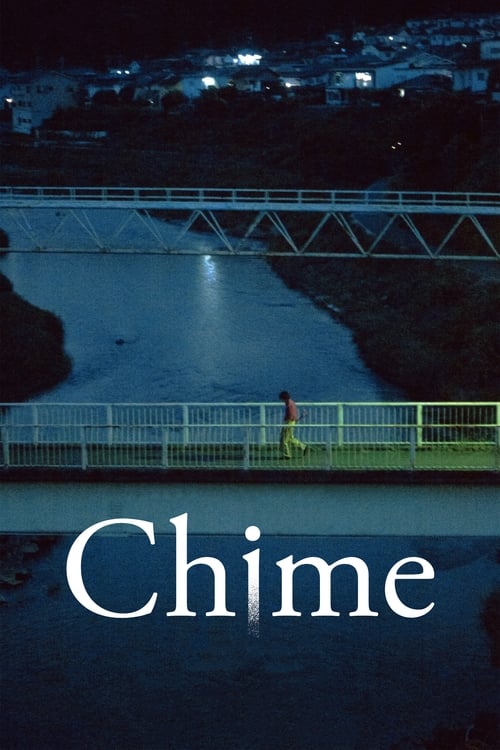
Chime
2024 · Kiyoshi Kurosawa
When you want a short, sharp dose of dread on a weeknight — something you can finish in under an hour and then fail to shake for days. Challenge in a small package.
What it's about
An instructor at a cooking school listens as one of his students insists he keeps hearing a chime no one else can hear — a sound that seems to carry a message. Soon after, the student does something sudden and violent, and the instructor's own life begins to come apart: at work, at home, and in his sense of what he himself might be capable of.
The experience
Forty-five minutes of pure, concentrated unease — no monster, no backstory, just ordinary gestures that start to feel one beat off. It's over before you've settled, and it doesn't explain itself, which is exactly why it lingers.
The craft
Kurosawa strips his method to the bone: still frames, kitchen knives and classroom routine charged with menace, and a sound design where an unheard chime matters more than anything shown. Precision filmmaking that rewards full attention and good speakers.
Why it matters
Premiering in the Berlinale Special section in 2024, it announced that Kurosawa's late period had lost none of its chill — a master's horror instincts distilled to medium length.
Snapshot
Chime (Chaimu) is a medium-length horror film of about 45 minutes, written and directed by Kiyoshi Kurosawa. It premiered in the Berlinale Special section of the 2024 Berlin International Film Festival. Mutsuo Yoshioka plays Matsuoka, an instructor at a cooking school. One of his students says he keeps hearing a chime-like sound that nobody else can hear and that seems to carry a message. Soon afterwards the student commits a sudden, shocking act of violence. From there Matsuoka's own world starts to come apart: at work, at home, and in his sense of what he himself might do. The film has no monster, no curse-object and no explanatory backstory. The dread lives in the gaps between ordinary actions.
Chime belongs to Kurosawa's unusually busy 2024. The same year he also released Serpent's Path, a French-language remake of his own 1998 V-cinema film, and Cloud, a thriller about an online reseller that became Japan's submission for the Academy Award for Best International Feature. Of the three, Chime is the most concentrated. Critics widely received it as a distillation of the tone Kurosawa first set out in Cure (1997) and Pulse (2001), compressed into the length of a television hour.
Industry & production
The film's commissioning is its most unusual production fact. Chime was made as an original work for Roadstead, a Japanese distribution platform launched in the mid-2020s. Roadstead experimented with selling films as limited-edition digital "ownership" copies that buyers could hold and resell, a model linked in press coverage to blockchain-based digital-rights schemes. Kurosawa's film was presented as one of the platform's flagship originals. That framing explains its length: it was not designed for conventional theatrical feature distribution, so it could run as long as its idea required and no longer.
After Berlin, the film played other festivals and had limited theatrical engagements in Japan and abroad, often as a standalone short feature. Detailed public figures on budget, funding structure, and the commercial performance of the Roadstead model are scarce, and this account does not estimate them. Accounts of the shoot describe it as small and quick, in keeping with Kurosawa's long experience of low-budget, tightly scheduled production going back to the V-cinema (direct-to-video) industry of the 1990s.
The context is a Japanese industry where veteran auteurs have increasingly financed work through hybrid channels: television, streaming, international co-production, and in this case a platform experiment. Kurosawa had already worked across these channels, with Penance (2012) made for WOWOW television and Wife of a Spy (2020) made initially for NHK's 8K broadcast. Chime extends that pattern.
Technology
Chime was shot digitally. Like Kurosawa's other recent work, it does not use technology as spectacle. There are almost no visual effects of the kind that defined the ghost imagery of Pulse. The horror comes from framing, duration, and sound design, not from compositing or prosthetics. The violent moments are handled with abrupt, mostly practical staging. Their force comes from timing rather than graphic detail.
The film's technological interest lies mostly in its distribution: it was used as a test case for selling cinema as a scarce digital asset. Commentators noted the irony that a film about an ominous, unexplained signal reaching people through ordinary channels was itself carried by a new, somewhat opaque delivery system. Whether Kurosawa meant that resonance is not documented, and it should be treated as critical observation, not stated intent.
Technique
Cinematography
The camera follows Kurosawa's long-established grammar:
- Frames and distance. Wide-to-medium frames, often fixed or moving slowly, that keep characters at a measured distance inside institutional and domestic spaces.
- Long takes. Scenes play out without coverage, so the viewer has to keep watching rooms where nothing is visibly wrong.
- Space and depth. The cooking school's work counters, back corridors and windows are used to build depth. Doorways and the far planes of the image become places where something might appear.
- Light. It is generally flat and daylit, not expressionist. This is typical of Kurosawa's preference for horror in ordinary visibility over horror in shadow.
The film's director of photography is not widely discussed in the English-language critical record. This dossier does not attribute the cinematography to a named individual.
Editing
The cutting is spare and patient. It is built around withholding the cut, then cutting suddenly. Kurosawa's established method of "dead time" is central: an action that should prompt a reaction, such as a grievous injury or an unexplained remark, is followed by an extended, unemotional continuation of the scene. The short running time makes the elisions sharper. Transitions between workplace and home are abrupt, and causal links are left out. The viewer has to infer what Matsuoka has done, or may do, from the shape of the gaps between scenes.
Mise-en-scène / staging
Kurosawa's staging prefers plain, functional settings: a cooking school's teaching kitchen, a modest family home, a restaurant where Matsuoka hopes to find a better job. The teaching kitchen is very well chosen. It is full of knives, cleavers, raw meat and routines of cutting, and violence is latent in its everyday tools. Characters often stand apart and face slightly away from one another. Their dialogue is delivered with a flat politeness that makes small departures from social script, such as a misplaced laugh, an obsessive household habit, or an inappropriate question, register as disturbances.
The domestic sequences echo the dinner-table scenes of Kurosawa's Tokyo Sonata (2008): a family that shares a space without sharing an inner life. Repetitive behaviour in the home, including Matsuoka's wife's compulsive handling of empty cans, works as a quiet counterpoint to the chime. It suggests that everyone is listening to something private.
Sound
Sound is the film's organising idea. The chime that only some characters hear is never given a source or a definitive meaning. It may be delusion, transmission, or something else. Kurosawa has long treated off-screen and ambient sound as a vector of dread: the hum of machinery, wind, and distant noise in Cure and Pulse. Here he makes it the premise. The soundtrack mostly holds back conventional scoring, so ambient noise, kitchen sounds and silences carry the tension. The film also implicates the audience: the viewer is left unsure whether they are hearing what the characters hear.
Composer credits and the details of the sound team are not well documented in widely available sources. This dossier does not name them.
Performance
Mutsuo Yoshioka is a familiar Japanese character actor without wide international recognition. He plays Matsuoka with reserve, a mild, slightly worn professional manner that gives little away. This follows Kurosawa's preference, seen in Kōji Yakusho's detective in Cure and Teruyuki Kagawa's father in Tokyo Sonata, for underplayed, interior performances in which a character's slide is shown through behaviour more than expression. The supporting cast play students, family members and officials in the same flattened register. Moments of abnormality, like a student's calm statement that part of his brain has been replaced by a machine, are delivered as information rather than hysteria. That flatness is the source of their horror.
Narrative & dramatic mode
The narrative is elliptical and works by contagion. It opens on a specific uncanny claim, the student's chime, and the violent act that follows. It then hands the disturbance to Matsuoka, whose job ambitions, home life and moral boundaries begin to shift in ways the film does not explain. There is no investigation that resolves anything. Authority figures appear, but they do not restore order or explain events.
The dramatic mode is Kurosawa's signature horror of transmission. As in Cure, where a hypnotic suggestion passes from person to person and unlocks latent violence, and Pulse, where loneliness spreads like a technological virus, the "something" in Chime moves through people instead of attacking them from outside. The film's brevity sharpens this. It plays almost like an episode or a case study, and it ends on an open, unsettled note, not a climax.
Genre & cycle
Chime is horror in Kurosawa's particular sense: a cinema of atmosphere, unease, and sudden, under-explained violence, not a vehicle for jump scares or creature effects. It relates to several lineages:
- J-horror (late 1990s–2000s). Kurosawa was a central figure in this cycle alongside Hideo Nakata and Takashi Shimizu, though he was always its most philosophical and least formulaic member. Chime returns to the territory of Cure and Pulse after years in which Kurosawa often worked in other genres.
- The "something is wrong" psychological horror film. Its open-ended uncanniness puts it near international contemporaries who favour dread over explanation. The resemblance is a matter of affinity, not documented influence.
- The medium-length film. Its 45-minute form recalls Kurosawa's television horror, such as Séance (2000, made for Kansai TV), and the economy of V-cinema, in which he made many genre films in the 1990s.
Authorship & method
Kurosawa wrote and directed Chime. Its authorship is unmistakable. Recurring elements include:
- Ordinary institutions as sites of dread. Schools, workplaces and family homes, as in Cure, Tokyo Sonata and Creepy (2016).
- Transmissible or contagious evil. A force that spreads through people instead of being embodied in one antagonist.
- The withholding of psychological explanation. Kurosawa has said repeatedly in interviews across his career that he distrusts tidy causal explanations for violence.
- A cinephile's formal discipline. It reflects his training under and admiration for figures such as Shigehiko Hasumi, his teacher at Rikkyo University, and his stated admiration for American genre directors including Tobe Hooper, Richard Fleischer and Don Siegel.
Kurosawa is also a prolific critic and theorist of the horror film. He took part in the discussions among Japanese genre writers and filmmakers of the 1990s, including screenwriters Hiroshi Takahashi and Chiaki J. Konaka, about how to make horror that was frightening rather than merely shocking. Some of the principles that grew out of that circle are visible in Chime:
- understated presentation of the uncanny;
- the ghostly or wrong element appearing in ordinary space;
- the refusal to resolve.
Information about the film's key crew (cinematographer, editor, composer) is thin in the readily available English-language record. Where this dossier discusses craft, it treats it as Kurosawa's method, not as the contribution of named collaborators.
Movement / national cinema
Chime sits within contemporary Japanese auteur cinema, specifically the generation that came out of 1980s independent and 8mm filmmaking and 1990s genre production. Kurosawa, Shinji Aoyama and others of that circle took the constraints of commercial genre work and turned them into a personal, rigorous style.
In the 2020s Kurosawa's international standing is secure. He won the Silver Lion for Best Director at Venice for Wife of a Spy (2020) and had earlier won the Jury Prize in Cannes' Un Certain Regard for Tokyo Sonata and the Un Certain Regard directing prize for Journey to the Shore (2015). Chime's Berlinale premiere reflects that status. It is a minor-format work that still received a major festival launch because of who made it. Within Japanese cinema, it represents a veteran director returning to the horror mode that first brought him international attention, now on a new distribution model.
Era / period
The film belongs to the mid-2020s. Several conditions shaped it: platform proliferation, experiments with digital scarcity and new distribution, and wider anxiety about information that arrives through invisible channels. A broader international revival of "elevated" or slow-burn horror created a receptive audience for its approach.
Within Kurosawa's career, 2024 is notable as an unusually productive year. Chime, Serpent's Path and Cloud together show him moving between a festival miniature, a French-language self-remake and a domestic genre thriller. Critics read the three side by side, and Chime was often singled out as the purest expression of his horror sensibility in the trio.
Themes
- Transmission and contagion. A signal, sound or idea passes from one person to another and carries the potential for violence. This links Chime directly to Cure and Pulse.
- The fragility of the everyday self. Matsuoka is a competent, unremarkable man. The film asks how thin the layer is between routine and atrocity.
- Work, ambition and humiliation. Matsuoka's hope to move from teaching to a proper restaurant job, and the small humiliations of that process, give an economic undertow to the horror. Kurosawa examined that terrain at length in Tokyo Sonata.
- Family estrangement. The home is a place of parallel solitudes, with private compulsions and failed communication.
- Body and cutting. The cooking-school setting turns kitchen craft, butchery and the handling of meat into images of how close the body is to violence.
- The unexplained. The chime is never decoded. The film treats the unknowability of other minds, and of one's own, as the ultimate source of fear.
Reception, canon & influence
Critical reception. Chime was generally received warmly by critics at Berlin and on the subsequent festival circuit. Reviewers frequently described it as a return to the eerie form of Cure and Pulse, and praised its compression: a full Kurosawa nightmare in under an hour. Commonly cited strengths were the restraint of its staging, the strangeness of its domestic scenes, and the shock of its violent moments. Some critics found its brevity and lack of resolution slight. Others argued that the open ending is exactly the point. This dossier does not report aggregate scores or box-office figures.
Influences on the film (backward).
- Kurosawa's own body of work. Above all Cure (1997), with its hypnotic transmission of violence; Pulse (2001), with its ambient, technologically mediated dread; Séance (2000) and Retribution (2006); and Tokyo Sonata (2008), for its portrait of a fraying family and an economically anxious father.
- The 1990s Japanese horror discourse Kurosawa took part in, with its emphasis on understatement and on the uncanny in ordinary space.
- American genre cinema of the 1950s–1970s, which Kurosawa has long cited as formative, especially the plain, unsentimental staging of violence in directors such as Richard Fleischer and Don Siegel, and the everyday dread of Tobe Hooper.
Legacy (forward). It is too early to establish a firm legacy for a 2024 release, and the record of direct influence is necessarily thin. Two consequences can already be observed. First, Chime re-centred critical discussion of Kurosawa as a horror director in the 2020s, prompting retrospective writing that reconnected his recent output to the J-horror period. Second, it showed that a medium-length horror film by an established auteur can travel internationally through festivals and specialty distribution. That serves as a reference point for the viability of the 40–60-minute form, which conventional theatrical economics have tended to marginalise. Its role as a flagship original for an experimental digital-ownership platform also makes it a case study in mid-2020s distribution experiments. Whether that model has lasting effect remains to be seen.
Within Sightlines, Chime is best placed on the line that runs from Cure and Pulse. It is a late, compressed return to Kurosawa's central theme: something unseen spreading from person to person, and the violence latent in ordinary life.
Influences: the films it descends from and the films it influenced
- Cure (1997) — Its model of violence passed by suggestion is the one Chime reuses: a sensory cue (a lighter flame, running water) makes ordinary people kill, and Kurosawa films it in static wide shots with no psychological explanation.
- Pulse (Kairo) (2001) — Builds dread from ambient sound and from figures seen far off through doorways in grey daylight, the same deep-space staging and score-free soundscape Chime brings to its kitchens and apartments.
- Séance (2000) — A TV-funded, small-scale horror film whose hero is a sound-effects recordist, which makes a sound with no visible source (later the chime) the way the uncanny gets in. The horror plays out in a cramped suburban home.
- Retribution (Sakebi) (2006) — Leaves big gaps in cause and effect around its killings and lets the narrative stop without resolving, a structure Chime squeezes into 45 minutes.
- Tokyo Sonata (2008) — Its family dinner-table scenes, held in long static takes, show a father hiding his work troubles from a family that has drifted away. Chime's home scenes use the same flat, underplayed staging.
- Creepy (2016) — Stages ordinary suburban houses as places of hidden violence, using open doorways, curtains moving in the wind and the depth of a corridor. Chime's teaching kitchen inherits that geometry.
- The Guard from Underground (1992) — Kurosawa's first horror film set inside a workplace: fluorescent-lit corporate space filmed in detached wide shots, a forerunner of Chime's institutional setting, the cooking school.
- Honto ni Atta Kowai Hanashi (1991) — A short straight-to-video J-horror anthology. It set up the plain, almost documentary 'just standing there' ghost figure, the uncanny shown without emphasis that Chime presents in medium-length form.
- Ringu (1998) — Hiroshi Takahashi's script turns the principles of the 1990s Konaka–Takahashi–Kurosawa discussions (understatement, a curse passed through a medium) into a structure where horror spreads from person to person. Chime echoes that spread through its chime.
- Invasion of the Body Snatchers (1956) — Siegel's flat, daylit staging of neighbours who are slightly wrong, with violence spreading through ordinary people, is the American B-film model Kurosawa cites for Chime's quiet idea of evil as contagion.
- 10 Rillington Place (1971) — Fleischer shows murder in a drab domestic interior with clinical, unsentimental framing and no suspense cutting. Chime's kitchen killing follows the same deadpan, matter-of-fact treatment.
- The Texas Chain Saw Massacre (1974) — Hooper's sun-bleached, unglamorous horror set in everyday spaces, and its abrupt, offhand bursts of violence, are the source Kurosawa names for horror that is frightening rather than just shocking.
- Evil Does Not Exist (2023) — Hamaguchi, Kurosawa's former student at Tokyo University of the Arts, uses ambient sound in place of a score, long patient takes, and a sudden unexplained act of violence that leaves the ending open.
- Cloud (2024) — Shot in the same 2024 burst. It applies Chime's sudden, plainly staged violence to the online reselling economy, and keeps the flat performances and the motives left unexplained.
- Serpent's Path (2024) — Kurosawa's French remake of his own 1998 V-cinema revenge film, made in the same year as Chime. It shares Chime's long takes in empty spaces and its procedural, emotionless handling of cruelty.
- Caché (2005) — Fixed, distant long takes, a sudden domestic act of violence filmed without cuts, and a threat that is never explained or resolved. Haneke reaches the same formal ideas as Chime from a separate European tradition.
- Exit 8 (2025) — Kurosawa's medium-length film makes horror from banal, evenly lit interiors and a nagging sound cue the protagonist can't place. It uses the same tools as Exit 8: suspicious ambient sound and the unease of looking for something wrong in a normal room.
Similar films
- Creepy (2016) — influence & lineage
- Cure (1997) — influence & lineage
- Tokyo Sonata (2008) — influence & lineage
- Séance (2004) — same viewing thread
- Pulse (2001) — same viewing thread
- Noroi: The Curse (2005) — same viewing thread
- Ring (1998) — same viewing thread
- Ju-on: The Grudge (2002) — shared sensibility
All the films related to Chime →
Watch it with: curated runs of related films
- Screens That Swallow You — A run of films where the screen — a pirate broadcast, a haunted website, a monitor, a late-night monster-of-the-week show — stops being a window and becomes a doorway that pulls the watcher bodily through into unreality.