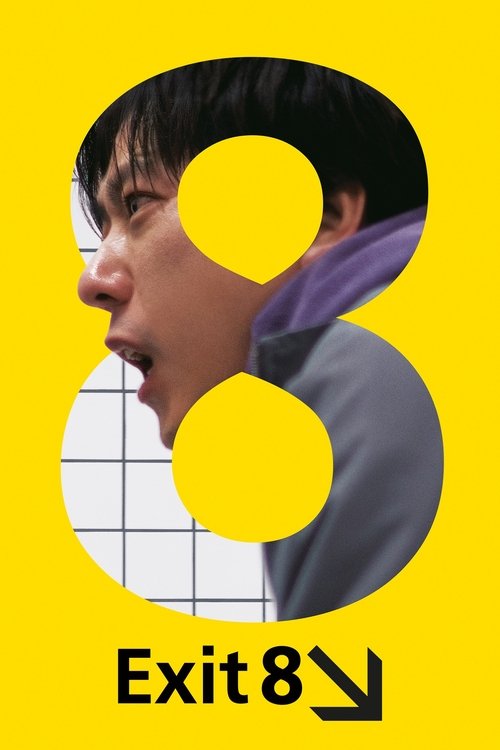
Exit 8
2025 · Genki Kawamura
When you want a clever, contained thriller that makes you an active player — lean in, study the screen, and feel the hum of fluorescent-lit dread. Great for viewers who like puzzles with their horror.
What it's about
A man finds himself trapped in an endless, white-tiled subway corridor that loops back on itself. The rules are posted plainly: watch for anomalies — anything different from the last pass. See one, turn back; see nothing, keep walking; get it right eight times and you reach Exit 8. One missed detail resets everything, and the man walking the loop has a decision from his life above ground that he's been avoiding.
The experience
A tense, hushed game of spot-the-difference that trains you to scan every frame — then weaponizes that attention against you. It's claustrophobic and quietly funny in places, and the repetition becomes hypnotic rather than dull.
Performances
Kazunari Ninomiya carries nearly the whole film as the Lost Man, holding attention through dozens of near-identical corridor walks with little more than posture, glances, and mounting desperation.
The craft
Adapted from a hit indie video game, it turns one anonymous underground passage into a full cinematic world through rigorous production design, precise framing, and sound — footsteps, hums, and silences you'll want good speakers for. The filmmaking challenge is the premise itself: making the same corridor feel different, and wrong, every time.
Why it matters
Part of the recent wave of 'liminal space' horror and one of the most high-profile video-game-to-film adaptations from Japan, it shows how a minimalist game concept can become a real psychological film rather than a gimmick.
Snapshot
Exit 8 (8番出口, Hachiban Deguchi) adapts The Exit 8, a 2023 independent video game made almost single-handedly by the Japanese developer Kotake Create. The game became an unexpected international hit. It has one location, a clean, white-tiled underground passage of the kind found under any large Tokyo station, and one rule. The player walks the corridor and looks for anomalies, meaning anything that differs from the last pass. If something is wrong, turn back. If nothing is wrong, keep going. Pass eight clean loops in a row and you reach the exit. One mistake sends the count back to zero.
Genki Kawamura's film keeps that set-up but adds a protagonist with a moral problem. Kazunari Ninomiya plays a man known only as the "Lost Man." Before he enters the passage, he has just failed to step in when a stranger was harassed on his commuter train, and he has had a phone call from a former partner telling him she is pregnant. The corridor becomes a test of attention and an allegory of conscience: a man who did not notice suffering now has to notice everything. The film premiered in the Midnight Screenings section of the 2025 Cannes Film Festival and opened in Japan in late summer 2025 through Toho. It belongs to a growing group of films adapted from small, viral games rather than big franchises, and it is one of the first serious attempts to film the "liminal space" aesthetic of the 2020s.
Industry & production
Kawamura came to directing late, after one of the most commercially successful producing careers in recent Japanese cinema. His producer credits include Tetsuya Nakashima's Confessions (2010), Lee Sang-il's Villain (2010) and Rage (2016), and Makoto Shinkai's Your Name (2016), Weathering with You (2019) and Suzume (2022). He is also a bestselling novelist. His first feature as director, A Hundred Flowers (Hyakka, 2022), adapted from his own novel about a son and his mother's dementia, won him the Best Director award at San Sebastián. Exit 8 is his second feature, and a deliberate swing from intimate family drama to high-concept genre.
The project came from the Toho production system, which Kawamura knows well, working with his own production company, Story Inc. Taking the rights to a cheap, one-developer game shows a change in Japanese studio thinking. These games already have a large, young, international audience, much of it built through streamers on YouTube and Twitch. Their structures are simple enough to film on a limited budget. And they carry a recognisable image: one dominant set, a small cast and a fixed location made the production manageable. A Cannes Midnight slot then gave the film international festival credibility that video-game adaptations rarely get.
The film did well commercially in Japan, and reports put its opening among the strongest of the summer for a live-action domestic release. I won't quote specific grosses here, because the figures should be checked against box-office sources. Rights were sold for international distribution after Cannes. The details of each territory's release are not covered in this account.
Technology
The film's main technical problem is that it is a loop. One corridor has to be photographed again and again, sometimes with no visible change, sometimes with very small changes, and sometimes with spectacular, large-scale effects. The production built a physical replica of the passage: tiled walls, fluorescent ceiling panels, yellow tactile paving, backlit advertising panels, wall signs and the corner where the corridor turns back on itself. Many anomalies could therefore be done in camera, with practical effects and real changes to the set, rather than added entirely in post-production. Digital effects carry the larger set pieces. The best known is a flood of red water rushing down the passage, taken directly from one of the game's most famous anomalies.
The opening is the film's most discussed technical choice. It is a long first-person sequence that matches the game's point of view, with the camera standing in for the protagonist's eyes on the train and through the station. The handheld or stabilised POV camera has an obvious ancestry in found-footage horror and first-person-shooter imagery. Kawamura uses it to tie the audience to the game before he releases them into a more conventional third-person grammar. Details of the camera systems and digital pipeline are not well documented in English-language sources, so I make no specific equipment claims here.
Technique
Cinematography
The look is dominated by the cold, even light of overhead fluorescent fixtures bouncing off white tile. The image is deliberately flat and has almost no shadow, which turns the usual horror rule upside down. The fear is not of what hides in the dark but of what is in plain sight. Framing is mostly symmetrical and frontal down the corridor, an image that inevitably recalls Kubrick. The vanishing point at the end of the passage is where the eye goes, and so where the viewer learns to search. The film teaches its audience to scan the frame as a player would, checking posters, doors, ceiling vents and the lone walking figure for differences. The cinematography is therefore partly an exercise in training perception. The credited director of photography is not something I can confirm reliably, so I leave the attribution open.
Editing
The editing has to manage repetition without boring the audience and without making the loops look the same. The film varies the rhythm of its passes. Some are shown in full, some are cut together in montage, and some stop on a long, held stare in which neither character nor audience is sure whether anything has changed. The cut back to the start of the corridor after a mistake works like a game's "reset," and the film uses it both as a punchline and as a shock. The rhythm is built around a running sign showing the current exit number, which gives the viewer a scoreboard for tension that has no real equivalent in conventional suspense cinema.
Mise-en-scène / staging
The production design is the film's main achievement and the clearest link to its source. The passage's ordinariness is what makes it frightening: commercial posters, a row of closed doors, a staff-room door, CCTV, warning signs. Anomalies range from the nearly invisible, such as a slightly changed poster, a door handle or a light, to the grotesque and theatrical. That range lets Kawamura shift between quiet perceptual suspense and openly horror-film spectacle. Staging is dominated by two kinds of movement. The protagonist walks toward the camera or away from it. The "Walking Man," a middle-aged figure in a suit carrying a briefcase who passes again and again, moves with mechanical regularity, and any departure from that pattern becomes an anomaly.
Sound
Sound matters as much as image in a film about noticing. Station ambience, the hum of the fluorescent lights, footsteps on tile and distant announcements make up a sound bed in which any change becomes suspicious. Ravel's Boléro recurs: the protagonist is listening to it on his earphones at the start, and the piece comes back as a motif. Its structure, one melody repeating with steady accumulation toward a climax, is a clever musical analogue for the film's loop. The original score is generally credited to Yasutaka Nakata and Shohei Amimori. Nakata is known as a producer of Japanese electronic pop, which suggests a synthetic, ambient approach in keeping with the sterile setting. The detailed workings of the score are beyond what I can confirm.
Performance
Ninomiya, a former member of the idol group Arashi, became internationally known through Clint Eastwood's Letters from Iwo Jima (2006). He has to carry most of the film nearly alone, reacting to small or empty stimuli, and he plays the Lost Man as passive and short of breath. The character has asthma, and the inhaler becomes a recurring prop and a sign of fragility. Yamato Kochi, a stage actor, has the hardest role: the Walking Man, a figure taken directly from the game, whose repetition has to be precise enough that any deviation registers. The film gives this figure a section of his own, and Kochi's performance moves from game-like automatism to some interiority. Nana Komatsu appears as the woman in the protagonist's life, mostly through the phone call. Naru Asanuma plays a child the Lost Man meets in the corridor, and that encounter becomes the moral hinge of the film.
Narrative & dramatic mode
The game has no story to speak of. The film's main act of adaptation is to give the loop narrative and moral content. The structure divides into perspectives, following the Lost Man, then the Walking Man, then the boy, and these sections give the loop different meanings according to who is trapped in it. The dramatic mode combines the time-loop film (Groundhog Day, 1993; Triangle, 2009) with the "single trap" thriller (Cube, 1997). It also has a quieter, nearly parable-like strand typical of Kawamura's interest in responsibility and family.
The decisive move is the frame narrative. The man on the train ignores a stranger being shouted at, and he hesitates over a future as a father. These scenes turn the game's instruction, "don't overlook anything out of the ordinary," into an ethical demand. The corridor punishes inattention, and the film suggests that his punishment fits the original sin. The ending, which brings the protagonist back to a version of the opening, makes that reading explicit. Some critics found this moral frame too obvious. Others thought it was what turned a gimmick into a film.
Genre & cycle
Exit 8 sits at the intersection of several cycles:
- Video-game adaptation. It is a rare art-house-leaning adaptation in the 2020s boom, which was dominated by franchises such as The Super Mario Bros. Movie (2023), Five Nights at Freddy's (2023) and A Minecraft Movie (2025). Its source is a tiny indie title with no lore.
- Liminal-space horror. It draws on the internet aesthetic of the "Backrooms" and liminal spaces: empty, institutional, transitional places that feel uncanny because people are missing from them. The game itself came out of that aesthetic, which spread through online imageboards and later through Kane Parsons's YouTube series The Backrooms. A feature film based on Parsons's series was announced with A24, and Exit 8 stands as an early theatrical treatment of the same idea.
- "Anomaly" or "spot the difference" game culture. Kotake Create's success led to many imitations, so many that "Exit 8-like" games became a recognised small subgenre. Kotake Create also followed up with Platform 8 (2024). The film carries that genre's specific mode of participation, the viewer as observer, into the cinema.
- Japanese puzzle-box horror. It loosely belongs to a tradition of Japanese and Japan-adjacent horror about confinement and rules, alongside Cube's Japanese remake (2021) and death-game cinema such as As the Gods Will (2014).
Authorship & method
Kawamura's authorship is unusual: he is a producer-novelist-director whose instinct for audience and concept has shaped much of 21st-century Japanese popular cinema. His producer credits show a liking for high-concept premises carried out with emotional seriousness, and Your Name is the clearest example. As a director, A Hundred Flowers showed an interest in memory, repetition and long takes. Its many one-shot sequences enacted a mother's dementia as loops and slippages of time. Exit 8 carries that formal interest in repetition into genre. In that sense it is a natural development, not a break.
The screenplay is credited to Kawamura with Kentaro Hirase, a playwright and theatre director. His theatrical background may help explain the film's chamber-like, single-location character and its reliance on a few performers. Kotake Create is credited for the source material. Questions about the cinematographer, editor and production designer can't be answered reliably here and should be checked against the film's official credits.
Movement / national cinema
Exit 8 belongs to contemporary Japanese mainstream cinema, specifically the Toho-led system of high-concept domestic releases that often draw on manga, novels and now games. It does not belong to a movement in the strict sense. It does, however, sit where two strands of current Japanese film culture meet: the industrial cinema of adaptation and the international festival circuit. Kawamura has moved between those worlds more freely than most. Its Cannes Midnight selection places it alongside other Japanese genre films that have reached international festivals. It also reflects Japan's position as a centre of game culture, which has historically been adapted by Hollywood (Resident Evil, Silent Hill) more than by domestic live-action cinema.
The setting is specifically Japanese. The underground passages of Tokyo's stations, crossed daily by millions of commuters, form a shared experience that is both banal and slightly disorienting, and the film turns that experience into nightmare. The opening scene on the commuter train, with its moral question of bystander passivity, also draws on familiar Japanese social debates about public behaviour and the reluctance to intervene. That reading is commonly made but should not be pushed too far.
Era / period
The film is a product of the mid-2020s. Several things shaped it: the spread of internet aesthetics into commercial cinema, streamer culture making small games into mass phenomena, and the post-pandemic interest in empty, sterile public space. The images of empty stations and corridors recall the lockdown era, when such places were briefly deserted. The film's interest in attention also has a contemporary edge. The protagonist is introduced absorbed in his phone and earphones and missing the world around him, and the corridor trains him to look again. In a period much concerned with distraction and screen culture, that reads as a deliberate comment, though it is not heavy-handed.
Themes
- Attention as ethics. The central idea is that perception is moral. Noticing the anomaly, the thing out of place, becomes analogous to noticing the person in trouble. The film ties the game's mechanic to the bystander effect.
- Repetition and routine. The loop is the commute made literal. Every day is the same passage, the same posters, the same man in a suit. The horror lies in recognising how much of ordinary life is already a loop.
- Responsibility and parenthood. The unborn child, and the boy in the corridor, give the protagonist's escape a stake beyond survival. Exit 8 is a way out but also a choice about the future.
- Anonymity and the urban crowd. No one has a name. The "Lost Man" and the "Walking Man" are types, figures in a crowd, and the film asks what it takes for an anonymous figure to become a person.
- The uncanny in the ordinary. Like the liminal-space aesthetic it draws on, the film finds dread in the familiar made slightly wrong. This is a Freudian unheimlich (uncanny) of tiles and fluorescent lights.
Reception, canon & influence
Critical reception. The Cannes Midnight premiere drew mostly positive notices. Critics praised the production design, the precision of the anomaly sequences, the opening POV sequence and Kawamura's control of tone. The most common reservation concerned the moral framing, which some reviewers found too explicit or sentimental for the austere premise. Opinion was also split on whether the multi-perspective structure deepened the concept or diluted it. In Japan the film was a commercial success, which confirmed the box-office pull of the source game and Ninomiya's star power. It is too early to describe its critical standing in any settled way.
Influences on the film (backward). The most direct influence is Kotake Create's game, whose set, rules and many anomalies the film reproduces. Behind that lies the liminal-space and Backrooms internet aesthetic. In cinema the line includes:
- Kubrick's The Shining (1980): symmetrical corridors, and a flood of red liquid that the game and film evoke, whether as conscious homage or shared visual memory.
- Vincenzo Natali's Cube (1997): rule-bound confinement in a repeating architecture.
- The time-loop film from Groundhog Day onward.
- The first-person perspective of found-footage horror and video games.
The use of Boléro places the film in a long tradition of using Ravel's piece as a figure of mechanical repetition and accumulation.
Legacy (forward). It is too soon to measure the film's influence with confidence. Its likely importance is as a proof of concept. It shows that a small, viral indie game with no narrative content can support a festival-selected, commercially successful feature, if the adaptation supplies a moral and emotional frame. That model is likely to matter for future adaptations in the same aesthetic, including the announced Backrooms feature and other films from the "anomaly game" boom. For Kawamura, it confirms a directing career that combines his producer's instinct for concept with a personal formal interest in repetition and memory. Whether Exit 8 holds a lasting place in the canon or stands mainly as a snapshot of the internet-aesthetic moment of the mid-2020s is for later criticism to decide.
Influences: the films it descends from and the films it influenced
- The Shining (1980) — Kubrick's one-point-perspective Steadicam shots down symmetrical hotel corridors, and the elevator flood of blood, are the visual model for Exit 8's vanishing-point passageway and its red-water anomaly.
- Last Year at Marienbad (1961) — Resnais repeats tracking shots through identical ornate corridors with small changes each time, so the viewer has to compare each pass against memory. That is the same perceptual task as Exit 8's anomaly-spotting.
- Playtime (1967) — Tati built Tativille, a full set of grey glass and flat, even light, and spread small gags across deep wide frames for the viewer to find. Exit 8 asks the audience to search its sterile, shadowless corridor for 'wrong' details in the same way.
- Cube (1997) — Natali built one modular room and relit it to stand in for hundreds. Its rule-based survival logic (study the room, deduce the trap, then step through) is the model for Exit 8's one reused corridor set and its rule: turn back if you see an anomaly.
- Groundhog Day (1993) — Ramis made the hard reset cut the grammar of the time-loop film: the same alarm-clock moment is shown again and again, and only the protagonist's knowledge changes. Exit 8 turns this into its loop-reset cut back to the corridor's start.
- Lady in the Lake (1947) — This was the first feature shot almost entirely as the protagonist's subjective camera, a precedent for Exit 8's long first-person POV opening on the subway, where the camera is the hero's eyes before the film cuts to Ninomiya's face.
- Run Lola Run (1998) — Tykwer replays one scenario three times, like a game being restarted, and uses a pounding repetitive score to drive each attempt. That game-structured loop is a forerunner of Exit 8's level logic, with Boléro playing the score's part.
- Pulse (Kairo) (2001) — Kurosawa built dread from emptied Tokyo interiors, flat fluorescent light and a low electronic hum, with no visible threat. That is the Japanese source of Exit 8's ambient-hum bed and its quietly menacing empty public space.
- Triangle (2009) — Smith's loop is set in a ship's identical, empty corridors, and the heroine learns from traces left by earlier passes: bloodstains, repeated objects, other versions of herself. Exit 8 uses the same device when the walking man and environmental clues mark failed cycles.
- Source Code (2011) — Jones restarts the same eight-minute train scene with a hard cut each time, and the hero must scan the set for an anomaly on each pass. This is an exact precedent for Exit 8's mix of observation test and reset.
- Edge of Tomorrow (2014) — Liman's death-and-respawn cut is openly taken from video games, and the editing compresses failed attempts into a running tally of progress. Exit 8's exit-number scoreboard does the same, dropping to zero when the hero fails.
- A Hundred Flowers (2022) — In Kawamura's first feature, unbroken one-shot sequences slip into repeated scenes and spaces to stage a mother's dementia. Exit 8 takes the same formal tool of the long take that loops back on itself and turns it into genre spectacle.
- Beyond the Infinite Two Minutes (2020) — Yamaguchi's micro-budget feature is filmed as one continuous take in a single small location, with characters running a tight, rule-bound time loop. It is a Japanese sibling of Exit 8's single-set, game-logic loop design.
- Mondays: See You 'This' Week! (2022) — This film sets the time loop in a deadening Japanese office routine and treats repetition as an allegory of numbed attention to everyday life. Exit 8 frames its corridor loop as the same kind of moral allegory about noticing.
- Vivarium (2019) — Finnegan's identical suburban houses, flat light and enclosing one-point compositions make a repeating architecture with no way out. It is the closest English-language sibling to Exit 8's design idea of an endlessly duplicated, uncanny public space.
- Skinamarink (2022) — Ball turned internet liminal-space and analog-horror imagery into a feature: empty hallways held in static frames, a constant hiss on the soundtrack, and dread that comes only from watching for small changes. It shares Exit 8's Backrooms-era source aesthetic.
- Chime (2024) — Kurosawa's medium-length film makes horror from banal, evenly lit interiors and a nagging sound cue the protagonist can't place. It uses the same tools as Exit 8: suspicious ambient sound and the unease of looking for something wrong in a normal room.
Similar films
- The Shining (1980) — influence & lineage · often watched together
- Chime (2024) — influence & lineage
- Source Code (2011) — influence & lineage
- Cure (1997) — same viewing thread · often watched together
- Creepy (2016) — same viewing thread
- Retribution (2007) — same viewing thread
- Enter the Void (2010) — same viewing thread
- Pulse (2001) — often watched together
All the films related to Exit 8 →
Watch it with: curated runs of related films
- Doubles, Dreams, and Dissolving Selves — Watch these when you want the floor to give way — dream machines, hypnotists, doppelgängers, and haunted houses where perception and identity quietly come undone.