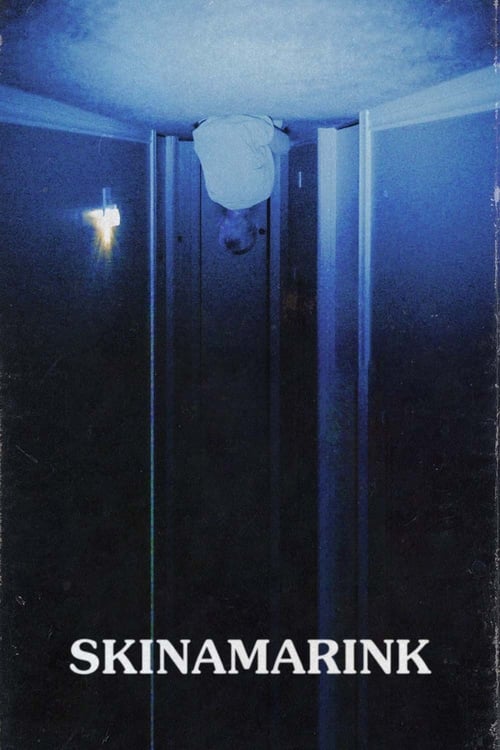
Skinamarink
2023 · Kyle Edward Ball
Skinamarink, a $15,000 liminal-space nightmare that went viral from a festival leak, became the definitive "TikTok horror" phenomenon and the test case for analog-horror aesthetics jumping to features — audiences either called it terrifying or a scam, loudly.
For when you want to be scared in a way no jump-scare machine can manage — lights off, phone away, alone or with one brave friend. This is the far end of challenge viewing: patience required, nightmares possible.
What it's about
Two small children wake in the night in their suburban house and can't find their father. Then the windows and doors begin to disappear. That's the whole situation: a 1995 house at 3 a.m., cartoons glowing on the TV, toys on the carpet, and something in the dark that may be speaking to them.
The experience
Less a story than a trance — long, grainy, nearly static shots of ceilings and hallways, whispered dialogue you strain to hear, and dread that accumulates by the minute. It's slow by design and genuinely frightening if you give yourself over to it; infuriating if you don't.
The craft
Shot for next to nothing in the director's own childhood home, it refuses faces, coverage and almost all conventional grammar — just low angles, heavy grain, analog hiss and public-domain cartoons. The sound design is the star: silence, murmurs and sudden wrongness. Watch it in the dark with good sound or not at all.
Why it matters
It leaked after its festival premiere, blew up through TikTok and Reddit word of mouth, and became the defining film of internet-born 'liminal space' horror — proof a micro-budget experiment could become a cultural event.
Snapshot
Skinamarink is a micro-budget Canadian horror film written, directed and edited by Kyle Edward Ball. It was shot in his own childhood home in Edmonton, Alberta. Two small children, Kevin and Kaylee, wake in the night and find their father gone. Then the house's windows and doors begin to disappear. The film is set in 1995 and runs about 100 minutes. It almost entirely avoids showing faces or conventional coverage. Instead it builds dread from low-angle shots of ceilings, corners, doorframes, toys, and the glow of public-domain cartoons on a television, all under heavy grain and digital noise. Whispered dialogue is often subtitled because it is barely audible. After premiering at the Fantasia International Film Festival in 2022, the film leaked online and became a word-of-mouth phenomenon on TikTok and Reddit. IFC Midnight released it in theatres in January 2023 and Shudder streamed it shortly after. It turned a tiny budget into a widely discussed commercial success. It is one of the clearest cases of internet-native horror, shaped by "analog horror," liminal-space imagery and YouTube nightmare culture, crossing into theatrical cinema. Critics were sharply divided: some called it an avant-garde breakthrough, others found it an endurance test.
Industry & production
Before Skinamarink, Ball ran a YouTube channel, Bitesized Nightmares. Commenters described nightmares they had had, and he recreated them as short, atmospheric films. Many of the submitted dreams shared a scenario: a child alone in a house at night, with parents absent or strange. That recurring scenario became the film's premise. In 2020 Ball made a short proof of concept, Heck, which uses many of the same strategies: a child's point of view, a darkened house, and a voice that cannot be trusted.
The feature was financed on a very small budget, widely reported at around CAD $15,000. Part of it came from crowdfunding. The shoot took about a week and used the family home Ball grew up in, which kept costs down and gave the project its personal, autobiographical charge. The cast was small and mostly non-professional. Lucas Paul plays Kevin, Dali Rose Tetreault plays Kaylee, Ross Paul plays the father and Jaime Hill plays the mother.
The film premiered at Fantasia in Montreal in July 2022 and screened at other genre festivals. Its distribution story is unusual. In late 2022 a copy circulated illegally online, reportedly after a lapse involving a festival's online screening. Instead of hurting the film, the leak spread its reputation through TikTok clips, Reddit threads and reaction videos ahead of the official release. Ball spoke publicly with mixed feelings about the leak. IFC Midnight opened the film theatrically in North America in January 2023, and Shudder released it on streaming in early February. The theatrical gross was reported in the low millions of dollars. Against the budget, that made it one of the most profitable horror releases of its year relative to cost. Exact worldwide figures vary between sources and should be checked against box-office trackers.
Technology
The film was shot digitally, but its look is built to suggest decayed analog media: VHS, late-night broadcast television, and 16mm footage seen through a fog of grain. Ball added heavy grain and noise in post-production and graded the image toward murky amber and blue-black. Many shots are so underexposed that the picture dissolves into flickering texture. The viewer's eye starts inventing shapes in the noise, and the film exploits that pareidolia on purpose.
The televisions in the house show public-domain animated shorts from the 1930s, including Fleischer Studios and Warner Bros. material that has lapsed out of copyright. This was a budget necessity: cartoons the production could use for free. It also matters to the film. The old animation's tinny music and bouncing figures work as a period marker, a source of light, and a strangely sinister counterpoint to the darkness around them.
Sound was assembled in post with deliberately degraded qualities: hiss, hum, and the compressed, muffled tone of old recordings. Burned-in subtitles carry many whispered lines. They are both a practical aid and a formal device that makes speech feel like found or recovered text.
Technique
Cinematography
Jamie McRae shot the film. Its defining strategy is withholding. The camera stays low, roughly at a small child's eye level or below, and usually points at ceilings, floor-level corners, the tops of doorframes, stretches of hallway carpet, or Lego bricks scattered across the floor. People appear in fragments: feet, legs, the back of a head, a hand reaching into frame. Faces are almost never shown, and when they are, they are hidden by darkness or turned away. Compositions often push the obvious subject to the edge of the frame or leave it out, so the empty space becomes what the shot is about.
Shots are long and static, often held well past the point where narrative information runs out. The audience is made to search dark areas for movement. Changes in orientation, such as a camera tilted, a room shown upside down, or furniture placed on the ceiling, mark the house's slide from familiar space into an impossible one.
Editing
Ball edited the film himself. The pacing is slow and repetitive, alternating long holds with sudden cuts to black or to another corner of the house. Ellipsis does much of the work. Time passes without being measured, and the children's sense of night becomes indistinguishable from an endless present. Late in the film an on-screen title gives a day count far beyond a single night, which retroactively stretches the ordeal to a frightening length. The rare loud shocks are timed against long stretches of near-silence, so jump scares become a punctuation of dread rather than the film's main currency.
Mise-en-scène / staging
The house is the only setting, staged as a child's universe: carpeted stairs, a television in the living room, a kitchen, bedrooms, and a closet. The props are the toys, picture books and household objects of the mid-1990s, and the film's nostalgia comes from them. Over the course of the night the set is subtly and then openly transformed. Doors and windows vanish into blank wall, objects are moved or turned over, and a toilet disappears. Ball handles the unseen presence entirely through these spatial changes and through voice, never through a visible monster. The only light sources are lamps, a nightlight, and the television's flicker.
Sound
The soundtrack is arguably the film's most important instrument. Ambient hiss and low drone run almost continuously, and the public-domain cartoons supply jaunty, distorted music from the 1930s. Dialogue is mostly whispered, sometimes subtitled and sometimes left unintelligible. The entity's voice, which asks Kevin to do things and claims to be one of his parents, is mixed close and flat in a way that feels intimate and invasive. Occasional bursts of loud noise break the textured quiet. The overall effect is closer to a found recording or a half-remembered audio memory than to a conventional horror mix.
Performance
Since faces are hidden, performance comes almost entirely through voice and body fragments. The child actors' lines were recorded in a quiet, whispered register suited to children awake past bedtime. The adult characters exist mostly as voices that change from comforting to commanding to menacing. Their reliability gradually collapses as the presence starts imitating them. This is a deliberate refusal of conventional screen acting. It throws identification onto the viewer's own memories of childhood night-time rather than onto the actors as people.
Narrative & dramatic mode
The story is minimal and elliptical. It opens with sounds suggesting Kevin has had an accident, perhaps falling down the stairs, and with a phone call that hints at a hospital and a sleepwalking incident. These clues are fragmentary. After that the children are alone in a house that is losing its exits. They camp in front of the television, explore the hallways, and respond to a voice that calls them to different rooms and gives increasingly sinister instructions. Kaylee disappears partway through, leaving Kevin as the main point of view.
The film does not resolve its ambiguities. Viewers and critics have offered several readings. Kevin may be in a coma or another liminal state after a head injury. The film may be a visualised nightmare in the tradition of Ball's channel. It may be an encoding of domestic trauma or abuse, given the parents' alarming absences and the presence's habit of speaking in a parent's voice. Ball has generally resisted settling on one interpretation. The dramatic mode is less a story than a duration: a sustained state of fear in which plot is replaced by atmosphere, suggestion and the viewer's own projection.
Genre & cycle
Skinamarink is supernatural horror, but it borrows from several adjacent and newer modes. It is close in spirit to analog horror, the internet genre of creepy fake broadcasts, VHS-styled fragments and degraded found media, and to the online fascination with liminal spaces and "the Backrooms." Both share its aesthetic of empty, familiar places made uncanny. It also connects to found-footage horror's mood of recovered evidence, though the film never claims to be literal found footage. Its devotion to the unseen and to off-screen presence links it to a long line of horror built on restraint, from Val Lewton productions to the Paranormal Activity cycle.
Its domestic, child-centred setting places it among haunted-house films and films about children's night terrors. Some critics also grouped it with the "elevated" or art-horror cycle of the 2010s and early 2020s. Its formalism, however, goes further from narrative than most films in that cycle, and is closer to experimental cinema than to the polished prestige horror of A24 and similar studios.
Authorship & method
Ball is the film's clear author. He wrote it, directed it and edited it, and it grows directly out of the method he developed on Bitesized Nightmares: taking a shared, archetypal nightmare and rendering it through texture, point of view and sound rather than plot. His collaboration with cinematographer Jamie McRae produced the low, faceless, corner-fixated camera grammar. Shooting in his childhood home added an autobiographical layer that Ball has acknowledged, though the film is not a literal memoir. Public reporting does not clearly credit a conventional composer: the soundscape relies on public-domain cartoon music and designed ambience, and that sound work was shaped largely in post under Ball's supervision. Public information about individual crew contributions beyond these key roles is thin.
His method rests on a few principles: extreme economy of means, treating limits as aesthetic choices (budget-driven public-domain material, a single location, non-professional performers), and trust in the viewer's own imagination and memory to supply the horror. Ball has cited the experience of childhood fear and the textures of 1990s home media as central influences. Critics have filled in a wider set of comparisons.
Movement / national cinema
The film is a Canadian independent production made outside the main English-Canadian industry centres of Toronto and Vancouver. It came from Edmonton without significant institutional backing. It sits loosely within a strong Canadian tradition of genre and body horror, from David Cronenberg's early work to the regional indie horror scene that Fantasia has long championed. It belongs even more to Canada's experimental film tradition. Critics invoked Michael Snow's Wavelength (1967), with its patient, sustained attention to an empty room, as a reference point.
Its more immediate context, though, is not national. It is the transnational culture of online horror on YouTube, Reddit and TikTok, where Ball first developed his style and where the film found its audience. In this sense it represents a "movement" of digitally native micro-budget filmmakers whose primary training ground is the platform rather than the film school or the festival circuit.
Era / period
The film is set in 1995, and its nostalgia is specific to people who were children in the 1990s: carpeted suburban houses, CRT televisions, VHS tapes, plastic toys and the hum of late-night broadcast. That generation is the core demographic of analog-horror and liminal-space culture, and the film's period texture is a big part of its emotional appeal.
It was made in 2021, during the COVID-19 pandemic. Some commentators have linked its sense of confinement in a single home, with the outside world cut off, to the mood of lockdown. That is a critical reading, not something Ball has documented as an intention. Its 2022–2023 release came at a moment when streaming platforms and specialist distributors such as Shudder and IFC Midnight were actively looking for low-cost horror with viral potential. It also came when TikTok had become a powerful, unpredictable marketing engine for films.
Themes
- Childhood fear and powerlessness. The film recreates what being very small in a dark house at night feels like: adults are absent or unreliable, rules no longer hold, and the familiar becomes hostile.
- Abandonment and parental absence. The vanished father, the uncertain mother, and an entity that imitates parental voices all point to anxieties about neglect, betrayal or harm at the hands of caregivers. Critics have read this in terms of trauma and abuse, though the film never states it directly.
- The house as trap. Disappearing doors and windows literalise the feeling of being unable to escape. Domestic space becomes a prison and then something stranger, a place outside ordinary physical rules.
- Memory and media. Grain, cartoons and VHS texture imply that childhood memory is itself mediated through screens and degraded recordings. The film looks like a memory or a tape found in an attic.
- Time and endlessness. The loss of time markers, together with the late revelation of how long the ordeal has lasted, evokes the boundless dread of a night that never ends.
- Perception and the unseen. By showing almost nothing, the film makes the viewer's projection part of its subject: horror lives in what we think we see in the dark.
Reception, canon & influence
Critical reception. Reviews were sharply polarised. Admirers called it among the most original horror debuts in years. They praised its formal daring, its commitment to sustained dread, and its uncanny closeness to the texture of real nightmares, comparing it to avant-garde and art cinema as well as to Lynch. Many detractors found it monotonous, overlong and wilfully obscure. They felt its techniques would have worked better at short-film length. Mainstream audience reactions were often harshly negative, which itself became part of the film's notoriety: a "you love it or hate it" status that kept it in discussion. On aggregators critics leaned positive while general audiences were cooler, a pattern often noted in coverage. The viral online circulation, both before and after the official release, made it one of the most talked-about horror films of early 2023.
Influences on the film (backward). Its clearest roots are in Ball's YouTube nightmare series and the analog-horror and liminal-space aesthetics of 2010s internet culture. Critics have cited a broad ancestry. David Lynch's dream logic and sound design are one. Experimental and structural cinema is another, including Michael Snow and the abstraction of Stan Brakhage. The found-footage tradition from The Blair Witch Project (1999) to Paranormal Activity (2007) also shaped its anticipatory dread, and the restrained horror of Val Lewton's productions trades on the unseen in a similar way. The 1930s public-domain cartoons, mostly Fleischer and Warner Bros., are both a source and a quotation within the film. The title comes from the children's song "Skinnamarink," which was widely familiar in Canada through the children's entertainers Sharon, Lois & Bram.
Legacy (forward). Skinamarink became a reference point for how far a micro-budget, platform-born horror film could travel: from YouTube aesthetics to festival premiere, viral leak, theatrical release and streaming. It is regularly cited in discussions of analog horror and liminal-space media reaching mainstream cinema. It is also part of a broader context in which internet-native horror creators have attracted interest from studios and distributors. How much later films were directly shaped by it, rather than simply sharing the same online sources, is hard to establish this soon. Critical and audience discourse around such projects nevertheless often uses Skinamarink as shorthand. It also revived debate over horror's relation to experimental film, and over whether duration, abstraction and refusing to show can sustain a feature-length genre work. Ball's subsequent projects were announced in the wake of its success, but how his career develops after it, and the film's long-term canonical standing, are still unsettled. The record so far suggests it will be remembered as a key film of early-2020s horror: a defining instance of the nightmare aesthetics of the internet age.
Influences: the films it descends from and the films it influenced
- Wavelength (1967) — Snow's near-fixed camera, trained on an empty room for a whole feature-length duration with a rising sine-wave drone, is the structural template for Skinamarink's locked-off views of corners and ceilings, where waiting itself becomes the event.
- Eraserhead (1977) — Lynch and Alan Splet's bed of industrial hum and room tone, running continuously under the image, anticipates Skinamarink's degraded hiss-and-drone mix, in which ambient noise rather than score carries the dread.
- Rabbits (2002) — Its static, proscenium-like framing of a single dim living room, with disembodied non-sequitur lines and an unmotivated sound field, prefigures Skinamarink's fixed domestic tableaux and its unreliable offscreen voices.
- Inland Empire (2006) — Lynch's turn to smeary, low-light consumer digital video, shot in murky interiors, legitimised video noise and crushed blacks as a nightmare texture that Skinamarink pushes further with its emulated grain.
- Cat People (1942) — The Lewton unit's 'less is more' method, which builds terror from pools of darkness and offscreen sound and withholds the monster, is the restraint principle behind Skinamarink's refusal to show its threat.
- The Haunting (1963) — Wise conjured an unseen presence through architecture: a door that bulges, pounding in the walls, a hostile house. Skinamarink's doors and windows that vanish make the house itself the agent of horror in the same way.
- Ghostwatch (1992) — This faux live BBC broadcast hid its ghost in the corners of low-resolution video frames, teaching viewers to scan dark, grainy compositions for figures, the exact viewing behaviour Skinamarink's analog-horror framing exploits.
- The Blair Witch Project (1999) — Its pitch-black night sequences, carried by voices and noises in the dark, set the lo-fi template of horror without a visible monster, in which an obscured image and audio cues let the audience's imagination do the work.
- Kairo (Pulse) (2001) — Kurosawa's ghosts are barely-there figures in dim apartment corners, held in long static takes and degraded by digital artefacts, a direct precursor to Skinamarink's dread fixed on corners and its corrupted digital image.
- Paranormal Activity (2007) — The locked-off night-vision camera on a sleeping household turned long, uneventful static takes of domestic space into suspense, a device Skinamarink strips of its found-footage alibi.
- Lake Mungo (2008) — Anderson's re-examined home-video stills and murky enlargements, in which a half-seen figure surfaces in the grain, model the idea of analog degradation as a place where presences hide.
- Begotten (1990) — Merhige's heavily rephotographed, high-contrast grain dissolves bodies into texture. That experimental-horror precedent turns film degradation into the subject itself, and it shapes Skinamarink's abstraction of faces and limbs into noise.
- I Saw the TV Glow (2024) — It extends the liminal, 1990s-childhood nostalgia that Skinamarink helped bring to mainstream distribution, rendering remembered late-night TV and suburban interiors as uncanny, half-dissolved dream space.
- Presence (2024) — Soderbergh's disembodied single-house camera, which drifts and lingers in hallways and corners as an unseen observer, takes up Skinamarink's premise that the camera's disembodied point of view is itself the haunting presence.
- We're All Going to the World's Fair (2021) — It also grew out of internet-native creepypasta culture and also works through static webcam-like frames, a solitary young protagonist and long uneventful takes, recasting YouTube horror vernacular as micro-budget art cinema.
- The Outwaters (2022) — Released in the same viral micro-budget wave, it pushes horror into near-total darkness, abstraction and degraded sound, refusing narrative clarity in favour of sensory disorientation much as Skinamarink does.
- Antrum: The Deadliest Film Ever Made (2018) — Its fake 'cursed' 1970s print, with scratches, burned-in subliminal frames and an emulated damaged-celluloid texture, is a parallel use of digital analog-emulation as a horror delivery system.
- Oddity (2024) — Pushes the early-2020s slow-burn ethos to its extreme — minimal location, near-silence, dread from withheld information and ambient sound — the silence-and-ambience economy Oddity practices in a more conventional frame.
- Hundreds of Beavers (2024) — A 2020s microbudget, near-silent formal-constraint experiment that became a DIY folk hit through festival-and-online word of mouth, the same distribution-and-constraint lineage as Beavers.
- Backrooms (2026) — The closest kin: a micro-budget liminal-space horror by a YouTube creator that crossed to theaters using grain, darkness, and empty domestic geometry as analog dread.
- Hokum (2026) — Ball pushes negative-space dread to its limit: static low-light digital frames aimed at corners, ceilings and doorways where nothing is happening yet, with offscreen sound carrying the entire event — the same wager that an unblinking camera on empty space out-frightens a reveal.
- Buddy (2026) — Locked-off cameras at toddler height, aimed at ceilings, corners and a glowing television rather than at the threat, with heavy analog grain and degraded audio doing the work a reverse shot would — the same refusal-to-look staging Buddy uses in the set's presence.
- Resident Evil (2026) — The camera is fixed at impossible vantages — ceiling corners, floor level, pointed at doorframes — and the entire threat lives in reverberant offscreen sound bleeding from rooms never shown, which is the purest screen realization of the fixed-camera, pre-rendered-background vantage the seed borrows from the games.
- Cobweb (2023) — From the same cycle: child's-eye framing at floor height and a voice without a visible source coming from the house's walls and dark doorways, pushed to an experimental extreme.
Similar films
- I Saw the TV Glow (2024) — influence & lineage
- Eraserhead (1977) — influence & lineage
- The Blair Witch Project (1999) — influence & lineage
- Wavelength (1967) — influence & lineage · often watched together
- [REC] (2007) — often watched together
- Leviticus (2026) — often watched together
- Backrooms (2026) — shared sensibility
- When Evil Lurks (2023) — shared sensibility