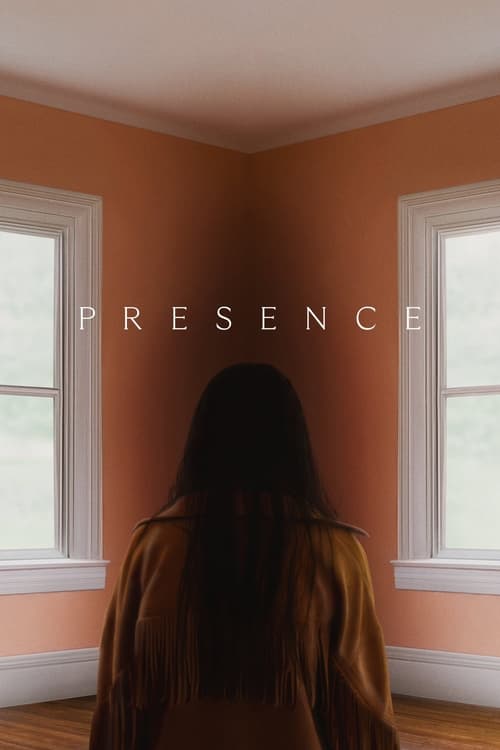
Presence
2025 · Steven Soderbergh
For when you want a haunted-house movie that's clever and melancholy instead of a scream machine — a one-sitting, lights-off watch that leaves you thoughtful more than terrified.
What it's about
A family of four moves into an older suburban New Jersey home, hoping for a fresh start — but something is already there. The entire film unfolds through the eyes of the ghost itself: it drifts through rooms, watches the parents' marriage strain and the kids struggle, and slowly comes to understand why it is bound to this house. Strange events mount, and the family begins to realize they are not alone.
The experience
Quietly eerie rather than loud — the floating, voyeuristic camera makes you complicit in the watching, and the tension creeps in through overheard arguments and half-seen trouble. It's as much an intimate family drama as a ghost story, and the unease builds to something genuinely affecting.
The craft
Steven Soderbergh shoots every scene as a single unbroken, roving take from the presence's point of view, separated by cuts to black — the camera is literally a character, and the whole film never leaves the house. Working from David Koepp's script, the formal constraint turns ordinary domestic space claustrophobic; it plays best uninterrupted, where the long takes can work on you.
Why it matters
A striking demonstration that the haunted-house film still had a genuinely new angle left in it, and another of Soderbergh's lean, self-imposed technical experiments — premiering at Sundance in 2024 before Neon's 2025 theatrical release.
Snapshot
Presence is a haunted-house film shot entirely from the ghost's point of view. Steven Soderbergh directed it from an original screenplay by David Koepp. A family of four moves into an older suburban home. Something already there watches them, drifts through the rooms and slowly comes to understand why it is there. The camera never leaves the house. Each scene is one unbroken, roving shot from the presence's perspective, and the scenes are separated by cuts to black. The result is a ghost story and a family melodrama. It is also a formal exercise in which the camera is literally a character. The film premiered at the Sundance Film Festival in January 2024. Neon acquired it and released it in theaters in January 2025.
It sits at a point where three strands of Soderbergh's career meet: his habit of setting himself technical constraints, his long run of small-scale, quickly made genre pictures, and his second collaboration with Koepp, after Kimi (2022). Critics read it less as a scare machine than as a meditation on grief, watching and the helplessness of love. It treats the ghost as the most sympathetic figure in the house.
Industry & production
Presence belongs to the independent, low-budget, director-controlled way of working that Soderbergh has used since his announced "retirement" from feature filmmaking (c. 2013) and his return with Logan Lucky (2017). It was shot quickly, in a single real house, with a small cast and crew. Reports put the budget in the low millions, though no authoritative figure has been published and none should be stated as fact.
The film was not made for a studio. It was presented at Sundance in the Premieres section in January 2024, and Neon bought distribution rights there. Neon, also the distributor of Parasite and Longlegs, had by then become a leading home for prestige-adjacent genre cinema, and the pairing suited the film. Neon held it for about a year and opened it wide in the United States in late January 2025. That timing put it close to the release of Black Bag (March 2025), Soderbergh and Koepp's spy thriller for Focus Features. In early 2025, then, Soderbergh had two Koepp-scripted films in theaters within roughly two months, typical of his rapid, overlapping output.
At the box office it performed modestly, consistent with a micro-budget genre release. Its commercial importance lies mainly in showing again that Soderbergh's small, self-contained model can produce theatrically distributable work.
Technology
The film's technology serves one idea: a lightweight digital camera, moved freely by a single operator, can stand in for a disembodied consciousness. Soderbergh has worked with compact digital capture for years, most visibly on the iPhone-shot Unsane (2018) and High Flying Bird (2019). Here he used a small mirrorless digital camera with a wide-angle lens on a stabilizing rig, and he operated it himself. Trade coverage and interviews describe the exact camera and lens, along with Soderbergh moving through the house in soft-soled footwear. The broad method is well documented; readers needing exact equipment specifications should consult production interviews directly.
The choice matters for the film's look. A wide lens on a stabilized handheld camera gives a gliding, weightless motion that is neither a Steadicam's dolly-like smoothness nor found footage's jitter. Digital capture in available or lightly augmented household light lets long takes run through rooms, up stairs and into closets without the lighting rigs that would make a 360-degree, continuous space impractical.
Technique
Cinematography
Soderbergh shot the film himself under his long-standing cinematographer pseudonym, "Peter Andrews." The governing rule is strict subjectivity: every shot is the presence's view. It hovers at roughly human eye height, drifts through doorways, retreats into corners and watches. The camera does not cut within scenes, and in principle it never shows what the presence cannot see.
The motion is expressive. When the presence is curious, the camera leans in. When it is agitated, it pulls back or rushes. When it wants to hide or brood, it retreats into a closet, which becomes a recurring vantage point. The wide lens exaggerates depth in the house's corridors and stairwells, so the domestic space feels slightly too large. The family often walk straight past or through the frame, unaware of it. That turns the conventional "unseen observer" shot of horror into the film's whole grammar. Because the camera is a character with feelings, the camerawork is also performance: Soderbergh is, in effect, acting the ghost.
Editing
Soderbergh also edited the film, as "Mary Ann Bernard," another pseudonym he has used for decades. With no cuts inside scenes, editing becomes a matter of structure: how long each take runs, what order the scenes come in, and how long the blackouts between them last. The cuts to black work like blinks, or lapses in the ghost's awareness. Days or weeks may pass between scenes, and the viewer, like the presence, has to piece together what happened in the gaps. This elliptical structure is the opposite of the "single continuous shot" gimmick of films like 1917 or Birdman. It does not hide its cuts. It turns them into missing time. This feeds the film's eventual reveal about time and identity.
Mise-en-scène / staging
The house is the film's only set and its organizing space. It is an older suburban home, freshly renovated for sale, with a central staircase, bedrooms upstairs and a kitchen and living area below. Because the camera moves continuously, actors had to be choreographed around it rather than the other way round. Actors enter and leave the frame on their own schedules, and many key exchanges are glimpsed from a doorway or across a room rather than covered in close-up.
Objects become events: a disturbed shelf, a toppled stack of items, things the presence moves to communicate. The staging deliberately makes the presence a bystander to conversations it cannot join. This visual helplessness is the film's emotional core. The renovated, impersonal décor also matters. The house is a blank slate on which the family's tensions get written. It is not a gothic mansion.
Sound
The score is by Zack Ryan, a composer who has worked on several of Soderbergh's recent productions. It is used sparingly and tends toward atmospheric unease rather than shock cues. Because the camera's point of view is so restricted, sound does much of the work of extending space. Voices drift in from other rooms, footsteps sound on the stairs, and arguments are overheard before they are seen. The presence knows the household largely by listening. The sound design avoids the loud, jump-timed stingers of contemporary studio horror, in keeping with the film's interest in dread and melancholy over fright.
Performance
Lucy Liu plays Rebekah, the mother. She is brittle, ambitious, openly favors her son, and is tied up in work dealings that her husband suspects are legally dubious. Chris Sullivan plays Chris, the warmer and more anxious father, who notices that his daughter is struggling. Callina Liang, in a breakout role, plays Chloe, the teenage daughter. She is grieving the recent drug-related death of a friend and is the first to sense the presence and the one most open to it. Eddy Maday plays Tyler, the swaggering son and competitive athlete. West Mulholland plays Ryan, Tyler's friend, whose charm hides predatory menace. Julia Fox appears briefly as the real-estate agent. A medium who visits the house and explains how spirits experience time is played by Natalie Woolams-Torres.
The long takes require stage-like sustained performances. Actors have to play whole scenes without the safety of coverage, often while partly turned away from a camera that is supposed to be invisible to them. Several critics singled out Liang's performance. Its quiet receptiveness to the unseen anchors the film emotionally.
Narrative & dramatic mode
Formally, Presence is a subjective-camera narrative. Dramatically, it is a domestic melodrama folded into a ghost story. Koepp's script runs on restricted knowledge. The presence, and so the audience, knows only what it sees and overhears in the house. Family secrets come out in fragments: Rebekah's possible financial wrongdoing, the parents' strained marriage, Chloe's grief and isolation, Tyler's thoughtless cruelty.
The suspense comes from Ryan's growing influence. As he grooms and eventually drugs Chloe, the presence's helplessness turns into frantic, physical intervention. In the climax the presence and Tyler act to save Chloe from Ryan, and both Ryan and Tyler die in a fall from a window. The final beat recasts the whole film. The presence was Tyler's own spirit all along, unmoored in time and drawn back to the house to protect his sister. Rebekah glimpses him in a mirror at the end.
This retrospective reveal shifts the film from haunting toward elegy. Its dramatic mode is ironic and tragic rather than terrifying. The ghost is not a threat but a guardian, and its sorrow is that it cannot speak. The medium's explanation that spirits may experience time out of order prepares the reveal without giving it away.
Genre & cycle
Presence works within the haunted-house tradition: The Haunting (1963), The Others (2001), Poltergeist (1982), and the suburban hauntings of the Paranormal Activity (2007–) and Insidious cycles. It inverts that tradition's main convention by narrating from the ghost's side. Its closest recent kin is David Lowery's A Ghost Story (2017), which also centers a mute, time-dislocated spirit bound to a house. Presence belongs to the strain of 2010s–2020s "elevated" or art-house horror that uses supernatural premises to explore grief and family dysfunction, alongside Hereditary (2018) and The Babadook (2014). Its pace and restraint, though, are closer to the art-house ghost film than to the jump-scare studio model.
It also belongs to the long, mostly experimental history of the first-person camera, from Robert Montgomery's Lady in the Lake (1947), whose experiment was famously awkward, to Gaspar Noé's Enter the Void (2009), which also gives a dead protagonist a floating point of view. Presence differs from found-footage horror in that its camera is not a diegetic recording device. It is a consciousness.
Authorship & method
Steven Soderbergh has been one of American cinema's most restlessly experimental mainstream directors since sex, lies, and videotape (1989) won the Palme d'Or. He has long taken on cinematography and editing under pseudonyms (Peter Andrews and Mary Ann Bernard, the names of his father and mother respectively). Presence is a purely authored object in that sense: one person designed, shot and assembled it. The film continues his practice of setting a governing technical constraint and building a genre story around it, as in Bubble (2005), Unsane and High Flying Bird. It also reflects his preference for speed, economy and small crews.
David Koepp wrote the screenplay. A veteran of the high-concept studio thriller (Jurassic Park, Mission: Impossible, Panic Room, Spider-Man), he also directed the ghost story Stir of Echoes (1999), so he has a direct track record in the supernatural domestic thriller. His partnership with Soderbergh, which includes Kimi (2022), Presence and Black Bag (2025), pairs Koepp's tight, plot-driven, often single-location scripts with Soderbergh's formal experiments. Reportedly the idea of a ghost's-eye film came from Soderbergh, and Koepp built the family story to fit it.
Zack Ryan composed the score. Soderbergh's regular collaborators off camera, including his producing partners, supported the lean production model. The record of specific credit-by-credit contributions beyond these key roles is less extensively documented in criticism.
Movement / national cinema
Presence is American independent cinema in the specific mode Soderbergh helped pioneer. It is not a product of a national "movement" so much as of a career-long argument about how films can be financed, shot and distributed outside studio systems. It fits into the post-2010s American genre landscape shaped by distributors such as A24 and Neon, which position horror as both an art-cinema and a commercial proposition. Its experiment with subjective, uninterrupted perspective also links it loosely to international long-take cinema, from Hitchcock's Rope (1948) to Sokurov's Russian Ark (2002). It uses those techniques for intimacy and restriction rather than spectacle.
Era / period
The film was made in the early 2020s and premiered in early 2024, in a period of upheaval for American film: the aftermath of the pandemic's disruption of theatrical moviegoing, the 2023 writers' and actors' strikes, and a contracting market for mid-budget films. Small, fast productions like this one were a practical response to those conditions. The film's concerns are also contemporary: teenage isolation, grief over an overdose death, smartphone-mediated adolescent life, and the hidden danger of a "charming" young man. They place it in a 2020s domestic present rather than a timeless gothic register.
Themes
- Watching and helplessness. The central experience is seeing without being able to act or speak. The presence watches a family it loves move toward catastrophe. The film turns spectatorship itself into an emotional condition and implicates the audience, who share the ghost's position.
- Grief and its transmission. Chloe's mourning for her friend and the family's later loss of Tyler frame the film as a study of bereavement. The presence is grief made spatial, a sorrow lingering in a house.
- Family dysfunction and favoritism. Rebekah's preference for Tyler, the parents' fractured marriage and the children's mutual cruelty provide the melodramatic substance. That the ghost is Tyler gives the theme a bitter twist: the favored, careless son becomes the silent protector of the sister he dismissed.
- Time and causality. The reveal suggests a non-linear afterlife, a spirit returning to a moment before its own death. That links haunting to regret and the wish to intervene in the past.
- Masculine menace. Ryan's predation, hidden behind social ease, places a recognizably contemporary danger at the heart of a supernatural story. The real threat in the house is human.
Reception, canon & influence
Critical reception. After its Sundance premiere and wider release, Presence drew largely positive reviews. Critics praised its formal ingenuity, its restraint and Callina Liang's performance. Several reviewers noted that its point-of-view conceit did more than serve as a gimmick, and that the final revelation recasts the film as moving rather than frightening. More skeptical responses found the domestic drama thin or the family's dialogue schematic. Horror audiences expecting conventional scares reacted more coolly than critics, a familiar split for slow-burn genre work of this period. It was generally counted among the stronger entries in Soderbergh's late-career run.
Influences on the film (backward). Clear antecedents include the subjective-camera tradition (Lady in the Lake; the voyeuristic first-person shots of slasher cinema, notably the opening of Halloween, 1978); the long-take tradition (Rope, Russian Ark); and especially A Ghost Story (2017), with which critics frequently compared it for its sympathetic, mute, time-unmoored ghost. The domestic-haunting conventions of Poltergeist and Paranormal Activity, and the twist ending of The Others, which also reconsiders who is haunting whom, are part of the backdrop. Within Soderbergh's own work, Unsane and High Flying Bird tested the lightweight-camera methods used here. Koepp's Stir of Echoes is a direct generic precedent.
Legacy (forward). Because the film is recent, any account of its influence has to stay provisional. As of this writing there is not enough history to name films it demonstrably shaped. Its likely legacy is as a reference point for camera-as-character storytelling and for showing that a strict formal constraint can carry emotional rather than merely technical weight. Within Soderbergh's filmography it stands as one of his purest experiments in perspective. It also marks the middle of his productive Koepp collaboration, between Kimi and Black Bag.
Influences: the films it descends from and the films it influenced
- Lady in the Lake (1947) — The first feature shot entirely as a character's optical point of view. It shows the central problem Presence had to solve: other actors have to play straight to the lens because the camera is the protagonist.
- Rope (1948) — It builds a thriller from long continuous takes in one domestic interior. Actors and furniture move around a roaming camera, the same choreography-around-camera staging Soderbergh uses scene by scene.
- Halloween (1978) — The opening is one unbroken subjective shot on a Panaglide stabilized rig: an unseen presence prowls through a suburban house. This is the stalking-POV grammar that Presence turns from predator into protector.
- Poltergeist (1982) — It sets the template of a haunting that targets the youngest daughter of a contemporary suburban family. The supernatural is played through the parents' marital dynamics, the domestic-drama frame Presence takes over.
- Stir of Echoes (1999) — Koepp's own domestic ghost story. A dead girl is trying to communicate with a living family through their house. It gives him the structure he reverses in Presence, where the ghost protects rather than demands justice.
- The Others (2001) — Its final reveal reverses who is haunting whom inside a single house. That is the structural model for Presence's late recontextualization of the ghost's identity and purpose.
- Panic Room (2002) — Koepp's single-house script turns the home's architecture into the story. Its digitally stitched camera moves glide through floors and keyholes as a disembodied observer, a prototype for a camera that moves like a presence.
- Russian Ark (2002) — One Steadicam take is the POV of an invisible, unexplained ghost-narrator drifting through a building and watching people who mostly can't see it. It is the closest formal precedent for a whole film seen through a disembodied consciousness.
- Bubble (2005) — An early test of Soderbergh's self-imposed constraint model: he shot it himself on HD with a tiny crew, non-professional actors and fixed locations. It sets up the economy that Presence takes to its limit.
- Paranormal Activity (2007) — It proved a haunted-house film could run on a single home, a diegetic camera, no score stingers and offscreen sound in empty rooms. Presence keeps those tools but drops the found-footage alibi.
- Enter the Void (2009) — After its protagonist dies, the camera becomes his floating spirit, drifting over the people he loved and watching them unable to act. It is the most direct precedent for a ghost's-eye camera driven by protective grief.
- A Ghost Story (2016) — A mute, sympathetic ghost is tied to one house, and the film cuts across elided time. It is the template for Presence's grief-centered inversion of haunting and its elliptical, unmoored sense of time.
- Black Bag (2025) — The next Soderbergh–Koepp film carries Presence's chamber-piece method into the spy genre. Tight interior staging, dinner-table scenes choreographed for long takes, and a self-shot camera stay at the center of the house.
- Kimi (2022) — The first Soderbergh–Koepp film. It is a near-single-apartment thriller that turns on an overheard offscreen recording, testing the restricted-knowledge, sound-built space that Presence then applies to a ghost.
- Nickel Boys (2024) — Released almost alongside Presence. It also sustains first-person camera POV for the length of a feature and turns the Lady in the Lake device toward empathy and witness rather than gimmick.
- Here (2024) — A near-contemporary film locked to one domestic space and one camera vantage. It makes the house the film's fixed point of view and lets families pass through it across time.
Similar films
- Black Bag (2025) — influence & lineage
- Blue Heron (2026) — shared sensibility
- undertone (2026) — shared sensibility
- Goodnight Mommy (2015) — shared sensibility
- Bring Her Back (2025) — shared sensibility
- Ghostlight (2024) — shared sensibility
- Skinamarink (2023) — shared sensibility
- Hallow Road (2025) — shared sensibility