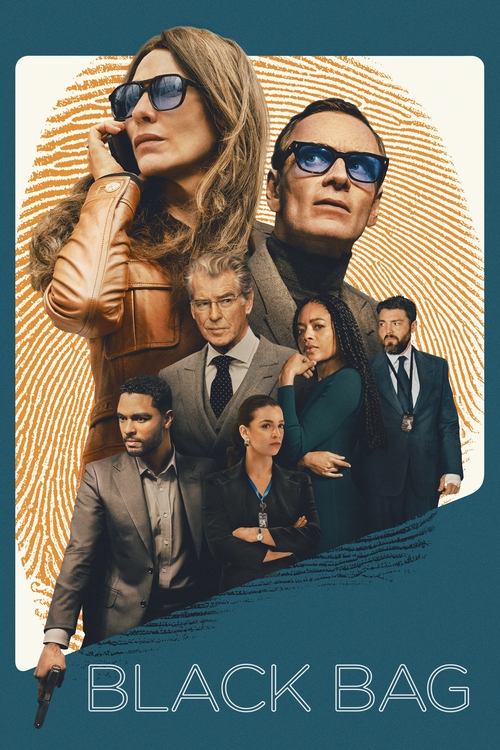
Black Bag
2025 · Steven Soderbergh
For a grown-up night in when you want to feel smart — martinis-and-suspicion cinema that rewards close attention. Reach for it when you're craving tension without a single wasted explosion.
What it's about
A senior British intelligence officer is quietly told that his wife — also a spy, and a formidable one — may be the mole who leaked classified intelligence. He has days to find the truth without letting her see he's looking, and the battlefield isn't a foreign capital but their own dinner table. It's a spy thriller where the highest-stakes surveillance happens inside a marriage.
The experience
Icy, elegant, and quietly electric — less about chases than about watching brilliant people read each other across a table, where a pause or a glance carries more menace than a gun. It keeps you leaning forward, parsing every line for the lie underneath.
Performances
Michael Fassbender and Cate Blanchett play the married spies as two perfectly controlled surfaces daring each other to crack — their scenes together are duels conducted entirely in composure.
The craft
Soderbergh strips the spy film down to conversation and lets a dinner-party sequence do the work most thrillers need a set piece for, with David Koepp's script doling out information like a card player. Sleek, precise, and paced like a held breath — it rewards an attentive room and a good sound system that catches every murmured half-truth.
Why it matters
A late-career Soderbergh proof that the adult, dialogue-driven thriller still works on the big screen, and a reminder that spy stories are really stories about trust.
Snapshot
A chamber spy thriller about a marriage tested by national security, Black Bag strips the genre of spectacle and replaces it with the dynamics of a dinner table. George Woodhouse (Michael Fassbender), a senior British intelligence operative, is informed that his wife Kathryn (Cate Blanchett) is among a handful of suspects who may have leaked classified intelligence. Over a compressed, claustrophobic span of days — anchored by a multi-character dinner-party sequence — George must determine whether the woman he loves is a traitor, without alerting her that she is under suspicion. The film operates as a formal exercise in trust, information asymmetry, and the intelligence tradecraft of reading other people. Its presiding mood is icy, elegant dread.
Industry & production
Black Bag was written by David Koepp, whose career spans blockbuster construction (Jurassic Park, Mission: Impossible) and tightly wound genre work, and whose instinct for escalating procedural architecture is well suited to Soderbergh's preference for plot as mechanism. The film was produced under the Working Title Films banner and distributed through Universal Pictures, positioning it within the mid-budget prestige-thriller channel that has grown increasingly rare at American studios. It belongs to a deliberately curated strand of Soderbergh's late-career output: films budgeted modestly enough to preserve formal autonomy, ambitious enough in cast and conception to justify theatrical windows.
Soderbergh assembled a cast that draws significantly from British and international talent — Fassbender, Blanchett, Tom Burke, Regé-Jean Page, Marisa Abela, Naomie Harris, Pierce Brosnan — an ensemble strategy consistent with his Ocean's films and Contagion (2011), where star density distributes narrative authority and prevents audience identification from settling on any single moral center. The ensemble casting is also functionally generic: in a film built around the question of who among a group is the traitor, you want faces the audience assigns prior credibility.
The film's compressed production schedule reflects Soderbergh's documented preference for efficiency as an aesthetic and logistical principle. His post-Traffic output has been consistently characterized by short, disciplined shoots that require exceptional cast preparation and precise pre-planning.
Technology
Soderbergh shoots his own films under the pseudonym Peter Andrews, a practice now so embedded in his method that it constitutes a defining structural condition of his filmmaking rather than a personal quirk. For Black Bag he continued his sustained engagement with digital acquisition — his camera choices across recent projects (RED for various features, Sony Venice in some cases, iPhone for Unsane in 2018) are dictated by what a given project's visual logic demands. The film's interior-heavy, candlelit and low-light settings point toward a sensor with strong shadow latitude; the record on the specific camera body for this production was not widely detailed in available pre-release materials, and specific equipment attribution here should be treated with appropriate tentativeness.
What is consistent across his digital career is the elimination of a traditional director-of-photography role: Soderbergh controls the image from concept to capture. This is not mere efficiency but a philosophical position — that the directorial and cinematographic decisions are inseparable, and that intermediary interpretation dilutes the precision of intent. He edits his own films under the pseudonym Mary Ann Bernard, completing the loop and making him, in the strictest sense, his own entire post-production department at the authorial level.
Technique
Cinematography
Soderbergh's visual register for Black Bag draws on the controlled interior aesthetic he has refined since The Limey (1999) and deepened through Contagion, No Sudden Move (2021), and Kimi (2022): a palette governed by deep shadows, motivated practical sources (lamps, candles, institutional fluorescence), and a camera that moves with deliberate purpose rather than expressive flourish. The dinner-party centerpiece sequence reportedly employs sustained, semi-choreographed coverage that foregrounds body language and seating geometry as informational systems — who is adjacent to whom, who can see whom's face, where eyelines cross. This is cinematography as eavesdropping apparatus.
His use of shallow focus as a tool of epistemological emphasis is consistent across his work: information is prioritized by focal depth, and ambiguity is sometimes rendered literally as blur. In a film about intelligence — about what characters know, suspect, or pretend not to know — shallow focus is not decorative but argumentative.
Editing
Mary Ann Bernard's (Soderbergh's) editing in his late-period thrillers is defined by rhythm and elision. He cuts on information rather than action, trusting the audience to make inferential leaps, and frequently drops the conventional beat of reaction shots to maintain pace and prevent sentimentality. His editing of The Informant! (2009) established a tragicomic temporal compression; his work on Contagion favoured the accumulation of procedural fact over emotional dwell-time. Black Bag, from its structural premise, would seem to demand a similar precision: scenes where we know something the protagonist doesn't, scenes where he knows something we don't, scenes where both parties are performing uncertainty at each other.
Mise-en-scène / staging
Soderbergh is fundamentally a choreographic director — his staging is an argument made through spatial relationships. The dinner table as a site of sustained theatrical blocking is one of cinema's great dramaturgical conventions (from Bergman to Buñuel to Chabrol), and Black Bag clearly operates in that lineage. Characters at a shared table are simultaneously intimate and exposed; every glance is readable, every evasion is visible. In a spy narrative, the dinner table becomes an intelligence operation in miniature: everyone is surveilling everyone else while appearing merely to be having a meal.
The film's setting — British intelligence milieu, presumably London-adjacent institutional and domestic interiors — places it in the same visual grammar as the Alfredson-era Le Carré adaptations (Tinker Tailor Soldier Spy, 2011), with their wood-panelled rooms, gray windows, and the physical quietness of characters trained to disclose nothing involuntarily.
Sound
David Holmes has served as Soderbergh's primary composer across a large portion of his output — the Ocean's trilogy, Out of Sight (1998), No Sudden Move, Kimi — and his score for Black Bag is reported to continue that collaboration. Holmes brings a sensibility rooted in British electronic music and jazz, capable of both pop propulsion (the Ocean's films) and something more searching and ambient. For a film predicated on cognitive suspense rather than physical action, a Holmes score would likely lean toward his more minimal register: textural underscore that heightens unease without cueing it, music that withholds the relief of conventional resolution.
Soderbergh is known for precise sound design in which dialogue is mixed to feel immediate and unadorned — recorded cleanly, not reinforced by cinematic convention. In a film this dependent on verbal performance and subtext, the acoustic fidelity of conversation is not a minor technical decision but a dramaturgical one.
Performance
Fassbender's capacity for controlled interiority — the tightly managed face behind which significant internal states are processing, visible to the audience in micro-expression but deniable to other characters — makes him precisely suited to a role that requires an intelligence professional performing normalcy while conducting a covert investigation of his own wife. His career-defining performances in Shame (McQueen, 2011) and Macbeth (Kurzel, 2015) both depend on this quality of legible concealment.
Blanchett's role — a character who may or may not be concealing a betrayal — inverts her husband's situation: where Fassbender performs normalcy while knowing something, she (if guilty) performs normalcy while being known about, or (if innocent) performs normalcy while being genuinely unaware. The part requires her to be unreadable in a structurally different way. Blanchett's well-documented range in sustained, emotionally modulated restraint (established across her work from Notes on a Scandal to Tár) positions her to make that ambiguity genuinely productive rather than merely opaque.
The supporting ensemble — Burke, Page, Abela, Harris, Brosnan — functions as a suspect gallery, each figure carrying their own measure of plausibility and misdirection.
Narrative & dramatic mode
Black Bag operates as a closed-system thriller in the tradition of the lateral investigation: not the detective pursuing an unknown criminal, but the investigator embedded among the suspects, unable to name his purpose, forced to use social and professional inference rather than forensic authority. The film's closest narrative kin is less the action-spy film than the parlor mystery — Christie by way of Le Carré — and its dramatic mode is fundamentally theatrical: constrained space, verbal sparring, the slow accumulation of readable detail.
The marriage as the thriller's spine introduces a second narrative register. George's investigation is also an ontological crisis: if Kathryn is the traitor, then his understanding of the marriage, of intimacy itself, has been constructed on a false foundation. This double jeopardy — lose your country or lose your self-knowledge — positions Black Bag as a marriage film wearing the costume of a spy thriller, or vice versa. Soderbergh has, across his career, shown consistent interest in institutional structures (espionage, medicine, crime, the entertainment industry) as lenses through which to examine how people manage — and mismanage — intimate life.
Genre & cycle
The film enters a distinctly identifiable cycle of prestige spy-thriller filmmaking that accelerated in the 2010s: Tinker Tailor Soldier Spy (2011), A Most Wanted Man (2014), Bridge of Spies (2015), Our Man from Havana adaptations and continuations — a genre mode defined by institutional paranoia, psychological interiority, moral ambiguity, and the Cold War's long aesthetic shadow extending into contemporary setting. This cycle depends heavily on the Le Carré world even when not explicitly adapting it: the intelligence professional as morally compromised figure operating in a landscape of procedural betrayal.
Within that cycle, Black Bag is distinctive for placing the marital question at the structural center rather than the periphery. The marriage-under-espionage-pressure premise has precedents (most notably in The Spy Who Came in from the Cold's romantically doomed structure and in various Cold War films about double agents), but Black Bag makes the marriage the narrative engine, not its collateral damage.
Authorship & method
Soderbergh's authorship is explicitly that of a formalist working across genre — he has described his filmmaking in terms of problem-solving, each film presenting a specific formal challenge whose solution generates the film's distinctive texture. This makes his output genuinely various in surface while remarkably consistent in underlying approach: information management, ensemble dynamics, temporal compression, and a cool analytical regard for his characters' professional and institutional lives.
Black Bag represents a synthesis of several recurring interests: the spy milieu he explored in The Good German (2006), the ensemble staging of the Ocean's films, the formal constraint of Kimi (essentially a single-location thriller), and his abiding interest in professionals doing their jobs under pressure. David Koepp as writer brings a complementary sensibility — Koepp's best work (The Trigger Effect, his underappreciated 1996 directorial debut; Stir of Echoes) shows an interest in ordinary people placed under extraordinary epistemological strain, which aligns closely with the film's premise.
Holmes as composer and Soderbergh as both cinematographer and editor constitute a creative unit whose coordination at this point requires no external mediation. The film emerges from a working method in which most of the conventional interstitial roles between conception and execution have been absorbed into a single authorial loop.
Movement / national cinema
Black Bag is a transatlantic co-production in the deepest sense: American director, British setting and institutional context, Irish-German and Australian leads, a story about British intelligence. It occupies the Working Title space that has historically produced a certain kind of literate, mid-budget British-inflected drama legible to global audiences. In placing an American genre filmmaker (Soderbergh) in a British espionage milieu, it participates in a long tradition of American cinema's imaginative investment in the moral landscape of British intelligence — a tradition running from the American productions of Le Carré adaptations through to the Bond franchise's own periodic attempts to interrogate itself.
The film is not British national cinema in any strict sense, but it draws freely on British genre conventions and institutional iconography, and its distribution context positions it as prestige European-flavoured American cinema: a category that has sustained the mid-budget adult thriller at a moment when the American studio system has otherwise largely abandoned it.
Era / period
Black Bag arrives at a specific moment in the post-pandemic theatrical economy when mid-budget prestige films occupy an uncertain commercial position — too expensive to be truly independent, too formally austere to compete with franchise blockbusters for opening-weekend dominance. Soderbergh has been one of the more articulate industry voices about this structural problem, and his late-career output can be read partly as a series of experiments in whether it is still possible to sustain this kind of filmmaking theatrically. The film's 2025 release places it alongside a modest revival of interest in the adult thriller as a distinct theatrical category — a cycle generated by films like Oppenheimer (2023) proving that not all prestige cinema has migrated to streaming.
Soderbergh's own trajectory through this moment is distinctive: his Presence (2024), a ghost story told entirely from the ghost's POV, preceded Black Bag, demonstrating his continued appetite for formal novelty regardless of commercial expectation.
Themes
The film's central thematic tension — loyalty to marriage versus loyalty to nation — is structured as genuinely irresolvable. Both loyalties are presented as legitimate total demands; neither has obvious priority. The spy thriller historically explores what the state asks of its agents in terms of emotional suppression, deception, and the instrumentalisation of intimacy, and Black Bag places that question inside a marriage rather than between agent and target. The result is a film about whether love is epistemically sufficient — whether you can really know another person well enough to stake national security on that knowledge — or whether love is, by its nature, an epistemically compromised position, a willed refusal to observe certain kinds of evidence.
Adjacent themes: professional identity versus personal identity (both characters are defined by their institutional roles in ways that complicate any notion of a private self separate from craft); the gendered politics of suspicion (Kathryn is suspected; George investigates; the distribution of those roles is not neutral); the ethics of surveillance within intimacy.
Reception, canon & influence
Black Bag received broadly positive critical attention upon release, with particular praise directed at the Fassbender-Blanchett central dynamic and Soderbergh's formal control. Critics positioned it within his late-career run of genre exercises — Kimi, No Sudden Move, Presence — as further evidence of a director operating with unusual formal autonomy and consistency of craft at a career stage when many contemporaries have slowed. The specific texture of its critical reception — whether reviewers emphasized the thriller mechanics or the marital drama — varies by the critical tradition the reviewer inhabits; the record in detail remains thin enough that synthesis beyond these broad strokes would be premature.
Influences on the film (backward): Hitchcock's domestic suspense films (Suspicion, Vertigo) and their interest in a husband's or wife's growing doubt about the partner; the Le Carré adaptations and their institutional-paranoia atmosphere; Chabrol's dinner-table chamber dramas (La Cérémonie, L'Enfer); Sidney Lumet's procedural intelligence (Lumet's own spy work remains a touchstone for the morally grounded thriller); Soderbergh's own Traffic (2000) as a precedent for multi-perspectival information management within a thriller frame; and, more distantly, the Pinter-inflected tradition of English stage drama — particularly Pinter's own plays about power, concealment, and the inadequacy of dialogue as a tool for truth.
Legacy and forward influence: It is too early for Black Bag to have generated documented forward influence. What can be said is that it contributes to the demonstration that the chamber spy thriller — dialogue-driven, interior-focused, morally unresolved — remains viable as a theatrical proposition, a case Soderbergh has been making repeatedly since his 2017 return from semi-retirement. If the film's commercial performance supports that case, it strengthens the argument for mid-budget prestige thrillers as a durable theatrical category, with implications beyond Soderbergh's own output. Its formal approach — confined setting, ensemble suspects, marital stakes — offers a template that other filmmakers working in the spy genre who wish to minimize spectacle and maximize psychological intensity may find instructive.
A Deleuzian reading
Watch the dinner table.
The full Deleuzian reading of Black Bag →
Reception
Rapturously reviewed on release in March 2025 — one of the best-reviewed films of the year — but a soft performer at the box office, it instantly became Exhibit A in the 'why won't adults go see movies for adults?' discourse; by year's end it was all over best-of-2025 lists.
How Black Bag was received, from release to now →
Influences: the films it descends from and the films it influenced
- Suspicion (1941) — Hitchcock structures the thriller entirely through restricted point-of-view as information-management device — we see only what Joan Fontaine sees, so the husband's guilt or innocence remains epistemologically inaccessible — establishing the marriage-as-thriller-spine template that Black Bag directly inverts: here it is the wife's professional competence, not helplessness, that becomes the site of doubt.
- The Servant (1963) — Harold Pinter's screenplay stages power reversals through what characters refuse to say rather than what they say, and Losey choreographs the shifts in two-character blocking within confined domestic rooms — the theatrical-blocking-lineage Black Bag acknowledges; dialogue functions as concealment rather than disclosure, a Pinter-derived formal principle the film inherits directly.
- The Ipcress File (1965) — Oswald Morris photographed Harry Palmer's unglamorous tradecraft in telephoto shallow-focus compositions that made institutional drabness formally distinctive — characters isolated in soft-edged frames against bureaucratic backgrounds — the same visual grammar Soderbergh applies to Black Bag's intelligence milieu, where shallow focus marks professional containment rather than romantic glamour.
- The Spy Who Came in from the Cold (1965) — Ritt and Morris render Le Carré's tradecraft entirely through dialogue and bureaucratic procedure rather than action, and the unadorned sound mix — no score cushioning the information exchanges — establishes the template for the morally compromised institutional spy narrative delivered through verbal revelation alone, the aesthetic Black Bag explicitly inherits.
- Sleuth (1972) — Shaffer's stage play is adapted as a pure dialogue-combat film in which theatrical blocking — characters repositioned around a single enclosed space to mark each power reversal — carries all the dramatic information; the parlour-mystery structure where every revelation retroactively reframes prior scenes is the formal architecture Black Bag's ensemble-suspect dinner scenes replicate.
- The Conversation (1974) — Walter Murch integrates electronic surveillance audio into the score itself — diegetic and non-diegetic sound bleeding together — so that the sound design embodies the protagonist's epistemological anxiety rather than accompanying it; this fusion of electronic texture and information asymmetry as sonic form is the prototype for Holmes and Soderbergh's electronic-jazz underscore approach in Black Bag.
- L'Enfer (1994) — Chabrol films marital destruction through the husband's mounting jealousy using shallow focus to isolate characters even in shared domestic space — the cinematographic grammar of information asymmetry within a couple — staging scenes so that physical proximity between spouses reads as epistemological distance, a technique Black Bag applies to the Fassbender-Blanchett dynamic throughout.
- La Cérémonie (1995) — Chabrol stages ensemble power dynamics across dinner-table scenes where the arrangement of bodies, eyelines, and dialogue rhythms carry the full dramatic weight — the table as theatrical arena for concealed social knowledge — directly prefiguring Black Bag's set-piece dinner sequences in which the blocking itself encodes who knows what about whom.
- Traffic (2000) — Soderbergh's own template for distributing narrative knowledge across an ensemble such that each strand's partial information creates a lateral investigation structure — no single character holds the complete picture — is the architectural precedent for Black Bag's ensemble-suspect gallery, where the viewer assembles the truth from oblique angles rather than following a single investigative line.
- Before the Devil Knows You're Dead (2007) — Lumet's final film parcels the same event through multiple perspectives in non-linear sequence, each pass withholding what the previous revealed and revealing what it concealed — temporal compression as information-management device — so that the editing structure itself enacts the film's theme of incomplete knowledge; the same editorial methodology governs Black Bag's withholding strategy.
- Tinker Tailor Soldier Spy (2011) — Alfredson structures the mole-hunt as archaeological reconstruction rather than pursuit, and Gary Oldman's performance of radical controlled interiority — suppressed emotion as professional competence — establishes the performance register Black Bag inhabits throughout its ensemble; the lateral investigation that accumulates certainty through inference rather than action is the shared narrative architecture.
- A Most Wanted Man (2014) — Corbijn and Philip Seymour Hoffman render Le Carré's tradecraft as exhausted bureaucratic labor; dialogue scenes are shot and cut to let information land without music cues or editorial amplification — the unadorned-dialogue-mix approach to intelligence procedure, where the weight of what is said derives entirely from the actors' controlled delivery and not from the sound mix's commentary on it.
- No Sudden Move (2021) — Shot under Soderbergh's Peter Andrews pseudonym with Don Cheadle-led suspect ensemble, the film employs the same editorial strategy as Black Bag — causal information withheld until a later scene retroactively recontextualizes earlier action — with period-jazz underscore integrated at the same low volume register, confirming the authorial unit's (Soderbergh as cinematographer-editor, jazz-inflected score) consistent formal method across genre.
- Kimi (2022) — Cliff Martinez's electronic score integrates with single-location formal constraint as non-diegetic sound that embodies the protagonist's epistemological entrapment rather than simply underscoring it — the same fusion of electronic texture, confined space, and information withheld from both character and viewer that the Holmes-Soderbergh collaboration pursues in Black Bag, confirming this as a deliberate authorial strategy across successive chamber thrillers.
Similar films
- Tinker Tailor Soldier Spy (2011) — influence & lineage
- A Most Wanted Man (2014) — influence & lineage
- La Cérémonie (1995) — influence & lineage
- Gone Girl (2014) — same viewing thread
- The Constant Gardener (2005) — same viewing thread
- The Housemaid (2025) — same viewing thread
- Blink Twice (2024) — same viewing thread
- Conclave (2024) — often watched together
All the films related to Black Bag →
Watch it with: curated runs of related films
- Elegant Betrayals — Watch these back-to-back for couples and beautiful people whose polished surfaces — a London flat, a Riviera villa, a spies' dinner party — hide a betrayal, a surveillance, and a body, each turning intimacy into a crime scene.