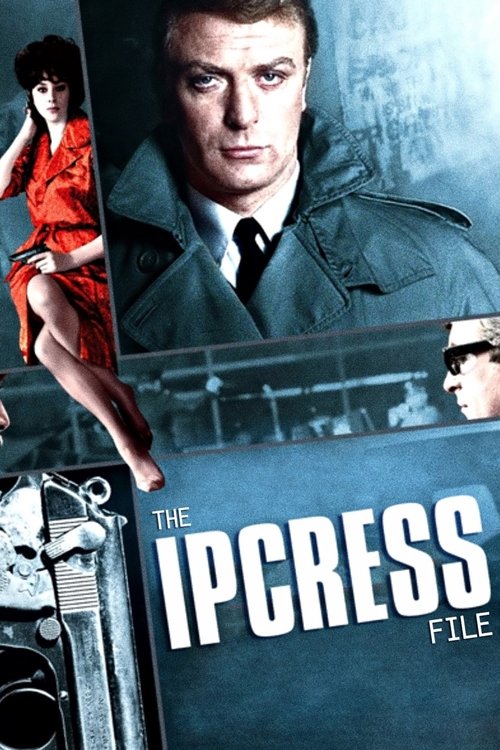
The Ipcress File
1965 · Sidney J. Furie
For when you want espionage with brains and attitude instead of gadgets and glamour — a rainy-evening watch that rewards paying attention. Challenge-adjacent comfort: stylish, but it makes you work a little.
What it's about
Harry Palmer is a spy with none of the perks: an insolent, bespectacled working-class sergeant seconded to British intelligence, where the job is expense claims, surveillance shifts, and supervisors he openly disdains. Assigned to investigate a leak inside the service, he's pulled into a case of kidnapped scientists and brainwashing — and the growing certainty that the traitor is somewhere close to home.
The experience
Dry, cool, and quietly paranoid — a thriller that trades car chases for bureaucratic menace, with a wit as deadpan as its hero. The tension creeps rather than explodes, tightening toward a genuinely nasty final stretch.
Performances
This is the film that made Michael Caine a star — his Harry Palmer is all horn-rimmed insolence, a man who cooks his own gourmet dinners, grumbles about his pay, and needles his superiors, making minor rebellion magnetic.
The craft
Sidney J. Furie shoots nearly everything at an angle or through an obstruction — lampshades, phone boxes, parking meters — turning gray institutional London into a maze where someone is always watching. John Barry's twanging, off-kilter score is instantly memorable, and the whole look rewards a proper screen.
Why it matters
It invented the anti-Bond — the spy film as grubby office job — launched Michael Caine, and spawned a franchise, permanently opening a second, cynical lane for the espionage genre.
Snapshot
The Ipcress File is the film that invented the anti-Bond and, in the same stroke, made Michael Caine a star. Adapted from Len Deighton's 1962 debut novel, it takes the apparatus of the contemporary spy thriller — defecting scientists, double agents, a traitor burrowed into the secret service — and strips it of glamour, relocating espionage from the casino and the ski slope to the gray institutional London of expense claims, requisition forms, surveillance shifts, and bureaucratic turf wars. Its hero, Harry Palmer, is an insolent, bespectacled working-class sergeant seconded to intelligence: a man who cooks gourmet meals in a cramped flat, shops at the supermarket, grumbles about his pay, and treats his superiors with barely concealed contempt. The plot concerns the abduction and "de-briefing" — that is, brainwashing — of British scientists, and Palmer's slow discovery that the rot lies inside his own organization. What distinguishes the film is less its story than its sensibility and its surface: Sidney J. Furie's aggressively mannerist camerawork, John Barry's cimbalom-driven score, and a deglamorized vision of the trade that, arriving the same year as the screen Spy Who Came in from the Cold, helped define the realist, disenchanted strand of 1960s spy cinema. It won the BAFTA for Best British Film and launched a Harry Palmer series; it remains a touchstone of mid-sixties British filmmaking and of the espionage genre's self-critical turn.
Industry & production
The film's defining production fact is that it came from inside the Bond machine and was conceived in deliberate opposition to it. Harry Saltzman, who with Albert R. Broccoli produced the Eon James Bond pictures, had separately acquired the rights to Deighton's novels and mounted The Ipcress File as a parallel franchise — a more sober, downbeat counter-Bond drawing on the same talent pool. Crucially, Saltzman brought across several of the key Bond craftsmen: production designer Ken Adam, editor Peter Hunt, and composer John Barry had all shaped the look and sound of the early 007 films, and their participation here is what gives The Ipcress File its paradoxical character — the same hands that built Bond's fantasy world deployed to render espionage as drab, bureaucratic labor.
The screenplay was credited to Bill Canaway and James Doran, working from Deighton's novel. A signal change from page to screen was the naming of the protagonist: Deighton's narrator is anonymous throughout the books, and the film's invention of "Harry Palmer" gave the series its bankable continuing figure. Casting Michael Caine was the decisive creative gamble. Caine had just registered strongly as the upper-class officer in Zulu (1964); to follow that with a defiantly working-class, Cockney-inflected lead was a counterintuitive move that paid off completely, and The Ipcress File is generally regarded as his breakthrough as a leading man. The supporting cast set Palmer between two rival intelligence chiefs — Nigel Green as Major Dalby and Guy Doleman as Colonel Ross — with Sue Lloyd as the colleague Jean and Gordon Jackson among the agents.
The production has long carried a reputation for friction. It is well documented that Furie was unhappy with the script and clashed over the material, and accounts of his frustration on set (including the often-repeated anecdote of his burning script pages) circulate widely; the precise details are best treated as production lore rather than settled fact, but the underlying tension between a director straining against conventional material and a producer protecting a commercial property is real and visible in the finished film's restless style.
Technology
The Ipcress File is a 35mm location-and-studio production of its period and makes no claim to technological innovation in the apparatus of filmmaking; its distinction lies in style and craft rather than in any new tool. What is technologically and historically notable is internal to the fiction: the film's premise turns on a then-topical anxiety about brainwashing and behavioral conditioning. The title is an acronym — Induction of Psychoneuroses by Conditioned Reflex under Stress — and the climactic sequences stage a primitive audiovisual conditioning regime of flashing patterns, disorienting sound, and sensory assault. This places the film within the Cold War's fascination with mind control and "the Manchurian Candidate" thesis, and its depiction of conditioning-by-media is rendered through optical and sound effects rather than any documented real technology. Beyond that thematic dimension, the record gives no basis for claims of special technical novelty, and it would be invention to assert any.
Technique
Cinematography
The photography is by Otto Heller, the Czech-born veteran whose credits include Michael Powell's Peeping Tom (1960), and it is here that the film's notoriety chiefly resides. Furie and Heller pursue an extravagantly self-conscious visual scheme built on obstruction and displacement: scenes are framed through and behind objects — a telephone dial, a parking meter, light fixtures, doorframes, the bars of a stairwell, car windscreens — so that the camera seems perpetually to be spying on its own spies. Compositions are radically off-center, with faces pushed to the edges of the widescreen frame and large foreground elements left to dominate the image; low and canted angles abound. The strategy literalizes the film's themes of surveillance, concealment, and partial knowledge, keeping the viewer in the same condition of obstructed sightlines as Palmer himself. Contemporary opinion was divided — some found the mannerism distracting — but the look proved enormously influential and is the film's most imitated feature. The palette is muted and institutional, the London exteriors unromantic, the interiors fluorescent and functional, all reinforcing the deglamorizing project.
Editing
The editing is by Peter Hunt, whose rapid, percussive cutting had helped energize the early Bond films and who would soon graduate to directing On Her Majesty's Secret Service (1969). On The Ipcress File his work is more restrained than his Bond montage but no less precise, organizing the film around procedure and observation: surveillance sequences, the meticulous business of tailing and being tailed, the bureaucratic to-and-fro. The cutting holds back narrative clarity in keeping with the script's labyrinthine plotting, so that the audience, like Palmer, must assemble meaning from fragments. The conditioning climax gives Hunt his most aggressive passage, a barrage of disorienting cuts and effects designed to enact psychological assault on the viewer as much as on the character.
Mise-en-scène / staging
Ken Adam's production design here is the inverse of his celebrated Bond spectacle: instead of volcano lairs and gleaming control rooms, he and the filmmakers build a world of cramped offices, supermarket aisles, anonymous flats, and institutional corridors. The mise-en-scène is organized around the mundane, and much of the film's wit comes from staging espionage amid domestic and bureaucratic banality — Palmer cooking, Palmer filling in forms, Palmer haggling over money. Costume and props do quiet thematic work: Palmer's heavy black-framed spectacles, reportedly Caine's own, became an emblem of the character and, beyond the film, helped make glasses a marker of cool rather than weakness. The staging consistently places Palmer as an insubordinate outsider within rigid hierarchies, the working-class man amid public-school spymasters, his body language and milieu marking a class divide the film never lets the audience forget.
Sound
The score by John Barry is among the film's most enduring contributions and a deliberate counterpoint to his lush, brass-driven Bond music. Built around the cimbalom — the Hungarian hammered dulcimer, here played by John Leach — Barry's main theme is spare, plangent, and faintly Eastern European, evoking espionage's melancholy and menace rather than its glamour. The instrument's metallic, tremulous timbre became indelibly associated with the film and with a certain register of Cold War screen music. Elsewhere the sound design favours naturalistic urban ambience over excitement, and the conditioning sequence weaponizes sound directly, using distorted noise as an instrument of the on-screen torture.
Performance
The film is anchored by Michael Caine's performance as Harry Palmer, a study in laconic insolence that redefined the screen spy. Where Bond is suave and obedient to glamour, Palmer is dry, sardonic, faintly resentful, and ostentatiously ordinary — a man more animated by a good omelet or a grievance over expenses than by the trappings of adventure. Caine plays him with a watchful understatement, the heavy spectacles and flat delivery doing much of the work, and the characterization's blend of competence, cheek, and class friction made him a star. Around him, Nigel Green and Guy Doleman supply contrasting studies in bureaucratic authority — Dalby's clipped command, Ross's smoother menace — and the ambiguity of their rivalry feeds the film's central suspicion that the enemy is internal. Sue Lloyd's Jean adds a note of guarded romantic and professional ambiguity. The ensemble's restraint serves the realist project: these are functionaries, not heroes.
Narrative & dramatic mode
The dramatic mode is the procedural spy mystery played in a deliberately disenchanted key. The plot follows an investigation — the abduction of scientists and their return mysteriously "drained" of expertise, traced through a tangle of surveillance, betrayal, and a missing file — but the film withholds easy legibility, and part of its design is that the audience shares Palmer's incomplete, obstructed understanding. The deeper subject is institutional: the drama is built less from action set-pieces than from the texture of bureaucratic espionage, the rivalries between departments, the paperwork and the pay, the sense of agents as expendable employees. The revelation that the traitor sits at the heart of the service turns the narrative into a study of internal corruption and misplaced trust, and the conditioning climax shifts the film into something closer to psychological horror, dramatizing the violation of the self that the trade can demand. Throughout, irony and class comedy leaven the tension, and the film's tone — cool, skeptical, faintly absurdist about the institutions it depicts — is as much its content as the plot.
Genre & cycle
The Ipcress File is a foundational entry in the realist, anti-glamour strand of the 1960s spy cycle, defined explicitly against the Bond fantasy that Saltzman himself had helped create. Its arrival in 1965 — the same year as the screen adaptation of John le Carré's The Spy Who Came in from the Cold — marks the moment when British spy cinema split into two countervailing modes: the escapist, gadget-driven Bond line and the sober, morally gray, bureaucratic line associated with Deighton and le Carré. Palmer is the cycle's emblematic figure, the spy as disgruntled civil servant. The film spawned its own series, with Caine returning in Funeral in Berlin (1966) and Billion Dollar Brain (1967), and again decades later, establishing Palmer as a durable franchise hero in counterpoint to 007. Within the broader genre it belongs to the Cold War thriller's preoccupation with brainwashing and divided loyalty, a lineage that runs alongside The Manchurian Candidate (1962).
Authorship & method
Authorship of The Ipcress File is unusually divided, and that division is the key to its character. Sidney J. Furie is its most assertive creative signature: the obstructed, off-kilter visual style is his, and the film's reputation as a feat of direction rests on the friction between his restless mannerism and the genre material he was straining against. Yet the film is equally the product of Harry Saltzman's strategy and of Bond-forged craftsmen redirected to anti-Bond ends — Ken Adam's anti-spectacular design, Peter Hunt's editing, and above all John Barry's cimbalom score, whose spare melancholy does as much as any image to set the film's tone. Otto Heller's camerawork realized Furie's compositional ideas. Among the writers, Bill Canaway and James Doran translated Deighton's anonymous narrator into the named, castable Harry Palmer. And the film is inseparable from Caine, whose performance fixed the character so completely that the authorship of "Harry Palmer" is shared between source novelist, screenwriters, and star. The collaboration is best understood as a productive tension: a producer protecting a commercial property, a director subverting it through style, and a design-and-music team importing Bond expertise to build Bond's opposite.
Movement / national cinema
The film is a significant artifact of 1960s British cinema at the height of its international confidence, the era of the British New Wave's afterlife and of "Swinging London" as a global brand. It belongs to the strand of British filmmaking that paired commercial genre with stylistic ambition and a sharpened attention to class — Caine's Cockney Palmer is, like the working-class protagonists of the kitchen-sink films earlier in the decade, a vehicle for the period's loosening of the old class order, transplanted now into glossy genre territory. As national cinema it sits at the intersection of British craft and American studio money and distribution, the Anglo-American production model that characterized much prestige British film of the period. Its deglamorized London — institutional, overcast, unremarkable — offers a pointed counter-image to the era's more celebratory visions of the capital.
Era / period
The Ipcress File is a precise document of mid-1960s Cold War anxiety. Its premise — the theft of scientists' minds, the fear of brainwashing and behavioral conditioning — channels a period preoccupation with mind control that had been given wide cultural currency by the Korean War's "brainwashing" scare and by works like The Manchurian Candidate. Its bureaucratic vision of intelligence work reflects a moment when, in the wake of real defections and mole scandals that shook British intelligence, public trust in the secret services had curdled into suspicion, and the figure of the traitor at the heart of the establishment had acquired genuine cultural charge. The film's class consciousness, its supermarket-and-bedsit texture, and its cool skepticism toward institutions all place it firmly in its decade, as does its very project of puncturing the escapist spy fantasy that the same years had made globally popular.
Themes
The film's governing theme is disenchantment — the demystification of espionage from glamorous adventure into grubby, bureaucratic, and morally compromised labor. Around this cluster several concerns. Class runs throughout: Palmer the insolent working-class operative set against his public-school superiors, his insubordination a form of social critique. Surveillance and obstructed knowledge are enacted formally as well as narratively, the camera's perpetual peering through obstacles making vision itself a theme — who watches whom, and how little anyone fully sees. Institutional betrayal and the untrustworthiness of authority drive the plot's discovery of internal treachery, dramatizing a Cold War suspicion that the real danger is within. And the conditioning premise raises the era's deepest anxiety: the violation of the autonomous self, the fear that identity and will can be unmade by stress and suggestion. Beneath it all runs a sardonic comedy about the ordinariness of extraordinary work — the spy who worries about his expenses — that is itself a thematic statement about the banality of the secret state.
Reception, canon & influence
The Ipcress File was a critical and commercial success that consolidated its standing quickly, winning the BAFTA for Best British Film (and further BAFTA recognition for its craft), and it established Michael Caine as a leading man of international stature. Critical response admired its intelligence, its tone, and Caine's performance; the most divided reaction concerned Furie's flamboyant visual style, which some praised as bracingly original and others found mannered and intrusive — a debate that has followed the film ever since. It is now securely canonized as one of the defining British films of the 1960s and the cornerstone of the realist spy genre.
Influences on the film run backward to Len Deighton's source novel and the broader literary turn toward disenchanted, procedural espionage exemplified by le Carré; to the Cold War brainwashing thriller, The Manchurian Candidate among its kin; and, decisively, to the Bond films themselves, against which it was conceived and from which it borrowed its key craftsmen while inverting their aesthetic.
Its influence forward is broad. It immediately generated the Harry Palmer series and established a durable model for the bureaucratic, morally weary screen spy that later espionage cinema and television would repeatedly draw upon. John Barry's cimbalom score helped fix a sonic vocabulary for Cold War melancholy. Furie's obstructed, foreground-cluttered compositional style became one of the most imitated visual signatures of the period, echoing through subsequent thrillers. Caine's bespectacled Palmer reshaped the image of the screen spy and, in a small but real way, the cultural meaning of glasses. More broadly, the film stands as a landmark in genre cinema's capacity for self-critique — proof that the spy thriller could be turned against its own myths — and it retains a secure place in the canon of British film and of the espionage genre's realist tradition.
A Deleuzian reading
Watch where the camera puts itself.
The full Deleuzian reading of The Ipcress File →
Reception
A hit on release — it took the BAFTA for Best British Film and made Michael Caine a star — though critics sniffed at Sidney Furie's showy canted angles; those same 'mannered' compositions are exactly what cinephiles now celebrate it for.
How The Ipcress File was received, from release to now →
Influences: the films it descends from and the films it influenced
- The Third Man (1949) — Establishes the pairing of Dutch/canted angles with a single plucked-string solo instrument (Karas's zither) for postwar espionage melancholy — the exact template John Barry inverts into the cimbalom and Furie into his tilted frames.
- Citizen Kane (1941) — Originates the deep-focus, foreground-cluttered composition and low ceiling-bound angle that Furie weaponizes by shooting Palmer through lamps, railings, and parking meters.
- The Manchurian Candidate (1962) — Codes the Cold War brainwashing thriller with disorienting formal devices (circular dolly, dream-logic montage) that license Ipcress's IPCRESS-machine montage-assault sequence.
- Dr. No (1962) — Supplies the Bond grammar of glamorous spectacle and Ken Adam's modernist sets that Ipcress was consciously built to negate, substituting bureaucratic banality for exoticism.
- Goldfinger (1964) — Direct crew source: producer Saltzman, John Barry's scoring, Peter Hunt's editing, and Ken Adam's design were lifted from this Bond entry and redirected to anti-spectacular ends.
- Funeral in Berlin (1966) — Directly continues the Harry Palmer character — Caine's bespectacled, insubordinate, laconic spy — sustaining the bureaucratic-banality staging Ipcress invented.
- Billion Dollar Brain (1967) — Inherits the Palmer franchise and pushes Furie's obstructed/canted visual mannerism into full baroque excess.
- Point Blank (1967) — Carries forward the fragmentary, elliptical editing and alienated off-center modernist compositions into the alienated-thriller idiom.
- Klute (1971) — Builds the surveillance theme into structure — recorded-tape eavesdropping and off-center framing that isolates the watched figure in oppressive, listening space.
- The Parallax View (1974) — Systematizes Furie's foreground-blocked, figure-dwarfing compositions into a paranoid grammar of institutional conspiracy and bureaucratic menace.
- The Conversation (1974) — Centers the laconic surveillance technician and weaponizes diegetic sound (the looped recording) as Ipcress weaponized its score and audio cues.
- Get Carter (1971) — Extends Caine's laconic-understatement persona — the watchful, terse professional — from the spy genre into pitiless British noir.
- Three Days of the Condor (1975) — Inherits the morally weary, agency-betrayed analyst navigating internal treachery, the procedural-mystery-meets-internal-betrayal plot Ipcress pioneered.
- Black Bag (2025) — Oswald Morris photographed Harry Palmer's unglamorous tradecraft in telephoto shallow-focus compositions that made institutional drabness formally distinctive — characters isolated in soft-edged frames against bureaucratic backgrounds — the same visual grammar Soderbergh applies to Black Bag's intelligence milieu, where shallow focus marks professional containment rather than romantic glamour.
- Tinker Tailor Soldier Spy (2011) — Pioneered oblique espionage framing — composing through foreground objects, glasses, and partitions to render spying as alienated clerical routine, prefiguring van Hoytema's shot-through-glass surveillance.
- Confessions of a Dangerous Mind (2002) — Baroque obstructed framings and in-camera optical flourishes that aestheticize the Cold War spy idiom Confessions quotes for its assassin fantasy.
- Alfie (1966) — Shot by Otto Heller, it forged Caine's articulate working-class star persona — the same cinematographer and the same cool, watchful Caine that Alfie immediately repurposed into its lead.
- The Spy Who Came in from the Cold (1965) — Shares the le Carré-derived realist proceduralism — drab interiors, moral exhaustion, and a spy reduced to expendable bureaucratic asset — pursued in monochrome austerity rather than Furie's stylization.
- The Quiller Memorandum (1966) — Extends the same disenchanted procedural-mystery structure of an undervalued operative navigating an opaque agency chain of command.
- Seconds (1966) — James Wong Howe's extreme wide-angle, body-mounted, and obstructed compositions parallel Furie's surveillance-paranoia framing of figures trapped in distorting foreground space.
Similar films
- The Spy Who Came In from the Cold (1965) — influence & lineage
- Goldfinger (1964) — influence & lineage
- Get Carter (1971) — influence & lineage
- The Third Man (1949) — influence & lineage
- The Servant (1963) — shared sensibility
- The Hill (1965) — shared sensibility
- Tinker Tailor Soldier Spy (2011) — shared sensibility
- Alfie (1966) — shared sensibility
All the films related to The Ipcress File →