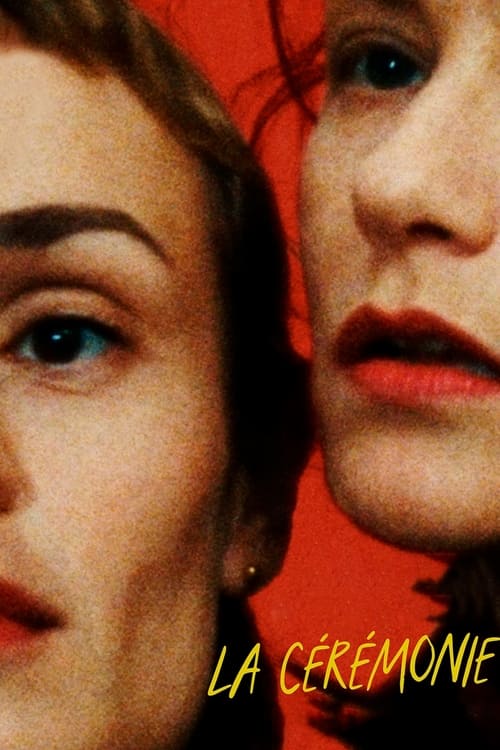
La Cérémonie
1995 · Claude Chabrol
When you want a grown-up thriller that trusts you — tense, precise, and morally uncomfortable. One for a focused night when you'd rather be gripped than soothed.
What it's about
Sophie, a quiet, almost eerily efficient maid, takes a job with a cultured, well-off family at their country house in Brittany — while hiding a secret she'll do anything to protect. Her only friend is Jeanne, the village postmistress, a brash busybody with a grudge against everyone comfortable. Between the family's well-meaning condescension and the two women's deepening, conspiratorial bond, something in the house begins to tilt toward disaster.
The experience
Ice-cold and riveting — a slow tightening where every polite dinner and small kindness adds pressure, and the humor is as sharp as the dread. It doesn't jolt you; it closes in, and the ending lands like a verdict.
Performances
Sandrine Bonnaire and Isabelle Huppert are extraordinary together — Bonnaire all blank, watchful stillness, Huppert all insolent energy — and the chemistry between them is the film's engine. They shared the Best Actress prize at Venice for it.
The craft
Chabrol directs like a scientist running an experiment: unshowy camera, immaculate framing, every class signal — the books, the opera on TV, who sits where — placed with surgical intent. The suspense is built entirely from behavior, which makes it scarier.
Why it matters
Widely considered the masterpiece of Chabrol's late career, it became a touchstone for films about servants, employers, and the violence simmering under good manners.
Snapshot
La Cérémonie is widely regarded as the masterpiece of Claude Chabrol's late career and one of the supreme achievements of his lifelong project: the clinical dissection of the French bourgeoisie. Adapted from Ruth Rendell's 1977 novel A Judgment in Stone, it follows Sophie (Sandrine Bonnaire), a quiet, efficient housemaid taken on by the cultivated, well-to-do Lelièvre family at their country house in Brittany. Sophie guards a secret — she cannot read or write — and conceals her illiteracy behind a mask of compliant blankness. Into her closed world arrives Jeanne (Isabelle Huppert), the village postmistress, a brash, prying, resentful woman who steams open other people's mail and nurses a generalized grievance against the comfortable. Their friendship, equal parts genuine intimacy and shared class hatred, curdles into something murderous, culminating in one of the most chilling and ideologically charged endings in modern French cinema. Chabrol himself described the film, only half-jokingly, as "the last Marxist film," and its power lies in the icy precision with which it stages a collision between two Frances — the educated, propertied, self-satisfied class and the excluded, humiliated underclass — without ever pleading for either side. Honored at Venice and crowned with a César for Huppert, La Cérémonie stands as a late-career summit and a definitive statement of Chabrol's misanthropic, scrupulously observed art.
Industry & production
La Cérémonie was produced by Marin Karmitz through MK2, the company that had become Chabrol's most important production partner in the latter part of his career and a pillar of French auteur cinema's financing and distribution. By the mid-1990s Chabrol was among the most prolific and reliable directors in France, a fixture of the national industry who worked steadily within its established structures of producer financing, television pre-sales, and the support apparatus of the French system. The film was a Franco-German co-production, with the involvement of France 3 Cinéma and other partners typical of the period's mixed financing, in which broadcasters underwrote theatrical features destined eventually for television — a circuit whose logic the film's climactic use of a televised opera broadcast wryly invokes.
The screenplay was written by Chabrol with Caroline Eliacheff, a psychoanalyst and writer whose collaboration brought a distinctive psychological acuity to the adaptation. Their source was Ruth Rendell's A Judgment in Stone, a novel whose celebrated opening sentence — declaring that the housekeeper killed her employers because she could not read or write — supplies the film's organizing premise: illiteracy as wound, as secret, and as the engine of class violence. Chabrol relocated Rendell's English story to the French countryside, transposing its anatomy of class into the specifically French textures of provincial Brittany.
Casting was decisive. Chabrol had a long and storied association with Isabelle Huppert, who had become his most important muse across films including Violette Nozière (1978) and Une affaire de femmes (1988); here she plays Jeanne. Opposite her he cast Sandrine Bonnaire — herself one of the major French actresses of her generation, indelible from Maurice Pialat's À nos amours and Agnès Varda's Sans toit ni loi — as Sophie. The pairing of two such formidable performers, of slightly different screen lineages, gives the film its charged central dynamic. The bourgeois household is filled out by Jacqueline Bisset as Catherine Lelièvre, Jean-Pierre Cassel as her husband Georges, Virginie Ledoyen as his daughter Melinda, and Valentin Merlet as the son Gilles — a family rendered with the unforced ease of people who have never doubted their place in the world.
Technology
La Cérémonie is a conventionally produced mid-1990s feature shot on 35mm film, and it makes no claim whatever to technological novelty; Chabrol was a classicist of means who placed every technical resource at the service of observation. Its sophistication is entirely a matter of craft rather than apparatus: precise lighting, exact lensing, and a refusal of any device that would call attention to itself. The film's one pointed engagement with technology is thematic rather than productive — the television set on which the Lelièvre family watches a broadcast of Mozart's Don Giovanni, the domestic screen that mediates high culture into the bourgeois living room and that becomes, in the final sequence, both alibi and obscene accompaniment to slaughter. The record offers no indication of unusual technical methods in the film's making, and it would be invention to suggest otherwise; the achievement is one of disciplined, traditional filmmaking.
Technique
Cinematography
The cinematography is by Bernard Zitzermann, and it is a model of restrained, legible classical style. Chabrol's camera observes rather than editorializes: compositions are clean and frontal, the framing patient and unhurried, the movements motivated and discreet. The visual strategy is one of cool, even surveillance — the spectator is placed at a slight clinical distance from which to watch behavior accumulate into meaning. The bourgeois interior is photographed with an even, comfortable light that registers the warmth and order of a moneyed home without sentimentalizing it; the spaces are handsome, full of books and objects, and the lighting lets us feel both their genuine appeal and their quiet exclusions. Chabrol repeatedly uses the geography of the house — the kitchen and servants' quarters versus the living areas — and the camera's attentiveness to thresholds, doorways, and the upstairs/downstairs of class to make the social order visible in spatial terms. The overall effect is of lucidity: nothing is hidden, yet the calm surface holds a steadily mounting dread.
Editing
The editing is by Monique Fardoulis, Chabrol's longtime and trusted collaborator, and it exemplifies the director's preference for a transparent, classical cutting style that subordinates rhythm to behavior and revelation. The film builds slowly and methodically, laying out the household routine and Sophie's place within it before the arrival of Jeanne accelerates the emotional chemistry. The cutting withholds and discloses with great control — Sophie's illiteracy is established and then exploited in a series of small, excruciating scenes whose timing the editing calibrates precisely. The famous final sequence is a masterclass in cross-cutting: the editing intercuts the family's absorbed viewing of Don Giovanni with the two women's preparation and the eruption of violence, so that the opera's music and the murders are bound together in a single, terrible montage. The restraint of the cutting throughout makes the climax land with the force of inevitability rather than shock.
Mise-en-scène / staging
Chabrol's staging is the film's deepest expression of its theme. The mise-en-scène maps a precise social topography: the kitchen as Sophie's domain, the comfortable rooms above and beyond as the family's, and the constant, casually maintained boundary between service and served. The bourgeois household is dressed with the props of cultivation — books, records, art, the apparatus of taste — and Chabrol stages countless small interactions in which the family's kindness is real yet inseparable from condescension, their decency shadowed by an unexamined assumption of superiority. The two women's complicity is staged in the kitchen and in Jeanne's cluttered post office and home, spaces of conspiratorial intimacy set against the ordered bourgeois interior. The blocking repeatedly isolates Sophie within the frame, a figure of watchful opacity, while Jeanne's restless physical energy disrupts the household's composure. Nothing is overstated; the social meaning is built from the patient accumulation of where people stand, who serves whom, and which thresholds may and may not be crossed.
Sound
The film's sound design is naturalistic and spare, grounding the drama in the quiet of a country house and the small noises of domestic labor. Its decisive sonic gesture is the use of Mozart's Don Giovanni, the opera the Lelièvre family watches on television during the climax — high European art transmitted through the domestic screen as the family is murdered, the music's grandeur set in unbearable counterpoint to the violence. The original score is by Matthieu Chabrol, the director's son and frequent composer, who supplies an unobtrusive accompaniment that heightens tension without melodrama. Throughout, Chabrol favors the meaningful deployment of silence and ambient sound over scoring, letting the absence of music underline the film's cool, observational register; the eruption of Mozart at the end is all the more powerful for that restraint.
Performance
Performance is the film's glory, and it rests on the contrast between its two leads. Sandrine Bonnaire's Sophie is a study in opacity — a blank, watchful, faintly stubborn surface behind which shame, cunning, and rage are barely legible. Bonnaire makes illiteracy a physical condition of vigilance: Sophie is forever managing the risk of exposure, and the performance's genius is how much it withholds, so that her capacity for violence registers as both shocking and, in retrospect, always latent. Isabelle Huppert's Jeanne is the volatile complement — brash, intrusive, gleefully transgressive, animated by a resentment she wears openly where Sophie buries hers. Huppert plays Jeanne with a dangerous vivacity, a corrosive charm that seduces both Sophie and the audience even as it curdles. The interplay of the two — opacity and exposure, stillness and motion — generates the film's electric center. Around them, Jacqueline Bisset, Jean-Pierre Cassel, Virginie Ledoyen, and Valentin Merlet render the Lelièvre family with an easy naturalism that makes their obliviousness, and ultimately their fate, the more disturbing.
Narrative & dramatic mode
La Cérémonie operates in the mode of the slow-burning psychological thriller, but its true dramatic engine is sociological inevitability rather than suspense in the conventional sense. The narrative is a study in accumulation: the steady establishment of Sophie's secret and her servitude, the catalytic friendship with Jeanne, the gradual loosening of restraint, and the final, almost ritualistic, explosion of violence. Chabrol, often called the French Hitchcock, here deploys a Hitchcockian command of dread while inverting the suspense form — we are not made to fear for the victims so much as to watch, with growing horror, the logic by which the murder becomes thinkable. The film refuses the consolations of motive in the ordinary sense; the killing is not a crime of passion or greed but the discharge of an entire structure of humiliation. The dual protagonist structure — two women whose folie à deux amplifies each other's grievance — gives the film its distinctive shape, and the title, with its connotations of an execution or rite, frames the ending as something more than murder: a ceremony of class vengeance. The drama's recognition is not the protagonists' but the audience's: an understanding of how ordinary decency and ordinary resentment can arrive, by small steps, at atrocity.
Genre & cycle
The film belongs to the genre of the psychological crime drama and, more specifically, to Chabrol's own decades-long cycle of bourgeois thrillers — films such as Le Boucher (1970), La Femme infidèle (1969), and Les Biches (1968) in which murder erupts within or against the propertied class and serves as the occasion for an anatomy of its hypocrisies. It also participates in the broader tradition of the "transgressive servant" narrative, the story of the domestic worker who turns on the household, with roots reaching back to the real-life Papin sisters case of 1933 — the murderous French maids whose crime haunted Genet's The Maids and a line of subsequent works, and whose shadow falls unmistakably across La Cérémonie. As an adaptation of Ruth Rendell, it sits within the cycle of literary crime fiction brought to the screen, and within Chabrol's particular fondness for adapting Anglo-American and French crime novelists. The film's fusion of murder mystery with class critique places it in a lineage of politically charged European thrillers that use the genre's machinery to expose social fracture rather than merely to thrill.
Authorship & method
La Cérémonie is unmistakably a Claude Chabrol film, and it distills the method and obsessions of one of the founders of the French New Wave. Chabrol, whose Le Beau Serge (1958) is frequently cited as the New Wave's first feature and who, with Éric Rohmer, co-authored an influential early study of Hitchcock, had spent a career training an unsparing, ironic gaze on the French middle and upper classes. His authorial signature is everywhere here: the cool observational distance, the refusal of moralizing, the location of horror within the everyday textures of bourgeois comfort, and the conviction that the social order is itself a kind of slow violence. His method favored economy, classical technique, and trust in his actors and collaborators over stylistic display.
That collaborative continuity is central to the film's achievement. The screenplay with the psychoanalyst Caroline Eliacheff brought a rigorous attention to the psychology of shame and resentment. Cinematographer Bernard Zitzermann supplied the lucid, even-handed images; editor Monique Fardoulis, a constant presence in Chabrol's later work, shaped the film's patient rhythm and its devastating climax; and composer Matthieu Chabrol, the director's son, provided a discreet score within a family working relationship that typified Chabrol's settled, ensemble approach to production. Above all, the film is a culmination of Chabrol's long partnership with Isabelle Huppert, the actress who had become the privileged instrument of his vision of feminine opacity and danger. The fit between Chabrol's conception and his performers — Huppert's resentment and Bonnaire's blankness — is the film's central creative fact.
Movement / national cinema
La Cérémonie is a late work by one of the New Wave's founding figures, and its existence testifies to the extraordinary longevity of that generation within French national cinema. Chabrol, unlike some of his Cahiers du Cinéma contemporaries, sustained a prolific commercial-artistic career across four decades, working continuously within the robust French system of auteur production supported by producers like Marin Karmitz, by broadcaster financing, and by a national film culture that prized the director as author. The film is quintessentially French in its concerns — the granular attention to class, provincial life, and the rituals of bourgeois domesticity — and it exemplifies a strand of French cinema that uses genre as the vehicle for social anatomy. As national cinema it represents the mature continuation of New Wave values: personal authorship, modest means, location-rooted realism, and a critical, unsentimental relationship to French society itself.
Era / period
The film is a precise artifact of mid-1990s France, and its class consciousness reflects a moment of renewed attention to social division and exclusion in French public life. The Brittany setting locates the drama in a recognizable provincial France of comfortable second homes and small-town post offices, and the texture of the Lelièvre household — its cultivated leisure, its casual affluence, its unexamined sense of entitlement — captures a particular contemporary bourgeoisie. Chabrol's framing of the story as, in his own phrase, a Marxist film registers the period's anxieties about an underclass shut out of the educated, propertied world, and about the persistence of rigid class boundaries beneath the surface of a modern, ostensibly egalitarian society. Illiteracy, the film's central wound, functions as a marker of the era's invisible exclusions — the existence, within an advanced society saturated with print and culture, of those whom that culture has failed and shamed. The film's vision of class antagonism feels neither dated nor antique; it speaks directly to the social tensions of its decade.
Reception, canon & influence
La Cérémonie was received as a major work on its 1995 release and is now firmly established among Chabrol's finest films and a high point of 1990s French cinema. Its performances drew the greatest acclaim: the film was honored at the Venice Film Festival, where its two leads were recognized for their work, and Isabelle Huppert won the César Award for Best Actress, with the film and its company gathering further French nominations and honors. Critics praised Chabrol's icy control, the script's psychological exactitude, and above all the central pairing of Bonnaire and Huppert, whose chemistry was singled out as the film's animating force. The picture has retained a secure place in the critical canon and is frequently named, alongside Le Boucher, as Chabrol's late masterpiece.
Influences on the film run backward to several sources. The immediate source is Ruth Rendell's A Judgment in Stone, whose premise and structure Chabrol followed closely; behind it stands the real Papin sisters case and the tradition of murderous-servant narratives, including Genet's The Maids, that had long haunted French culture. Chabrol's own New Wave formation and his deep study of Hitchcock inform the film's command of dread and its method of locating menace within ordinary domestic surfaces, while his decades of bourgeois thrillers supply the template the film perfects.
Its influence forward is felt in the continued vitality of the class-conscious thriller and the servant-against-the-household narrative, a form that later filmmakers across world cinema have returned to and reworked. The film consolidated the Chabrol–Huppert collaboration as one of the great director-actor partnerships of modern French cinema, a relationship that would continue in subsequent films and that helped define Huppert's screen persona of cool, dangerous opacity. Rendell's novel would be adapted again elsewhere, but Chabrol's version is generally regarded as the definitive screen treatment. More broadly, La Cérémonie endures as a model of how the crime genre can be turned into rigorous social analysis — a film that uses the mechanics of the thriller not to reassure but to expose, and that remains one of the most unsettling portraits of class hatred the cinema has produced.
A Deleuzian reading
The first thing to notice is how often someone hands Sophie a piece of paper.
The full Deleuzian reading of La Cérémonie →
Reception
Acclaimed on release as a late-career triumph for Chabrol, it has only climbed since — the Parasite era sent a new generation of class-warfare cinema fans back to it, and it's now routinely called his last great masterpiece.
How La Cérémonie was received, from release to now →
Influences: the films it descends from and the films it influenced
- La Règle du jeu (1939) — Establishes the upstairs-downstairs architecture Chabrol inherits — masters and servants choreographed in parallel through the same house, their worlds cross-cut until the boundary collapses into violence.
- Shadow of a Doubt (1943) — The Hitchcock that Chabrol and Rohmer studied: menace located inside the placid domestic family unit rather than in exotic locales, a method Chabrol applies to the Lelièvre household.
- Rope (1948) — A folie à deux of two killers bound by a shared sense of being above their victims — the psychological dyad Chabrol restages in Sophie and Jeanne's mutual incitement.
- The Servant (1963) — The servant who dismantles the employing household from within through slow inversion of domestic power — the master-servant dialectic Chabrol compresses into a thriller climax.
- Les Abysses (1963) — Draws directly on the real Papin sisters case, dramatizing murderous-servant rage against bourgeois employers — the same true-crime substrate beneath La Cérémonie.
- The Housemaid (1960) — A live-in servant infiltrates and detonates a striving middle-class home, the domestic-staff-as-intruder thriller structure Chabrol refines with cooler distance.
- La Femme infidèle (1969) — Chabrol's own template of the calm-surfaced bourgeois crime film, where murder erupts from impeccably composed domestic interiors observed without moralizing.
- Le Boucher (1970) — The acknowledged late-masterpiece companion: restrained, clinically observed menace in provincial everyday life, trusting performance and economy over stylistic display.
- Les Biches (1968) — An earlier Chabrol study of two women in a charged, mutually destructive dyad observed with icy detachment — the female folie that La Cérémonie weaponizes against class.
- The Discreet Charm of the Bourgeoisie (1972) — Chabrol deploys flat-neutral ensemble cinematography and deadpan ironic naturalism to observe bourgeois domestic ritual as latent class violence — the unobtrusive camera and Buñuelian gap between composed social surface and catastrophe channeled into French crime film.
- The Vanishing (1988) — Chabrol applies Sluizer's ordinary-killer dramaturgy within the French psychological thriller: the two women's methodical build toward violence is filmed with a steady, non-alarming camera that withholds visual judgment, the perpetrators remaining socially embedded domestic figures observed from a clinical remove.
- Diary of a Chambermaid (1964) — A maid's class resentment erupting into violence with authorial judgment withheld — justice subordinate to class, observed with cool unobtrusive framing.
- Merci pour le chocolat (2000) — Extends the Chabrol–Huppert partnership by handing Huppert another serenely poisonous bourgeois woman, her opaque danger embedded in tasteful domestic ritual.
- The Piano Teacher (2001) — Builds an entire film on the cool, repressed, dangerous Huppert persona that La Cérémonie crystallized, sustaining her blankness as the engine of dread.
- Caché (2005) — Inherits the clinical, even-handed camera trained on a bourgeois household whose comfort conceals class guilt — the crime film turned into rigorous social autopsy.
- Parasite (2019) — Reworks the servant-against-the-household class thriller, choreographing upstairs-downstairs space and cross-cutting the staff's infiltration toward an eruptive violent climax.
- Saltburn (2023) — Revives the outsider-infiltrates-the-manor structure, using the mechanics of the thriller to expose class hatred within an immaculate aristocratic interior.
- Misericordia (2024) — Builds dread from social opacity and class friction in a rural household, letting violence arrive matter-of-factly rather than as melodramatic climax — the same refusal of cathartic punctuation Guiraudie inherits.
- Anatomy of a Fall (2023) — The bourgeois French household held in a camera register that withholds sympathetic or condemnatory framing; the social performance of domestic normalcy as a surface beneath which violence accumulates without directorial editorial intervention on guilt.
- Black Bag (2025) — Chabrol stages ensemble power dynamics across dinner-table scenes where the arrangement of bodies, eyelines, and dialogue rhythms carry the full dramatic weight — the table as theatrical arena for concealed social knowledge — directly prefiguring Black Bag's set-piece dinner sequences in which the blocking itself encodes who knows what about whom.
- Sister My Sister (1994) — A contemporaneous Papin-sisters adaptation building the same claustrophobic servant-pair intimacy toward an explosion against the mistress of the house.
- Heavenly Creatures (1994) — A female folie à deux whose private bond escalates, via cross-cut momentum, into a domestic murder — the same year's parallel anatomy of two women killing as one.
- Kisapmata (1981) — Maintains an unhurried, placid house-film surface straight through the rifle massacre, the camera refusing to escalate its style at the moment of violence — precisely Kisapmata's tactic of shooting the killings in the same unhysterical register as the breakfasts.
Similar films
- The Butcher (1970) — influence & lineage
- Caché (2005) — influence & lineage
- The Piano Teacher (2001) — influence & lineage
- The Rules of the Game (1939) — influence & lineage
- Misericordia (2024) — influence & lineage
- The Servant (1963) — influence & lineage
- Diary of a Chambermaid (1964) — shared sensibility
- Story of Women (1988) — shared sensibility
All the films related to La Cérémonie →