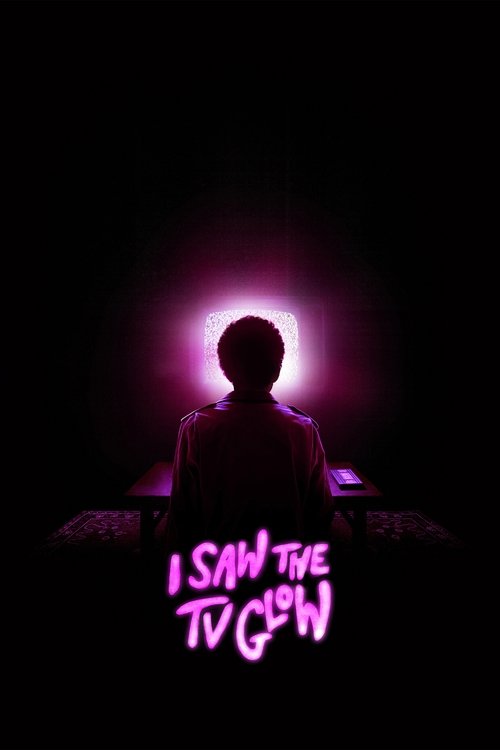
I Saw the TV Glow
2024 · Jane Schoenbrun
I Saw the TV Glow became the defining trans allegory of the era, adopted with religious intensity by its fandom; discourse about "the egg crack movie" and A24's handling of its release made Schoenbrun the most important new queer voice in American film.
For when you want a film to chew on for days — one that unnerves you softly and makes you feel seen in uncomfortable ways. This is a challenge, not a comfort watch, best met alone and late at night.
What it's about
Two teenagers in late-90s suburbia bond over a late-night TV show called The Pink Opaque, a monster-of-the-week series about a supernatural world pulsing just beneath the ordinary one. Owen is lonely and tentative; Maddy, a little older, insists the show is more real than the beige lives they're stuck in. Across two decades, the film follows what happens when a shared obsession becomes a question neither of them can put down: which world is actually the true one.
The experience
Slow, hushed, and quietly devastating — less jump-scare horror than a creeping ache that gets under your skin. It moves like a half-remembered dream, and it leaves you unsettled in a way that's hard to shake, the kind of sad that follows you to bed.
Performances
Justice Smith plays Owen with a wounded, folded-in stillness that carries the whole film, and Brigette Lundy-Paine's Maddy burns with a conviction that makes every scene between them feel like a dare.
The craft
Jane Schoenbrun directs in saturated neons against suburban gloom, with the glow of a TV screen doing real emotional work — the film looks like a VHS memory of the 90s, lovingly warped. Sound and music matter enormously here; watch it in the dark with good speakers and let the drone of it work on you.
Why it matters
One of the most discussed American independent films of 2024, widely embraced as a landmark of trans storytelling in genre form and a breakout for Schoenbrun as a major new voice.
Horror · Psychological horror · Art-horror · Techno-horror. Hushed, neon-lit art-horror about two 90s teens and a late-night TV show, moving like a dream and leaving a long, uneasy ache.
Snapshot
I Saw the TV Glow is Jane Schoenbrun's second narrative feature, a horror-adjacent drama about two suburban teenagers bound together by a canceled 1990s young-adult television series called The Pink Opaque. Owen (Justice Smith) and the slightly older Maddy (Brigette Lundy-Paine) form their friendship around the show, a monster-of-the-week saga that Maddy insists is more real than the beige lives they are living. Over roughly two decades, the film watches Owen fail to answer the question the show keeps posing: whether the flat, suffocating world of the suburbs is the truth, or the buried "Midnight Realm" of The Pink Opaque is. Released by A24 in 2024 after a Sundance premiere, the film arrived as one of the year's most discussed American independent works — widely and openly read as an allegory of gender dysphoria and egg-cracking, though its ambitions extend to nostalgia, dissociation, and the way screens metabolize a life. It confirmed Schoenbrun as a distinctive authorial voice in a new strain of American art-horror.
Industry & production
The film was produced and distributed by A24, the boutique studio that had become the dominant home for elevated American genre cinema in the 2010s and 2020s, and it fits squarely inside A24's institutional profile: modest budget, festival launch, auteur-forward marketing. Among its producing partners was Fruit Tree, the production company founded by Emma Stone and Dave McCary; Stone is credited as a producer, part of a broader pattern in this period of established performers using producing capital to underwrite formally adventurous first- and second-time directors. Schoenbrun had come to the project off the back of We're All Going to Die at the World's Fair (2021), a micro-budget feature made largely alone and celebrated on the festival circuit; TV Glow represents the step up to a fuller crew, a recognizable cast, and a distributor's promotional machine, while retaining the intimacy of the earlier work.
The film premiered at the Sundance Film Festival in January 2024 and received a theatrical release in the United States that spring. Precise budget and box-office figures are not something I can cite reliably here, and I will not invent them; what is well established is that the film performed as a specialty release — strong per-theater interest and critical saturation rather than wide commercial reach — and that its cultural footprint, particularly online, exceeded its ticket sales. The soundtrack, assembled as an A24 music release, became a notable commercial and promotional object in its own right.
Technology
TV Glow is a digitally photographed film that is, at the level of its craft, obsessed with an older display technology: the cathode-ray-tube television and the degraded textures of VHS, cable broadcast, and late-night airings. Much of the film's design labor goes into simulating the look of 1990s consumer video — scan lines, blooming phosphor glow, the specific washed color of a signal watched too close and too late. The title itself names this: the "glow" is the CRT's emission, the light of a screen imprinting itself on a face in a dark room. The production reconstructs an analog media environment (tube TVs, taped episodes, a fictional channel) using contemporary digital tools, and the friction between the sharp digital capture of the present-day scenes and the fuzzed video of The Pink Opaque is itself a dramatic device. In this the film belongs to a broader 2020s tendency toward "analog nostalgia" horror, in which obsolete media formats — tape, broadcast static, creepypasta lore — carry dread precisely because they are decaying and half-remembered.
Technique
Cinematography
Eric Yue's cinematography is the film's most immediately identifiable signature. The palette is built on saturated, unnatural color — chalky pinks, bruised purples, acid greens, and the ambient blue of screen light — laid over the deliberately flattened, over-lit blandness of suburban interiors and school hallways. Yue and Schoenbrun stage many compositions with a frontal, slightly airless symmetry that makes the ordinary world feel like a set, so that when the film tips into the neon of a nightclub, a suburban cul-de-sac lit like a stage, or the fluorescent aisles of a big-box store, the shift reads as a rupture in reality rather than a change of location. Chalk-drawn text, glowing signage, and the recurring image of light bleeding from a doorway or a screen recur as motifs. The camera favors held, dilated takes over coverage, letting discomfort accumulate.
Editing
Sofi Marshall, who also cut World's Fair, edits the film across a long and deliberately disorienting timeline that leaps forward years at a stroke, often without the usual signposts, mirroring Owen's dissociative relationship to his own life. The cutting integrates three registers — the "real" world, the in-world footage of The Pink Opaque, and passages that blur the two — and much of the film's unease comes from how it withholds clear boundaries between them. Time compresses violently in the back half; the editing enacts the sensation of a life passing while its owner is absent from it.
Mise-en-scène / staging
The production design draws a hard line between two aesthetic worlds: the deadened naturalism of the suburbs — wood-paneled dens, popcorn ceilings, the cold of a school at night — and the handmade, papier-mâché fantasy of The Pink Opaque, whose monsters (an ice-cream-man villain, the moon-faced antagonist "Mr. Melancholy") deliberately evoke the cheapness and sincerity of 1990s children's television effects. Chalk, the color pink, and the recurring instruction "There is still time" function as visual refrains. The staging repeatedly isolates Owen within frames — behind glass, at the edge of a room, under a screen's glow — visualizing a self that never fully inhabits its surroundings.
Sound
Sound is central to the film's affect. Alex G (Alex Giannascoli) composed the score, contributing a fragile, warped, indie-folk-inflected soundscape that sits between lullaby and unease. The film also functions partly as a musical showcase: a lengthy sequence set in a bar stages live performances by contemporary artists, and the A24 soundtrack gathered a roster of indie and experimental musicians whose songs act as emotional set-pieces rather than background. Sound design leans on the hums and hisses of electronics — static, the whine of a tube TV, the ambient drone of empty rooms — so that even silence carries a technological texture.
Performance
Justice Smith gives a performance of near-total interiority as Owen, playing a character defined by suppression: a flattened voice, a body that seems to apologize for itself, an affect of chronic, unspeakable discomfort. The role's difficulty is that its drama is almost entirely withheld, and Smith carries the film on the smallest registers of hesitation and dread, aging the character across decades. Brigette Lundy-Paine, as Maddy, plays the film's charge of conviction and escape — more openly desperate, more willing to name what Owen cannot. Their two-hander scenes, especially a late monologue, anchor the film. Supporting turns — including Danielle Deadwyler and, in a piece of pointed casting, Fred Durst as Owen's father — populate the suburban world with muted, watchful presences.
Narrative & dramatic mode
The film's dramatic mode is deliberately anti-climactic, even anti-cathartic. It is structured as a tragedy of the road not taken: Maddy offers Owen an exit from a life that is killing him, and the horror is that he cannot, or will not, take it. Where conventional narrative would build to the crossing of a threshold, TV Glow stages the refusal of that threshold, again and again, and lets the audience feel the cost accrue over years. Its central device — a television show that may be reality and a reality that may be the fiction — is a frame for a story about self-recognition deferred. The mode is closer to elegy than to thriller: dread without release, a slow suffocation the film asks us to sit inside rather than escape.
Genre & cycle
Nominally horror-drama, the film belongs to the 2010s–2020s cycle of American "elevated" or art-horror associated with A24 and its peers, in which genre iconography carries psychological and identity-based subtext. But it sits at that cycle's experimental edge, closer to a mood piece than a scare machine. It also participates in a specific sub-current of media-nostalgia horror — works built from the residue of old television, tapes, and internet lore — and in the emergence of an explicitly trans horror, a small but growing body of films using the genre's language of transformation, monstrosity, and doubled bodies to dramatize gender. Its show-within-a-show is a loving pastiche of a real genre: the 1990s supernatural teen serial in the lineage of Buffy the Vampire Slayer, Are You Afraid of the Dark?, and Goosebumps.
Authorship & method
Jane Schoenbrun (who is nonbinary and uses they/them) is the film's writer-director and its animating sensibility. TV Glow is the second panel of what Schoenbrun has described as a loosely linked body of work about screens, alienation, and the internet-mediated self, following We're All Going to Die at the World's Fair. Schoenbrun's method is deeply personal: they have discussed the film in relation to their own experience of transition and dysphoria, framing it not as a coded message but as an emotional autobiography rendered through genre. Their key collaborators form a continuing team: cinematographer Eric Yue and editor Sofi Marshall shape the film's image and rhythm, while musician Alex G supplies its score and the wider soundtrack extends Schoenbrun's affinity for a specific corner of contemporary indie music. The authorial approach fuses fan-cultural sincerity — a genuine love of the disposable media the film pastiches — with formal control, so that nostalgia is never merely warm; it is the trap.
Movement / national cinema
The film is a work of American independent cinema, produced within the A24-centered ecosystem that had, by the 2020s, become the effective institutional home for auteur-driven genre film in the United States. It can be located in a loose contemporary tendency — sometimes discussed as a new queer or trans wave in American independent film — and in the broader "post-internet" sensibility that treats screens, feeds, and online subcultures as the native environment of selfhood. It is not attached to a formal movement with a manifesto; its lineage is better understood through affinities than membership.
Era / period
Two time frames matter. The film is set largely in the late 1990s and early 2000s, and it reconstructs that period's suburban and media textures with obsessive specificity — the cable schedule, the tube TV, the taped episode as sacred object. But it is unmistakably a product of the mid-2020s, a moment preoccupied with nostalgia as a commodity, with the parasocial intensity of fandom, and with questions of gender and self-recognition that had moved to the center of American cultural life. The film's power comes partly from the gap between these eras: it looks back at 1990s media through 2020s eyes and finds in that childhood ephemera the buried evidence of a self that went unlived.
Themes
The film's most discussed theme is gender dysphoria and the "egg" — the pre-transition self that has not yet recognized itself — dramatized through Owen's inability to accept that his ordinary life is a kind of death. But the film layers several concerns: nostalgia as both refuge and prison; the parasocial power of media to feel truer than lived experience; dissociation and the sensation of watching one's own life from outside; the suburb as an engine of conformity; and the terror of time passing unclaimed. The recurring line "There is still time" operates as the film's ambiguous heart — at once a promise and a taunt. Crucially, the film resists reducing these to a single key; the dysphoria reading is the strongest and most authorially supported, but the film's images of buried selves and unreal realities reach toward a wider audience of the alienated.
Reception, canon & influence
I Saw the TV Glow was met with strong critical acclaim following its Sundance premiere, and it became one of the most written-about American independent films of 2024, appearing on numerous year-end lists and generating a large body of essayistic and personal criticism, much of it centered on the trans reading and on the film's use of nostalgia. Its reception was notably discourse-driven, sustained online by viewers who found their own experience mirrored in Owen and Maddy; the soundtrack amplified this reach. (Specific award tallies I won't enumerate beyond noting that the film featured prominently in the independent-film awards conversation for its year.)
Looking backward, the film's influences are legible. The strongest is David Lynch, whose Twin Peaks and especially Fire Walk With Me haunt the film's suburban dread, its evil beneath the ordinary, and its logic of doubled realities; critics widely noted the debt. The tradition of 1990s teen supernatural television — Buffy, Are You Afraid of the Dark? — is the film's overt source material, treated with fan-scholar affection. One can also situate it near the millennial-suburban-uncanny of Donnie Darko and near the internet-horror and creepypasta sensibility Schoenbrun had already mined in World's Fair.
Looking forward, its legacy is still forming — it is too recent for a settled verdict, and I won't overstate it. What can be said is that the film immediately became a reference point for an emerging trans and queer horror, a demonstration that genre could carry that experience without literalizing it, and that it consolidated Schoenbrun's standing as a filmmaker whose future work would be closely watched. In the near term its clearest influence is atmospheric: it helped legitimize analog-nostalgia and screen-alienation as a serious mode within American art-horror, and it modeled a way of making deeply personal identity narrative through the grammar of the uncanny rather than the memoir.
A Deleuzian reading
A boy sits too close to a television in a dark den.
The full Deleuzian reading of I Saw the TV Glow →
Reception
Premiered in Sundance's Midnight section in January 2024 and became A24's most argued-about release of the year — critics were rapturous while audience scores lagged badly. Barely a year on, the reappraisal has already happened: it's routinely called a landmark of trans cinema and an instant cult classic.
How I Saw the TV Glow was received, from release to now →
How to watch I Saw the TV Glow: what to notice on a first viewing
- Notice how unreal the pinks and greens look. Eric Yue's palette runs chalky pink, bruised purple, and acid green over ordinary suburban rooms, so the color itself feels like a chemical leaking into the frame. The color is not decoration. It tells you a feeling is soaking through the picture, not just a place being shown.
- Watch how flat and centered the suburban rooms look. Yue and Schoenbrun frame dens, hallways, and stores head-on and symmetrical, so ordinary spaces look staged rather than lived in. The world starts to feel like a set nobody actually inhabits, which is exactly the unease the film wants.
- Watch how little Owen's face and voice change. Justice Smith plays Owen flat and apologetic, a body that shrinks to take up as little space as possible, across two decades of the story. His stillness is the performance. Watching him not react is how you feel how stuck he is.
- Notice how the story jumps years without warning. Sofi Marshall's editing leaps forward in time at a stroke, often with no signpost, so you feel time passing the way Owen does, from outside himself. The abrupt jumps make years feel skipped rather than lived, matching a life happening without its owner.
- Listen for the hum and static under every scene. Sound design keeps a low technological hiss running, the whine of a tube TV, the drone of an empty room, so even quiet has a texture. Even silence in this film sounds manufactured, like it is coming through a screen.
The whole guide to watching I Saw the TV Glow, with the keys for a rewatch →
Influences: the films it descends from and the films it influenced
- Twin Peaks: Fire Walk With Me (1992) — Supplies the template of a small-town supernatural mythology bleeding into private dread — a doomed adolescent, an 'evil beneath the ordinary,' and the red-lit doubled-reality staging that TV Glow reworks as the Pink Opaque's Mr. Melancholy.
- Mulholland Drive (2001) — Models the film's core structural device: two incompatible aesthetic worlds housing one dissolving self, where the 'real' timeline is the anti-cathartic denial of the fantasy one, told through dream-logic rather than explained plot.
- Twin Peaks (1990) — Establishes the invented-network-mythos aesthetic — a fictional serialized cosmology treated with total sincerity — that Schoenbrun literalizes by building the diegetic teen show and letting its lore become the protagonist's ontology.
- Donnie Darko (2001) — Pioneers the millennial-suburban-uncanny register — a withdrawn teen, a doomed private cosmology, and a synth-scored dread that treats the ordinary cul-de-sac as a haunted stage — that TV Glow inherits wholesale.
- We're All Going to Die at the World's Fair (2021) — Schoenbrun's own prior panel establishes the continuing method — screen-mediated identity, CRT/webcam glow as emotional texture, creepypasta logic standing in for interior transition — with editor Sofi Marshall's rhythm carried directly forward.
- Videodrome (1983) — Originates the CRT-as-portal grammar in which the television screen is a permeable membrane onto the body and identity, licensing TV Glow's literal buried-alive-inside-a-show conceit and its analog-signal dread.
- Suspiria (1977) — The foundational text for saturated, unnatural gel-lit color used as psychological rather than realistic space — the sourceless pinks and blues that TV Glow deploys to mark the Pink Opaque's world bleeding into the suburb.
- Beyond the Black Rainbow (2010) — Joins frontal symmetrical framing, an analog-synth electronic hum, and retro-tech saturated color into a single hypnotic mode — the exact cinematographic-plus-sound package Eric Yue and Alex G reassemble here.
- Under the Skin (2013) — Demonstrates withheld interiority as a formal principle — a blank, isolated-in-frame protagonist scored by alien electronic drone — so that alienation is rendered texturally rather than through dialogue or backstory.
- The Virgin Suicides (1999) — Codifies nostalgia-as-trap: gauzy, mediated suburban memory that is seductive precisely because it is a prison, the affect TV Glow weaponizes so the warm glow of childhood TV becomes the mechanism of self-erasure.
- Buffy the Vampire Slayer (1997) — The overt structural source for the Pink Opaque — the 1990s teen monster-of-the-week format with a Big Bad and a hero-and-sidekick dyad — pastiched with fan-scholar fidelity down to the episodic mythology and cheap-effects villain.
- Skinamarink (2022) — Extends the same analog-nostalgia horror — degraded VHS/CRT texture, static electronic hum, and childhood-media dread — into a contemporaneous mode that treats obsolete home-video grain itself as the source of the uncanny.
- Knife+Heart (2018) — Runs a parallel queer-horror aesthetic of saturated giallo color scored by a wall of synth, using genre pastiche as a vehicle for non-normative desire rather than coding it — the same 'genre carries the identity without literalizing it' strategy.
- Come True (2020) — Shares the synth-scored, screen-mediated dread of an alienated teen and the electronic-hum texture, resolving on an anti-cathartic reveal that refuses reassurance in the same way TV Glow withholds transformation.
- Saint Maud (2019) — A neighboring A24-era 'elevated' horror built on withheld interiority and an anti-cathartic ending, using genre imagery to externalize a private, unspeakable identity-crisis without ever explaining it.
- Aftersun (2022) — Extends the same nostalgia-as-trap and withheld-interiority craft through camcorder/DV mediation, letting degraded analog footage carry a grief that is structurally refused resolution — memory as an object you cannot re-enter.
- Leviticus (2026) — Renders queer dread as slow suffocating unreality and a split, doubled self — the egg-crack horror of an unlived life — extending internalized shame into ambient formal terror.
- Teenage Sex and Death at Camp Miasma (2026) — The direct template: Eric K. Yue's unmotivated pink and green gels, Sofi Marshall's elliptical year-skipping cuts, and Alex G's score with staged live performances used as chapter breaks.
- Buddy (2026) — Builds a fictional children's-fantasy series in saturated primaries with foam monster-of-the-week costumes and a theme song used as an earworm, then treats that program as a prison the viewer is inside rather than watching.
Similar films
- Videodrome (1983) — influence & lineage · same viewing thread · often watched together
- Perfect Blue (1998) — same viewing thread · often watched together
- Close (2022) — often watched together
- Past Lives (2023) — often watched together
- Teenage Sex and Death at Camp Miasma (2026) — shared sensibility
- All of Us Strangers (2023) — shared sensibility
- Ghostlight (2024) — shared sensibility
- Presence (2025) — shared sensibility
All the films related to I Saw the TV Glow →
Watch it with: curated runs of related films
- Screens That Swallow You — A run of films where the screen — a pirate broadcast, a haunted website, a monitor, a late-night monster-of-the-week show — stops being a window and becomes a doorway that pulls the watcher bodily through into unreality.