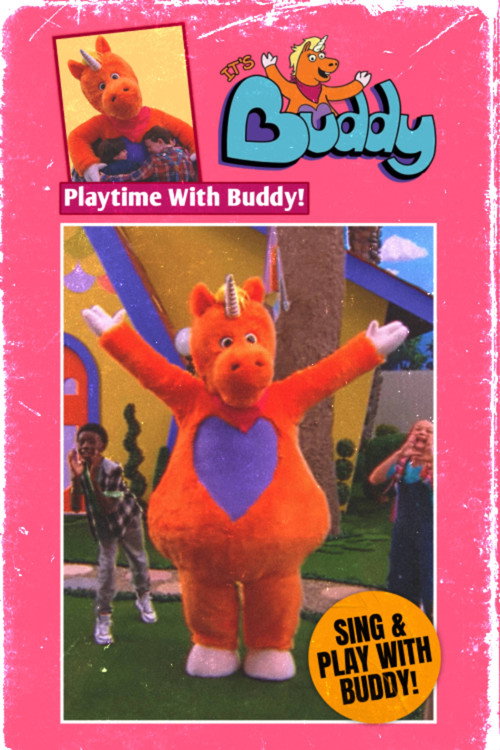
Buddy
2026 · Casper Kelly
For a late night with friends when you want something loud, weird, and gleefully messed up — the pick when 'normal horror' sounds boring and you'd rather gasp and cackle in the same breath. Definitely a challenge, not a comfort watch.
What it's about
A magical orange unicorn hosts his own TV show — and he sings, he sparkles, and he's slowly losing his mind. When Buddy takes his cast hostage inside the show's candy-colored dimension, the smiling world of children's television starts to rot from the inside. What follows is a slasher trapped inside a kids' program, where the set itself won't let anyone leave.
The experience
Giddy and grisly at once — it plays like a sugar rush that turns into a fever, veering from absurd musical cheer to genuine gore without warning. You laugh, then wince, then laugh at yourself for wincing. The wrongness of seeing kids'-show sweetness curdle is the whole ride.
The craft
Casper Kelly directs with a prankster's precision: the film mimics the bright lighting, cheap sets, and chipper songcraft of children's television so faithfully that every violation of it lands harder. The production design does the heavy lifting — a closed, artificial world that gets more demented as its host does. Watch it with the sound up; the jingles are half the horror.
Why it matters
Kelly's cult short about a sitcom intro devouring its own cast became one of the most-shared pieces of TV comedy of its decade, and this feature extends that reputation — a midnight-movie calling card for horror-comedy built on broadcast nostalgia gone wrong.
Snapshot
A magical singing unicorn takes his own cast hostage inside the television show he lives in, and deteriorates. That premise is not a gimmick bolted onto a horror picture; it is the logical feature-length extension of the single idea Casper Kelly has been refining since 2014, when an eleven-minute piece called Too Many Cooks aired in Adult Swim's 4 a.m. "infomercial" slot and became, within days, one of the most widely circulated pieces of American television comedy of the decade. That short proposed that the sitcom title sequence — the most reassuring, most formally rigid unit of broadcast grammar — was a closed system that could be made to eat its inhabitants. Buddy moves the same argument from the title card into the body of the show, and from sitcom into children's programming, where the affective stakes are higher because the address is to a child and the promise is friendship.
The choice of a unicorn is precise. Not a clown, not a doll, not an animatronic bear — those figures arrive pre-loaded with menace and have been thoroughly worked over by the horror cycle of the past decade. A unicorn is unfalsifiably benign: a creature whose entire cultural function is to signify wonder, purity and the unavailability of harm. Making it the captor requires the film to do the corruption itself rather than inherit it.
A caveat that governs what follows. Buddy carries a late-August 2026 release and a 95-minute running time, and it arrives as this is written. Its production history, financing, full crew credits, festival path and critical reception are not things I can verify, and I will not manufacture them. What can be established with confidence is the method Kelly brings to it, the deep and specific film-historical traditions the premise sits inside, and the industrial and technological conditions of the moment that produced it. Where I am inferring from the premise rather than reporting, I say so.
Industry & production
Two industrial facts frame this film even in the absence of a verified production record.
The first is Atlanta. Williams Street, Adult Swim's production arm and Kelly's professional home for two decades, is headquartered there, and Georgia has been a first-tier American production center since the Entertainment Industry Investment Act of 2008 established a 20 percent transferable tax credit with a further 10 percent uplift for carrying the state's promotional logo — the most aggressive incentive regime in the country, and the reason a genre feature of modest budget can be shot in Georgia with crew depth that would otherwise require Los Angeles. Too Many Cooks was itself made with local performers, one of whom, William Tokarsky, became a minor cult figure on the strength of eleven minutes of screen time. A Kelly feature is, structurally, an Atlanta film.
The second is the viral-short-to-feature pipeline, which by the mid-2020s had become one of the horror genre's most reliable development routes: Lights Out (2013 short, 2016 feature), The Babadook out of Monster (2005), Smile out of Laura Hasn't Slept (2020), Talk to Me (2022) out of a YouTube channel. Horror is the one genre where a proof-of-concept that frightens an internet audience functions as a complete market test. Kelly held the most conspicuous viral asset in Adult Swim's history for more than a decade before a feature emerged, which is itself worth noting: the delay suggests the difficulty of the conversion problem rather than any shortage of interest.
Hanging over both is the condition of Adult Swim's corporate parent. Turner became Time Warner, then AT&T's WarnerMedia in 2018, then Warner Bros. Discovery in 2022, a period of asset write-downs, library removals and shelved productions. A film about a cast that cannot leave a show, made inside that ecosystem, is not obliged to be read as allegory. It invites it.
Technology
The central technical problem is the unicorn, and the industry has recently re-litigated exactly this question. The default 2010s answer was digital: a CG creature composited into live-action plates, infinitely directable in post. But the commercial success of Five Nights at Freddy's (2023), whose animatronics were built practically by Jim Henson's Creature Shop, hardened a counter-position that had been gathering since The Thing revivalists of the 2000s — that a physical object in the room produces a specific unease that rendering does not, because the actors are reacting to something with mass, and because a suit or animatronic has real articulation limits that read as wrongness. The lineage runs from Henson's Creature Shop through the Chiodo brothers' Killer Klowns from Outer Space (1988) to the mascot-suit horror of Willy's Wonderland (2021). I cannot confirm which approach Buddy takes, but a character who sings, degrades progressively, and must hold a room hostage for most of a running time argues for a hybrid: practical body, augmented face.
The second technology is the image of television itself. The film's "surreal TV-show dimension" is a format problem before it is a design problem. Broadcast children's programming has a legible material history — videotape rather than film, the 4:3 frame, the flat high-key wash of three-camera studio lighting, the chroma-key limbo backgrounds of the 1980s, and the generation loss of tapes dubbed and re-dubbed. Too Many Cooks was fastidious on exactly this axis, reconstructing period title-card typography and video degradation with an accuracy that did much of the short's comic work before any joke landed. The available grammar for a feature includes aspect-ratio shifts, resolution collapse, and the deliberate reintroduction of interlacing and tape artifacts into a digitally originated image — the toolkit Skinamarink (2022) and Late Night with the Devil (2023) had recently made legible to general audiences.
Technique
Cinematography
Children's television lighting is the opposite of horror lighting: no shadow, no modeling, no unlit corner for anything to be in. That is the film's likeliest primary resource, and it inverts the genre's default. Dread in a fully-lit white room is harder to manufacture and more disturbing when it arrives, because the image offers nowhere to hide and therefore no relief — the lesson of Kubrick's over-bright interiors and of the fluorescent daylight horror that Midsommar (2019) returned to circulation.
The camera in the children's-studio mode is also socially specific: it is placed at the height of a seated child, it holds, and it does not move much, because the form's purpose is direct address. Any deviation from that grammar — a handheld drift, a lens change, a shot from behind the set wall — becomes an event. On the evidence of the premise, this is inference rather than reportage, but it is the grammar the material supplies.
Editing
Kelly's authorial signature is not a cut but a curve. Too Many Cooks works by escalation across a fixed structure: the same eight bars of theme, the same card format, repeated past the point of tolerance, with each iteration admitting slightly more contamination until the form has been converted into its opposite without any single moment where it broke. This is an anti-comedy technique in the American line that runs from Andy Kaufman through Tim and Eric — humor generated by duration and refusal rather than by punchlines.
Scaling that curve to ninety-five minutes is the film's structural gamble. A gradient that is exquisite over eleven minutes is a different instrument over a feature, where an audience will require reversals, subplots and at least the appearance of agency in the hostages. The synopsis's key phrase — "more and more demented" — describes a monotonic escalation, which suggests the film has chosen to solve the problem with the curve rather than around it.
Mise-en-scène / staging
The set is the antagonist's body. In a hostage picture the geography of confinement is the dramaturgy — the doors, the sightlines, the one window — and here that geography is a television set, which is to say a construction with no fourth wall, painted backdrops, and an offstage that is not a real place. The design tradition being drawn on is Sid and Marty Krofft's foam-and-felt psychedelia (H.R. Pufnstuf, 1969), whose sets have aged into something involuntarily menacing, and the Children's Television Workshop model of the trusted neighborhood, where the set's job is to feel like somewhere a child is safe.
Saturation is the other weapon. A palette engineered for preschool attention — primary orange against primary green — under horror conditions becomes an assault, the strategy Suspiria (1977) established and Mandy (2018) refreshed.
Sound
Children's television sound is manufactured happiness, and its component parts are all available as horror instruments. The laugh track is the richest: Charley Douglass's "laff box," in use from the 1950s, played canned laughter harvested from audiences long since dispersed, so that every sitcom of the network era was scored with the amusement of the dead. A laugh track that responds to the wrong things, or fails to stop, needs almost no authorial intervention to become terrifying.
Then the songs. A singing antagonist places the film in a small and distinguished company — Little Shop of Horrors, whose Audrey II demands to be fed in an Ashman and Menken showtune, is the structural precedent, and behind it Phantom of the Paradise (1974) and the whole horror-musical strain. The children's song is a purpose-built earworm: designed for repetition, memorization, and installation in a listener's head against their will. That is already a description of possession. I cannot confirm the film's composer or songwriters and will not guess; on the evidence of Too Many Cooks, whose theme was the short's actual delivery mechanism, the songs are likely to be the film's load-bearing element rather than decoration.
Performance
The premise assigns the human cast a single, unusual task: to keep performing delight under duress. This is the trapped-performer tradition — Sunset Boulevard, Opening Night, The King of Comedy — narrowed to its cruelest case, because the obligatory affect is children's-television cheer, the most effortful and least interruptible register an actor can be held in. The horror is not primarily the unicorn; it is the smile that is not allowed to drop, and the film's performances will live or die on whether that strain is legible frame by frame.
Buddy himself belongs to the composite-performance tradition: a suit or puppet operator supplying body, a separate voice supplying menace, the two fused in post — the Vader model, the Henson model. What makes such figures frightening is the mismatch between a face locked in a fixed expression and a voice that is free to change.
Narrative & dramatic mode
Three modes are braided. The first is the siege: a confined space, a captor, hostages, and a clock. The second is the metafiction of the medium turning on its occupants, whose canonical instances are Sherlock Jr. (1924), The Purple Rose of Cairo (1985), Videodrome (1983), Stay Tuned (1992) and, in the recent mainstream, WandaVision (2021), which trained a mass audience to read format itself as a prison. The third is the creature-turns-on-maker fable descending from Frankenstein, with a specifically contemporary inflection: the creation here is intellectual property, and what it has outgrown is not a scientist but a production.
The reflexive edge is sharpest in the hostage relation. In Misery (1990) a fan imprisons an author. Buddy inverts it — the character imprisons the people who perform him — and that inversion is the film's actual thesis about how franchises now work.
Genre & cycle
Buddy sits at the convergence of four live cycles.
The corrupted-mascot cycle, whose commercial proof was Five Nights at Freddy's (2023) and whose disreputable wing is the public-domain horror boom — Winnie-the-Pooh: Blood and Honey (2023) and the slate that followed Steamboat Willie's entry into the public domain on 1 January 2024. The Banana Splits Movie (2019) had already converted a real children's show into a slasher.
The cursed-broadcast cycle, native to the internet: Kris Straub's "Candle Cove" (2009), a creepypasta about a children's program that could not have existed, adapted as Channel Zero (2016), and the analog-horror channels that followed — Local58, Gemini Home Entertainment, The Mandela Catalogue. Adult Swim's own infomercial block, which produced Alan Resnick's Unedited Footage of a Bear (2014) alongside Too Many Cooks, is the televised branch of the same tree.
The depraved-puppet cycle: Meet the Feebles (1989), Team America (2004), Wonder Showzen (2005), The Happytime Murders (2018) — and the older ventriloquist horror of Dead of Night (1945) and Magic (1978).
And the studio horror-comedy revival of the 2020s — M3GAN (2022), Renfield and Cocaine Bear (2023), Lisa Frankenstein and Abigail (2024) — which restored a commercial berth for high-concept genre comedy at feature length.
Authorship & method
Kelly is a career Williams Street writer who became, almost accidentally, one of the most imitated short-form directors of the 2010s. He wrote across Adult Swim's roster — Squidbillies among them — and co-created Your Pretty Face Is Going to Hell (2013–2019), a live-action comedy about the bureaucracy of damnation whose relevance here is its insistence that hell is a workplace with a schedule. Too Many Cooks (2014) and Final Deployment 4: Queen Battle Walkthrough (2015) established the method: take a piece of media furniture so familiar it is invisible — a title sequence, a video-game walkthrough — reproduce it with archival exactitude, then let it decay under sustained pressure. The pleasure is forensic before it is comic; you laugh first because the pastiche is correct.
His nearest peers are the Adult Swim and MTV2 experimentalists — PFFR's Vernon Chatman and John Lee, the Wham City group around Alan Resnick, Tim Heidecker and Eric Wareheim, whose Tim and Eric's Billion Dollar Movie (2012) is the direct precedent for this transition and a cautionary one, having demonstrated how much of the sketch mode's power depends on brevity and on the ambush of late-night scheduling.
For Buddy specifically, I cannot verify the cinematographer, composer, editor or co-writing credits, and I decline to attribute names I cannot confirm. The pattern in Kelly's prior work is unusually concentrated authorship — he writes, directs, and drives the music — and the design and creature-effects credits are likely to matter more than usual, since the title character must carry the film physically.
Movement / national cinema
The relevant formation is not a national cinema but an American institutional one: the late-night television avant-garde that Adult Swim underwrote between roughly 2001 and the early 2020s. Its conditions were specific — near-zero budgets, no ratings pressure at 4 a.m., and a network willing to air work that looked like a malfunction. That produced a body of formally radical American comedy with essentially no theatrical equivalent, distributed by broadcast accident and then by YouTube. The cycle's economic basis has since eroded under Warner Bros. Discovery's cost discipline, which makes the migration of its practitioners to features less an ambition than a necessity.
Underneath sits an older American strain: the anti-comedy of Kaufman and Neil Hamburger, where the audience's discomfort is the material, and behind that the founding observation of the Krofft and Children's Television Workshop era — that the most emotionally engineered images in American life were manufactured for children.
Era / period
Three conditions of the mid-2020s make this premise legible as commentary rather than whimsy.
Children's media had become an automated firehose. The "Elsagate" affair of 2017 exposed algorithmically generated, keyword-optimized children's video circulating at scale on YouTube, and the years since normalized infinite, machine-shaped content delivered to the youngest possible audience. A children's entertainer who cannot stop, and who degrades as he continues, describes that system precisely.
Second, the labor question. The 2023 WGA and SAG-AFTRA strikes turned on residuals and on the capture of performers' likenesses by synthetic systems — the fear that a performance, once recorded, could be made to continue without the performer. A cast trapped inside a show that will not release them is the plainest available image of that anxiety.
Third, the franchise condition itself: intellectual property that is never permitted to conclude, revived past exhaustion because the asset must keep working. Buddy, on the synopsis's own terms, is a property that has outlived its purpose and will not accept cancellation.
Themes
Enforced delight. The film's cruelty is aimed at the obligation to be pleasant — the affective labor of the children's performer, sustained past the point where it is survivable.
Innocence as instrument. The iconography of purity is not the opposite of harm here but its delivery system; the unicorn works as a monster only because nothing about it is permitted to seem threatening.
The loop as afterlife. Syndication, the repeat, the episode that resets — children's television is the most repetitive form in broadcasting, and a character who lives inside it is already in purgatory. This is the sitcom-as-prison argument of WandaVision pushed back into horror.
Parasocial address. Children's programming invented the second-person television relationship — the performer who looks into the lens and speaks to you alone. Every technique the genre developed to make a child feel personally accompanied is available, unmodified, as a technique for making a viewer feel personally pursued.
Reception, canon & influence
On reception I have to be plain: the film's critical and commercial record is not something I can verify, and I will not invent notices, figures or quotations. What is documented is the reception of the work that precedes it. Too Many Cooks spread in late 2014 with a speed that was itself the story, was written about across general and film press, and entered the culture as shorthand for a particular kind of formal joke; it is one of the few television shorts of its decade with a durable canonical position. The reasonable expectation for Buddy — that reviewers will evaluate it primarily on whether an eleven-minute escalation can sustain ninety-five — is a prediction about discourse, not a report of it.
Influences on the film. Sid and Marty Krofft's foam surrealism and the Children's Television Workshop's grammar of direct address. Peter Jackson's Meet the Feebles and the depraved-puppet tradition. Wonder Showzen above all, as the prior demonstration that children's-television form could be turned against itself with genuine malice. Videodrome and Poltergeist for television as a permeable membrane; The Purple Rose of Cairo and Sherlock Jr. for traffic across the screen. Haneke's Funny Games for the hostage held under the captor's control of the medium itself. Little Shop of Horrors for the singing monster. Kris Straub's "Candle Cove" and the analog-horror channels for the specific dread of programming that should not exist. Misery and Frankenstein for the creation that turns. And the Adult Swim infomercial block, which is less an influence than the film's native language.
Influence forward. Too early to assess honestly. What can be said is that the traffic has been running the other way for a decade — internet-native horror forms colonizing television, then features — and that the mid-2020s theatrical market had already proved that kid-coded horror IP sells. If Buddy matters downstream, the most plausible route is formal rather than thematic: a demonstration that the long escalation, the anti-comic curve Kelly built in eleven minutes at 4 a.m., can hold a feature. That would be a genuinely new structural option for horror comedy, and a vindication of a body of late-night work that most of the industry filed under novelty.
A Deleuzian reading
The camera sits low.
The full Deleuzian reading of Buddy →
Reception
Premiered at Sundance in January 2026 with 'Too Many Cooks guy makes a movie' buzz, then quietly overperformed in theaters that August — a $3 million oddity that grossed over $21 million. Too new for a reappraisal arc; right now it's riding the sleeper-hit glow.
How Buddy was received, from release to now →
Influences: the films it descends from and the films it influenced
- Too Many Cooks (2014) — The escalation curve itself — an archivally exact sitcom title sequence held past its natural length until repetition, not incident, becomes the horror engine; Buddy is the experiment of whether that eleven-minute decay structure can be stretched across five acts.
- Wonder Showzen (2005) — Reproduces the Children's Television Workshop grammar — puppet segments, alphabet interstitials, direct-address to a camera at child height — with enough fidelity that the form's own sincerity becomes the weapon, the model for Buddy's enforced-cheer performance register.
- Pufnstuf (1970) — Krofft's oversize foam suits with fixed smiling faces, lit flat and high-key against saturated primaries so the creature never gains a shadow to hide in — the exact lighting and palette contract Buddy honors and then refuses to break for horror.
- Meet the Feebles (1989) — Full-body practical puppets staged in a proscenium variety-show space, performed to camera in long takes rather than cut around, establishing that a felt creature can carry sustained on-set physical menace without animation or cheats.
- Labyrinth (1986) — Composite creature performance — several operators plus radio-controlled facial servos driving one on-camera body, cut to a vocalist's pre-recorded playback — which is the working method a singing antagonist who must hold the frame for ninety-five minutes requires.
- Little Shop of Horrors (1986) — The singing monster as engineering problem: the puppet shot undercranked so playback at speed syncs the lip plate to the vocal, making charm and appetite the same performance — the direct precedent for Buddy's earworm number.
- Frankenstein (1931) — The creation-turns-on-maker structure staged through a visibly built body — makeup and performer as one legible composite — so that the audience's sympathy and dread are produced by the same construction seams.
- Sherlock Jr. (1924) — In-camera traffic across the screen plane: a body entering and exiting a projected image via matched framing and surveyor-precise match cuts, the original grammar for a character crossing the membrane that Buddy stages in reverse.
- The Purple Rose of Cairo (1985) — The characters inside the program know they are programming and negotiate the exit out loud, which turns the screen from a window into a contract — the metafictional premise Buddy inverts by trapping a person inside instead of releasing a fiction out.
- Poltergeist (1982) — The domestic CRT as portal, shot from a child's eye line with the set as the brightest object in a dark room, using broadcast snow and analog artifacting as the diegetic signal that something is arriving.
- Videodrome (1983) — Practical prosthetics give the broadcast signal a body and a voice that addresses the viewer by name, making the television a permeable organ rather than a symbol — the physical, non-digital approach to screen-horror Buddy's creature effects follow.
- Funny Games (1997) — The captor controls the medium as well as the room — remote in hand, rewinding the film, addressing the audience — and withholds release across durations calibrated to become unbearable, the anti-comic timing discipline Buddy applies to a laugh track.
- The Greasy Strangler (2016) — Holds repetition and dead air far past the laugh into discomfort and back again, proving the anti-comedy duration curve can sustain a feature runtime through rhythm rather than plot escalation.
- Skinamarink (2022) — Locked-off cameras at toddler height, aimed at ceilings, corners and a glowing television rather than at the threat, with heavy analog grain and degraded audio doing the work a reverse shot would — the same refusal-to-look staging Buddy uses in the set's presence.
- Late Night with the Devil (2023) — A period-exact broadcast reconstructed as found object — studio lighting, tape texture, audience reactions on cue — that decays into horror without leaving the show's own format, with the crowd's laughter repurposed as an instrument of dread.
- I Saw the TV Glow (2024) — Builds a fictional children's-fantasy series in saturated primaries with foam monster-of-the-week costumes and a theme song used as an earworm, then treats that program as a prison the viewer is inside rather than watching.
Similar films
- Child's Play (1988) — shared sensibility
- Toy Story 5 (2026) — shared sensibility
- The Sheep Detectives (2026) — shared sensibility
- KPop Demon Hunters (2025) — shared sensibility
- Late Night with the Devil (2024) — shared sensibility
- Coraline (2009) — shared sensibility
- Hunt for the Wilderpeople (2016) — shared sensibility
- Terrifier 2 (2022) — shared sensibility