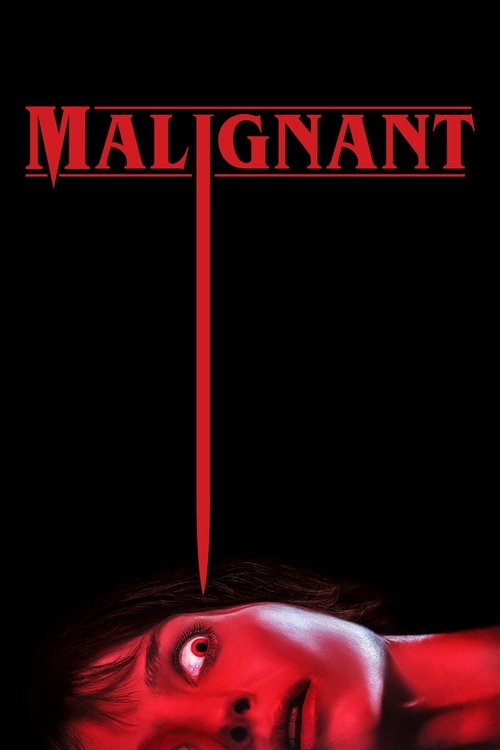
Malignant
2021 · James Wan
For a night when you want horror that's wild rather than bleak — a go-for-broke ride to watch with friends who'll yell at the screen. Not for the gore-averse, but a blast if you're in on the joke.
What it's about
Madison, a woman in Seattle recovering from a violent home life, begins having waking visions of brutal murders — and learns the killings are really happening, committed by someone with a mysterious connection to her childhood. As detectives close in and the body count rises, she has to dig into a past that was deliberately buried.
The experience
It starts as a glossy haunted-house-ish mystery, then accelerates into gleeful, gory delirium — the kind of film where you can feel the director having fun. By the final act it's operatic, absurd, and completely committed, and your jaw will be somewhere on the floor.
The craft
James Wan swings for the fences: swooping overhead camera moves that turn a house into a dollhouse, a killer realized through remarkable contortion-based physical performance and effects, and a blaring electronic score. It's lurid, saturated, and staged like a giallo crossed with a comic book — absolutely a loud-speakers, big-screen movie.
Why it matters
A major-studio director spending blockbuster capital on something this strange made it an instant cult object; initially divisive, it was quickly embraced as one of the decade's great bonkers studio horror swings and revived mainstream interest in giallo-flavored excess.
Snapshot
Malignant is James Wan's return to original horror after a decade spent building and supervising the most commercially successful horror franchise of the 2010s, the Conjuring universe. In between, he also directed the blockbusters Furious 7 (2015) and Aquaman (2018). The premise begins conventionally. Madison Mitchell (Annabelle Wallis), a pregnant woman in Seattle, survives a violent attack by her abusive husband. She then starts having waking visions of brutal murders and learns they are really happening. About two-thirds of the way through, the film turns into something else entirely. The killer, "Gabriel," turns out to be Madison's parasitic twin, a sentient mass fused to the back of her skull and brain, surgically reduced when she was a child. He takes over her body by walking it backwards, with his face showing through the back of her head.
The film is a deliberate pastiche of the Italian giallo, early Brian De Palma, and the body horror of the 1970s and 1980s, presented in the polished studio style Wan perfected at Warner Bros. When it came out in September 2021, during the pandemic, it opened in theaters and on HBO Max on the same day. Critics were sharply divided, audiences were often baffled, and the film quickly picked up a cult following. Its admirers treat it as a knowing exercise in excess, a big-budget studio film that commits fully to the logic of a midnight movie.
Industry & production
Malignant was produced by Wan's company Atomic Monster with Starlight Culture Entertainment and released by Warner Bros. Pictures. Atomic Monster had been the production engine behind the Annabelle films and The Curse of La Llorona (2019). Wan has said he made Malignant partly as a reaction to the franchise work: he wanted to make something with no ties to an existing property. The story is credited to Wan, Ingrid Bisu and Akela Cooper, and the screenplay to Cooper. Bisu, an actress and frequent Wan collaborator, also plays a supporting role as the lab technician Winnie.
Principal photography took place in Los Angeles in 2019, before Wan moved on to Aquaman and the Lost Kingdom. The story is set in Seattle, and locations such as the Seattle Underground tour figure in the plot. As far as the public record shows, most of the city is a constructed or stand-in Seattle of rain, brick and gaslit undercroft rather than location work.
The release was shaped by the COVID-19 pandemic. In 2021 Warner Bros. released its entire theatrical slate on HBO Max on the same day it opened in theaters. Malignant opened on September 10, 2021, under that arrangement. Its budget was reported at around $40 million, and its theatrical gross was modest. Much of its audience found it at home, which helped its later life as a film passed around by word of mouth. Distribution history matters here: a film that might have been written off as a theatrical disappointment in another year found its cult partly through streaming.
Technology
The film was shot digitally. Published technical detail about cameras and lenses is thin, and this dossier does not specify them. The key technical story is the mix of practical and digital effects used to create Gabriel. The contortionist and dancer Marina Mazepa performed much of Gabriel's physical movement, including the backward-walking, joint-reversed action and the fight choreography in the jail and police-station sequences. Her performance was combined with Annabelle Wallis's and with prosthetic and digital work to create the face set into the back of Madison's skull. Some of the movement is also enhanced by reversed or manipulated footage, an old trick (Jean Cocteau used it, and so did The Exorcist III's and The Ring's uncanny movers) that Wan revives here at blockbuster scale. Gabriel's voice was supplied by the voice actor Ray Chase, and it is heavily processed.
The vision sequences rely on digital compositing. In these sequences the walls and furniture of Madison's house melt or slide away, and the murder scene materializes around her so that she seems to stand in the room where the killing is happening. The effect plays as a spatial dissolve rather than a cut, and it is one of the film's signature devices.
Technique
Cinematography
The cinematographer, Michael Burgess, had previously shot The Curse of La Llorona for Atomic Monster. He gives Malignant a heightened palette borrowed from the giallo: saturated reds, sickly greens, sodium-orange street light and deep blue shadow. The opening at Simion Research Hospital, set in 1993, takes place in lightning-lit gothic corridors that recall Hammer and Universal more than modern realism.
Wan's habitual moving camera reaches a showpiece in an extended overhead shot. As Madison flees through her house, the camera glides above the set as if the house were a dollhouse with its ceiling removed, tracking her across rooms and over the tops of walls. It extends Wan's earlier fluid tours of haunted houses in The Conjuring (2013), and it treats domestic space as a diagram to be surveyed. The style also favors Dutch angles, push-ins on faces, and compositions that put darkness or doorways behind characters so that the frame invites the viewer to watch the background.
Editing
Kirk Morri, Wan's editor since Insidious: Chapter 2 (2013) and across The Conjuring, Furious 7 and Aquaman, cut the film. The editing has to serve two registers. For the first two acts it uses the measured build-up of the haunted-house film: long holds and delayed reveals. In the third act it switches to the rapid cutting of action cinema. The police-station massacre, in which Gabriel kills a holding cell full of women and then much of a station's staff, is cut like a martial-arts set piece and has been widely compared to the police-station attack in The Terminator (1984).
The reveal itself is structured as a cascade. A hospital video, a flashback and the first full view of Gabriel's face arrive close together. The editing gives the audience little time to reorient, and much of the film's divisive reputation rests on that abruptness.
Mise-en-scène / staging
The production design mixes the ordinary with the grand guignol. Madison's house is an old, creaking Seattle home, a familiar Wan setting. The abandoned Simion hospital on its cliff is a full gothic ruin. The Seattle Underground offers a buried city beneath the modern one, and it works as an architectural metaphor for the buried twin within Madison. The killer's look comes straight from the giallo: a long black coat, a featureless shadowed silhouette, and a weapon fashioned from a gold medical trophy. The bladed trophy pays obvious homage to the fetishized knives and gloved killers of Argento and Bava.
Staging repeatedly withholds the killer's face and stresses his strange gait, which plants the clue that Gabriel moves backwards. On a second viewing, many early scenes reveal their staging as deliberate misdirection.
Sound
Joseph Bishara composed the score. Bishara is a longtime Wan collaborator from Insidious (2010) and the Conjuring films, and he also played the "Lipstick-Face Demon" in Insidious. He moves away from the atonal drones of his earlier Wan scores toward a pulsing, synth-led sound with clear debts to 1980s horror scoring and to the progressive-rock and synth scores of the giallo tradition, Goblin's work for Argento above all. The soundtrack also features a slowed, eerie cover of the Pixies' "Where Is My Mind?", a choice that comments on the plot almost too directly.
The sound design gives Gabriel a crackling, electronic presence. He can manipulate electricity and speak through radios and phones, so electrical interference becomes his signature sound. Wan uses this sound the same way his haunting films use creaks and knocks: as a cue that something is present before anything is seen.
Performance
Annabelle Wallis, who had starred in Atomic Monster's Annabelle (2014), plays Madison as a classic final-girl victim for most of the film, and her performance is deliberately restrained and wounded. The role demands an unusual double performance. In the final act Wallis has to play Madison possessed: her body moves against its own will, sometimes in combination with Mazepa's contortion work. Maddie Hasson brings warmth and comic energy as Madison's sister Sydney, the film's real investigator and the emotional anchor of its final sibling bond.
George Young and Michole Briana White play the detectives Kekoa Shaw and Regina Moss in the brisk, slightly heightened manner of a procedural. Several critics read this deliberately broad or stilted dialogue and acting as either a flaw or a knowing imitation of the dubbed Italian thrillers the film emulates. Jacqueline McKenzie plays Dr. Florence Weaver, the surgeon whose 1993 line "It's time to cut out the cancer" anticipates the title. McKenna Grace appears in the 1990s flashbacks as the young Serena May, the adopted sister who becomes key to the backstory. Jean Louisa Kelly plays the adult Serena.
Narrative & dramatic mode
The film has the structure of a bait-and-switch. For roughly its first hour it presents itself as a psychic-link thriller in the line of Eyes of Laura Mars (1978): a woman sees through a killer's eyes, and the police suspect her. The assumed register is supernatural. "Gabriel" seems to be an imaginary friend from childhood, perhaps a ghost or a demon. The third act reframes everything as body horror with a medical explanation, however outlandish: Gabriel is a teratoma-like parasitic twin. Madison has not been witnessing the murders. Her body has been committing them while Gabriel controlled it and her consciousness was "elsewhere."
The film's mode is melodramatic excess, deliberately pitched. Exposition is delivered flatly, coincidences are taken for granted, and the tone shifts in ways that ask the audience to treat the film as a sincere homage to the logic of exploitation cinema rather than as a realist thriller. The closing movement turns the story into a narrative of recovery. Madison reclaims control of her own body, states that she is in control now, and chooses Sydney, the sister she was given rather than the twin she was born with. The ending folds a story about abuse and bodily autonomy into the monster plot.
Genre & cycle
Malignant sits where several genres and cycles meet:
- The giallo. The black-coated killer, the ornate weapon, the saturated color, the mystery framing and the psychiatric backstory all come from the Italian thriller tradition of Mario Bava, Dario Argento and their imitators.
- De Palma's psycho-thriller. Sisters (1972), about separated conjoined twins, one of whom is murderous, is the most direct ancestor. De Palma's split diopters, voyeurism and Hitchcock homage are echoed throughout.
- Body horror. David Cronenberg's films about bodies that rebel against their owners (The Brood, 1979; Dead Ringers, 1988) and Frank Henenlotter's Basket Case (1982), whose separated deformed twin murders on his brother's behalf, are clear precursors. Henenlotter's Brain Damage (1988), with its parasite controlling a human host, is another reference point that critics frequently cited.
- The possession film and Wan's own haunted-house cycle, whose conventions the film first imitates and then overturns.
Its release came during a period of "elevated" or prestige horror dominated by A24 and similar companies, which favored slow, allegorical approaches. Malignant was widely read as a deliberate counter-move: a loud, gory, campy genre film made at studio scale.
Authorship & method
James Wan's authorship runs through the whole film. His recurring signatures appear in full:
- an elaborately moving, often overhead or long-take camera
- the house as a terrain to be mapped
- a fascination with dolls, puppets and the uncanny body, from Saw (2004) and Dead Silence (2007) onward
- jump scares with careful timing
Malignant also brings back the ingenious, twist-driven plotting of Saw and the B-movie playfulness of Dead Silence, which the more earnest Conjuring films had largely set aside. Wan has spoken of the film as a tribute to the genre films he grew up loving, and that explains its open quotations.
Key collaborators:
- Akela Cooper (screenplay; story with Wan and Bisu) came from television, including Grimm, Luke Cage and The 100, and had co-written Hell Fest (2018). Her pulpy, high-concept sensibility, later seen in M3GAN (2022), which she wrote from a story by Wan and Cooper, suits the film's mix of camp and sincerity.
- Ingrid Bisu (story; actress) shared in developing the original concept.
- Michael Burgess (cinematography) brought an Atomic Monster house style pushed toward giallo saturation.
- Kirk Morri (editing) is Wan's most constant collaborator, and he balances the film's horror and action registers.
- Joseph Bishara (music) shifts Wan's sound from drone to synth homage.
The film was produced by Wan with Michael Clear of Atomic Monster. Wan's protected position after Aquaman almost certainly explains why a major studio funded such an unconventional original project. That point is an inference, though it is consistent with Wan's own statements about the creative freedom he was allowed.
Movement / national cinema
Malignant is an American studio film. Its creative reference points, however, are notably international, which is typical of Wan's career. Wan was born in Malaysia and raised in Australia, and he emerged from the Australian genre scene with Leigh Whannell before Saw launched them both in the American market. The film's strongest stylistic debt is to Italian popular cinema of the 1960s through the 1980s. The giallo's long afterlife in international filmmaking includes Hélène Cattet and Bruno Forzani's Amer (2009), Peter Strickland's Berberian Sound Studio (2012) and Edgar Wright's Last Night in Soho (2021), released the same autumn. Malignant belongs to this neo-giallo revival, though it is louder and more commercial than most of it.
The film does not belong to a national movement in the strict sense. It is better described as a product of the transnational genre-auteur system Wan himself helped shape, in which directors trained on low-budget horror move into studio franchise work and back again.
Era / period
The film belongs to a specific moment. It was released during the pandemic's disruption of theatrical exhibition, under Warner Bros.' one-year experiment with simultaneous streaming. It also came at the height of the "Conjuring universe," whose success had made Wan one of the most commercially reliable figures in the genre. It sits against the late-2010s and early-2020s divide between prestige "elevated horror" and franchise studio horror, and it rejects both: it is neither allegorical restraint nor sequel.
Within the fiction, the 1993 prologue and its VHS-style hospital footage point to the analog era of medical oddity and video horror, and Gabriel's electrical, radio-transmitted voice gives the film a quasi-technological uncanny that also feels mid-century.
Themes
- Bodily autonomy and violation. The film opens with Madison suffering domestic violence and miscarriages. The violent husband is killed early, and it is Gabriel who kills him. In horror terms the film is about a woman whose body is not her own, controlled by an abusive male presence that lives inside her. The ending, in which Madison takes back control of her body, reads as a story of survival.
- The double and the split self. Twins, parasitic twins and the hidden other self link the film to the long tradition of the doppelgänger, from Poe and Stevenson through Sisters and Dead Ringers. The title refers both to the "cancer" Dr. Weaver cut out and to an inner malignancy that cannot be removed.
- Chosen family versus blood. The relationship between Madison and Sydney, her adoptive sister, drives the climax. Madison's final rejection of Gabriel ("You're not my family") puts emotional ties above biological ones.
- Medicine and the monstrous body. The film draws on the long horror tradition of medical institutions that experiment on and conceal abnormal bodies, and it uses the teratoma, a real medical phenomenon, in deliberately fantastical ways. The trophy-knife, fashioned from a medical award, sharpens the film's suspicion of medicine's authority.
- Memory and repression. Madison has repressed both Gabriel and her birth mother. The plot is an excavation of the past, made literal in the descent into the Seattle Underground.
Reception, canon & influence
Critical reception. Reviews were sharply divided. Critics who disliked it found the dialogue clumsy, the acting stiff and the plot absurd. Its champions argued that these qualities were deliberate effects of a homage to giallo and exploitation cinema, and that the third act was among the most audacious sequences in recent studio horror. Many reviews, positive and negative, described it as "bonkers," "unhinged" or similar. Opening-weekend audiences were reported to give it a poor CinemaScore grade (a "D"), a sign of how much the film's tonal shift alienated viewers expecting another Conjuring. Within months, though, a strong online fan base had formed around it, and lists and retrospective essays began calling it a modern cult classic. Its standing has generally improved since release. As of this writing it has no settled place in the critical canon, but it is regularly cited among the best-loved horror films of its period by genre-focused writers and audiences.
Influences on the film (backward). The documented and widely acknowledged influences include:
- Mario Bava and Dario Argento's gialli for color, killer iconography and murder-set-piece structure
- Brian De Palma's Sisters (1972) for its separated-twins premise and psycho-thriller style
- Frank Henenlotter's Basket Case (1982) and Brain Damage (1988) for the parasite-companion killer
- David Cronenberg's body horror for the rebellious flesh
- Irvin Kershner's Eyes of Laura Mars (1978) for the psychic witness to murders
- The Terminator (1984) for the police-station massacre
- Wan's own filmography, especially Dead Silence and Saw, for the twist structure and puppeteer imagery: Gabriel, after all, operates Madison's body like a marionette
Legacy (forward). It is too early to trace firm lines of influence, and the record does not support strong claims of direct imitation. Three things can be said:
1. The film became a reference point in discussions of "maximalist" or deliberately excessive studio horror, and it is often invoked alongside other twisting, tonally unstable horror films of the early 2020s. 2. Its creative partnership continued. Akela Cooper's next produced screenplay for Atomic Monster, M3GAN (2022), carried forward its blend of camp, horror and knowing humor to substantial commercial success. 3. Its cult afterlife, with fan art, cosplay and memes of Gabriel's backward gait and the "head reveal," shows how streaming-era releases can turn an initial theatrical disappointment into a lasting following.
In the Sightlines map, Malignant sits at a junction where the giallo, De Palma's psycho-thriller and 1980s body horror feed into 21st-century studio horror. It shows that the corporate franchise system that produced the Conjuring universe could also, at least once, support a defiantly strange original.
Influences: the films it descends from and the films it influenced
- Sisters (1972) — The source of the premise: a surgically separated twin who goes on living through the surviving sibling, with De Palma's misdirection about who the killer is that *Malignant* copies in its withheld-identity structure.
- Basket Case (1982) — A deformed twin cut away against its will hunts the doctors who performed the separation, which is exactly the revenge plan Gabriel carries out against Dr. Weaver's team.
- Brain Damage (1988) — A parasite fused to its host's brain stem that feeds it and steers its body supplies Gabriel's biology: a second mind wired into Madison's head that takes over her motor control.
- The Brood (1979) — Cronenberg turns repressed trauma into physical offspring that kill on the host's behalf, the body-horror logic behind Gabriel as Madison's suppressed flesh rebelling.
- Eyes of Laura Mars (1978) — A heroine who sees murders from the killer's point of view as they happen; Wan stages Madison's version by dissolving her room into the crime scene around her.
- Blood and Black Lace (1964) — Bava's faceless killer in black coat and gloves, lit with saturated red and green gels, is the template for Gabriel's costume and the film's color scheme in its murder scenes.
- Deep Red (1975) — Argento hides the killer's identity in plain sight inside the frame and backs it with Goblin's prog-rock synths, both of which shape *Malignant*'s reveal and Joseph Bishara's score.
- Tenebre (1982) — Its famous Louma-crane shot that roams over and around a house's exterior is the model for Wan's overhead camera moving through Madison's home as if it were a dollhouse with the roof off.
- Raising Cain (1992) — De Palma's late split-personality thriller, with John Lithgow playing several warring selves including an evil twin, uses the narrative fake-outs that *Malignant* treats as a rule of the genre.
- The Terminator (1984) — The single unstoppable killer wiping out a police station is restaged almost shot for shot in Gabriel's holding-cell massacre.
- Saw (2004) — Wan's own last-minute twist, where the 'corpse' in the room was the killer all along, is the template for hiding Gabriel inside the protagonist's body.
- Dead Silence (2007) — Wan's ventriloquist-dummy horror sets up the puppeteer imagery that pays off when Gabriel works Madison's body like a marionette.
- M3GAN (2022) — Akela Cooper's next Atomic Monster script, from a story by Wan and Cooper, carries over the camp-sincere tone and the killer's uncanny, physically performed movement (Amie Donald's doll body, like Marina Mazepa's contortionist Gabriel).
- The Substance (2024) — A second, rival self tears out of the host's spine through practical-effects body horror, extending *Malignant*'s image of the parasitic twin living in the back of the body.
- Insidious (2010) — Same director and same composer: Joseph Bishara's dissonant score and Wan's long gliding tracking shots through a house the camera maps room by room.
- Possessor (2020) — A body piloted from inside by a second consciousness, with practical in-camera effects showing the struggle for control of one physical form, much as Gabriel commandeers Madison.
- Barbarian (2022) — An abrupt mid-film switch of tone and story that pulls the rug out from under the audience, the same studio-horror gamble *Malignant* made with its third-act turn.
- X (2022) — Mia Goth plays both the heroine and her monstrous double under heavy prosthetics, the one-actor dual role *Malignant* builds with Annabelle Wallis and the Gabriel performers.
- Evil Dead Burn (2026) — Deploys the camera as a mobile predatory force and treats sound design as the primary scare engine, extending the Raimi force-cam grammar into modern studio horror.
- The Conjuring (2013) — Wan extends his own craft — the overhead gliding long take (the top-down house-plan tracking shot) and a practical body-horror creature — pushing the in-camera camera-choreography of The Conjuring to a formal extreme.
- Last Night in Soho (2021) — A deliberate giallo revival using neon lighting and a body/identity twist — a parallel modern reanimation of Argento's palette and reveal mechanics arriving the same year.
Similar films
- Saw (2004) — influence & lineage
- X (2022) — influence & lineage
- Strange Darling (2024) — shared sensibility
- Teenage Sex and Death at Camp Miasma (2026) — shared sensibility
- Insidious (2011) — shared sensibility
- Final Destination Bloodlines (2025) — shared sensibility
- The House That Jack Built (2018) — shared sensibility
- Smile (2022) — shared sensibility