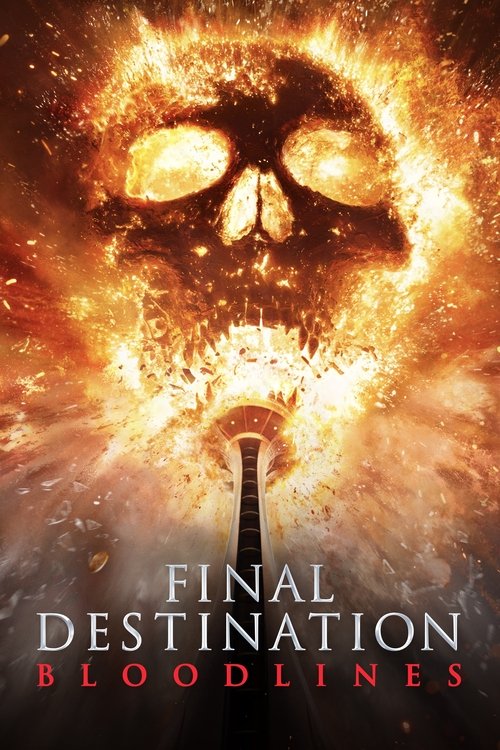
Final Destination Bloodlines
2025 · Zach Lipovsky
When you want a rollercoaster horror night with friends — jumpy, gory, and fun rather than bleak. Reach for it when you're craving suspense you can yell at the screen about, not a film that leaves you depressed.
What it's about
A college student is tormented by a violent recurring nightmare of a disaster that happened decades before she was born. Tracing it back to her own family, she discovers they've been living on borrowed time — and that Death has a ledger to balance. To save the people she loves, she has to figure out how the cycle works before it works its way down the bloodline.
The experience
Tense and gleefully sadistic in equal measure — every mundane object becomes a suspect, and the film milks agonizing suspense out of ceiling fans, lawn mowers, and family dinners before paying off with gory, over-engineered catastrophe. You wince, you laugh, you grip the armrest, repeat.
The craft
The franchise's signature is the Rube Goldberg death sequence, and this entry stages them with real patience — long, teasing setups where the camera lingers on every hazard, misdirecting you about which one will actually fire. Opening on a spectacular 1960s-set disaster gives it a period sheen the series never had. It's built for a crowd and a big screen, where the collective flinching is half the fun.
Why it matters
Reviving a franchise dormant for fourteen years, it became one of 2025's big horror success stories and the series' best-received entry — proof that a simple, elastic premise about cheating Death still has cultural teeth.
Horror · Splatter & gore · Suspense & terror. Death stalks a family via ceiling fans and lawn mowers — gory, gleeful Rube Goldberg kills built to make a crowd flinch, then laugh.
Snapshot
Final Destination Bloodlines is the sixth entry in the Final Destination series and the first in fourteen years, arriving well over a decade after Final Destination 5 (2011). Released through New Line Cinema and Warner Bros. in May 2025, it revived a dormant franchise built on a single, elastic premise: a character foresees a mass-casualty disaster, averts it, and thereafter Death "corrects" the ledger by killing the survivors in baroque, causally over-engineered accidents. One production note deserves correction up front, because the assignment lists a single director: the film was co-directed by Zach Lipovsky and Adam B. Stein, the filmmaking duo behind the well-regarded low-budget science-fiction film Freaks (2018). Treating Lipovsky as sole author misstates the record. The film is also widely noted as the final screen appearance of Tony Todd, the series' recurring mortician-oracle William Bludworth, who died in late 2024. Beyond that, the picture reframes the franchise's usual "strangers connected by a premonition" structure as a multigenerational family curse, giving the death-cheating mythology an inherited, bloodline logic its title announces.
Industry & production
Bloodlines is a legacy-sequel/soft-reboot of a property that had lain fallow since 2011. The franchise began at New Line Cinema in 2000, and by the 2020s New Line sat within Warner Bros. Discovery, which developed Bloodlines with a theatrical release strategy rather than routing it to streaming — a meaningful choice given that Warner had, in the same era, sent some genre titles to Max. The commercial logic proved sound: the film was widely reported as a strong performer and, by press accounts, the highest-grossing installment in franchise history, an outcome credited to nostalgia demand, a long absence that made the return feel like an event, and horror's reliable theatrical economics. I don't have verified exact box-office figures to cite here and will not invent them; the safe, supportable claim is that it was received as a significant commercial success. Story credit involves Jon Watts — the Spider-Man: Homecoming/Far From Home/No Way Home director — who is reported to have helped originate the concept, with a screenplay by Guy Busick and Lori Evans Taylor. Busick's presence connects the film to the contemporary studio-horror revival, as he was a writer on the Scream relaunch films.
Technology
The film was produced and finished digitally, consistent with contemporary studio horror. The Final Destination series' signature has always been its set-piece "accidents," and the technological interest of Bloodlines lies in how those sequences are assembled: a hybrid of practical mechanical effects, stunt work, physical gags, and digital augmentation/compositing to extend or complete gore beats that cannot be performed safely or repeatably on set. The series' aesthetic historically prizes the appearance of physical cause and effect — liquid, glass, fire, torque, gravity — so the technology serves an illusion of unbroken mechanical causality even when individual links are digital. I don't have a verified breakdown of specific vendors or a documented practical-versus-CGI ratio for this installment and won't fabricate one; the general approach follows franchise convention.
Technique
Cinematography
The cinematography is credited to Christian Sebaldt, a veteran of episodic television and genre features. The franchise's visual grammar is functional and legible above all: the camera must plant every hazard in a scene clearly enough that the audience registers it as a potential instrument of death, then withhold which hazard will actually "fire." This produces a characteristic style of pointed coverage — insert shots of dripping fluid, loose fixtures, spinning blades, frayed cable — that turns ordinary spaces into fields of Chekhovian threats. The 1968-set prologue, staged in an elevated revolving-restaurant tower, calls for a more elevated, vertiginous compositional register than the series' usual suburban settings, exploiting height and glass for dread.
Editing
Editing is the true engine of a Final Destination film, arguably more than in most horror. The set pieces operate on misdirection: the cut must chain a long series of small mechanical causes so the viewer is invited to "solve" the accident in advance, guessing which object kills, while the montage repeatedly feints toward a red herring before delivering the real mechanism. This premeditation-and-swerve rhythm is the franchise's authorial fingerprint at the level of cutting. I don't have the editor's name verified to the standard this dossier requires and will not guess at an attribution.
Mise-en-scène / staging
The series' defining formal idea is environmental: every location is pre-loaded with instruments of death, and the staging distributes those instruments across the frame so that the eventual kill feels both surprising and, retrospectively, inevitable. Bloodlines extends this to the family home and to the period tower of its prologue, converting domestic and civic spaces into lethal machines. The production design's job is to make hazards read as ambient and ordinary until they activate — the aesthetic of the everyday turned homicidal.
Sound
Sound design in the franchise performs a specific narrative function: it isolates and amplifies the small acoustic cues — a creak, a drip, a hiss of gas, a metallic strain — that flag the coming accident, training the audience to listen for danger the characters ignore. The score is credited to composer Tim Wynn. As with prior entries, music tends to alternate between stalking, suspense-building cues during the "assembly" of each death and sharp stingers at the moment of execution.
Performance
The ensemble is led by Kaitlyn Santa Juana as Stefani, the college-student protagonist who inherits the premonition-driven predicament through her family line, with a supporting cast including Teo Briones, Richard Harmon, Owen Patrick Joyner, Anna Lore, and Brec Bassinger (as the younger version of the family's originating survivor, Iris), among others. The performance the film is most identified with, however, is Tony Todd's. His William Bludworth appearance carries a documented poignancy: Todd was terminally ill during production and died before release, and multiple reports describe his scene as drawing on his own valediction, giving a series stock figure — the ominous coroner who explains Death's rules — an unusual real-world weight.
Narrative & dramatic mode
Structurally, Bloodlines is a variation on a rigid franchise template: premonition → aversion → a survivor "list" that Death works through in order → attempts to break or cheat the pattern. Its innovation is to make the list a family. Where earlier films assembled strangers linked only by proximity to a disaster, Bloodlines threads the curse down a bloodline, so the deaths become an inheritance and the prologue's 1968 survivor becomes the origin point of a genealogical debt. This shifts the dramatic mode from the earlier films' near-anthological "who's next" suspense toward something closer to a family tragedy, with the protagonist's quest — return home, find the one person who understands the pattern, protect kin — foregrounding lineage and legacy. The mode remains fundamentally suspense-comic: the pleasure is dramatic irony (the audience sees the trap assemble) laced with gallows humor, a tone the series has always cultivated.
Genre & cycle
The film sits at the intersection of the "elaborate death-trap" horror subgenre the Final Destination series essentially defined and the 2020s cycle of legacy horror sequels reviving 1990s–2000s brands (the Scream relaunch, Halloween, Candyman, Evil Dead). Within horror taxonomy it is distinctive for having no embodied slasher: the antagonist is Death itself — an invisible, systemic force — which places the films closer to a supernatural-fate tradition than to the masked-killer slasher, even though they inherit the slasher's serial-victim structure and setpiece kills. Bloodlines also participates in horror's broader turn toward "generational trauma" framings, literalizing inherited doom as a hereditary curse.
Authorship & method
The authorial signature here is dual and collaborative. Directors Zach Lipovsky and Adam B. Stein came from a genre-inventive independent background (Freaks), and the franchise itself imposes a strong template that constrains and shapes any director's contribution: the "premonition set piece," the ordered kill-list, the recurring Bludworth figure, the misdirection-driven death choreography. Key collaborators include cinematographer Christian Sebaldt, composer Tim Wynn, and screenwriters Guy Busick and Lori Evans Taylor, with story involvement from Jon Watts. The franchise's originating authorship is worth naming for context: the series sprang from a spec script by Jeffrey Reddick (developed from an idea he first conceived as an X-Files spec), and the first film was directed and co-written by James Wong with Glen Morgan — both alumni of The X-Files and Millennium — whose sensibility gave the franchise its fatalistic, quasi-metaphysical premise. Bloodlines' "method" is therefore less a matter of individual auteur vision than of executing and refreshing an established machine, with the directing duo's task being to make the sixteenth-year revival feel both faithful and new.
Movement / national cinema
This is a mainstream American studio production (New Line/Warner Bros.), squarely within Hollywood commercial horror rather than any art-cinema movement. Its relevant "movement" context is industrial: the 2020s legacy-sequel strategy by which major studios mine dormant intellectual property from the late-1990s/2000s horror boom. Production is understood to have used North American (reportedly Canadian) facilities and crews, consistent with contemporary studio genre filmmaking, though I don't have verified location details to specify beyond that general practice.
Era / period
Bloodlines is a 2025 film that is deliberately bi-temporal: its framing prologue is set in 1968, at the opening of a modernist revolving-restaurant tower, while its main action is contemporary. That period prologue is thematically load-bearing — it establishes the moment the curse is "born" and lets the film reach back across half a century of a family's history, making time and inheritance part of the subject rather than mere backdrop. The film's release era also matters: it lands within a post-2020 exhibition landscape in which horror was one of the few genres reliably drawing audiences back to theaters, and its success reads partly as a statement about the enduring theatrical viability of the brand.
Themes
The franchise's core theme is fate versus agency — the futility, or not, of cheating a predetermined design — and Bloodlines sharpens it into questions of inheritance and family debt: what is passed down a bloodline, whether the sins or salvations of a grandparent bind their descendants, and whether protecting one's family can break a cycle or merely defer it. Adjacent themes include mortality made mechanical (death as an impersonal system of cause and effect rather than a moral agent), the anxiety of the ordinary (the everyday environment as a latent death-trap), and, inflected by Tony Todd's real circumstances, a meta-textual meditation on death and farewell that the film's audience read against the actor's own passing. The series has always treated the audience's foreknowledge as a theme in itself — we, like the premonition-cursed characters, are made to see death coming and are powerless to stop it.
Reception, canon & influence
Critically, Bloodlines was received as one of the stronger entries in the series — praised for the ingenuity and wit of its set pieces, for its emotional grounding in the family premise, and for the poignancy of Todd's send-off, though reviews within the franchise's established idiom rather than transcending it. I'll flag that I don't have verified aggregate critic scores or specific quotations to cite, and I won't fabricate them; the supportable summary is a generally favorable-to-warm reception unusually strong for a sixth franchise installment.
Influences on the film (backward): it inherits directly from the 2000 original's fate-and-design premise, from the X-Files/Millennium fatalism of James Wong and Glen Morgan, and from Jeffrey Reddick's originating conceit. Its Rube Goldberg death choreography descends from a longer tradition of cinematic mechanical-causality suspense; the "premonition disaster set piece" that opens each film is itself the series' most-imitated formal invention. The legacy-sequel framing borrows from the contemporaneous Scream revival (sharing writer Guy Busick), Halloween, and Candyman — the last of which also centered Tony Todd, linking the two threads of his late career.
Legacy / what it shaped (forward): as a commercial success reviving a fourteen-years-dormant brand, Bloodlines is likely to be cited as evidence for further franchise continuation and for the broader viability of long-gap horror legacy sequels. Its most durable cultural marker will almost certainly be its status as Tony Todd's final performance, cementing the William Bludworth figure — and Todd's association with it — in horror memory. Any longer-term influence on the genre remains, as of this writing, too recent to assess, and I won't overstate it.
A Deleuzian reading
The room turns.
The full Deleuzian reading of Final Destination Bloodlines →
Reception
Greeted with 'do we really need this?' legacy-sequel skepticism after a 14-year franchise gap, it landed as the best-reviewed AND highest-grossing Final Destination ever — the rare part six that critics, fans, and the box office all agreed on.
How Final Destination Bloodlines was received, from release to now →
How to watch Final Destination Bloodlines: what to notice on a first viewing
- Notice a close-up on a frayed cable or loose fixture. The camera repeatedly cuts to ordinary objects, dripping fluid, spinning blades, loose parts, turning every room into a field of small planted threats. You start reading every object on screen as a possible weapon before anything has actually gone wrong.
- Listen for a creak or hiss just before a close call. Small sound cues, a metallic strain, a gas hiss, a drip, flag the coming accident well before the characters ever notice them. You are trained to hear danger the people on screen are ignoring.
- Watch the restaurant floor slowly rotate on its own. The period prologue is staged high above the ground in a tower with glass on every side, using height and exposure for dread instead of the series' usual suburban setting. The vertigo of the location does the work a jump scare would elsewhere.
- Watch the editing point you toward the wrong object. The cutting builds a chain of small mechanical causes and repeatedly feints toward one likely culprit before revealing a completely different actual mechanism. The film lets you feel like you solved the puzzle and then proves you were looking at the wrong clue.
- Notice how ordinary and lived-in each room looks at first. Every location is loaded with potential hazards distributed quietly across the frame, so a kitchen or a garage reads as safe until it suddenly doesn't. The everyday setting itself becomes the threat, not any single villain standing in it.
The whole guide to watching Final Destination Bloodlines, with the keys for a rewatch →
Influences: the films it descends from and the films it influenced
- Final Destination (2000) — Establishes the franchise's core formal invention that Bloodlines executes: the opening premonition set piece that previews a mass-casualty disaster, then structures the film as an ordered kill-list working through survivors in the sequence Death 'intended.'
- The Omen (1976) — Pioneers the elaborate freak-accident death as standalone spectacle — the pane-of-glass decapitation and lightning-rod impalement — engineering mundane environmental objects into balletic, over-determined killings rather than knife-in-hand murders.
- The Wages of Fear (1953) — Founds the mechanical-causality suspense grammar Bloodlines inherits: sustained dread built from physics and inanimate hazards (fluid, pressure, friction, weight) where the audience tracks a chain of cause-and-effect toward catastrophe.
- Psycho (1960) — Models the misdirection-editing and protagonist-expendability the series lives on — cutting so the viewer anticipates one threat while the fatal one arrives from an unexpected vector, and killing 'safe' characters against genre expectation.
- Deep Red (1975) — Supplies the giallo tradition of baroque, pre-choreographed murder set pieces staged as suspense puzzles, where the camera surveys a space cataloging every object that will later become an instrument of death.
- Jaws (1975) — Perfects Chekhovian hazard coverage — deliberately planting mundane objects and off-screen threats in early framing so their later lethal payoff feels both shocking and pre-ordained, the exact coverage logic Bloodlines uses to seed its traps.
- Candyman (1992) — Establishes Tony Todd's mythic, sonorous reciter-of-doom persona — the calm figure who narrates the rules of an inescapable supernatural death — directly feeding his William Bludworth role and making Bloodlines his valediction.
- Final Destination 2 (2003) — Extends the same craft by refining the interlocking-causality set piece (the Route 23 logging-truck pileup) and formalizing the retroactive rule that deaths ripple back through the survivor chain, a mechanic Bloodlines reworks via bloodline inheritance.
- Final Destination 5 (2011) — Sibling entry that sharpens the misdirection-death-chain into red-herring engineering (the gymnastics and Peace Bridge sequences) and pioneers the franchise's temporal-loop twist, the structural template Bloodlines' bi-temporal 1968 prologue answers.
- Saw (2004) — Parallel death-trap horror that mechanizes lethality into Rube Goldberg apparatuses with no embodied killer required, sharing Bloodlines' fascination with the room-as-machine and the victim's futile agency against a pre-set design.
- It Follows (2014) — Sibling in the no-embodied-slasher mode: a rule-bound, inexorable force that pursues victims in inherited sequence, dramatizing fate-versus-agency through mechanics rather than a masked figure — the same abstract-antagonist design Death embodies.
- Scream (2022) — Direct legacy-sequel-cycle sibling sharing screenwriter Guy Busick, whose method of reviving a dormant franchise by fusing a new bloodline of characters to legacy mythology structures Bloodlines' generational-inheritance framing.
- Halloween (2018) — Provides the long-gap legacy-sequel template Bloodlines follows — reactivating a dormant brand through a multigenerational family line and a returning icon, treating inherited trauma as the engine that reopens the cycle.
Similar films
- Scream (2022) — influence & lineage · same viewing thread
- Final Destination (2000) — influence & lineage
- Final Destination 3 (2006) — same viewing thread
- The Conjuring: Last Rites (2025) — same viewing thread
- Five Nights at Freddy's (2023) — same viewing thread
- Malignant (2021) — same viewing thread
- Saw II (2005) — same viewing thread
- Scream VI (2023) — same viewing thread
All the films related to Final Destination Bloodlines →
Watch it with: curated runs of related films
- Fresh Blood: 2020s Studio Horror — A run of the decade's mainstream fright machine — abduction shockers, franchise revivals, and one arthouse throwback — best watched back-to-back to feel how modern horror hunts its prey.
- Blood by the Bucketload — A run of horror that treats gore as showmanship: elaborate death set-pieces, practical effects by the gallon, and the giddy, squirming fun of watching it with a crowd, from Jigsaw's traps and Final Destination's chain reactions to Ready or Not's wedding-night bloodbath and The Substance's body-horror finale.