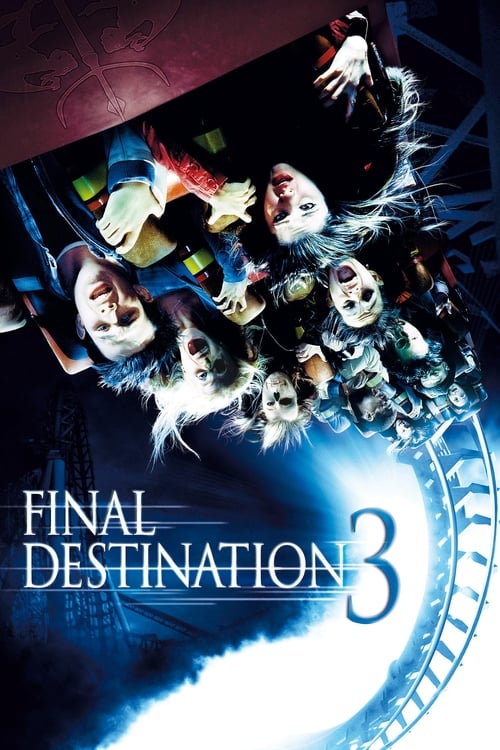
Final Destination 3
2006 · James Wong
For when you're craving a rollercoaster in movie form — jump-and-groan horror that's more fun than frightening, ideal with friends who like to shout predictions at the screen.
What it's about
On graduation night at an amusement park, high-school senior Wendy has a vivid premonition of a catastrophic rollercoaster derailment and panics, getting herself and a handful of classmates off the ride before it kills the rest. But death doesn't accept substitutions — one by one, the survivors start dying in freak accidents, and Wendy realizes the photos she took that night may hold clues to how each of them goes.
The experience
A tense, gleefully nasty machine — every ordinary space becomes a Rube Goldberg deathtrap you scan for hazards, and the film knows you're doing it. It's grim and darkly funny in equal measure, with real squirm-in-your-seat suspense before each payoff.
The craft
Series creators James Wong and Glen Morgan returned to their own formula and sharpened it, with the photographs-as-omens conceit giving each death sequence the structure of a puzzle. The accident set pieces are engineered with sadistic precision — suspense built from tanning beds, nail guns, and everyday objects framed like loaded weapons.
Why it matters
The installment that re-centered the franchise on its original creators and cemented the series' signature contribution to 2000s horror: death itself as the unkillable slasher, and the elaborate accident chain as a set-piece form.
Horror · Teen horror · Splatter & gore · Slasher. Teens who dodge a rollercoaster crash meet engineered everyday accidents: gleefully nasty set pieces, more fun than frightening.
Snapshot
Final Destination 3 is the third installment in New Line Cinema's Final Destination franchise, and the one in which the series' creators returned to steer it back toward its origins. Directed by James Wong and co-written by Wong with his longtime creative partner Glen Morgan — the same duo responsible for the 2000 original — the film restages the franchise's foundational premise on a rollercoaster rather than an airplane. High-school senior Wendy Christensen experiences a premonition of a catastrophic derailment on the "Devil's Flight" coaster at a graduation-night fair, panics, and gets herself and several classmates ejected from the ride before it kills those who remain. Death, cheated of its design, then works methodically down the list of survivors. The distinguishing formal conceit is that Wendy has photographed her friends throughout the evening, and those snapshots encode, in their composition and incidental detail, the manner of each impending death. Released in February 2006 by New Line, the film was a solid commercial performer and hardened the franchise's identity as a series of elaborate, Rube-Goldberg death set-pieces organized around a supernatural-fatalist premise.
Industry & production
The film sits inside New Line Cinema's most reliable horror property of the 2000s. The franchise had been conceived by Jeffrey Reddick, whose original concept reportedly began life as a spec script for The X-Files before being developed into a standalone feature; that lineage matters because Wong and Morgan were themselves X-Files and Millennium alumni, and the tonal DNA of those shows — procedural dread, cosmic malevolence rendered through everyday objects — runs through the whole series. Wong and Morgan launched the franchise in 2000, sat out David R. Ellis's Final Destination 2 (2003), and returned for the third film, which gave FD3 the character of an authorial reset by the originators rather than a work-for-hire sequel.
New Line positioned it as a mid-budget genre release aimed squarely at the teen-horror audience that had sustained the first two films on home video as much as in theaters. Precise budget and grosses should be treated cautiously, but the film is generally understood to have been produced economically and to have returned a comfortable multiple of its cost in worldwide theatrical release, consistent with the franchise's reputation as a dependable earner. The DVD release is a notable industry artifact in its own right: New Line issued a "Thrill Ride Edition" featuring a branching "Choose Their Fate" interactive mode that let viewers make choices altering certain outcomes — a gimmick that both exploited the disc format's capabilities and literalized the series' fatalism-versus-agency theme as a marketing hook.
Technology
Final Destination 3 was made at the transitional moment when digital compositing had become routine for horror set-pieces but the format of capture remained photochemical. The film was shot on 35mm and relies on a hybrid effects methodology: practical mechanical rigs, prosthetics, and physical stunt work for the moment-to-moment carnage, augmented and stitched together with computer-generated imagery for the impossible camera moves, the rollercoaster catastrophe, and the connective "engineering" that makes each death machine legible. The opening premonition — the coaster derailment — is the film's most CGI-dependent sequence, a virtual-camera showcase of the kind that early-2000s digital tools had made affordable at this budget tier. Elsewhere the technology is deliberately invisible: the tanning-bed sequence, the hardware-store and drive-thru deaths, and the nail-gun material depend on the seamless marriage of on-set practical gags with digital cleanup and enhancement. The interactive DVD, discussed above, is also a technological signature of the moment — a use of DVD branching authored specifically to the property's premise.
Technique
Cinematography
Cinematographer Robert McLachlan photographs the film in the clean, high-key, slightly heightened idiom of mid-2000s studio horror: legible, brightly lit spaces punctuated by set-pieces that turn ordinary environments — a gym, a tanning salon, a home-improvement store, a fast-food drive-thru — into arenas of suspense. The camera's key rhetorical device is anticipatory movement: it prowls a location before a death, isolating the mundane objects (a loose screw, a pooling liquid, a frayed cable) that the audience learns to read as instruments. This "menace-in-the-mundane" coverage is the visual grammar the franchise had established, and McLachlan executes it with a crispness that makes the environmental cause-and-effect readable. The premonition sequence, by contrast, is shot to feel unstable and vertiginous, using the freedom of virtual camerawork to convey the coaster's kinetics.
Editing
Editing is arguably the franchise's central craft, and in FD3 the death set-pieces are constructed as suspense montages built on misdirection. Chris Willingham's cutting withholds and redistributes information: it teases multiple potential mechanisms of death within a single scene, letting the audience's dread attach to the wrong hazard before the actual chain resolves — often through the object least foregrounded. The rhythm is deliberately protracted, stretching the interval between the first ominous detail and the fatal payoff so that tension accrues. The photographs provide a second editorial layer: the film cross-references Wendy's snapshots against unfolding events, so that editing becomes a puzzle mechanic in which images planted earlier are "solved" as each death arrives.
Mise-en-scène / staging
The staging philosophy is essentially that of the elaborate trap. Each death is a designed apparatus in which set decoration is causally loaded — every prop in frame is a potential link in a lethal chain, and the pleasure (and dread) lies in not knowing which. The film stages its most discussed sequence in a tanning salon, where malfunctioning equipment, a fallen shelf, and a jammed mechanism combine; the composition of the space is engineered so that the calamity feels both arbitrary and, in retrospect, inevitable. This is mise-en-scène as mechanism: rather than expressing psychology, the arrangement of objects expresses fate's design.
Sound
Shirley Walker's score is a significant element and carries real franchise weight — Walker composed for all three of the first films, giving the series a rare continuity of musical voice across a change of directors. Her writing leans on orchestral tension-building and a recognizable motific menace, cueing the audience to Death's presence. The film also uses sound design in the franchise's characteristic way: small diegetic noises — a creak, a drip, a mechanical whir — are foregrounded as harbingers, training the ear to treat ambient sound as threat. Walker's involvement gives the film an additional, somber historical resonance, as she died later in 2006, making the Final Destination films among her final major scoring credits.
Performance
The performances are pitched to the genre's requirements: legible, sympathetic types who function as the audience's proxies in reading and resisting Death's pattern. Mary Elizabeth Winstead anchors the film as Wendy, giving the "final girl" a watchful, guilt-inflected seriousness — an early lead role for an actress who would go on to a substantial career, and one that lends the film more gravity than the material strictly requires. Ryan Merriman, as Kevin Fischer, provides the skeptical-then-converted partner in investigation. The ensemble of doomed classmates is written and played to broad, quickly-sketched archetypes, which is functional rather than incidental: the film needs to establish each victim efficiently so that the machinery of their death can take center stage.
Narrative & dramatic mode
The dramatic mode is fatalist suspense structured as a countdown. The premise inverts the usual horror question: not "who will survive?" but "in what order, and by what mechanism, will they die?" This produces a distinctive relationship with the audience, closer to dramatic irony than to mystery — we generally know death is coming, and the tension lies in anticipating the how. FD3 complicates this with the photographs, which convert the film into a semi-detective narrative: Wendy and Kevin attempt to decode the images to predict and forestall each death, giving the survivors a form of agency that the franchise repeatedly grants and then revokes. The overarching argument of the mode is that agency is illusory — the "design" reasserts itself — which lends the series its bleak, closed-loop dramaturgy and its characteristically pitiless endings.
Genre & cycle
The film belongs to the 2000s teen-horror cycle and, more specifically, to the "elaborate-death" strain that the Final Destination franchise essentially defined and dominated. It stands apart from the slasher tradition by having no embodied killer: the antagonist is causality itself, an unseen agency working through physics and coincidence. This makes it a hybrid of supernatural horror and something almost mechanical — the "death trap" film abstracted from any Saw-like human designer. It also participates in the era's appetite for spectacle-driven, set-piece-organized horror, in which narrative largely exists to string together bravura sequences. Within its own franchise cycle it is the third of what would become a six-film series (through Final Destination Bloodlines, 2025), and it functions as the installment where the creators consolidated the formula they had originated.
Authorship & method
The authorial signature here is the Wong–Morgan partnership. James Wong directs and co-writes; Glen Morgan co-writes and produces. Their shared background in television — The X-Files, Millennium, Space: Above and Beyond — informs the franchise's sensibility: a fascination with fate, dread, and the intrusion of the uncanny into ordinary American life, delivered with genre-craft efficiency. Their return for FD3, after ceding the second film to another director, frames the movie as an auteur reclamation of a property they had launched, and the film accordingly foregrounds the "purest" version of the concept — a single premonition, a survivor list, a decoding heroine — rather than the escalating mythology of the sequels.
Key collaborators reinforce the film's identity. Cinematographer Robert McLachlan provides the clean, suspense-legible imagery. Composer Shirley Walker supplies the franchise's musical continuity across all three of the first films, a rare through-line given the change of directors between installments. Editor Chris Willingham shapes the suspense architecture on which the death sequences depend. The photographs-as-omens device is the film's most distinctive authorial invention, a structural idea that gives FD3 a formal identity separate from its predecessors' airplane and highway premonitions.
Movement / national cinema
Final Destination 3 is a mainstream American studio production with no meaningful affiliation to an art-cinema movement; it is a product of Hollywood genre filmmaking under New Line Cinema. If it belongs to any tradition beyond the commercial, it is the American horror lineage's ongoing negotiation with fate, punishment, and the fragility of the body — but that is a thematic inheritance, not a movement affiliation. Its most legible "national cinema" context is the early-2000s Hollywood horror industry: mid-budget, franchise-oriented, home-video-conscious filmmaking aimed at a broad international teen audience.
Era / period
The film is firmly of its mid-2000s moment. It sits alongside the era's other set-piece-driven horror — the years in which Saw (2004) and its sequels made ingenious mechanized death a commercial mainstay — and shares that period's taste for spectacle, gallows humor, and morbid ingenuity. It also reflects the DVD-era economics of horror, in which interactive features and unrated/extended cuts extended a film's commercial life; the "Choose Their Fate" branching disc is a period signature. Technologically and industrially, it captures the moment just before the found-footage and remake waves reshaped studio horror later in the decade.
Themes
The governing theme is fatalism: the impossibility of escaping a predetermined design, and the futility — or worse, the provocation — of trying. The franchise stages an ongoing argument between free will and predestination, and FD3 comes down, characteristically, on the side of inevitability. Adjacent themes include survivor guilt (Wendy is defined by her responsibility for those she saved and those she couldn't) and the uncanny hostility of the ordinary — the conviction that everyday environments and machines are latent instruments of harm, a domestic-technological dread the series returns to obsessively. The photographs introduce a further theme of premonition and legibility: the idea that the future is already inscribed in the present if only one could read the signs, and that reading them is both a gift and a curse. Underlying all of it is a preoccupation with the body's fragility, the ease with which flesh is undone by physics.
Reception, canon & influence
Critically, Final Destination 3 was received as competent, gruesome franchise entertainment — reviews of the Final Destination films generally acknowledged the ingenuity of the death set-pieces while treating the surrounding drama as functional; a detailed characterization of the film's specific critical consensus should be made cautiously, but it is fair to say it was regarded as a satisfying delivery of what the series promised rather than a departure or elevation. Commercially it performed dependably, sustaining a franchise that would continue for years.
Looking backward, the film's influences are its own franchise DNA (the Reddick-originated premise and the Wong–Morgan sensibility) and, more broadly, the horror tradition of fate and cosmic punishment; the creators' television work in supernatural dread is the clearest formative lineage. Looking forward, its legacy is chiefly its consolidation of the Final Destination formula for the sequels that followed — The Final Destination (2009), Final Destination 5 (2011), and eventually Final Destination Bloodlines (2025) — and its contribution to the broader 2000s culture of elaborate-death horror. The film's tanning-bed sequence in particular became one of the franchise's most-cited set-pieces, a touchstone in later discussions of the series' ingenuity. Its most durable cultural influence is arguably the franchise's normalization of a whole mode of suspense — the audience scanning an ordinary room for the object that will kill someone — which has since become shorthand well beyond the films themselves.
Reception
Shrugged off by critics in 2006 as more disposable franchise fodder, it's since climbed to the top of most fan rankings — the Bloodlines-era reappraisal of the whole series has FD3 sitting pretty as many people's favorite entry.
How Final Destination 3 was received, from release to now →
How to watch Final Destination 3: what to notice on a first viewing
- Watch the camera prowl each room before the danger arrives. McLachlan's camera drifts across ordinary spaces, a gym, a tanning salon, a hardware store, isolating small objects like a loose screw or frayed cable. Every object it lingers on becomes a clue you are being trained to read as a weapon.
- Listen for small sounds, a creak, a drip, a whir. The sound design foregrounds tiny diegetic noises before each death, training your ear to treat ambient sound as a warning. The soundtrack turns ordinary background noise into something you have to actively monitor.
- Notice how the editing points you at the wrong hazard. Willingham's cutting teases multiple possible causes of death within one scene before the real chain of events resolves. The suspense comes from misdirection: your dread attaches to the wrong object almost every time.
- Notice how many objects are visible in each death scene. Every prop in frame during a set piece is potentially part of the chain, shelves, cables, machinery, laid out like a trap. The arrangement of objects, not any person's intent, is what does the killing.
- Watch Wendy study her photographs for hidden details. She reexamines snapshots from earlier in the evening, looking for the small compositional clue that predicts how each friend will die. The photographs turn the film into a puzzle you can try to solve alongside her.
The whole guide to watching Final Destination 3, with the keys for a rewatch →
Influences: the films it descends from and the films it influenced
- Final Destination (2000) — Wong's original establishes the machine FD3 reruns — a mass-casualty premonition, a survivor list, and Death reclaiming its victims in original order — plus the diegetic-harbinger grammar (a flapping tag, a leaking fluid) that misdirects the audience before the real kill lands.
- Final Destination 2 (2003) — Ellis's opening logging-truck pileup perfected the bravura vehicular-disaster premonition as cold open; FD3's rollercoaster derailment is a direct formal answer, escalating the same first-reel catastrophe-in-full before rewinding to the survivor.
- The Omen (1976) — The mechanically choreographed baroque set-piece death (the sheet-glass decapitation) and, crucially, the photographer whose developed prints pre-visualize each victim's specific manner of death — the direct forebear of FD3's photographs-as-omens structural device.
- Don't Look Now (1973) — Roeg's associative montage seeds premonitory visual omens (the recurring red) so that death becomes retroactively legible on rewatch — the editing logic FD3 borrows so a scanned frame silently pre-announces the kill.
- The Birds (1963) — Hitchcock converts the wholly ordinary — birds, a gas-station puddle, a schoolyard jungle gym — into uncanny lethal hostility, the 'scan the mundane room for what will kill you' dread the FD franchise later made shorthand.
- Psycho (1960) — The shower sequence's fragmented, object-fixated cutting fused to a stabbing sound accent is the suspense-montage template on which FD3 assembles each death — inserts of hazard components edited into inevitability.
- Sabotage (1936) — Hitchcock's 'bomb under the table' principle — letting the audience see the lethal apparatus and its timing while the victim cannot — is the dramatic-irony engine FD3 runs in every set-piece, dread generated by superior audience knowledge.
- Carrie (1976) — The prom catastrophe is built through slow crosscut dread and object-focused inserts (the rope, the bucket rigged overhead) — the 'lethal apparatus assembled in plain sight' staging FD3's trap sequences inherit wholesale.
- Cube (1997) — Reframes the environment itself as a booby-trapped death machine whose mechanism is the spectacle, prefiguring FD3's staging/lethal-trap-apparatus logic where a room's ordinary fixtures are one triggered chain from murder.
- Saw (2004) — Wan codified the mid-2000s lethal-trap-apparatus as the film's main attraction — the contraption's Rube Goldberg mechanics are the payoff — running as FD3's sibling in the era's elaborate-death horror economy.
- Jaws (1975) — Spielberg's withheld predator and editing that turns a sunlit beach into a kill zone is the menace-in-the-mundane suspense FD3 abstracts — the threat is the ordinary space itself, not a visible antagonist.
- The Final Destination (2009) — Descendant that consolidates FD3's formula and pushes its hybrid practical-CGI kills toward 3-D spectacle, retaining the premonition/survivor-list skeleton Wong reasserted as the 'purest' version in FD3.
- Final Destination 5 (2011) — Descendant that revives FD3's diegetic-harbinger misdirection and suspense-montage assembly (the gymnasium and bridge set-pieces), climaxing in a circular tie-back that treats the franchise's fatalist countdown as closed clockwork.
Similar films
- Final Destination (2000) — influence & lineage · same viewing thread
- Final Destination Bloodlines (2025) — influence & lineage · same viewing thread
- Saw (2004) — influence & lineage
- Evil Dead Rise (2023) — same viewing thread
- The Final Girls (2015) — same viewing thread
- Malignant (2021) — same viewing thread
- Scream VI (2023) — same viewing thread
- House of 1000 Corpses (2003) — same viewing thread
All the films related to Final Destination 3 →
Watch it with: curated runs of related films
- Blood by the Bucketload — A run of horror that treats gore as showmanship: elaborate death set-pieces, practical effects by the gallon, and the giddy, squirming fun of watching it with a crowd, from Jigsaw's traps and Final Destination's chain reactions to Ready or Not's wedding-night bloodbath and The Substance's body-horror finale.
- Slashers That Know the Rules — A run of body-count films that know their own genre: requels, camp-slasher love letters, Ti West's X trilogy and outright parodies, all reworking the masked killer, the final girl and the cursed summer camp, so each one sharpens the jokes and scares in the next.