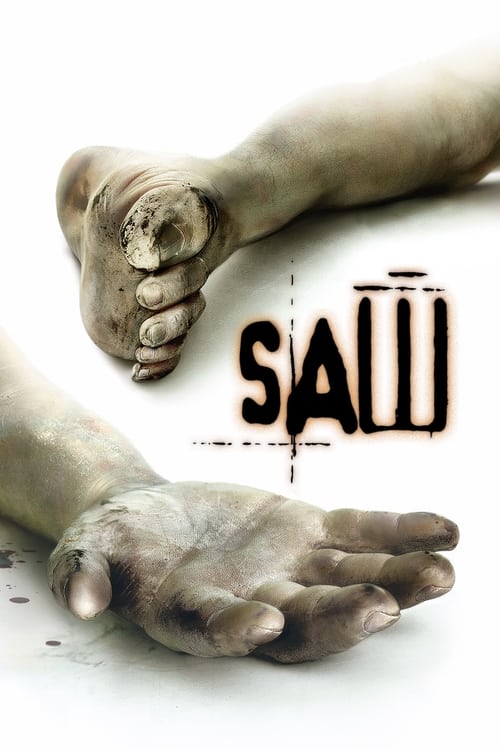
Saw
2004 · James Wan
When you're craving a real scare with a puzzle inside it — this is white-knuckle, look-through-your-fingers viewing, firmly on the challenge end of the dial. Not one for a queasy stomach.
What it's about
Two strangers — a photographer and a doctor — wake up chained at opposite ends of a filthy, abandoned bathroom with a body on the floor between them and a tape recorder telling them the rules. The unseen mastermind the police call Jigsaw doesn't kill his victims; he builds games that force them to do terrible things to themselves to survive. As the two men work out why they were chosen, detectives close in on the killer from the outside.
The experience
Grimy, claustrophobic, and relentlessly tense — most of it is two desperate men in one room, and the film wrings that single location for everything it has. It builds to a finish that people were still talking about years later.
Performances
Cary Elwes and co-writer Leigh Whannell carry the bathroom scenes between them, and the escalating desperation of Elwes's buttoned-up doctor is the film's engine.
The craft
James Wan's debut, shot in about eighteen days on a tiny budget, and the constraints show up as style: sickly desaturated color, frantic whiplash editing at the moments of violence, and a screeching industrial score that became the franchise's signature. The screenplay is really a mystery-box machine, doling out flashbacks until the full design snaps into place.
Why it matters
One of the most profitable horror films ever made relative to cost — it launched a franchise, made James Wan's career, and defined the trap-and-torture wave that dominated 2000s American horror.
Horror · Serial-killer thriller · Suspense & terror. Two men chained in a filthy bathroom play a killer's cruel game: a grimy, frantic locked-room puzzle with traps that make you look away.
Snapshot
Saw is the debut feature of Australian director James Wan, written by Wan with his collaborator and star Leigh Whannell, that reorganized American horror around a single premise: a killer who does not murder his victims but forces them, through elaborate mechanical "games," to mutilate themselves in exchange for survival. Two men, the photographer Adam (Whannell) and the physician Lawrence Gordon (Cary Elwes), wake chained at opposite ends of a filthy industrial bathroom with a corpse between them, and must decode the rules laid down by an unseen figure the police call Jigsaw. Built on a tiny budget and shot in roughly eighteen days, the film's commercial success turned it into a franchise engine for Lionsgate and made it a defining text of the mid-2000s horror moment. Its combination of a trap-based moral conceit, a desaturated industrial aesthetic, a puzzle-box narrative, and a hard third-act reversal proved enormously influential — and enduringly controversial.
Industry & production
Saw is a classic proof-of-concept success story. Wan and Whannell had met as students in Melbourne (both attended RMIT) and wrote a feature script they could not finance on reputation alone. To demonstrate the material's power, they produced a short film in 2003 — essentially a single sequence built around the "reverse bear trap" head device — with Whannell performing as the test subject. That short functioned as a pitch reel and helped attract producers; the feature was set up through Evolution Entertainment and its Twisted Pictures arm, with Mark Burg and Oren Koules among the producers, and distributed by Lionsgate (then Lions Gate Films), a company that was aggressively building a genre identity in this period.
The production is inseparable from its constraints. The feature was shot in Los Angeles on a compressed schedule widely reported at around eighteen days, on a budget commonly cited in the low seven figures (roughly $1.2 million); these figures are the standard reported numbers rather than audited studio accounts, and should be read as such. The confined bathroom set — where the bulk of the film's present-tense action unfolds — is a direct expression of that economy: a small number of standing locations, a mostly nighttime/interior shoot, and a cast anchored by a handful of principals. Casting Cary Elwes and Danny Glover (as Detective Tapp) gave the low-budget project recognizable names, while Whannell took the co-lead and Tobin Bell was cast in the role of John Kramer that would define the rest of his career. Saw premiered at the Sundance Film Festival in January 2004 and received a wide theatrical release timed to the Halloween season that October — a release-window strategy the subsequent sequels would ritualize, arriving almost annually around late October for the remainder of the decade.
Technology
Saw was made at the tail end of the era when low-budget American genre features were still shot and finished photochemically rather than digitally, and its look reflects standard early-2000s Super 16 / 35mm independent practice; precise format details of the shoot are not something to assert without the camera reports, so I will not overstate them. What matters technologically is less the acquisition format than the aggressive post-production manipulation of the image: heavy color timing toward sickly greens and jaundiced yellows, high-contrast grading, and a battery of in-camera and editorial effects (snap zooms, ramped speed, stuttering inserts) that give a cheaply shot picture a maximalist sensory surface. The traps themselves are practical, mechanical, and prosthetic-driven — Jigsaw's "games" are staged as physical apparatus and makeup effects rather than digital gore, which is central to their visceral credibility. The film thus belongs to a moment when practical effects and post-production grading, not CGI, carried horror spectacle.
Technique
Cinematography
Shot by David A. Armstrong, who would become the franchise's signature director of photography, Saw codified a visual grammar that hundreds of imitators would borrow. The palette is desaturated and jaundiced, pushed toward industrial greens and grimy amber, with deep shadow and hard, often single-source-feeling light in the bathroom. The camera is restless: handheld coverage, canted framings, and abrupt "snap zooms" that lunge toward a face or an object. The confined central space is shot to feel simultaneously claustrophobic and disorienting, the geography deliberately hard to map. This look — cheap to light, expressive on screen — became shorthand for "gritty" horror in the mid-decade and was widely copied.
Editing
Editing is arguably the film's defining formal weapon. Kevin Greutert cut Saw (and would remain the franchise's editor before graduating to directing later entries), and his work fuses the confined present-tense with a barrage of flashbacks, subliminal-feeling inserts, and speed-ramped montage. The editing does double duty: it generates raw sensory aggression in the trap sequences, and it manages the film's mystery structure, doling out and withholding information across timelines so that the audience is assembling the puzzle alongside the characters. The climactic reversal is fundamentally an editing achievement — a rapid recontextualizing montage set to Charlie Clouser's score that retroactively rewrites everything the viewer has seen.
Mise-en-scène / staging
The bathroom is the film's dramaturgical engine: two men, chained apart, a body and a gun and a hacksaw between them, the whole plot a function of what they can and cannot reach. The production design (by Julie Berghoff) renders a decayed industrial world of tile, rust, and effluent that reads as both literally filthy and morally rotten. Jigsaw's paraphernalia — the tricycle-riding puppet "Billy," the cassette tapes, the color-coded clues — supplies an iconography of ritual and game-playing that grounds the killer's philosophy in objects. The staging repeatedly turns the room's props into instruments of choice and self-destruction, so that space itself becomes an ethical trap.
Sound
Charlie Clouser, formerly of Nine Inch Nails, composed a score built from industrial textures, distorted percussion, processed metallics, and dread-laden drones that mirror the film's décor in sound. His cue for the finale — the piece popularly known as "Hello Zepp" — became one of the most recognizable horror themes of its generation and a franchise signature. Sound design leans on the mechanical: the clank of chains, the whir and snap of traps, the tape hiss and treated voice of Jigsaw's instructions ("I want to play a game"), which give the killer an aural presence long before he has a face.
Performance
Whannell, writing his own part, plays Adam as abrasive, frightened, and increasingly desperate, an everyman foil to Elwes's more composed, morally compromised Dr. Gordon. Elwes carries the film's melodramatic register, including the notorious escalation of the final act. But the performance that outlasted the film is Tobin Bell's: playing John Kramer with a low, deliberate gravity, he made Jigsaw a horror icon out of relatively limited screen time, and Shawnee Smith's Amanda — the survivor of the reverse-bear-trap — provided the franchise's other recurring human anchor. The acting is uneven by design and circumstance, but its best notes (Bell's stillness) proved franchise-defining.
Narrative & dramatic mode
Saw is structurally a mystery-thriller wearing horror's skin. Its dominant mode is the puzzle-box: a present-tense entrapment scenario braided with an investigative flashback strand (Glover's obsessive detective) and the backstory of Jigsaw's earlier "games." The film withholds the killer's identity and method and invites the audience to solve it, then detonates a twist — the corpse on the bathroom floor has been the living Jigsaw all along — that recodes the entire preceding narrative. This is the reveal grammar of the post–Usual Suspects, post–Se7en thriller applied to graphic horror. Thematically the "games" frame the drama as a series of forced moral choices, so that horror here is less about monstrous pursuit than about complicity and will: victims are made agents of their own suffering.
Genre & cycle
The film sits at the crossroads of horror, crime/serial-killer thriller, and the "elaborate-death-trap" tradition. It arrived at the head of a cycle that critics soon labeled — pejoratively — "torture porn," a term David Edelstein popularized in New York magazine in early 2006 to describe a wave of graphically punishing horror. Saw is routinely paired with Eli Roth's Hostel (2005) as the cycle's cornerstones, though the two films differ substantially: Saw is more plotted, more puzzle-driven, and comparatively less wall-to-wall in its onscreen gore than its reputation suggests, with much of its violence implied, aftermath-focused, or concentrated in short bursts. Within horror history it also revived the serialized annual-sequel model, becoming a Halloween franchise fixture through the late 2000s.
Authorship & method
Saw is a genuine two-author work. James Wan directed and co-wrote; Leigh Whannell co-wrote and starred. Their method — build an undeniable short to sell an unfinanceable feature — is itself part of the film's authorship, and the pair's partnership continued into Dead Silence (2007) and, most consequentially, Insidious (2010), which launched the other major horror franchise of Wan's career before he moved to The Conjuring (2013) and large-scale studio filmmaking (Furious 7, Aquaman). Among key collaborators, cinematographer David A. Armstrong, editor Kevin Greutert, and composer Charlie Clouser were not one-off hires but architects of a franchise house style who carried the aesthetic across sequels (Greutert eventually directing Saw VI and Saw 3D). Producers Burg and Koules, through Twisted Pictures, institutionalized the annual-installment model. The authorship of Saw, in other words, is both a specific creative duo and a repeatable industrial system.
Movement / national cinema
Saw is a Hollywood-financed, Los Angeles–shot American genre film, but its creative DNA is Australian: Wan and Whannell are products of the Melbourne film scene, and the film belongs to a broader early-2000s pattern of Antipodean genre talent breaking into American horror. It is not part of a formal "movement" so much as a node in the transnational, festival-to-distributor pipeline (Sundance premiere, Lionsgate release) through which independent horror reached wide audiences in that decade. If it has a movement identity, it is as a keystone of the American "torture"/extreme-horror cycle rather than of any national school.
Era / period
The film is deeply of the mid-2000s. Culturally it is often read against the anxieties of the post-9/11, Abu Ghraib–era United States, when images of confinement, interrogation, and bodily coercion were saturating public discourse; critics have repeatedly situated the torture-horror cycle within that atmosphere, though such readings are interpretive rather than authorial statements of intent. Industrially it belongs to the last pre-streaming boom of theatrical genre franchises and to the moment when a mini-major like Lionsgate could build its brand on horror. Technologically it sits on the cusp between photochemical finishing and the digital-grading-forward look that would dominate the years after.
Themes
At its center is a perverse moral philosophy: Jigsaw does not see himself as a murderer but as a corrective force who tests whether those who "don't appreciate their lives" will fight to keep them. The film's recurring motifs — games, tests, choices, self-mutilation as the price of survival — dramatize agency, complicity, and the value of life under duress. Secondary themes include surveillance and voyeurism (the killer as watching designer, the audience as spectator of suffering), guilt and secret sin (nearly every victim is being punished for a moral failing), and the body as the site where ethics are literally enforced. The bathroom-as-purgatory and the puzzle-as-judgment give the material an almost allegorical, morality-play structure beneath the grime.
Reception, canon & influence
Critical reception at release was mixed-to-divided: many reviewers acknowledged the ingenuity of the premise and the force of the twist while recoiling from the violence and the unevenness of the execution, and the film became a lightning rod in the broader debate over "torture porn." Whatever the notices, its commercial impact was decisive — the modest budget returned many times over — and it immediately spawned a franchise that became one of horror's most durable, with near-annual installments across the 2000s and periodic revivals thereafter (including later reboots and legacy entries). Jigsaw, Billy the puppet, and Clouser's theme entered the horror canon as instantly legible icons.
Looking backward, Saw synthesizes several clear lineages: the moralizing serial-killer thriller and grimy urban dread of David Fincher's Se7en (1995); the confined lethal-architecture premise of Vincenzo Natali's Cube (1997); the puzzle-box twist storytelling of The Usual Suspects (1995); and, more diffusely, the elaborate themed-murder tradition running back through the Dr. Phibes films and the ornamental cruelty of Italian giallo. Looking forward, its influence is outsized: it standardized the trap-and-game horror subgenre, cemented the desaturated-green "gritty" horror look and snap-zoom editing that flooded mid-2000s genre cinema, helped establish Lionsgate's horror dominance, revived the annual-franchise release model, and — through Wan and Whannell — seeded Insidious and, indirectly, the Wan-driven mainstreaming of studio horror in the 2010s. For a film shot in under three weeks for pocket change, Saw exerted a shaping pressure on the following decade of horror that few contemporaries can match.
A Deleuzian reading
There is a body on the floor between them.
The full Deleuzian reading of Saw →
Reception
Dismissed by many 2004 critics as grimy shock-schlock and later lumped into the 'torture porn' backlash, it's since been reappraised as a lean, twist-driven thriller that's far less gory than its reputation — and the launchpad for both a ten-film franchise and James Wan's whole horror empire.
How Saw was received, from release to now →
How to watch Saw: what to notice on a first viewing
- Watch the sickly green and yellow in the bathroom. David Armstrong grades hard toward industrial green and jaundiced amber, with heavy shadow and light that feels like one bare source. Julie Berghoff's tile, rust and standing water do the rest. The color does the work of a whole backstory. The room looks infected before anything happens in it.
- Count the snap zooms that lunge at a face. Armstrong shoots handheld, tilts the frame off level, and jabs the lens at objects and faces. The room is never mapped for you. After twenty minutes you still could not draw its floor plan. Not knowing where things sit in space is the point. The camera keeps you as disoriented as the men chained to the pipes.
- Count what the two men can and cannot reach. Everything they need is in the room and everything sits just past arm's length. A saw, a phone, a gun, a body. Wan builds the entire plot out of chain length. They can see everything and do almost nothing. That gap is the horror, not a monster in the hallway.
- Listen to the tape hiss under Jigsaw's voice. Instructions arrive on cassette, processed and low, from a body you cannot place anywhere in the room. Charlie Clouser's score is built from distorted percussion and metallic drones that match the plumbing. The voice has authority because it comes from nowhere you can point to.
- Look at the puppet, the tapes and the color-coded clues. Billy on his tricycle, cassette players, marked envelopes, machinery built by hand. The traps are practical: physical rigs and makeup, not digital. Every object belongs to a ritual somebody designed in advance. The objects tell you this violence is staged to be watched. That design is the whole philosophy on display.
The whole guide to watching Saw, with the keys for a rewatch →
Influences: the films it descends from and the films it influenced
- Se7en (1995) — Bequeaths the desaturated, tenebrous urban grime and the didactic serial-killer-as-moralist who stages themed, sin-specific tableaux the detectives must decode — Jigsaw is Doe with a workshop instead of a scripture.
- The Usual Suspects (1995) — Model for the closing recontextualizing-twist montage that rapid-cuts back through planted details to reveal the unreliable narrator (Verbal/Kobayashi ≈ the corpse on the floor rising as Jigsaw).
- Cube (1997) — Establishes the single lethal-architecture premise — strangers imprisoned in a booby-trapped space who must reason out its rules to survive — the structural DNA of Saw's confinement and its traps.
- The Abominable Dr. Phibes (1971) — Origin of the elaborate themed-murder tradition: a mastermind engineers ornate, thematically-coded death-devices as ritual, the direct forerunner of Jigsaw's baroque contraptions.
- Deep Red (1975) — Giallo template for ornamental cruelty and stylized murder set-pieces built around insert close-ups of gleaming mechanisms and a driving score fused to the kill.
- Requiem for a Dream (2000) — Source of the mid-2000s snap-zoom and speed-ramped 'hip-hop montage' — macro-cut bursts and whip-fast micro-edits — that Wan and editor Kevin Greutert weaponize for panic and reveal.
- Jacob's Ladder (1990) — Pioneers the under-cranked, twitchy speed-ramp for demonic/uncanny bodies (the head-shaking shudder) that becomes horror's default motion signature and recurs in Saw's flashback frights.
- The Texas Chain Saw Massacre (1974) — Blueprint for grimy, industrial low-budget verité horror — rust, bone, and mechanical menace shot cheap and fast — the texture and economy Saw revives for the tiled bathroom and Jigsaw's lair.
- The Silence of the Lambs (1991) — Provides the forensic serial-killer procedural and the fetishized killer's-lair mise-en-scène, plus the captive investigator who must psychologically read the murderer's design.
- Audition (2000) — Centers an immobilized victim subjected to a methodical bodily apparatus, a load-bearing entry in the 2000s 'torture horror' turn that critics trace back through Audition's needles and wire.
- Identity (2003) — Extends Identity's puzzle-box logic where the screenplay's concealed architecture is the true author, climaxing on a retroactive reveal that recontextualizes a confined kill-space.
- Resident Evil (2002) — The lethal mechanized trap-room recast as a lethal 'game' extends the Cube/laser-corridor death-apparatus into torture-puzzle horror.
- Saw II (2005) — Codifies the franchise house style — Clouser's industrial score, Armstrong's jaundiced grade, the trap-montage reveal — and institutionalizes the annual-installment release model.
- The Collector (2009) — Written by Saw-sequel scribes Dunstan and Melton, it lifts the trap-and-game architecture into a home-invasion frame, extending the booby-trapped-room subgenre Saw standardized.
- Dead Silence (2007) — The Wan–Whannell duo's direct follow-up, carrying forward the iconic-object horror (Billy the puppet → Mary Shaw's dolls) and twist-driven structure as a repeatable authorial method.
- Insidious (2010) — Same duo's build-a-cheap-scare-machine method — a low-budget high-concept engineered to launch a franchise — transplanted from gore to supernatural jump-scare craft.
- The Conjuring (2013) — Wan's mainstreaming of studio horror grows directly out of the Saw system: franchise-first design, precise camera choreography, and iconic-villain branding scaled to a shared universe.
- Escape Room (2019) — Pure inheritor of Saw's puzzle-box confinement — contestants decoding a themed lethal room against a hidden designer — proving the trap-and-game subgenre Saw founded as durable IP.
- Would You Rather (2012) — Builds its whole structure on Saw's moral-choice-under-duress engine — a captor forcing escalating complicity via impossible either/or tortures — stripped to the game mechanic itself.
- The Conjuring 2 (2016) — Wan's origin point for the reveal-timed edit and mechanical dread, where withholding then abruptly disclosing spatial information (the body, the trap) becomes the scare engine later refined into the withheld jump-scare.
- Saw X (2023) — Establishes the single-room chamber piece resolved by a third-act flashback montage cut to Clouser's 'Hello Zepp' — the corpse-on-the-floor rug-pull whose editorial grammar Saw X reprises almost as homage.
- Heretic (2024) — Gives the captor an ideological 'game' with explicit rules and engineered choices, so the physical space is a purpose-built moral apparatus — the rule-system-as-trap logic Heretic dresses in doctrine.
- Law Abiding Citizen (2009) — The apparatus of engineered punishment — a victim woken inside a purpose-built rig, the mechanism revealed by a slow tilt or pull-back before it operates — supplies both the lethal-injection opening's inversion and the film's habit of treating each killing as a designed device with an explanatory reveal.
- Malignant (2021) — Wan's own last-minute twist, where the 'corpse' in the room was the killer all along, is the template for hiding Gabriel inside the protagonist's body.
- Hostel (2005) — The co-defining 'torture porn' text released a year later, extending Saw's protracted, clinically-staged bodily suffering into a business-of-cruelty premise.
- Buried (2010) — Radicalizes Saw's single-room-confinement staging into an entire feature shot inside one coffin, extending the constrained-space, real-time survival grammar Saw popularized.
- Final Destination 3 (2006) — Wan codified the mid-2000s lethal-trap-apparatus as the film's main attraction — the contraption's Rube Goldberg mechanics are the payoff — running as FD3's sibling in the era's elaborate-death horror economy.
- Final Destination (2000) — Monetized the mechanism-driven death, turning the elaborate lethal contraption — the intricately engineered kill as centerpiece — into its own franchise economy.
- Final Destination Bloodlines (2025) — Parallel death-trap horror that mechanizes lethality into Rube Goldberg apparatuses with no embodied killer required, sharing Bloodlines' fascination with the room-as-machine and the victim's futile agency against a pre-set design.
Similar films
- Saw II (2005) — influence & lineage
- The Texas Chain Saw Massacre (1974) — influence & lineage
- The Conjuring (2013) — influence & lineage
- Gonjiam: Haunted Asylum (2018) — same viewing thread
- The Evil Dead (1982) — same viewing thread
- Insidious (2011) — shared sensibility
- Saw X (2023) — shared sensibility
- Exit 8 (2025) — shared sensibility
All the films related to Saw →
Watch it with: curated runs of related films
- Trapped in the Dark — Watch these as a run of survival horror where the place itself — a chained-shut bathroom, a cabin cellar, a lightless cave, an endless fluorescent nowhere, an emptied city — turns into the thing hunting you.