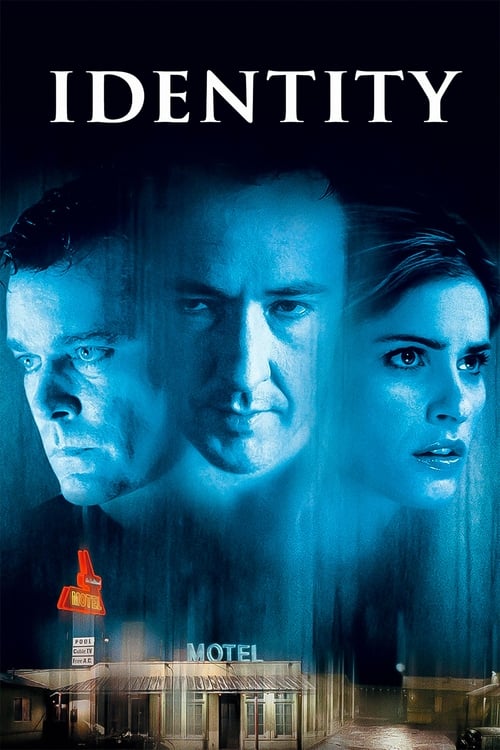
Identity
2003 · James Mangold
Perfect for a stormy night when you want a whodunit you can play along with — guessing, being wrong, and gasping at the reveal. Comfort-food suspense with real bite.
What it's about
A flash flood strands ten strangers — among them a limo driver who used to be a cop, a Las Vegas prostitute, a movie star, and a convict under escort — at a run-down Nevada motel in the middle of the night. Then they start dying, one by one, each body marked with a countdown. As the storm rages and the numbers drop, suspicion turns everyone against everyone.
The experience
A tight, rain-soaked pressure cooker — tense, twisty, and fast, with a mounting wrongness that tells you this is more than a body-count thriller. It plays fair while quietly rearranging the board under you.
Performances
John Cusack anchors it as the weary ex-cop trying to hold the group together, and Ray Liotta brings a live-wire menace that keeps you guessing about which side of the law he's really on.
The craft
James Mangold wrings maximum claustrophobia from one drenched location, using the relentless rain, neon, and darkness to seal the characters in. The screenplay is a precision machine — a classic ten-little-strangers setup engineered to snap into a completely different shape.
Why it matters
A sleeper hit at the height of the early-2000s twist-thriller craze, it became a touchstone example of the puzzle-box mystery and one of the era's most argued-about endings.
Snapshot
Identity is a closed-circle mystery engineered as a magic trick. Ten strangers are stranded by a flash flood at a derelict Nevada motel and begin dying one by one, their corpses tagged with room keys counting down from ten. Running parallel is a midnight death-row hearing in which a psychiatrist argues that his condemned patient, a multiple murderer named Malcolm Rivers, should be spared because he suffers from dissociative identity disorder. The film's governing reveal — that the motel and everyone in it are personalities inside Rivers's mind, being psychically "killed off" in a last-ditch attempt to isolate and destroy the homicidal one — converts a slasher into a metaphysical puzzle. Directed by James Mangold from a script by Michael Cooney and released by Columbia/Sony in April 2003, it sits at the crest of the turn-of-the-millennium "twist movie," explicitly grafting Agatha Christie's And Then There Were None onto the surprise-ending vogue inaugurated by The Sixth Sense. It is the rare Mangold film that foregrounds structure over character, and it remains his most purely mechanical genre object — admired by some as a clockwork entertainment, faulted by others for the gap between its rain-lashed atmosphere and its cerebral gimmick.
Industry & production
Identity was a mid-budget studio thriller produced by Columbia Pictures with Konrad Pictures (Cathy Konrad, then Mangold's producing partner and spouse). It belongs to a specific early-2000s economic niche: the high-concept genre film that could be sold on premise alone, made for a controlled cost with an ensemble of recognizable but not top-tier-salaried actors, and aimed at a wide spring release. Trade reporting at the time placed the production budget in the region of the high-$20-million range; precise figures vary across sources, so the exact number should be treated as approximate rather than authoritative. The picture opened at or near the top of the U.S. box office and went on to a healthy worldwide gross several times its negative cost — a clear commercial success — though, again, the specific dollar totals reported by different aggregators differ enough that I will not assert a single figure as definitive.
The casting strategy is itself a production fact worth noting: the ensemble (John Cusack, Ray Liotta, Amanda Peet, John Hawkes, Alfred Molina, Clea DuVall, John C. McGinley, Rebecca De Mornay, Jake Busey, Pruitt Taylor Vince, Bret Loehr) is stacked with familiar character actors rather than a single marquee lead, a configuration that both suits the Christie-style "everyone is a suspect" architecture and keeps costs disciplined. The shoot was relatively compact, built around a largely single-location set — the motel and its waterlogged forecourt — which lends itself to controlled, stage-like production economics. For Mangold the film functioned as a palate-cleanser: it followed the period romance Kate & Leopold (2001) and preceded the prestige biopic Walk the Line (2005), and it demonstrated to the industry that he could deliver a tight, suspense-driven commercial machine on schedule.
Technology
Identity is a photochemical, late-film-era production: shot on 35mm and finished, for its time, through largely traditional means rather than the digital-intermediate pipeline that would soon become standard. Its technological signature is not in capture format but in old-fashioned craft applied to a controlled environment — most conspicuously the relentless rain. The deluge that isolates the motel is a built effect, achieved with rain towers, standpipes, and stage rigging over a constructed exterior, allowing continuous downpour to be sustained and matched across a long shoot. The flooded-out roads, washed-away bridge, and pervasive wet are the film's principal practical-effects achievement, and the consistency of that weather across scenes is a quiet technical accomplishment given the continuity demands of rain. The visual-effects work is restrained and largely invisible: the film's "trick" is dramaturgical rather than digital, which is part of its design philosophy. Crucially, the central twist is engineered to survive technological scrutiny — it depends not on a special effect but on what the camera chooses to withhold, an editorial and screenwriting sleight of hand rather than a rendered illusion.
Technique
Cinematography
The cinematography is by Phedon Papamichael, the Greek-American cinematographer who would become one of Mangold's most enduring collaborators (later shooting Walk the Line, 3:10 to Yuma, Knight and Day, and Ford v Ferrari). Here he renders the motel in a palette of sodium-vapor amber, cold blue night, and the silver static of rain, the imagery kept deliberately overcast and enclosed. The aesthetic is classical neo-noir: low-key lighting, wet reflective surfaces that double the frame, neon signage bleeding into the dark, and a camera that prowls the breezeways and parking lot to keep the geography legible while sustaining dread. Papamichael's compositions emphasize the closed system — characters repeatedly framed through doorways, windows streaked with water, and the recurring numbered room doors — so that the visual field itself becomes a grid of suspects. The death-row interludes, by contrast, are shot in a flatter, more clinical institutional register, a tonal counterpoint that the film banks for its eventual collision of the two worlds.
Editing
Editing, by David Brenner (an Oscar winner for Born on the Fourth of July and a veteran of large-scale Hollywood pictures), is the film's most load-bearing technical element, because Identity is fundamentally an editing trick. The cut must cross-stitch two timelines — motel and courtroom — while concealing their true relationship, parcel out the countdown of bodies and keys at a quickening rhythm, and stage the revelation so that earlier scenes retroactively reorganize in the viewer's mind. The construction rewards and depends on misdirection: information is timed to be just sufficient for suspense and just insufficient for premature solution. The pacing tightens as the ensemble thins, and the film's final movements rely on rapid reframing of what has come before — the hallmark of the twist-film editorial mode, where the last reel is engineered to make the audience rerun the whole picture.
Mise-en-scène / staging
The single-location design is the film's dramaturgical engine. The motel — peeling, fluorescent-lit, ringed by flooding asphalt — is an archetypal "old dark house" updated to a roadside Americana key, and the staging exploits its corridors and identical numbered doors to keep the cast physically corralled and mutually suspect. Production design leans on iconography of transience: a motel (people passing through), a storm (no exit), a dead phone line, a washed-out road. Mangold blocks the ensemble in clusters and pairings that continually reshuffle alliances and isolate victims, the classic Christie choreography of "who was where when." The numbered keys left on the bodies function as both prop and structuring device, a literal countdown embedded in the décor. The deliberate artificiality of the space — its stagey containment — is, in retrospect, thematically motivated: it is a mental construct, and the set's slightly unreal, hermetic quality is the film quietly playing fair.
Sound
Alan Silvestri's score works in the register of orchestral suspense, deploying tension-and-sting dynamics appropriate to a stalk-and-kill structure while reserving weight for the metaphysical turn. The sound design is dominated by rain — a constant sonic blanket that both isolates the characters and masks the approach of danger, the downpour doubling as white noise under which threats move. Thunder, dripping water, the hum of fluorescent fixtures and dead phones, and the mechanical thunk of motel-room locks build an acoustic world of enclosure. Sound also carries some of the film's misdirection, with offscreen noise prompting the audience to assume presences and movements that serve the puzzle.
Performance
The ensemble is the film's chief pleasure and its alibi. John Cusack anchors it as Ed, a former cop turned limo driver, playing a watchful, melancholic competence that grounds the genre mechanics. Ray Liotta brings coiled menace and ambiguity as a man transporting a prisoner, exploiting the actor's gift for instability. Amanda Peet, as a sex worker trying to leave the life, is given the film's most conventional arc of sympathy. The deep bench — Alfred Molina's psychiatrist, Clea DuVall's frayed newlywed, John Hawkes's twitchy motel clerk, John C. McGinley's panicked motorist, Jake Busey's volatile convict, Rebecca De Mornay's faded actress — supplies the texture of distinct, instantly readable types that the Christie template requires. Special note belongs to Pruitt Taylor Vince, whose performance as the institutionalized Malcolm Rivers (and whose real-life nystagmus lends an unsettling instability to his gaze) is the human hinge on which the whole conceit turns; the film's emotional and conceptual payoff rests on his quietly disturbing presence.
Narrative & dramatic mode
The film operates in two interleaved modes that it eventually collapses into one. The dominant mode is the closed-circle whodunit-as-body-count: a fixed cast, an inescapable location, a methodical killer, and a dwindling population, with the audience invited to solve the pattern (the keys, the shared birthday, the connections among victims). The second is the procedural-forensic frame of the hearing, presented as a sober legal-psychiatric inquiry. The masterstroke — and the source of both admiration and complaint — is that these are revealed to be the same event at different scales: the motel is the interior theater of Malcolm Rivers's mind, and the murders are the psychiatric "extermination" of his personalities. This is an unreliable-narration structure in which the unreliability is ontological rather than merely perspectival; the diegesis itself is a lie the film tells in good faith. A coda then supplies a second twist, undercutting the apparent therapeutic victory and reasserting horror's pessimism — a final reversal characteristic of the era's appetite for the rug pulled twice.
Genre & cycle
Identity sits at the intersection of three lineages. First, the Golden Age detective puzzle, specifically Agatha Christie's And Then There Were None (1939), whose ten-isolated-strangers-killed-by-pattern blueprint the film openly adapts, down to the counting-down motif. Second, the slasher, whose stalk-and-dispatch grammar and rain-soaked nocturnal dread the film borrows wholesale, placing it adjacent to the post-Scream revival of the late 1990s and early 2000s (Mangold's producing partner Cathy Konrad was a producer on the Scream films, a relevant industrial proximity). Third, and most defining for its moment, the "twist film" or puzzle-box thriller cycle catalyzed by The Sixth Sense (1999) and extending through Fight Club (1999), The Others (2001), and the broader vogue for endings that reframe the whole. Identity's particular contribution is the fusion of the Christie chassis with the dissociative-identity reveal — a synthesis that makes it both a throwback and a thoroughly 2003 artifact.
Authorship & method
James Mangold is, across his career, a genre generalist with a classicist's instincts — a director who moves between the cop drama (Cop Land), the psychiatric institutional film (Girl, Interrupted), the music biopic (Walk the Line), the Western (3:10 to Yuma), the superhero elegy (Logan), and the racing picture (Ford v Ferrari), bringing to each a preference for legible storytelling, actor-centered scenes, and old-Hollywood craft. Within that filmography Identity is something of an outlier: a high-concept structural exercise in which the screenplay's architecture, more than character interiority, is the star. Yet the film's traceable through-lines to Mangold's work are real — its interest in fractured psychology and institutional confinement rhymes with Girl, Interrupted, and its disciplined command of a contained genre machine anticipates the controlled tension of 3:10 to Yuma.
The screenplay is by Michael Cooney, an English writer-director whose background in genre horror (he is associated with the Jack Frost killer-snowman pictures) suits the film's mechanical ingenuity; the script is the film's true author in the sense that its value is overwhelmingly its construction. Among collaborators, cinematographer Phedon Papamichael's partnership with Mangold begins to consolidate here and becomes one of the defining director-DP pairings of subsequent American mainstream cinema. Composer Alan Silvestri and editor David Brenner are seasoned big-studio craftsmen who supply, respectively, the suspense scoring and the precision cross-cutting on which the trick depends. The method, in sum, is one of subordinating every department to a single concealed structural premise.
Movement / national cinema
The film is firmly a product of mainstream American studio cinema, with no avant-garde or national-cinema affiliation; its lineage is Hollywood genre filmmaking and its immediate context the early-2000s commercial thriller. If it has an aesthetic ancestry beyond America, it is the British Golden Age detective tradition by way of Christie — a literary rather than cinematic-movement inheritance. It can also be read against the long shadow of Hitchcock, particularly Psycho (1960), whose roadside-motel setting and split-personality revelation are the film's most obvious classical precedent; the debt is structural and iconographic rather than stylistic homage.
Era / period
Identity is diegetically contemporary (set in its own present) but evokes a timeless Americana of two-lane highways and roadside motels, a deliberately unmoored, almost mythic vernacular landscape. As a cultural-period artifact, it is precisely datable to the early-2000s twist-thriller moment — the years immediately after The Sixth Sense made the reframing ending a commercial template and before audience fatigue with the device set in. Its treatment of dissociative identity disorder as a horror engine also places it in a specific period of popular-cultural fascination with the condition, a fascination the film exploits dramatically rather than clinically; its psychiatry is a genre device, not a documentary account, and the film makes no claim to therapeutic realism.
Themes
The film's central theme is the fragmented self: the question of what constitutes a single identity, and whether a person can be reduced to, or rid of, a constituent part. The motel-as-mind conceit literalizes the idea that the self is a contested space shared by competing personae. Bound up with this is the theme of culpability and determinism — if a murderer is "another person" inside the same body, where does guilt reside? — staged across the death-row frame as an explicitly moral and legal problem. Fate and predestination recur in the Christie inheritance: a shared birthday links the victims, suggesting an order beneath apparent randomness, and the film flirts with the sense that the characters are pieces moved by an unseen hand (which, diegetically, they are). Trauma and origin surface in the backstory of childhood abandonment that the film posits as the root of Rivers's condition. And running throughout is the genre's perennial preoccupation with appearance versus reality — every character is not who they seem, a literalized lesson the structure delivers as both pleasure and warning.
Reception, canon & influence
Critical reception was mixed-to-positive and notably divided along a single fault line: admiration for the film's atmosphere, craft, and ensemble versus skepticism toward its twist. Many reviewers praised the rain-drenched mood, the propulsive construction, and the deep cast — Cusack and the character players especially — while a significant cohort argued that the dissociative-identity revelation cheats the suspense it builds, retroactively draining stakes from the body count by declaring the characters unreal. The film was widely received as a clever, well-built entertainment rather than a major work, and that consensus has largely held. (Specific aggregate scores and individual critics' verdicts vary across sources; I am characterizing the broad shape of the response rather than quoting figures.)
Looking backward, the influences on the film are unusually legible and openly worn: Christie's And Then There Were None for the closed-circle countdown; Hitchcock's Psycho for the motel and the split psyche; the slasher tradition for the kill grammar; and the Sixth Sense-era twist film for the structural ambition of the ending. Looking forward, Identity's legacy is more modest and diffuse. It stands as one of the more accomplished entries in the early-2000s puzzle-box cycle and is frequently cited in discussions of twist-ending films and of "old dark house" updates, where it functions as a reference point and a case study in fair-play misdirection. For Mangold specifically, its most consequential downstream effect was professional: it cemented his standing as a versatile, reliable director of commercial genre material and inaugurated the Mangold–Papamichael collaboration that would shape the look of his subsequent, more celebrated films. Beyond that, the record of any direct, traceable influence on later filmmakers is genuinely thin, and it would be an overstatement to claim a lineage descending from it; its place in the canon is that of a skillful, much-revisited genre exercise rather than a fountainhead.
A Deleuzian reading
Start with the key.
The full Deleuzian reading of Identity →
Reception
A modest hit in spring 2003 — it opened #1 at the US box office — with reviews split between 'clever' and 'gimmicky,' it's since settled into beloved-rewatchable status, a staple of 'underrated 2000s thrillers' lists and streaming rediscovery threads.
How Identity was received, from release to now →
Influences: the films it descends from and the films it influenced
- And Then There Were None (1945) — Supplies the closed-circle countdown engine — a fixed cast of strangers eliminated one by one against a tallying device (the rhyme/figurines), which Identity reworks as the motel-room keys diminishing toward zero.
- Psycho (1960) — Donates the rain-arrival motel as crime scene and, structurally, the literalized split psyche explained by a clinical authority — the murderer-as-fractured-self that Identity scales up to ten bodies.
- The Old Dark House (1932) — Establishes the template Identity updates: a storm strands disparate travelers in one isolated building, forcing the ensemble into a single weather-sealed location where the threat is internal.
- Dead of Night (1945) — Frames fractured identity through a psychiatric encounter and dramatizes the ventriloquist's-dummy split self, prefiguring Identity's framing device of a doctor litigating one mind's personalities.
- Angel Heart (1987) — Builds a rain-and-decay neo-noir on the ontological twist that the investigator is himself the perpetrator — the identity reveal that retroactively reframes every prior scene, Identity's exact maneuver.
- Primal Fear (1996) — Makes dissociative identity disorder the literal mechanism of the twist ending, planting the courtroom-DID device Cooney's script repurposes as its concealed structural premise.
- The Sixth Sense (1999) — Codifies the fair-play retroactive-reframe twist of its era — clues seeded so the final reveal forces a re-read of the whole film — the 'twist-film' grammar Identity openly adopts.
- Fight Club (1999) — Pioneers the cross-cutting that conceals a single dissociated mind by staging its facets as separate characters, the editing-level misdirection on which Identity's revelation depends.
- Saw (2004) — Extends Identity's puzzle-box logic where the screenplay's concealed architecture is the true author, climaxing on a retroactive reveal that recontextualizes a confined kill-space.
- Shutter Island (2010) — Pushes the storm-bound, institutionalized DID reveal further — an investigator whose reality is a delusion, unmasked by a clinical authority — the fullest later flowering of Identity's trick.
- 3:10 to Yuma (2007) — Inherits the disciplined contained-genre tension and inaugurates fully the Mangold–Papamichael visual partnership that consolidated on Identity, applying its single-pressure-cooker staging to the Western.
- Girl, Interrupted (1999) — Mangold's own prior film rhymes through institutional confinement and fractured female psychology, establishing his interest in the diagnosed unstable mind that Identity abstracts into structure.
- Memento (2000) — A contemporaneous puzzle-box that organizes its entire narrative around unreliable cognition and a withheld self-knowledge, the early-2000s structural-twist cycle Identity belongs to.
- Mulholland Drive (2001) — Dissolves its characters into projections of one psyche so that the 'real' world is revealed as a mind's construction — the same ontological-unreliable premise Identity renders as genre mechanism.
- Haute Tension (2003) — Released the same year, it runs the identical split-personality slasher trick — killer and victim revealed as one person — exposing how both films weaponize point-of-view to hide a single fractured mind.
- Clue (1985) — Runs the single-location, character-actor-ensemble whodunit as a self-aware machine, the same contained 'who-among-us' device Identity plays straight rather than for farce.
Similar films
- 3:10 to Yuma (2007) — influence & lineage · often watched together
- Memento (2000) — influence & lineage
- Saw (2004) — influence & lineage
- Girl, Interrupted (1999) — influence & lineage · often watched together
- My Own Private Idaho (1991) — often watched together
- Vanilla Sky (2001) — often watched together
- Enemy (2013) — often watched together
- Gerry (2002) — often watched together