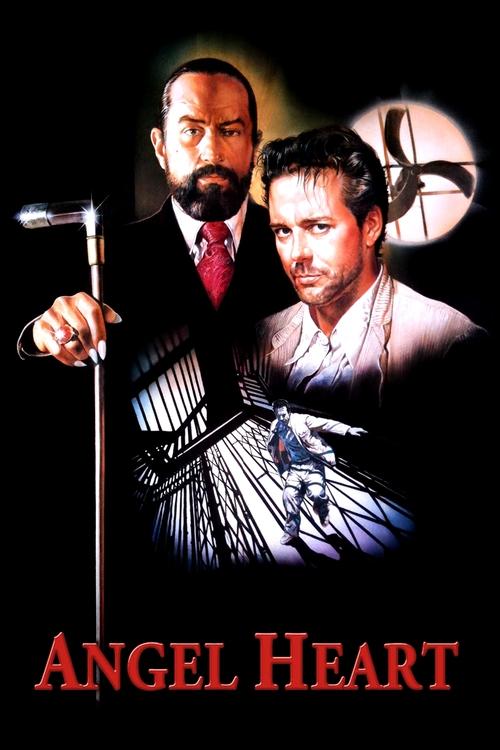
Angel Heart
1987 · Alan Parker
When you're craving something wicked — a late-night, lights-off mystery that trades jump scares for creeping damnation. Not comfort viewing; it's for when you want a film to get under your skin and stay there.
What it's about
In 1955, seedy Brooklyn private eye Harry Angel is hired by an elegant, unnervingly courtly stranger named Louis Cyphre to find a crooner who vanished owing a debt. The search drags Angel from Harlem jazz clubs down to the voodoo backwaters of Louisiana, and everyone he questions has a way of turning up dead. What starts as a missing-persons job curdles into something much older and darker.
The experience
Sweaty, dread-soaked, and hypnotic — a slow-burn mystery where the humidity practically drips off the screen and every clue makes you more uneasy. It's as much horror as noir, and the final stretch hits like a trapdoor opening.
Performances
Mickey Rourke at his rumpled mid-80s peak makes Harry Angel magnetic and doomed, while Robert De Niro's Louis Cyphre — precise, purring, toying with a hard-boiled egg — is one of the great minimal menace performances.
The craft
Alan Parker directs with a fever-dream density: fans turning, rain on windows, jazz bleeding through walls, New Orleans shot like an open wound. The atmosphere carries as much information as the plot, and it rewards dimming the lights and turning up the sound.
Why it matters
Notorious on release for a censorship battle over its most explicit scene, it has endured as a cult touchstone — the standard reference point for blending detective fiction with the supernatural.
Snapshot
Angel Heart is Alan Parker's hallucinatory fusion of hardboiled detective story and supernatural horror, adapted from William Hjortsberg's 1978 novel Falling Angel. Set in 1955, it follows Harry Angel (Mickey Rourke), a seedy Brooklyn private investigator hired by the courtly, sinister Louis Cyphre (Robert De Niro) to locate a crooner named Johnny Favorite who reneged on a debt. The search carries Angel from Harlem to the bayous of Louisiana, leaving a trail of mutilated corpses, until the investigation collapses into a single annihilating revelation: Angel himself is the man he is hunting, and Cyphre is the Devil come to collect a soul pledged long ago. The film is built around the noir convention of the detective who is unknowingly pursuing himself, pushed to a metaphysical and damnatory extreme. It is remembered for its oppressive, decaying atmosphere; for the controversy surrounding a bloody, voodoo-inflected sex scene between Rourke and Lisa Bonet that forced cuts to escape an X rating; and as one of the most committed marriages of detective fiction and occult horror in 1980s American cinema.
Industry & production
Angel Heart was produced through the orbit of Carolco principals Mario Kassar and Andrew Vajna, with Parker's film financed and assembled as an independent production and released in the United States by TriStar Pictures in March 1987. (Carolco/Tri-Star's exact financing arrangement and the picture's budget are matters where published figures are inconsistent, and I will not assign a specific number.) The project sat squarely in the mid-budget, auteur-driven adult thriller space that Hollywood still supported in the 1980s before the form was squeezed out.
The production's defining industrial event was its collision with the MPAA. Parker's first cut received an X rating, principally for a sex scene between Harry Angel and Epiphany Proudfoot (Lisa Bonet) intercut with imagery of blood and ritual. Parker trimmed roughly ten seconds to secure an R, a fight he discussed publicly and which became part of the film's marketing identity. The episode is frequently cited in histories of the MPAA's inconsistent treatment of sexual versus violent content.
A second, extra-textual controversy amplified the film's notoriety: Lisa Bonet was at the time a star of NBC's hugely popular family sitcom The Cosby Show, and her appearance in a graphic, blood-soaked sex scene generated significant press friction. The casting of a wholesome television personality against type became a talking point that shadowed the film's release.
Casting otherwise drew on Parker's instinct for faces with built-in history. Rourke, then near the peak of his early stardom, took the lead; De Niro accepted the supporting role of Cyphre, playing the Devil with manicured nails and a satanic beard, in a brief but defining part. Charlotte Rampling played the astrologer-mistress Margaret Krusemark.
Technology
Angel Heart is a conventionally photographed 35mm production of its period, and its technical character lies not in novel apparatus but in the deliberate cultivation of grain, smoke, and degraded light. Michael Seresin's cinematography leans on heavy atmospheric haze, practical-source lighting (bare bulbs, neon, fans throwing rotating shadows), and a desaturated, sepia-leaning palette that reads as both period evocation and moral decay. The recurring motif of the slowly turning ceiling fan — a blade chopping the light — is a simple in-camera device used as a metronome of dread. The film's effects are largely practical and makeup-based rather than optical: prosthetic gore, set dressing, and staged ritual rather than the optical compositing then increasingly common in genre cinema. The supernatural is achieved almost entirely through editing, sound, and performance rather than visual-effects technology, which is central to the film's grounded, tactile menace.
Technique
Cinematography
Seresin, Parker's longtime collaborator, gives the film its single most distinctive register: a world perpetually filmed through smoke and dust, lit so that highlights bloom and shadows swallow detail. New York is cold, gray, and verminous; New Orleans and the Louisiana bayou are humid, amber, and rotting. The camera favors low angles in cramped interiors and a restless attention to surfaces — peeling paint, standing water, rust, flesh. Slow push-ins and the obsessive recurrence of descending motifs (stairs, elevators, a turning fan) build a visual argument that the protagonist is moving downward, toward hell, throughout. Seresin's lighting is heavily motivated and often harsh, refusing the glamour of classical noir in favor of grime.
Editing
Gerry Hambling, Parker's regular editor, cuts the film as a steadily intensifying delirium. The structure is procedural on the surface — interview, clue, next location — but Hambling laces it with brief, violent flash-inserts: subliminal glimpses of blood, a fan, a face, ritual imagery, a piston-like pumping motion. These fragments recur and lengthen as Angel's repression cracks, so that the film's editing literalizes the return of buried memory. The notorious sex scene is the apotheosis of this method, intercutting carnal and sanguinary imagery until the two become indistinguishable. The cumulative effect is a movie that feels like it is remembering something it cannot bear to know.
Mise-en-scène / staging
Brian Morris's production design renders 1955 as a continuum of squalor and decay rather than nostalgic Americana. Spaces are cluttered, water-stained, and oppressively enclosed; even the wealthy interiors carry an air of corruption. Religious and occult iconography saturates the frame — crosses, voodoo altars, astrological charts, chickens, eggs, blood — staged so that Christian and Vodou symbolism bleed into one another. The Louisiana sequences exploit real swamp and small-town locations for an atmosphere of inescapable wetness and rot. Parker stages violence and ritual with deliberate, almost liturgical pacing, and the film's signature image — Angel descending in a cage elevator — is staged as a literal journey into the underworld.
Sound
The soundtrack is fundamental to the film's effect. Trevor Jones's score blends a smoky period jazz idiom — saxophone, the diegetic world of the crooner Johnny Favorite — with low, ominous synthesizer and percussion textures that signal the supernatural. Source music and score interpenetrate, so that the romance of 1950s popular song curdles into menace. The sound design foregrounds the mechanical (the fan, dripping water, the elevator), ritual percussion in the Vodou ceremony, and sudden stings tied to the flash-cut inserts. Sound, more than image, is what repeatedly punctures Angel's — and the viewer's — composure.
Performance
Mickey Rourke anchors the film with a performance of mounting disintegration: cocky and rumpled at the outset, he is progressively hollowed out by terror as the case turns inward, ending in shattered horror. It is one of the defining roles of his early career. Robert De Niro, in limited screen time, plays Louis Cyphre with controlled, velvet menace — fastidious, amused, peeling an egg, growing his nails and beard — a portrait of the Devil as patient gentleman; the name itself ("Lou Cyphre" / Lucifer) is the film's central pun. Lisa Bonet plays Epiphany Proudfoot with a wary sensuality that the film exploits and the surrounding controversy overdetermined. Charlotte Rampling brings cool decadence to the astrologer Margaret Krusemark. The ensemble of Southern characters lends the bayou sequences a vivid grotesquerie.
Narrative & dramatic mode
The film's dramatic engine is the detective-investigates-himself structure inherited from noir and from Oedipus: the searcher and the sought are one, and the solution is self-destruction. Parker and Hjortsberg play this as a deferred, dawning horror rather than a single twist — the audience, like Angel, accumulates dread before comprehension. The mode is subjective and unreliable: the flash-inserts mean we are inside a mind actively refusing its own memory, so that the realist procedural surface is continually destabilized by intrusions of the repressed. The ending offers no escape or redemption; it is a closed loop of damnation, with Angel's fate sealed before the film began. This fatalism — the sense that the investigation only confirms a verdict already rendered — is the film's defining dramatic shape.
Genre & cycle
Angel Heart is a deliberate hybrid of two genres usually kept apart: the hardboiled private-eye film and supernatural/occult horror. It belongs to the 1980s wave of "neo-noir," films that revived the visual and narrative conventions of 1940s detective cinema with explicit sex, violence, and a self-conscious darkness; and simultaneously to the post-Rosemary's Baby/The Exorcist tradition of Satanic horror. Its specific innovation is to make the noir detective's fatal self-discovery literally a matter of damnation. It also participates in a cycle of period-set Louisiana/Vodou gothic. The film stands as one of the era's most fully committed genre fusions, a noir whose darkness turns out to be metaphysical.
Authorship & method
Alan Parker, a British director who came up through advertising before features, was known for restless versatility across genres — musicals (Bugsy Malone, Fame), social drama (Midnight Express, Mississippi Burning), and prison and protest films. Angel Heart is his sole excursion into outright horror, and it bears his hallmarks: meticulous, atmosphere-saturated craft; a willingness to provoke; and a strong visual-stylistic control sometimes faulted as overwrought. Parker adapted Hjortsberg's Falling Angel himself, making the consequential structural decision to relocate much of the novel's New York–bound action to New Orleans and the Louisiana bayou, importing Vodou and the Deep South's atmosphere of decay to deepen the supernatural register.
His key collaborators are largely his recurring team. Cinematographer Michael Seresin and editor Gerry Hambling were long-standing partners whose work defines the film's smoky, fragmented texture. Composer Trevor Jones supplied the jazz-and-dread score. Production designer Brian Morris built the world of rot. The authorship is thus best understood as a tight, repeated creative unit applying a honed house style to unfamiliar genre material — with Hjortsberg's source novel providing the architecture and the central conceit.
Movement / national cinema
The film sits at a transatlantic crossing. Parker, Seresin, and Hambling were part of the British commercial-then-feature filmmaking cohort that emerged from advertising in the 1970s; their sensibility is European in its emphasis on atmosphere and style. Yet Angel Heart is profoundly an American film in subject — a study of the American 1950s, of New York and the South, of jazz, race, and home-grown syncretic religion. It is best located not in a national movement but in 1980s neo-noir, an international, stylistically self-aware revival of an American form, here executed by British craftsmen on American ground.
Era / period
The film is doubly periodized: made in the mid-1980s, set in 1955. Its production era explains its frankness — the post-1968 permissiveness around sex and violence, the MPAA negotiations, the appetite for adult genre cinema that the decade still sustained. Its setting in 1955 is essential to its meaning: the year places the action a decade after the wartime trauma implied in Johnny Favorite's backstory, within a pre-rock-and-roll jazz culture, and in a Jim Crow South whose racial and religious worlds the film traverses. The collision of a sanitized cultural memory of the 1950s with the film's vision of rot and damnation is part of its argument.
Themes
At its center is the theme of damnation and the irrevocable bargain — the Faustian sale of the soul, here literalized and collected. Closely bound to it is identity and repression: Harry Angel is a man who has annihilated his own past, and the film treats memory as a buried crime that the act of investigation exhumes. The detective-as-Oedipus motif makes self-knowledge synonymous with self-destruction. The film is steeped in the imagery of religion and its dark doubles — the interpenetration of Christianity and Vodou, baptism and blood, sex and death. Decay, corruption, and the inescapability of the past pervade every setting. Race and the American South form a charged undercurrent, with Vodou and Black Southern culture rendered both vividly and, as some critics have noted, through a lens of exoticized menace. Above all the film asserts a fatalism in which free will is an illusion and the verdict precedes the trial.
Reception, canon & influence
On release in 1987 Angel Heart divided critics. Admirers praised its sustained atmosphere, its visual and aural craft, and De Niro's chilling cameo; detractors found it overwrought, more impressive as mood than as story, and faulted its style as oppressive or its content as exploitative. Much of the contemporary conversation was absorbed by the MPAA dispute and the Lisa Bonet controversy, which arguably overshadowed sober critical assessment. (Specific box-office and review-tally figures vary across sources, and I will not cite numbers I cannot verify here.) Over time the film's reputation has settled into that of a flawed but distinctive cult object — a high-water mark for atmosphere in the neo-noir/horror hybrid, and a touchstone performance for Rourke.
The influences running into the film are clear: the hardboiled detective tradition of Chandler and Hammett and their screen adaptations; the Oedipal structure of the searcher who is the sought; the Satanic-horror lineage of Rosemary's Baby and The Exorcist; and, fundamentally, Hjortsberg's novel Falling Angel, which supplied the plot and the Cyphre/Lucifer conceit. Parker's advertising-honed visual maximalism and his team's prior collaborations shaped the execution.
Its legacy lies chiefly in atmosphere and template rather than direct imitation. Angel Heart helped consolidate a strain of Louisiana/Vodou gothic and the broader practice of grafting supernatural revelation onto noir investigation, an approach later visible across occult-detective film and television. Its imagery — the turning fan, the descending elevator, the courtly Devil — became reference points for the era's dark genre cinema, and the film is regularly revisited as a key 1980s neo-noir and as evidence of how MPAA ratings politics shaped what American genre films could show. Tracing its precise downstream debts is partly speculative, and where the documentary record of direct influence is thin, that thinness should be acknowledged rather than papered over; what is secure is the film's standing as one of the decade's most fully realized fusions of detection and damnation.
A Deleuzian reading
There is a fan turning at the top of almost every room in *Angel Heart*, a slow blade chopping the light into flicker.
The full Deleuzian reading of Angel Heart →
Reception
Released under a cloud in 1987 — a notorious MPAA ratings battle and Lisa Bonet tabloid frenzy overshadowed mixed reviews and soft box office — it's since been reappraised as one of the great neo-noir/horror hybrids of the decade.
How Angel Heart was received, from release to now →
Influences: the films it descends from and the films it influenced
- The Element of Crime (1984) — Michael Seresin sustains a damp tungsten-amber register with dripping water and rotating fans as recurring image-and-sound motifs, servicing the same structural reveal — the detective's investigation delivers him to himself as the murderer.
- Se7en (1995) — Inherits the rain-and-rot detective procedural that climaxes in the investigator discovering the case was authored around him — damnation delivered as the killer's premeditated design rather than a solvable crime.
- The Usual Suspects (1995) — Parker stages a neo-noir private investigator as unreliable narrator of his own hidden identity, using expressionist flashback lighting to visualize a protagonist whose embodied performance conceals his true nature from himself—the identity-as-performance-reveal template Singer adapts for Verbal's physical transformation.
- Identity (2003) — Builds a rain-and-decay neo-noir on the ontological twist that the investigator is himself the perpetrator — the identity reveal that retroactively reframes every prior scene, Identity's exact maneuver.
- The Machinist (2004) — The investigator who discovers he is his own quarry — a doppelganger guilt revealed by a retroactive reveal that rereads the whole film — is the structural blueprint for Trevor's pursuit.
- Constantine (2005) — Welds film noir's compromised private investigator to occult damnation, giving Constantine its template of a supernatural detective whose real case is the ledger of his own soul.
- The Devil's Advocate (1997) — The devil in mortal disguise with a punning name and manicured calm (Louis Cyphre → John Milton), plus the sulfurous amber-and-shadow interiors and the reveal that the protagonist was contracted before frame one.
- Rosemary's Baby (1968) — Establishes the slow-build Satanic conspiracy whose dread emerges from the protagonist's dawning, too-late comprehension — Angel Heart inherits its method of staging damnation as a banal social network closing around an oblivious victim rather than as overt monstrosity.
- The Exorcist (1973) — Pioneers subliminal demonic flash-frames cut into otherwise naturalistic footage; Angel Heart adopts the same near-invisible intercutting (faces, blood, descending shapes) to seed dread below conscious registration.
- Chinatown (1974) — The template of the hired detective whose investigation incriminates himself and ends in horrified, irreversible revelation — Angel Heart transposes Chinatown's noir Oedipal trap into a literal Faustian one.
- Murder, My Sweet (1944) — Codifies the Chandler hardboiled-PI screen idiom — first-person narration, smoky interrogations, the gumshoe led by a wealthy client into deepening corruption — the genre grammar Cyphre's hiring of Angel literalizes.
- Out of the Past (1947) — Defines noir fatalism as a buried past that hunts the protagonist down; Angel Heart restages this as supernatural predestination, the repressed crime returning as Lucifer's collection of a debt.
- Vertigo (1958) — Builds the investigation-into-a-woman that is secretly an investigation into the seeker's own dissolving identity, with descending/spiraling visual motifs — Angel Heart echoes its falling imagery and identity collapse.
- Don't Look Now (1973) — Associative, premonitory editing that splinters chronology and plants recurring color/object motifs whose meaning only resolves in a fatal final reveal — the fragmented, foreshadowing cut Hambling deploys throughout Angel Heart.
- Performance (1970) — Pioneers the British art-cinema identity-merger between two men through disorienting montage and mirror imagery — a direct precedent for the Angel/Cyphre doubling and Rourke's disintegration of self.
- Midnight Express (1978) — Parker and editor Gerry Hambling's earlier collaboration establishing the sweat-soaked, percussive, hallucinatory style of physical and psychological degradation that Angel Heart turns toward the occult.
- Pink Floyd – The Wall (1982) — Parker, cinematographer Michael Seresin, and Hambling perfect the nightmare-logic insert and metaphor-dense surreal montage — the advertising-honed maximalist image-stream carried directly into Angel Heart's smoke-and-haze visuals.
- Mississippi Burning (1988) — Sibling work where the same Parker/Seresin team renders the Deep South as a heat-hazed landscape of buried violence and Jim Crow rot — sharing Angel Heart's atmospheric treatment of Southern decay and racial guilt.
- Jacob's Ladder (1990) — Descendant from the same British-advertising cohort (Lyne) using subliminal flash-frames, demonic glimpses, and unreliable subjectivity so the protagonist — and viewer — only belatedly grasp he is already damned/dead.
Similar films
- Murder, My Sweet (1944) — influence & lineage
- Mississippi Burning (1988) — influence & lineage
- Chinatown (1974) — influence & lineage
- Longlegs (2024) — same viewing thread
- Kiss Me Deadly (1955) — shared sensibility
- In a Lonely Place (1950) — shared sensibility
- L.A. Confidential (1997) — shared sensibility
- Elevator to the Gallows (1958) — shared sensibility
All the films related to Angel Heart →
Watch it with: curated runs of related films
- Fever-Dream Horror — Watch these when you want horror that runs on dream logic — witches, circuses, crematoria and occult dread rendered as hand-crafted, hallucinatory nightmare rather than jump-scare.