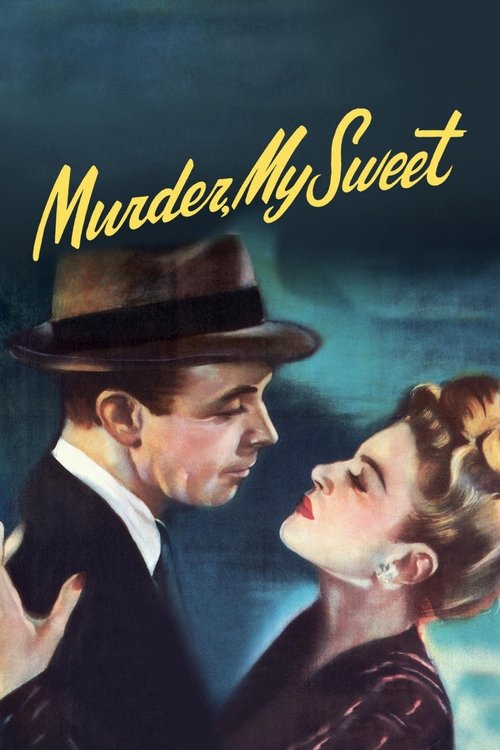
Murder, My Sweet
1944 · Edward Dmytryk
For a late night when you want shadows, cigarettes, and dialogue that snaps — rainy-evening comfort viewing for anyone who loves a detective story with style to burn.
What it's about
Private detective Philip Marlowe takes what looks like a simple job — a hulking ex-con wants help finding his old girlfriend — and is promptly pulled into a Los Angeles maze of jade, blackmail, drugged interrogations, and beautiful people lying to him. Every thread he pulls tangles with another, and every client seems to want him for something other than what they say. He narrates the whole descent himself, wisecracks intact.
The experience
Moody, quotable, and pleasurably disorienting — the hard-boiled voice-over carries you through shadows, double-crosses, and one famously woozy drug-induced nightmare sequence. It's tense but fun, the kind of mystery where the atmosphere matters more than the solution.
Performances
Dick Powell, previously known as a boyish musical star, reinvented himself as Marlowe — hard, funny, and believably out of his depth — a casting gamble that rescued his career and set the mold for the wisecracking screen detective.
The craft
This is foundational noir style: first-person narration, chiaroscuro shadow, and expressionist flourishes like the hallucination sequence, which was daring for a 1944 studio picture. The black-and-white photography drips with menace and rewards a dark room.
Why it matters
One of the key films of noir's watershed year, it put Raymond Chandler's Marlowe on screen under his own name and helped codify the visual and narrative grammar of film noir itself.
Horror · Suspense & terror. A wisecracking private eye narrates his way through shadows, double-crosses and a woozy drugged nightmare; all human menace, no gore.
Snapshot
Murder, My Sweet is the film that put Raymond Chandler's private detective Philip Marlowe on the screen under his own name, and in doing so helped codify the visual and narrative grammar of what French critics would later christen film noir. Adapted by John Paxton from Chandler's 1940 novel Farewell, My Lovely and directed by Edward Dmytryk for RKO Radio Pictures, it arrived in the same watershed year as Billy Wilder's Double Indemnity (also Chandler-connected, as co-writer) and Otto Preminger's Laura. Its most storied gambit was casting Dick Powell — the boyish tenor of Warner Bros. Busby Berkeley musicals — as the hard, wisecracking Marlowe, a reinvention that rescued Powell's fading career and permanently altered the public image of the detective hero. Wrapped in first-person voice-over, chiaroscuro shadow, and a celebrated drug-induced hallucination sequence, the film translated Chandler's prose-thick subjectivity into cinema more fully than almost any noir before it.
Industry & production
The film was produced at RKO, a mid-major studio that during the 1940s became one of the most fertile grounds for the emerging noir cycle, thanks in part to a house style of atmospheric, economical, shadow-heavy filmmaking (the same lot that produced Val Lewton's horror unit and, later, Out of the Past). The producer was Adrian Scott, working with director Edward Dmytryk — a pairing that would prove consequential both artistically and politically, since both men were later among the Hollywood Ten blacklisted after the 1947 HUAC hearings.
RKO had already exploited Chandler's Farewell, My Lovely once: the studio owned the rights and had folded its plot into the 1942 B-picture The Falcon Takes Over, one of its Falcon detective series, without Marlowe. For this second, straight adaptation the studio faced a marketing problem. Dick Powell, cast against type, was still associated by audiences with light musicals and crooning; a picture titled Farewell, My Lovely risked being mistaken for a Powell musical or romance. RKO therefore retitled it Murder, My Sweet for U.S. release, sharpening the genre signal — though in the United Kingdom it was released under Chandler's original title. The reported anecdote that the retitling followed disappointing preview reactions to the "Farewell" name is widely repeated in the literature; the precise internal chronology is not something I can verify with certainty here.
Powell's casting is the production's defining decision. He reportedly lobbied hard for a role that would break his musical image, and the gamble succeeded: the performance relaunched him as a credible tough-guy lead and is often cited as one of Hollywood's most effective deliberate career pivots. The supporting cast drew on RKO contract and character players, including Claire Trevor, Mike Mazurki, Otto Kruger, Miles Mander, and Anne Shirley — for whom this was among her last films before she retired from acting.
Technology
Technically the film is a conventional mid-1940s studio production in its materials — 35mm black-and-white photography, Academy ratio, optical sound, studio-bound sets supplemented by process work — but it deploys the standard toolkit toward unusually expressive ends. The signal technological showcase is the hallucination sequence, in which Marlowe is drugged and interrogated. Here the filmmakers combine optical effects, superimposition, distorting devices, drifting smoke, and dissolving "cobweb" imagery to visualize a subjective descent into unconsciousness — Chandler's oft-quoted image of "a black pool opened up at my feet" rendered through the era's in-camera and laboratory optical techniques rather than any exotic apparatus. The achievement lies less in novel hardware than in the imaginative marshalling of existing optical-printing and lighting tools to externalize a first-person mental state, an ambition that the technology of the period could only approximate but that the film embraces wholeheartedly.
Technique
Cinematography
The cinematography, by Harry J. Wild, is foundational to the film's reputation as an early noir template. Wild works in deep, sculpted low-key lighting: pooled light and engulfing shadow, hard key lights that throw faces into partial darkness, wet-looking streets and windowpanes streaking rain-light across interiors, and the recurrent motif of a figure looming out of blackness (most memorably Moose Malloy's first appearance, reflected in Marlowe's office window). Compositions favor depth and entrapping foreground elements — banisters, bars of shadow from blinds, doorframes — that box the protagonist inside the frame. The camera also participates in the film's subjectivity, at moments aligning with Marlowe's point of view, and the visual scheme tips fully into expressionism during the drug sequence. This is textbook noir photography partly because Murder, My Sweet helped write the textbook.
Editing
The editing, credited to Joseph Noriega, serves a structure built on flashback and retrospection. The film opens at its chronological end — Marlowe under interrogation, his eyes bandaged — and then unspools the case as narrated recollection, so the cutting must continually stitch present-tense frame to past-tense investigation. Within scenes the rhythm is largely classical and dialogue-driven, but the editing turns aggressively subjective in the hallucination passage, where dissolves, superimpositions, and disorienting transitions collapse continuity to mimic drugged perception. The overall shape prioritizes the sensation of a mind reconstructing events, which is precisely the Chandlerian effect the adaptation chases.
Mise-en-scène / staging
Dmytryk stages the film across a gallery of noir spaces: the cramped detective's office, a decaying rooming house, an opulent seaside mansion housing corrupt wealth, a quack psychic's consulting rooms, a beach hideout. The staging repeatedly contrasts the physical enormity and childlike menace of Moose Malloy with Marlowe's smaller, verbal cunning, and it uses domestic and luxurious interiors to expose the rot beneath moneyed surfaces — a class critique embedded in décor. Costuming and playing space distinguish the film's two women: the predatory glamour of Helen Grayle against the plainer, more sincere Ann. Objects and thresholds — mirrors, windows, staircases — recur as staging devices that trap or double the characters.
Sound
Sound design centers on Marlowe's first-person voice-over, which carries Chandler's similes and cynicism directly onto the soundtrack and binds the flashback structure together. The narration is not incidental color; it is the film's organizing consciousness, and its success is a large part of why the movie feels so thoroughly "Chandler." Diegetic sound is used pointedly in the hallucination sequence, where distorted and layered audio reinforces the visual disorientation. Roy Webb's score (see below) provides the film's musical sound-world, keyed to menace and romance rather than to Powell's former musical persona.
Performance
Dick Powell's Marlowe is the performance the film is remembered for: dry, weary, quick with a barb, physically credible in danger, and vulnerable in the drugged and blinded passages. He established a template — the wisecracking but bruised knight — that Bogart would inflect differently in The Big Sleep two years later. Claire Trevor, a noir specialist, plays Helen Grayle with cool, calculating allure as the film's femme fatale. Mike Mazurki's Moose Malloy is an indelible piece of physical typecasting: hulking, obsessive, pathetically fixated on his lost "little Velma," and genuinely frightening. Otto Kruger brings smooth menace as the fake spiritualist-blackmailer Jules Amthor, and Anne Shirley supplies the film's counterweight of decency. The ensemble's contrast of grotesque, seductive, and sincere registers gives the moral murk its texture.
Narrative & dramatic mode
The narrative mode is retrospective first-person mystery: a framing interrogation from which Marlowe narrates the tangled case in flashback. The dramatic engine is the classic hard-boiled structure of an investigator hired for one small job — finding Moose Malloy's missing girlfriend Velma, and separately guarding a jewel payoff for the nervous Lindsay Marriott — who is pulled into a widening conspiracy of blackmail, murder, hidden identity, and corrupt wealth. Chandler's plots are famously labyrinthine and Murder, My Sweet preserves that density; comprehension depends less on tracking every plot thread than on following Marlowe's sensibility through the moral fog. The mode is subjective throughout — we know only what Marlowe knows, discover as he discovers, and are literally plunged into his compromised perception during the drug sequence — which makes the film an unusually faithful cinematic analog to Chandler's narrating voice.
Genre & cycle
The film sits at the fountainhead of the American film noir cycle, appearing in 1944 alongside Double Indemnity and Laura at the moment the style crystallized. It is simultaneously a hard-boiled detective picture — descended from the Black Mask school of Hammett and Chandler and from earlier screen detectives — and a fully noir work in its visual style, moral ambiguity, femme fatale, doomed romantic undercurrent, and subjective narration. As the first film to name Philip Marlowe on screen, it also inaugurated the specifically Chandlerian strain of noir, distinct from the Hammett-derived Maltese Falcon line, and it set expectations for the Marlowe adaptations that followed. Its influence on the private-eye subgenre — the voice-over, the retrospective structure, the wounded knight-errant hero — was substantial.
Authorship & method
Authorship here is genuinely collaborative. Edward Dmytryk directs with a command of atmosphere and pace that anticipates the socially conscious, shadow-driven work he would continue (notably Crossfire, 1947, again with producer Adrian Scott); Dmytryk's later trajectory — blacklisted as one of the Hollywood Ten, then controversially recanting and testifying — belongs to Hollywood's political history more than to this film's text, but it frames how his career is read. John Paxton, the screenwriter, performed the crucial labor of compressing Chandler's sprawling novel into a filmable structure while retaining the voice; the decision to foreground first-person narration is central to the adaptation's success. Cinematographer Harry J. Wild supplied the low-key, expressionist look that is inseparable from the film's identity. Composer Roy Webb, an RKO stalwart whose scoring across the studio's noir and Lewton horror output shaped the label's sonic signature, provided a score attuned to dread and romantic fatalism. Editor Joseph Noriega realized the flashback architecture. Art directors Albert S. D'Agostino and Carroll Clark built the entrapping interiors. The film is a case study in how noir was a studio-craft achievement as much as a directorial one.
Movement / national cinema
As American studio cinema, the film belongs to the classical Hollywood system at its height, but it is a key early instance of the noir sensibility that fused several currents: German and Central European expressionism (carried by émigré cinematographers, art directors, and directors), the American hard-boiled literary tradition, and the darker national mood of the wartime and immediate postwar years. RKO functions almost as a movement unto itself in this period, its economical, shadow-forward house aesthetic providing an ideal incubator. The film is thus both quintessentially Hollywood and part of the transnational stylistic migration that made noir possible.
Era / period
Released in 1944, the film is a product of the later war years, and its cynicism, moral exhaustion, and preoccupation with corruption and hidden guilt resonate with a culture strained by war even when the story itself is not about the war. It stands at the threshold of the great postwar noir boom of 1945–1955. Its production also sits on the eve of the political upheaval that would soon engulf its makers: within a few years, HUAC's investigations would blacklist both Dmytryk and Scott, making the film a poignant artifact of talents about to be scattered by the anti-Communist purges.
Themes
The film's themes are Chandler's: obsession and the destructive persistence of desire, embodied in Moose Malloy's fixation on the vanished Velma; the corruption festering beneath wealth and respectability; identity as disguise, with a past self buried under a new name; and the lone investigator's precarious integrity in a world that constantly tries to buy, drug, beat, or seduce him off his course. Marlowe's temporary blindness in the framing device literalizes a recurring noir motif of impaired vision and hidden truth — the detective who must reconstruct reality while unable to see. Betrayal, blackmail, and the impossibility of clean moral outcomes pervade the resolution.
Reception, canon & influence
Contemporary reception is generally recorded as strong, with particular surprise and praise directed at Dick Powell's transformation from crooner to convincing tough guy — the performance is consistently treated in the historical record as the film's revelation and as a savvy piece of career reinvention. I would avoid citing specific grosses or individual period reviews I cannot verify, but the broad consensus that the film was both a commercial success and a critical validation of Powell's gamble is well established.
Looking backward, the film draws on the Black Mask hard-boiled tradition (Chandler and, before him, Hammett), on the German expressionist visual lineage transmitted through Hollywood's émigré craftsmen, and on RKO's own developing atmosphere-first house style. Looking forward, its influence is considerable: it established Philip Marlowe as a screen figure and set the terms — voice-over narration, flashback confession, chiaroscuro, the bruised-knight detective — that later Marlowe films and private-eye pictures would inherit and vary, from Howard Hawks's The Big Sleep (1946) onward. Chandler's Farewell, My Lovely was adapted again in 1975 under its original title, with Robert Mitchum as an aging Marlowe, a version that consciously measures itself against the 1944 template. Within the noir canon, Murder, My Sweet is routinely named among the founding works of the cycle and among the most faithful screen translations of Chandler's narrating sensibility — a reputation that has only solidified through decades of noir scholarship and retrospective programming.
A Deleuzian reading
Marlowe stands at his office window after dark, looking down at the city.
The full Deleuzian reading of Murder, My Sweet →
Reception
A hit in 1944 and one of the films French critics actually had on the table when they coined the term 'film noir' in 1946 — so its stock never crashed; it just got promoted from snappy thriller to founding document of a genre.
How Murder, My Sweet was received, from release to now →
How to watch Murder, My Sweet: what to notice on a first viewing
- Watch shadows from window blinds cut across every interior. Harry Wild lights the film in deep pools of shadow and hard key light, with banisters and blind-slats repeatedly boxing Marlowe inside the frame. The lighting traps him visually before the plot does, telling you he is caught in something long before he admits it.
- Listen for Marlowe's voice narrating over nearly every scene. The first-person voice-over carries Chandler's wisecracks and similes directly onto the soundtrack, binding the flashback structure into a single remembered voice. You are never just watching the case; you are hearing one man's mind reconstruct it after the fact.
- Watch Mazurki's size against Powell's quick, small movements. Moose Malloy's hulking physical menace is staged directly against Marlowe's smaller, verbal cunning, so their scenes together play as a contrast in scale. The mismatch in size sets up who wins each scene through wits rather than strength, before either man throws a punch.
- Notice the film opens with Marlowe already under interrogation, eyes bandaged. Everything that follows is his own recollection told backward from that room, so the case is delivered to you as memory rather than as it happens. You already know he survives whatever is coming, which changes how you watch every danger along the way.
- Notice the wealthy mansion staged as carefully as the shabby office. Dmytryk moves between a cramped detective's office, a decaying rooming house, and an opulent seaside mansion, using the luxury interiors to expose the rot under moneyed surfaces. The film uses its sets to make a quiet argument about class before any character says a word about money.
The whole guide to watching Murder, My Sweet, with the keys for a rewatch →
Influences: the films it descends from and the films it influenced
- The Maltese Falcon (1941) — Established the screen grammar of the Hammett/Black Mask private eye that Paxton's Marlowe inherits — the shabby office, the parade of duplicitous clients delivering exposition, and dialogue lifted near-verbatim from hard-boiled prose.
- Citizen Kane (1941) — RKO source for the interlocking flashback architecture and Gregg Toland's low-key deep-focus with visible ceilings and pooled shadow, the studio-craft toolkit Harry Wild draws on for the entrapping interiors.
- Stranger on the Third Floor (1940) — RKO's proto-noir that first fused German-expressionist distortion with a first-person subjective nightmare montage — the direct precedent for Marlowe's drugged hallucination sequence.
- The Cabinet of Dr. Caligari (1920) — Origin of the expressionist visual code — canted geometry, painted shadow, unstable subjective space — transmitted to Hollywood by émigré craftsmen and cited directly in the film's oneiric drugged passages.
- M (1931) — Lang's expressionist crime staging — figures pinned by hard key light against enveloping black, the criminal underworld rendered as a shadow-architecture — models the chiaroscuro entrapment Wild builds around Marlowe.
- Cat People (1942) — Val Lewton's RKO unit set the atmosphere-first house style — Nicholas Musuraca's suggestive low-key lighting and Roy Webb's dread-and-fatalism scoring, the same sonic signature Webb brings here.
- The Big Sleep (1946) — Inherits the screen Marlowe that this film established — the wisecracking bruised-knight detective moving through a labyrinth of Chandler exposition, though Hawks trades voice-over for repartee.
- Out of the Past (1947) — Perfects the RKO flashback-plus-voiceover noir — Musuraca's chiaroscuro and a doomed retrospective narration organizing a man's account of a femme fatale who ensnared him.
- Crossfire (1947) — Dmytryk reunites with producer Adrian Scott, writer John Paxton, and the RKO shadow style, carrying the same socially conscious, low-key noir craft forward to a message picture.
- Lady in the Lake (1947) — Pushes this film's first-person Marlowe to a literal extreme — the entire picture shot as subjective point-of-view camera, radicalizing the retrospective narration device into optics.
- The Long Goodbye (1973) — Revisionist deconstruction of the screen Marlowe codified here — Altman keeps the private-eye-adrift-in-a-corrupt-milieu and Chandler source but drains the heroic voice-over and chiaroscuro certainty.
- Farewell, My Lovely (1975) — A conscious re-adaptation of the same Chandler novel that measures itself against the 1944 template, restoring the period voice-over narration with an aging Robert Mitchum as Marlowe.
- Dark Passage (1947) — Dmytryk's drugging and knockout sequences used optical superimposition and crash-zooms to render Marlowe's disoriented subjectivity, establishing the expressionist grammar for subjective-camera states that Daves deploys in Dark Passage's post-surgical transition.
- Kiss Me Deadly (1955) — Pioneers the brutalized first-person PI subjected to drugging and beating (the swirling 'black pool' subjectivity), the abused-detective template Aldrich escalates into Mike Hammer's sadism.
- The Band Wagon (1953) — Supplies the hard-boiled first-person voiceover and expressionist noir lighting grammar that the Girl Hunt Ballet parodies beat-for-beat in its Spillane-style pastiche.
- Pursued (1947) — Its first-person framed-flashback confession and hallucinatory nightmare inserts model the subjective, memory-driven noir structure Christian Nyby cuts into Pursued.
- Kiss Kiss Bang Bang (2005) — Established the Chandler template Black burlesques — the whole case told in retrospective first-person confession by a Marlowe who narrates from a chair he can't leave — which Harry's constantly-derailed voice-over quotes and then sabotages by admitting he's a bad narrator.
- Double Indemnity (1944) — The same-year template for retrospective first-person confession: a doomed narrator's voice-over frames the whole film as flashback testimony, foregrounding a fatal romantic obsession exactly as Paxton's structure does.
- The Lost Weekend (1945) — Extends the subjective-derangement montage — Wilder's delirium-tremens hallucination sequence is the same first-person collapse of perception dramatized in Marlowe's drugged 'black pool' passage.
- Spellbound (1945) — Deploys the era's subjective-hallucination device — a stylized dream/psychosis montage rendering a character's impaired, distorted vision on screen, kin to the film's expressionist drugged interlude.
- Detour (1945) — Poverty-row distillation of the retrospective first-person noir — a bitter voice-over narrator recounts his own entrapment, the bruised-fatalist confession mode Powell's Marlowe helped codify.
- The Blue Dahlia (1946) — Chandler writing directly for the screen rather than adapted — the same hard-boiled investigation voice and returning-veteran fatalism that Paxton preserved in translating him.
- Angel Heart (1987) — Codifies the Chandler hardboiled-PI screen idiom — first-person narration, smoky interrogations, the gumshoe led by a wealthy client into deepening corruption — the genre grammar Cyphre's hiring of Angel literalizes.
Similar films
- The Big Sleep (1946) — influence & lineage
- Double Indemnity (1944) — influence & lineage
- The Long Goodbye (1973) — influence & lineage
- The Maltese Falcon (1941) — influence & lineage
- Out of the Past (1947) — influence & lineage
- Kiss Me Deadly (1955) — shared sensibility
- The Woman in the Window (1944) — shared sensibility
- Laura (1944) — shared sensibility