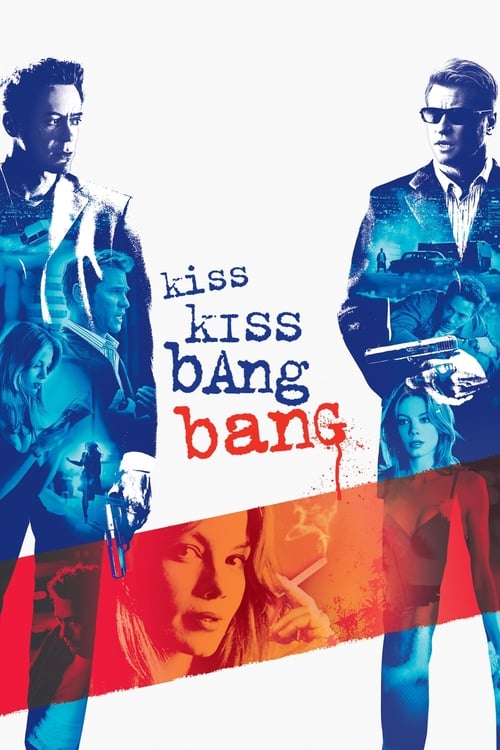
Kiss Kiss Bang Bang
2005 · Shane Black
For when you want to be entertained, full stop — a whip-smart crime comedy for a night in with someone who loves quotable dialogue. Ideal off-season Christmas viewing for people allergic to sentimentality.
What it's about
Harry Lockhart is a small-time New York thief who flees a botched Christmas robbery straight into a Hollywood audition — and wins it. Shipped to Los Angeles, he's assigned to shadow Perry van Shrike, a gay private eye who consults for the movies, as research for a role. Then a real body turns up, Harry's high-school dream girl reappears as a struggling actress, and the three of them tumble into exactly the kind of pulpy murder mystery Harry has only ever read about.
The experience
Fast, profane and constantly winking — the narrator interrupts himself, the plot happily tangles, and the jokes arrive faster than you can catch them all. Underneath the snark there's real menace and a surprising sweetness, and it rewatches beautifully.
Performances
Robert Downey Jr., in the role that relaunched his career, is all motor-mouthed charm and self-sabotage, and Val Kilmer gives arguably his funniest performance as the unflappable, withering Perry. Michelle Monaghan crackles as the dream girl with her own agenda.
The craft
Shane Black — the screenwriter who defined the 1980s buddy action movie — directs his own script for the first time and gleefully takes apart every trick he invented: the mismatched partners, the Christmas setting, the hard-boiled narration that keeps admitting it's telling the story badly. The pulp-novel chapter structure and neon-noir Los Angeles are all part of the joke.
Why it matters
A box-office footnote that became a beloved cult comedy, it put Downey back on the map on the road to his superstardom and set the template for Black's later self-aware action films.
Snapshot
Kiss Kiss Bang Bang is the directorial debut of Shane Black, the screenwriter who more or less defined the shape of the American studio action film in the late 1980s and early 1990s, and it plays like a settling of accounts with his own idiom. A petty thief, Harry Lockhart (Robert Downey Jr.), flees a botched Christmas-season robbery in New York, blunders into a Los Angeles audition, and is farmed out for research to Perry van Shrike (Val Kilmer), a gay private detective who consults for the movies. A surveillance job goes wrong, a body turns up, and Harry — reunited with Harmony Faith Lane (Michelle Monaghan), the girl he idolized in high school, now a struggling actress — finds himself inside the kind of story he has only ever read.
The film is credited as based in part on Brett Halliday's 1941 Mike Shayne mystery Bodies Are Where You Find Them, but its true source text is Raymond Chandler, whose novels supply the film's five chapter headings. What Black builds on that armature is a hardboiled Los Angeles mystery narrated by a man who cannot competently narrate, in which the detective story's machinery is simultaneously executed and heckled. It failed commercially on release and has since become one of the most durable cult objects of the DVD era — the hinge on which Downey's career turned, and the direct ancestor of Black's The Nice Guys (2016).
Industry & production
The production is best understood as a rehabilitation on two fronts. Black had been the most conspicuous beneficiary of the spec-script boom: Lethal Weapon (1987) made him a name at twenty-something, and The Last Boy Scout (1991) and The Long Kiss Goodnight (1996) sold for sums widely reported at the time as records, figures that became part of the industry's folklore about screenwriter pay. The commercial failure of Last Action Hero (1993) — a film he rewrote and which was positioned as an event picture — damaged that standing badly, and Black effectively vanished from produced credits for most of a decade. Kiss Kiss Bang Bang was his return, and his first time directing.
Downey's situation was more precarious. After a period of arrests, court-mandated treatment and incarceration, he was largely uninsurable for studio leads; his mid-2000s work came through directors and producers willing to absorb the risk. Casting him as Harry was not a coup at the time but a concession to a modest budget, and the film's subsequent reputation as the pivot of a comeback is retrospective. Kilmer, likewise, was some distance from his early-1990s peak.
Joel Silver produced through Silver Pictures, with Warner Bros. distributing — a continuity worth noting, since Silver had produced both Lethal Weapon and The Last Boy Scout. The film screened at Cannes in 2005 outside the competition and played the festival circuit before a platform release in the autumn of that year. It did not find an audience theatrically; its domestic gross was small enough that the film was understood as a commercial disappointment, and it recouped and then far exceeded its theatrical profile on home video. Precise budget and grosses circulate in the trade record, but the meaningful fact is structural rather than numerical: a mid-budget, dialogue-driven genre film aimed at adults was, by 2005, exactly the category the studios were least equipped to market.
Technology
Technically, the film is unremarkable by design, and that is the interesting thing about it. It was shot on 35mm for anamorphic-width presentation (2.39:1), largely on Los Angeles locations — houses in the hills, motels, industrial edges of the city — with practical lighting logic and a small-unit economy. There are no set-piece effects of consequence; the film's most spectacular moments are a car going into a reservoir and a gunshot to a hand, both handled with in-camera pragmatism.
The technology that actually determined the film's fate was distributive rather than photographic. Kiss Kiss Bang Bang arrived at the apex of the DVD market, when a studio title that underperformed theatrically could be rediscovered wholesale by a rental-and-purchase audience, passed along by word of mouth, and sustained by the supplementary culture of commentary tracks and message-board evangelism. Its reputation was built in living rooms across 2006 and 2007, in a window that no longer exists in the same form; the same film released in the streaming era would likely have been algorithmically buried rather than culted into permanence. Detailed documentation of the production's specific camera, lab and finishing choices is thin in the public record, and it would be invention to be more precise.
Technique
Cinematography
Michael Barrett's photography holds a difficult middle position: it has to be handsome enough that the noir pastiche registers as sincere, and unfussy enough that the comedy can breathe. He shoots Los Angeles at Christmas in a register of warm interiors and cold exteriors — string lights, lamplit rooms, party houses glowing above the basin — against night streets that are sodium-orange and unglamorous rather than rain-slicked and expressionist. The widescreen frame is used for two-shots: much of the film is Harry and Perry in a car, in a doorway, on a rooftop, positioned so that the joke is architectural, one man composed and one man coming apart within the same image.
Barrett largely refuses the visual quotations the material invites. There are no venetian-blind shadows, no smoke-and-key-light homages. The genre memory is carried by the writing and the structure; the camera stays contemporary, which keeps the film from curdling into costume.
Editing
Jim Page's cutting is where the film's argument about narration actually lives. Harry's voice-over is not an overlay on a stable story but an active, unreliable interference with it. He gets ahead of himself and the film jumps; he admits he has forgotten to show us something and the film reverses to insert it; he apologizes for a scene and the scene is elided. Freeze-frames, rewinds and direct address are deployed not as continuous stylistic noise but as punctuation, arriving when the mystery plot threatens to become merely competent.
The effect is to make the audience conscious of the detective story as a device — a machine for withholding and revealing — without ever disabling it. The mystery still resolves; the clues still pay. Black and Page are running the genre and annotating it in the same pass, and the editing does most of the annotating.
Mise-en-scène / staging
The film's world is Hollywood as an ecology of the almost-arrived. Harmony's apartment, the audition offices, the party at which the plot detonates, the sad hotel where Harry keeps not sleeping: these are the spaces of people adjacent to an industry that has not admitted them. Christmas decoration is everywhere, a Black signature carried over from Lethal Weapon and The Long Kiss Goodnight and forward into Iron Man 3 and The Nice Guys. The tinsel does specific work here — it insists on family, homecoming and reconciliation in a story about orphaned, transplanted people lying about who they are.
Violence is staged flatly and abruptly. Bodies arrive without warning and are disposed of with logistical embarrassment; a corpse in a trunk becomes a problem of parking rather than of conscience. The film's most famous gag — a finger lost to gunfire and then compounded by an act of sanitary indignity — is staged as slapstick with real consequences, which is the film's tonal method in miniature.
Sound
The soundscape is dense with talk. Overlapping dialogue, interruption and self-correction are the film's native rhythm, and the mix has to keep three registers legible at once: scene dialogue, Harry's retrospective narration, and the narration's arguments with itself. John Ottman's score works in noir idiom — brass, low strings, a jazz-inflected investigative pulse — but plays it with a slight lift that signals affection rather than gravity, and folds in seasonal orchestral color for the Christmas frame. Gunfire is mixed dry and loud, arriving as shock rather than spectacle. The film consistently uses sound to deny the audience the cushioning that action cinema normally supplies.
Performance
Downey's Harry is a performance of continuous verbal panic: a man narrating his life a half-second before he understands it, whose fluency is a symptom rather than a competence. It is the template for the register Downey would carry into Iron Man three years later, though here it runs without the armor of charisma-as-power — Harry is genuinely a coward and genuinely unequipped.
Kilmer plays Perry as the exact inverse: economical, unhurried, professionally lethal, and bored by Harry's crisis. That Perry is gay is treated as a plain fact of the character rather than a subject of the film — in 2005, a mainstream studio genre picture in which the competent detective is gay, and in which the joke is consistently on the straight protagonist's discomfort, was not nothing, even if the nickname "Gay Perry" reflects the era's limits.
Monaghan's Harmony has the hardest assignment: she has to hold the film's grief. Her performance carries the dead sister, the ruined childhood, and the specifically Angeleno disappointment of a person who came west on the strength of pulp novels, and she plays it without softening Harmony's anger.
Narrative & dramatic mode
The film's mode is metafictional hardboiled comedy. Chapter titles borrowed from Chandler — among them Trouble Is My Business, The Lady in the Lake, The Little Sister, The Simple Art of Murder and Farewell, My Lovely — announce a structure that the film then treats as both scaffolding and punchline. Harry addresses us; he mocks the conventions of voice-over while using them; he complains about narrative economy; near the end he jokes about the film's refusal to stop ending.
Beneath the reflexivity, the plot is a genuine mystery of the Chandler type: a wealthy patriarch, a scheme of substitution and concealment, sexual violation inside a family, and a solution that implicates the powerful and rescues nobody entirely. Black's structural fidelity is real — the pieces interlock — but he keeps exposing the seam between the pleasure of the puzzle and the ugliness of what puzzles like this are always about. The film's recurring device, the in-world Jonny Gossamer pulp novels that Harmony and her sister read as children, makes the argument explicit: these stories teach people to expect a world with detectives in it, and the disappointment of finding out otherwise is the film's actual subject.
Genre & cycle
It belongs to three overlapping lines. First, the Los Angeles private-eye film in its revisionist phase — Altman's The Long Goodbye (1973), Chinatown (1974), and Farewell, My Lovely (1975) — where the detective's competence is precisely what is under interrogation. Second, the Hollywood-on-Hollywood noir, from Sunset Boulevard (1950) through The Player (1992), L.A. Confidential (1997) and Mulholland Drive (2001), in which the film industry is the crime scene. Third, the post-Pulp Fiction cycle of talkative, structurally playful crime comedies that dominated the 1990s and had largely exhausted its studio welcome by 2005.
Its nearest contemporary is Rian Johnson's Brick, also 2005, which transposes Hammett's diction into a high school. The coincidence is telling: the mid-2000s produced two significant American films built on the premise that hardboiled language had become a found object, available for quotation rather than inheritance.
Authorship & method
Black is the film's author in the strong sense — writer and director, adapting his own long-standing preoccupations. The Black signature set is fully present: Christmas in a warm city; a mismatched professional pair; violence that hurts; ornate insult comedy; a wounded woman with more moral seriousness than either man; and dialogue built on interruption. What is new is the reflexive layer, which reads unmistakably as commentary on the buddy-action formula he himself standardized with Lethal Weapon. Having watched that formula become the industry's default and then watched the industry discard him, Black returned to disassemble it in public.
His key collaborators serve that program. Barrett's photography grounds the pastiche; Page's editing enacts the unreliability; Ottman — himself an editor by training, on The Usual Suspects and the X-Men films — supplies a score that knows it is quoting. Silver's production support connects the film directly to the 1980s action cycle it is arguing with. Black had also been on the other side of the camera in that cycle, appearing as Hawkins in Predator (1987), a role that gave him a first-hand education in how a genre ensemble functions and gets killed off.
Movement / national cinema
Kiss Kiss Bang Bang is not a movement film, and it would be false to place it in one. It is American studio filmmaking made at an independent scale — the product of a specific pocket in mid-2000s Hollywood where a producer with standing could get a modest genre picture financed on the strength of a writer's reputation. If it belongs to any tendency, it is the long American practice of genre self-commentary, an internal rather than a national or regional formation. Its Los Angeles is a genuine subject rather than a backdrop, which aligns it with a durable strain of city-specific American cinema, but it is not part of any organized school.
Era / period
The film is precisely of 2005. It arrives after the exhaustion of the 1990s crime-comedy wave, before the superhero cycle reorganized the studio slate around intellectual property, and at the last moment when DVD revenue could still rescue a mid-budget picture from theatrical failure. Its cast reflects the period's ambivalence about second acts: two actors with damaged market value, given a film that no one expected to matter.
Its sexual politics are also of the period — an openly gay lead detective played without apology, alongside a running joke premised on straight discomfort, and a script whose treatment of Harmony is empathetic in substance while its surface remains coarse. It reads now as a transitional document.
Themes
The organizing theme is the cost of believing in stories. Harry is a thief who becomes an actor who becomes a detective, each identity a performance he is caught inside; Harmony came to Los Angeles because pulp novels promised a world where wrongs are investigated. The film is warmest toward these delusions and most unsparing about what they conceal — a plot whose engine is incest, exploitation and a father's crimes laundered through wealth.
Second, failure and second chances: nearly every character is operating in the ruins of an earlier ambition, and the film's Christmas setting turns that into a question about whether reconciliation is available at all.
Third, competence and its absence. Perry is the only genuinely capable person on screen, and the film keeps testing what capability is worth when the institutions around it — studios, police, families — are corrupt or indifferent.
Fourth, narration as self-defense. Harry talks constantly because talking is how he avoids being known, and the film's formal games are a dramatization of that evasion rather than decoration on top of it.
Reception, canon & influence
Critical reception. Reviews were substantially positive; critics singled out the script's velocity, Downey's return to form, Kilmer's underplaying, and the film's ability to be funny about a genre without condescending to it. It appeared on a number of year-end lists. This favorable critical position did not translate into ticket sales, and the film's theatrical run remains the standard case study cited when writers discuss the mid-2000s collapse of the adult mid-budget studio comedy. Its reputation grew steadily through home video and has continued to grow; it is now routinely treated as a modern neo-noir touchstone.
Influences on the film (backward). Chandler above all — the chapter titles, the Los Angeles topography, the corrupt-patriarch plot, and the essayistic conscience of The Simple Art of Murder. Brett Halliday's Bodies Are Where You Find Them supplies acknowledged plot material. Behind those, the revisionist detective films of the 1970s, particularly The Long Goodbye, whose treatment of the private eye as an anachronism the film shares. Black's own back catalog is the other major source, quoted and undermined. The title itself derives from Pauline Kael's 1968 collection Kiss Kiss Bang Bang, which she named after a phrase she encountered on an Italian movie poster and offered as the shortest possible statement of what movies are for — an allusion that frames the film as being about moviegoing appetite as much as about crime.
Legacy (forward). The most consequential effect was on Downey. The film demonstrated that he could carry a studio picture, and it is regularly identified as the credit that made Iron Man (2008) thinkable; the entire subsequent shape of his career, and by extension a large part of the following decade's blockbuster landscape, runs through it. For Black, it reopened a directing career: he went on to Iron Man 3 (2013), reuniting with Downey at a scale unimaginable in 2005, then The Nice Guys (2016), which is Kiss Kiss Bang Bang's direct descendant — the same mismatched-investigator structure, the same Los Angeles, the same comedy of incompetence surrounded by real violence — and The Predator (2018).
More diffusely, the film licensed a mode: the genre picture that performs and annotates itself without collapsing into parody, executed with enough craft that the underlying story still works. Its influence is visible across subsequent comic neo-noirs and in the persistence of the self-aware voice-over as a mainstream device. That mode has since been overused, which makes it easy to underrate the film's originality; in 2005 the balance it struck between affection, cruelty and formal mischief had very few precedents at studio scale.
A Deleuzian reading
Twenty minutes in, Harry Lockhart stops the movie.
The full Deleuzian reading of Kiss Kiss Bang Bang →
Reception
Warner Bros barely released it in 2005 and it earned back roughly its budget, despite a warm Cannes premiere and glowing reviews. Twenty years on it's a certified cult classic — the film credited with rebooting Robert Downey Jr.'s career and getting screenwriting legend Shane Black his shot as a director.
How Kiss Kiss Bang Bang was received, from release to now →
How to watch Kiss Kiss Bang Bang: what to notice on a first viewing
- Listen for Harry admitting he forgot to show you something. His narration gets ahead of itself, and the film jumps back to insert scenes he skipped or apologizes and removes ones he already showed. The voice-over is not describing the story. It is actively building and unbuilding it as it goes.
- Watch for a freeze frame or a rewind interrupting the plot. Jim Page's editing deploys these as punctuation, arriving exactly when the mystery threatens to become merely competent and ordinary. Each interruption reminds you that a person, not just a camera, is deciding what you get to see.
- Watch how often Harry and Perry share one composed frame. The widescreen frame keeps them together in doorways, cars, and rooftops, one man visibly composed and the other visibly coming apart in the same image. The joke is architectural: you can read the whole relationship off how each man fills his half of the frame.
- Watch for Christmas lights and decorations in nearly every scene. String lights, party houses, and seasonal color show up constantly around characters who are lying about who they are and drifting far from any real home. The tinsel keeps insisting on family and homecoming in a story about people who have neither.
- Watch how much faster Harry talks than Perry does. Downey plays continuous verbal panic, narrating his life a half-second before he understands it, while Kilmer plays Perry as unhurried, economical, and bored by the crisis. The contrast in pace tells you instantly which of the two actually knows what he is doing.
The whole guide to watching Kiss Kiss Bang Bang, with the keys for a rewatch →
Influences: the films it descends from and the films it influenced
- Murder, My Sweet (1944) — Established the Chandler template Black burlesques — the whole case told in retrospective first-person confession by a Marlowe who narrates from a chair he can't leave — which Harry's constantly-derailed voice-over quotes and then sabotages by admitting he's a bad narrator.
- The Big Sleep (1946) — Licensed the deliberately unsolvable plot as texture rather than defect — Hawks let the chauffeur's murder go unexplained and covered the gap with overlapping wisecrack tempo, the exact tactic behind Black's dueling-Chandler mystery and Harry's 'don't worry about the plot' asides.
- Sunset Boulevard (1950) — The compromised Hollywood narrator addressing us from beyond his own ending; Black lifts the structural joke wholesale — a failed writer/actor telling a Los Angeles industry story he is losing control of — and pushes it further by having Harry narrate his own apparent death and then take it back.
- Kiss Me Deadly (1955) — Made violence land on the detective's body as damage rather than punctuation — the beatings, the drugging, the bewildered protagonist several steps behind a conspiracy — which is the register of Harry's shot-off finger and Perry's coolly brutal reprisals.
- The Long Goodbye (1973) — Altman's post-sync overlapping dialogue and Gould's continuous mutter-to-self turned the private eye into an anachronism narrating his own irrelevance; Black inherits both the sound design (talk stepping on talk) and the premise that the Chandler code no longer fits the city it's spoken in.
- Chinatown (1974) — Supplies the plot skeleton Black openly recycles — corrupt patriarch, a daughter's buried paternity, a detective whose competence arrives too late — shot in anamorphic Panavision that maps L.A. geography as evidence, the framing logic Michael Barrett reproduces in the film's cold-exterior canyon and reservoir work.
- Lethal Weapon (1987) — Black's own script standardized the components the film disassembles: Christmas in a warm city as ironic backdrop, the mismatched professional pair whose partnership is negotiated entirely through insult, and the torture-scene-as-bonding beat that Kiss Kiss Bang Bang restages with Harry as a useless hostage.
- The Last Boy Scout (1991) — The Black/Silver two-hander that fused the ornate insult exchange with casually appalling violence and a hardboiled P.I. sunk in Los Angeles sleaze — the same architecture, minus the reflexive layer, and the direct production line (Silver) connecting the 2005 film to the cycle it argues with.
- Last Action Hero (1993) — Black's earlier metafictional attempt — a genre film annotating its own clichés from inside, complete with characters who know the rules of the movie they're in — whose commercial failure taught him to hide the commentary inside a working mystery rather than in the premise.
- Pulp Fiction (1994) — Reintroduced the literary chapter card as mainstream editing punctuation and normalized comic dialogue interrupted by sudden non-comic violence; Black borrows the device but retitles his chapters after Chandler books, making the structure an act of attribution rather than swagger.
- The Usual Suspects (1995) — Direct collaborator debt — John Ottman cut and scored it, building a picture whose narration is assembled unreliably in front of us; he brings the same editor's ear to Kiss Kiss Bang Bang, writing a noir score that audibly knows it is quoting one.
- The Big Lebowski (1998) — Black directly extends Lebowski's Brechtian narrator device: Robert Downey Jr.'s Harry Lockhart addresses the audience to correct himself, skip scenes, and comment on plot incoherence — a fully self-aware extension of the Stranger's aside mode — while the Chandler-sourced LA neo-noir accumulates conspiracy without resolution in the same structural model.
- Hot Fuzz (2007) — Extends the mode Black licensed — affectionate annotation of a formula executed with enough craft that the formula still works — including the freeze-frame/whip-cut grammar and a mismatched pair whose competence gap is the engine of both the comedy and the actual case.
- Seven Psychopaths (2012) — Takes the Hollywood-on-Hollywood reflexivity to its limit: a screenwriter protagonist narrating an L.A. crime story that keeps critiquing its own construction, with the same trick of letting characters complain about the script's treatment of women while the script does it anyway.
- Iron Man 3 (2013) — Black smuggles the whole apparatus into a Marvel tentpole — Christmas setting, retrospective voice-over that lies by omission and gets called out at the end, Downey's stammering verbal panic, and a villain reveal that turns the genre's mythology into theatrical fraud.
- Inherent Vice (2014) — Rebuilds the Chandler-in-L.A. investigation around a detective who cannot retain his own case, with the plot's incomprehensibility treated as design and a narrating voice that belongs to someone other than the investigator — the unreliable-narration problem posed as melancholy rather than as gag.
- Deadpool (2016) — The mainstreaming of Black's freeze-and-rewind device: action halts, the protagonist turns to camera to explain how he got here, then hands the film back to itself — the self-aware voice-over as a studio default, which is precisely the mode Kiss Kiss Bang Bang made viable.
- The Nice Guys (2016) — The film's direct sequel in everything but title — same Los Angeles, same mismatched investigator pair split between a brutal professional and a flailing incompetent, same comedy of botched procedure surrounded by real bodies, with the porn-industry corruption plot swapped in for the film-industry one.
- Deadpool & Wolverine (2024) — A self-aware narrator who interrupts to critique his own film's construction, fused to a buddy-crime frame — the meta-narration-plus-banter DNA of the Reynolds voice.
- Brick (2005) — Released the same year and running the parallel experiment: Hammett/Chandler diction transplanted intact into an incongruous setting so the genre's language becomes the object of attention, though Johnson plays the dislocation straight where Black plays it for verbal panic.
Similar films
- The Nice Guys (2016) — influence & lineage · same viewing thread
- Iron Man 3 (2013) — influence & lineage
- Lethal Weapon (1987) — influence & lineage
- Kiss Me Deadly (1955) — influence & lineage
- The Usual Suspects (1995) — influence & lineage
- Murder, My Sweet (1944) — influence & lineage
- Iron Man (2008) — shared sensibility
- Die Hard (1988) — shared sensibility
All the films related to Kiss Kiss Bang Bang →
Watch it with: curated runs of related films
- Schemers, Crews, and the Big Score — A run of witty crime pictures where somebody always has an angle — watch these together for intricate plans, colliding crooks, and heists that go gloriously sideways.