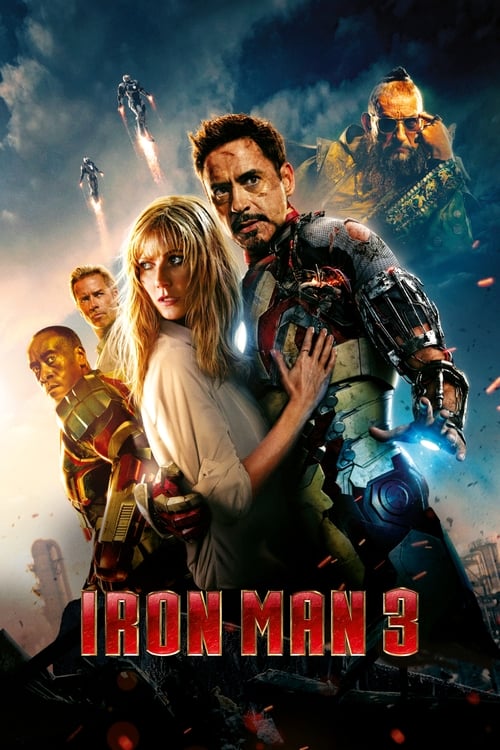
Iron Man 3
2013 · Shane Black
For when you want a blockbuster with actual personality — big action, quick banter, and a Christmas setting that makes it a sneaky holiday watch. Pure entertainment, zero homework beyond knowing who Iron Man is.
What it's about
Tony Stark can't sleep. Shaken by his near-death experience saving New York, he's building armor compulsively while a terrorist called the Mandarin orchestrates bombings across America — and when the threat arrives at his Malibu doorstep, Stark is stripped of his suits, his home, and his swagger. Stranded in small-town Tennessee at Christmas with little more than his wits, he has to work out who he is without the armor.
The experience
Faster and funnier than the standard superhero picture, with a wise-cracking detective-story rhythm underneath the spectacle — it plays like a buddy-action comedy that happens to feature a man in a flying suit. There's real anxiety in Stark's panic attacks, but the film keeps its wit even at its darkest.
Performances
Robert Downey Jr. gets his richest solo outing, playing Stark's bravado and vulnerability in the same breath — much of the film is just him talking his way through crises, and it's a pleasure. Ben Kingsley makes an unforgettable impression as the Mandarin.
The craft
Shane Black brings his signature screenwriting voice — noir narration, holiday backdrop, banter that ricochets — to the Marvel machine, and the set pieces are genuinely inventive, including a mid-air rescue sequence that remains one of the franchise's best. It's a superhero film written like a detective story.
Why it matters
One of the biggest hits of its year, it proved a Marvel solo film could survive a distinctive authorial voice — and its boldest storytelling choice remains one of the most argued-about decisions in the franchise's history.
Snapshot
Iron Man 3 is the third solo Tony Stark feature and the film chosen to reopen the Marvel Cinematic Universe after the world-altering scale of The Avengers (2012). Rather than escalate outward, it turns inward: a wounded, insomniac Tony Stark, rattled by the near-death wormhole climax of the previous film, is stripped of his armor, his mansion, and his composure, and forced to improvise his way back to competence. Directed and co-written by Shane Black — the screenwriter who defined the wisecracking 1980s–90s action script and who had earlier resurrected Robert Downey Jr.'s career with Kiss Kiss Bang Bang (2005) — the film grafts a neo-noir buddy-detective sensibility and a Christmas setting onto the Marvel blockbuster template. It is best understood as the point where the MCU first tested whether its solo installments could carry thematic weight and authorial voice, and as a commercial juggernaut that confirmed the franchise's post-Avengers durability.
Industry & production
The film arrived as the opening chapter of Marvel Studios' "Phase Two," the first solo entry produced in the shadow of The Avengers' success and the first Iron Man picture released under the full Disney corporate umbrella following Disney's 2009 acquisition of Marvel (Paramount had handled distribution of the first two Iron Man films). Kevin Feige produced. Jon Favreau, director of the first two entries, stepped back to a producing and acting role (returning as Happy Hogan), and Shane Black — recommended by Downey — took over direction, co-writing the screenplay with Drew Pearce.
Production centered on EUE/Screen Gems Studios in Wilmington, North Carolina, taking advantage of state film incentives, with additional work in Miami and elsewhere. A notable industrial dimension was the film's arrangement as a U.S.–China co-production with DMG Entertainment: a modified cut for the Chinese market included additional footage featuring Chinese performers (including Wang Xueqi's Dr. Wu and a cameo by Fan Bingbing), a strategy aimed at securing favorable access to the fast-growing Chinese exhibition market. Commercially the result was emphatic. The film grossed well over $1.2 billion worldwide, ranking as the year's top global earner and, at the time, among the highest-grossing films then released — a result that removed any doubt about the appetite for MCU solo sequels.
Technology
Visually, the film's most consequential technology is the "Extremis" conceit borrowed from the comics: a nanotech-driven regenerative treatment that lets human bodies heal, glow with internal heat, and become weapons. This gave the effects houses — including Digital Domain, Weta Digital, and Scanline VFX among others — a distinctive character-animation problem: rendering superheated, molten-veined human beings rather than only hardware. The other signature technological showpiece is the proliferation of Iron Man suits. Where earlier films fetishized the single armor, Iron Man 3 introduces remote-piloted and self-assembling suits — Tony summoning armor pieces that fly onto his body mid-action — and culminates in the "House Party Protocol," a swarm of autonomous suits deployed in the climax. This shifts the technology theme from armor-as-body toward armor-as-drone-fleet, a prescient nod to automation and remote warfare.
The record on the exact acquisition format is one I would not overstate; what is well documented is the film's blend of large-scale digital compositing with striking practical work — most famously the mid-air "barrel of monkeys" rescue, in which passengers ejected from Air Force One are caught in a falling human chain, staged with professional skydivers to ground the sequence in real bodies and real air.
Technique
Cinematography
Director of photography John Toll — a two-time consecutive Academy Award winner for Legends of the Fall and Braveheart — brought a more classical, painterly sensibility than one might expect from a superhero tentpole. The Tennessee stretch, in which a de-suited Stark is stranded in a snowy small town, is shot with a warmer, more grounded naturalism that suits the film's detour into low-tech investigation. Toll's compositions favor legible geometry in the action and a controlled palette that leans into the wintry Christmas setting, keeping the human-scaled middle section visually distinct from the fireballed set pieces at either end.
Editing
Cut by Jeffrey Ford and Peter S. Elliot, the film manages an unusual structural gambit: a long central act in which Iron Man is barely "Iron Man" at all. Ford — who became one of the MCU's most trusted editors across the Avengers films — helps the picture sustain momentum through detective beats and buddy comedy rather than continuous spectacle, before accelerating into the dockyard climax. The editing also carries the film's biggest narrative sleight of hand, the Mandarin reveal, timing the tonal pivot from dread to farce as a genuine cut-based surprise.
Mise-en-scène / staging
Black stages the film as a seasonal noir. The Christmas iconography — lights, a small-town holiday, gift-giving as a running motif — is a Shane Black signature carried over from Lethal Weapon, The Long Kiss Goodnight, and Kiss Kiss Bang Bang. The staging repeatedly separates Stark from his technology: the destruction of his Malibu cliff house, the improvised weaponry he builds from hardware-store parts, and his partnership with a resourceful child (Harley) all physically dramatize a hero forced back onto his wits.
Sound
Composer Brian Tyler replaced the earlier films' composers and supplied a more overtly heroic, theme-forward orchestral score, giving Iron Man a recurring melodic identity the franchise had previously lacked. The sound design leans on the tactile mechanics of the self-assembling armor — the clank and whir of pieces locking into place — as a recurring sonic motif that reinforces the film's man-and-machine theme.
Performance
Robert Downey Jr. anchors the film with a performance that deliberately punctures his own iconography, playing Stark as anxious, sleepless, and prone to panic attacks — a marked departure from the untouchable showman of the earlier entries. Guy Pearce plays Aldrich Killian with reptilian charm; Gwyneth Paltrow's Pepper Potts is given more agency in the climax; Don Cheadle's Rhodes functions as the buddy-movie counterweight. The performance most discussed, however, is Ben Kingsley's, whose Mandarin is revealed to be Trevor Slattery, a dissolute British actor hired as a media front — a comic turn that recasts a menacing terrorist as a piece of manufactured theater.
Narrative & dramatic mode
The film's dramatic mode is closer to detective noir and buddy comedy than to the mythic register of most superhero cinema. It opens with Downey's first-person voiceover — another Black hallmark — framing the story as a confession, and proceeds through investigation, reversal, and unmasking rather than through steadily rising cosmic stakes. The central act follows the classic stranded-hero structure: robbed of his powers, the protagonist must solve a mystery from the ground up. The controversial Mandarin twist is the narrative's organizing risk: it converts the ostensible arch-villain into a hoax, relocating the real threat to a corporate-scientific source and turning the film into a satire of media-constructed terror.
Genre & cycle
Iron Man 3 sits at the intersection of the superhero blockbuster and the Shane Black action-comedy. Within the MCU cycle, it belongs to the "deconstruct the hero" strand — films that interrogate rather than simply celebrate their protagonists — and it prefigures later franchise experiments in tonal variation. Against the broader superhero cycle of the early 2010s, dominated by the sincerity of the Nolan Batman films and the assembling grandeur of The Avengers, Black's picture is comparatively ironic, verbal, and genre-promiscuous, importing the rhythms of 1980s buddy action into a comic-book tentpole.
Authorship & method
The dossier's clearest authorial signature is Shane Black's. His recurring fingerprints are all present: the Christmas setting, the hard-boiled voiceover, the mismatched-partners dynamic, the fondness for banter over exposition, and a structural willingness to subvert audience expectation of the villain. That Black cast Downey — with whom he had revived his own career on Kiss Kiss Bang Bang — makes the collaboration feel continuous with that earlier neo-noir. The screenplay's genetic material comes chiefly from Warren Ellis and Adi Granov's comics arc Extremis (2005–06), which supplies the regenerative-biotech premise, though Black and Pearce diverge sharply, most notably in the Mandarin conceit. Key collaborators shaping the film's texture include cinematographer John Toll, editor Jeffrey Ford, and composer Brian Tyler, each of whom pulls the film toward a more classical, character-grounded craft than the franchise's house style demanded.
Movement / national cinema
As a Hollywood studio tentpole, the film is not attached to any art-cinema movement, but it is a revealing artifact of two industrial currents. First, it is a mature product of the "cinematic universe" model that Marvel Studios pioneered — serialized, cross-referential, franchise-first filmmaking. Second, its formal co-production status with China's DMG Entertainment marks it as an early, prominent example of Hollywood tailoring content and financing to the Chinese market, a globalizing pressure that would reshape blockbuster production through the 2010s.
Era / period
The film is a document of its post-9/11, post-financial-crisis moment. Its villain is a media spectacle — a bogeyman broadcast into living rooms — and its satire of manufactured terror speaks directly to War on Terror anxieties about how threats are packaged and sold. Tony Stark's panic attacks, meanwhile, register a broader cultural interest in trauma and vulnerability seeping into even the most triumphalist genre. Situated at the dawn of Marvel's Phase Two, it also belongs to the specific industrial moment when the studio was proving that its interconnected model could survive the gravitational pull of its own crossover event.
Themes
The dominant theme is the man beneath the armor. Stripped of his suits, Stark must confront the question the film poses explicitly — whether he is the technology or the person inside it — and his arc bends toward self-reliance and, at the close, a symbolic shedding of the armor. Anxiety and trauma run parallel: the film treats its hero's psychological wounds as seriously as its physical spectacle. A third strand is the manipulation of fear: the Mandarin plot is a meditation on how terror is authored and performed, indicting both the manufacturers of villainy and the audiences primed to consume it. Beneath these sits a familiar Stark preoccupation — the double-edged nature of invention, here embodied by Extremis, a technology that heals and weaponizes in equal measure.
Reception, canon & influence
Critical reception was broadly positive, with particular praise for Black's wit, Downey's willingness to play vulnerability, and the film's brisker, funnier register. The most durable point of contention was the Mandarin reveal, which split audiences: some admired its audacity as satire, while many comic readers felt cheated of a legendary antagonist. Marvel itself acknowledged the debate, later producing the short All Hail the King to complicate the fate of Trevor Slattery, and eventually addressing the "real" Mandarin lineage in Shang-Chi and the Legend of the Ten Rings (2021) with Tony Leung's Wenwu — a rare instance of a franchise course-correcting a controversial creative choice years downstream.
Looking backward, the film's influences are legible: Warren Ellis and Adi Granov's Extremis comics for its premise; the buddy-action and neo-noir traditions Black himself helped codify; and the seasonal-thriller lineage of his own filmography. Looking forward, its legacy is twofold. Commercially, it demonstrated that MCU solo sequels could thrive after the crossover event, reinforcing the studio's serialized model. Creatively, it validated bringing distinctive directorial voices and tonal experimentation into the franchise, an approach the MCU would extend with filmmakers such as James Gunn and Taika Waititi. For Shane Black, the film's success enabled a return to his native register in The Nice Guys (2016) and a franchise assignment on The Predator (2018). Within the MCU's own canon, Iron Man 3 remains a pivotal closing statement on Tony Stark's solo journey — the film that insisted, against the genre's grain, that the hero and not the hardware was the point.
A Deleuzian reading
The best stretch of *Iron Man 3* has no Iron Man in it.
The full Deleuzian reading of Iron Man 3 →
Reception
A billion-dollar hit that landed fine with critics in 2013 but enraged a chunk of the fanbase — a decade on, it's been steadily reclaimed as one of the MCU's few genuine auteur outings, 'a Shane Black movie that happens to star Iron Man.'
How Iron Man 3 was received, from release to now →
How to watch Iron Man 3: what to notice on a first viewing
- Watch Downey's hands and breathing when someone says New York. Downey plays Stark as sleepless and jumpy. Mention of the wormhole and he stops functioning: he sees everything, does nothing, and has to walk out of the room. Action heroes normally see a threat and hit it. Downey keeps that gap open, which is what makes Stark frightened rather than untouchable.
- Count the Christmas lights, trees and gifts in the background. Black hangs holiday decoration over a manhunt from the first scenes onward, and gift-giving keeps turning up in the plot. He did the same in Lethal Weapon and Kiss Kiss Bang Bang. The season tells you which genre you are in: this is a seasonal noir wearing a superhero suit.
- Count how many minutes of the first hour Stark spends studying footage. Broadcasts, news clips, blast-site records. Long before any armor works, the hero's main activity is watching screens and asking what he is looking at. The film makes competence forensic instead of aerial. Stark solves things by looking, which is a detective's job, not a superhero's.
- Notice how the light changes between spectacle and quiet scenes. Toll keeps the big set pieces hard and fireballed, then softens the quieter stretches into wintry small-town naturalism. The look separates the human-scaled investigation from the spectacle, so you feel the change of register.
- Listen for the clank and whir of armor pieces locking on. The self-assembling suit has its own recurring mechanical sound, and the film keeps letting you hear it fail, arrive late, or fly toward a man who can't rely on it. The soundtrack keeps asking whether Stark is the machine or the person waiting for it to catch up.
The whole guide to watching Iron Man 3, with the keys for a rewatch →
Influences: the films it descends from and the films it influenced
- Iron Man (2008) — Establishes Downey's improvised, self-deprecating Stark cadence and the self-assembling-suit VFX grammar that Iron Man 3 deliberately inverts by stranding the hero away from a working armor.
- Kiss Kiss Bang Bang (2005) — Black's own neo-noir template — unreliable hard-boiled voiceover confession, an LA-Christmas setting, and Downey as a fast-talking screwup narrating his own case — is transplanted almost wholesale into the superhero frame.
- Lethal Weapon (1987) — Black's screenplay codified the mismatched-partners buddy-action structure and the Christmas-set thriller that Iron Man 3 reuses in Stark's odd-couple pairing with the kid Harley.
- The Last Boy Scout (1991) — Black's script model of a broken, wisecracking hero who advances plot through banter rather than exposition supplies the film's dialogue rhythm.
- The Long Kiss Goodnight (1996) — Another Black screenplay built on a Christmas-set action-thriller and an amnesiac reinvention arc, prefiguring Stark's stripped-of-identity, rebuild-from-scratch midsection.
- Chinatown (1974) — The neo-noir investigative structure — a detective-hero peeling back a manufactured public menace to expose a hidden corporate architect — underlies the Killian-behind-the-Mandarin reveal.
- The Big Sleep (1946) — The Chandler-derived first-person hard-boiled voiceover confession that Black stylizes throughout his filmography descends from this Marlowe adaptation's tone.
- Iron Man 2 (2010) — Doubles down on the Downey screwball-comedy register and mortality/legacy theme, foregrounding the actor-driven banter Favreau established over spectacle.
- Megamind (2010) — Pushes villainy-as-performance to its endpoint: the terrifying nemesis is a fabricated media production fronted by a hired actor — the same manufactured-antagonist device Megamind runs when it builds Titan to fill a vacancy in its own narrative.
- Shang-Chi and the Legend of the Ten Rings (2021) — Explicitly course-corrects IM3's Mandarin gambit, reclaiming the 'real' Ten Rings lineage through Tony Leung's Wenwu — a franchise answering a downstream creative controversy.
- Thor: Ragnarok (2017) — Extends IM3's proof that an auteur's comedic, tonally subversive voice can override MCU house style and remake a solo hero in the director's register.
- Guardians of the Galaxy (2014) — Validated by IM3's success in carrying a distinctive directorial voice — needle-drop scoring and banter-forward comedy — into the franchise's serialized model.
- The Nice Guys (2016) — IM3's box-office let Black return to pure neo-noir buddy comedy, refining the mismatched-investigators-in-LA register the blockbuster had smuggled into a cape film.
- The Predator (2018) — Black's next franchise assignment carries his signature wisecracking-ensemble dynamic and holiday-adjacent action staging into another studio property.
- Avengers: Endgame (2019) — Pays off IM3's insistence that Stark's arc is about the man beneath the armor, closing the solo journey with a sacrifice framed as a human rather than technological triumph.
- The Usual Suspects (1995) — The villain-identity twist — a theatrical decoy concealing the true mastermind — is the exact narrative device Iron Man 3 deploys with Trevor Slattery fronting for Killian.
- Skyfall (2012) — A franchise entry that imports prestige cinematography and a damaged-hero interiority alongside a villain whose 'capture' is a staged act of manufactured terror, mirroring IM3's Toll-lensed classicism and Killian's engineered spectacle.
- Logan (2017) — Strips the superhero down to the wounded, fallible man beneath the powers — the same 'the hero, not the hardware' thesis IM3 insisted on against the genre's grain.
Similar films
- Iron Man (2008) — influence & lineage
- Kiss Kiss Bang Bang (2005) — influence & lineage
- Avengers: Endgame (2019) — influence & lineage
- Guardians of the Galaxy (2014) — influence & lineage
- Skyfall (2012) — influence & lineage · same viewing thread
- Iron Man 2 (2010) — same viewing thread
- Captain America: The Winter Soldier (2014) — same viewing thread
- Thunderbolts* (2025) — same viewing thread
All the films related to Iron Man 3 →
Watch it with: curated runs of related films
- Rogue Heroes, Rigged Systems — A run of slick, propulsive 21st-century spectacle — spies, super-soldiers, sci-fi survivors, and dystopian rebels all squaring off against some vast machine or shadowy apparatus — best watched back-to-back when you want momentum, style, and a lone figure taking on the whole board.