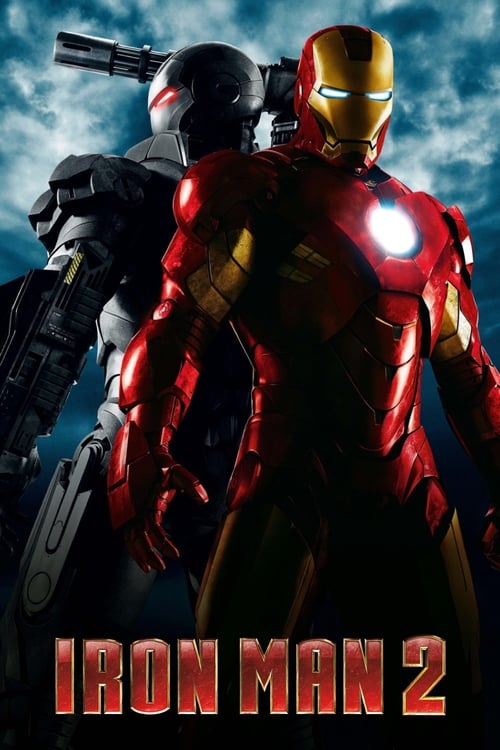
Iron Man 2
2010 · Jon Favreau
For a no-stakes popcorn night when you're already invested in the character and just want more of the swagger. Comfort viewing, best consumed as part of a run rather than on its own.
What it's about
Now that the world knows the man inside the armor, everyone wants a piece of him: the government demands he hand over the suit, a smarmy rival contractor schemes to copy it, and a Russian physicist with an old family grudge builds his own crackling answer to it. Meanwhile the genius at the center is quietly being poisoned by the very technology keeping him alive, and hiding it from everyone who loves him. It's a story about fame, legacy, and a man self-destructing in public.
The experience
Busy, glossy, and fun in bursts — the banter still fizzes and the villains chew happily on the scenery, though it juggles a lot of plates at once. Think of it as a loud, crowded party: uneven, but never boring.
Performances
Sam Rockwell nearly steals the film as a desperate, dancing wannabe-mogul — every scene he's in gets funnier — and Mickey Rourke brings genuine menace and wounded pride to the vengeful physicist.
The craft
The set pieces have real flair — a whip-cracking assault on a Monaco race track is the standout — and the film doubles down on the improvisational, overlapping-dialogue style that made the first one feel human. The hardware design escalates pleasingly: drones, new suits, and electrified whips that light up a big screen.
Why it matters
As the first sequel of the Marvel machine, it became the test case for building a shared universe inside a single film — and it introduced Scarlett Johansson's Black Widow to the franchise.
Snapshot
Iron Man 2 is the second feature in what would become the Marvel Cinematic Universe and the first true test of whether the surprise success of Iron Man (2008) could be engineered into a system rather than caught as lightning. Jon Favreau returned to direct, Robert Downey Jr. returned as Tony Stark, and the film inherited both the buoyant improvisational comedy of its predecessor and a new, heavier burden: it had to be a sequel and a franchise scaffold at the same time. The plot follows Stark as he is publicly celebrated for being Iron Man, privately dying from the palladium core that powers his arc reactor, and besieged on three fronts — by a U.S. government that wants his armor, by a rival arms manufacturer (Sam Rockwell's Justin Hammer), and by a vengeful Russian physicist, Ivan Vanko (Mickey Rourke), whose grievance reaches back to the sins of Stark's father. The film is most consequential not for its own story but for what it introduced: Scarlett Johansson's Black Widow, Don Cheadle as Rhodey/War Machine, an expanded S.H.I.E.L.D., and the connective tissue that pointed toward The Avengers. It is, accordingly, both a real movie and a famous case study in the costs of cinematic universe-building.
Industry & production
Iron Man 2 was produced by Marvel Studios and distributed by Paramount Pictures, made under intense schedule pressure to capitalize on the first film's momentum and to keep Marvel's self-financed, multi-picture plan on track. Marvel had recently begun building toward a shared universe, and the studio's leadership — Kevin Feige ascending to a central producing role — treated this film as proof-of-concept for serialized franchise architecture. That ambition shaped the production at every level. Where the first Iron Man had been developed with unusual latitude for improvisation, the sequel arrived with a mandate to seed future properties, and the strain of that double duty is part of the historical record around the film.
The most discussed off-screen event was the recasting of James Rhodes: Terrence Howard, who played Rhodey in the first film, did not return, and Don Cheadle stepped in. The change has been attributed publicly to contract and salary disputes, though the principals have given differing accounts and the full details remain contested; the safe statement is that it was a business and casting dispute rather than a creative repudiation. The film also marked the formal expansion of the ensemble strategy — adding Johansson, Cheadle, and a larger role for Samuel L. Jackson's Nick Fury and Clark Gregg's Agent Coulson — that would define Marvel's subsequent decade. A celebrated post-credits tag, showing the discovery of a hammer in the New Mexico desert, set up Thor (2011), formalizing the post-credits "stinger" as a franchise instrument.
Technology
The film is a showcase for late-2000s digital effects work, with the Iron Man and War Machine suits realized through a blend of practical costume elements and computer-generated armor, primarily by Industrial Light & Magic and other vendors. By 2010 the photoreal CG hero-in-motion had matured enough that the armor could carry extended action without the seams that dogged earlier comic-book films. The film's most distinctive technological flourish is diegetic: Tony Stark's holographic interface, where he manipulates volumetric data with his hands and "discovers" a new element by physically sculpting a molecular lattice in mid-air. This sequence is a notable entry in the lineage of speculative gesture-based interfaces in cinema, extending the Minority Report (2002) idiom into a domestic, single-user workshop key. Production-wise, the Monaco Grand Prix sequence combined location and set photography with CG augmentation, and the Stark Expo finale stacked large numbers of CG drones into a climactic swarm — an early instance of the "army of disposable robots" climax that would become a recurring (and criticized) MCU pattern.
Technique
Cinematography
Matthew Libatique, the cinematographer of the first Iron Man (and a longtime collaborator of Darren Aronofsky), returned, giving the two films visual continuity. Libatique's work keeps the Stark world glossy and warm — burnished metals, lens flares, a clean high-key sheen in the workshop and party scenes — while reserving harder, cooler light for Vanko's grimy Russian and Monaco settings. The contrast between Stark's chromed affluence and Vanko's improvised, sparking workbench is built into the lighting and palette. The action coverage favors clarity of geography in the marquee set pieces (the Monaco track attack is staged so the threat of Whiplash's energy whips reads cleanly), even as the film's overstuffed plotting pulls the camera through a lot of expository interiors.
Editing
Cut by Dan Lebental (returning from the first film) with Richard Pearson, the editing carries the brisk, overlapping comic rhythm that is the series' signature — Downey's dialogue is frequently cut to preserve the feel of improvisation, with reaction shots timed to let ad-libbed lines land. The film's structural problem, widely noted in its reception, is legible at the editorial level: it juggles Stark's illness arc, the Vanko revenge plot, the Hammer subplot, the Rhodey/War Machine turn, and the S.H.I.E.L.D./Avengers setup, and the cutting must constantly shuttle between threads, producing a middle stretch that feels more administrative than dramatic.
Mise-en-scène / staging
The production design leans into Stark's world as a fantasy of design itself. The Stark Expo — explicitly framed as the legacy of Howard Stark — evokes mid-century World's Fair futurism (the 1964 New York World's Fair is the clear referent), complete with retro-futurist domes and a vintage promotional film of Howard (John Slattery) whose mannered optimism the plot later weaponizes as a coded message to Tony. The staging of the film's signature party sequence — Tony, drunk and dying, firing repulsors in his suit at his own birthday — visually literalizes the theme of self-destruction. Whiplash's introduction at the Monaco circuit stages spectacle against glamour, the energy whips slicing through race cars in a setting of conspicuous wealth.
Sound
The sound design foregrounds the mechanical signatures of the armor — the servo whine, the repulsor charge, the heavy footfalls — as recurring sonic motifs. Musically, the film is saturated with AC/DC; the band's catalog functions almost as a leitmotif for Tony Stark's swagger, with "Shoot to Thrill" scoring his grand entrance. Guitarist Tom Morello contributed to the score and appears in a cameo, lending an aggressive rock texture that ties Vanko's and Stark's musical worlds. The needle-drop strategy is a deliberate authorship choice, aligning the character's personality with classic hard rock rather than relying solely on orchestral heroics.
Performance
Performance is the film's strongest and most durable asset. Robert Downey Jr. deepens the wounded narcissism beneath Stark's wit, playing a man performing invincibility while quietly poisoned. Sam Rockwell's Justin Hammer is a comic gem — a try-hard arms dealer whose flop-sweat insecurity is the perfect inversion of Stark's effortless cool — and his and Downey's contrasting energies give the film much of its life. Mickey Rourke, fresh from his The Wrestler (2008) resurgence, built Ivan Vanko with characteristic immersion: he is reported to have visited a Russian prison to research the role and pushed for details (the accent, gold teeth, a pet bird, tattoos) that give Vanko a lived-in menace, though the script gives the character relatively little to do across the runtime. Scarlett Johansson's Natasha Romanoff makes a controlled, watchful debut, with a corridor fight sequence designed to establish her physical competence. Gwyneth Paltrow's Pepper Potts and Don Cheadle's Rhodey ground the ensemble.
Narrative & dramatic mode
The film operates in the mode of the comic-superhero blockbuster crossed with screwball comedy — its dialogue rhythms owe more to fast-talking comedy than to the operatic register of contemporaneous DC films. Dramatically, its spine is a mortality-and-legacy story: Tony, believing himself dying, behaves recklessly and pushes away those closest to him, and his salvation comes through reconciliation with his late father's hidden message of belief. This father-son reconciliation, mediated through old film footage and a literal hidden blueprint, is the film's most genuine emotional through-line. Around it, however, the narrative is structurally a setup machine, and the central tension between satisfying character drama and franchise table-setting is the film's defining dramatic problem.
Genre & cycle
Iron Man 2 belongs to the post-2008 superhero cycle that Iron Man itself helped ignite, arriving in the same window as Christopher Nolan's tonally opposite Batman films and the broader comic-adaptation boom. Within that cycle it is a transitional artifact: it marks the moment the Marvel film stops being a stand-alone genre entry and becomes a serialized installment, importing the logic of the comic-book "crossover event" into cinema. It also continues the techno-thriller and arms-race anxieties of its predecessor, with Vanko and Hammer representing the proliferation of Stark's technology that the first film warned against.
Authorship & method
Jon Favreau directs with the loose, actor-friendly, comedy-trained sensibility he brought to the first film, prioritizing performance and improvisation; he also appears on screen as Happy Hogan. The collaboration with Robert Downey Jr. is central to the authorship — the films' voice is substantially a Favreau-Downey co-creation. The screenplay is credited to Justin Theroux, working from the established Stark template. Key collaborators carry over for continuity: cinematographer Matthew Libatique and editor Dan Lebental return, while composer John Debney took over scoring duties (Ramin Djawadi had scored the first film), with Tom Morello's guitar contributions threaded through. Favreau has spoken in the years since about the pressures of subordinating his film to a larger studio plan, and the production is often cited as a turning point after which Marvel's centralized producing model — Kevin Feige's house style — increasingly governed individual directors' latitude. That tension is itself part of the film's authorship story.
Movement / national cinema
This is mainstream American studio filmmaking at industrial scale — Hollywood's tentpole apparatus operating as a coordinated, multi-film enterprise. It is less the product of an artistic movement than of a business model, and its true "movement" significance is institutional: it is an early load-bearing piece of the shared-universe paradigm that American (and then global) commercial cinema would adopt as its dominant tentpole strategy through the 2010s.
Era / period
Iron Man 2 is a document of its precise moment in late-2000s/early-2010s blockbuster culture: the digital-effects superhero film fully ascendant, the post-credits stinger becoming standard, and the franchise pivoting from sequel to "cinematic universe." Its anxieties — privatized military technology, surveillance, the spectacle of celebrity, a billionaire inventor as both savior and liability — are recognizably of the post-financial-crisis, Web 2.0 era, and its Stark Expo nostalgia frames mid-century technological optimism against a more cynical present.
Themes
The film's central themes are mortality and legacy: a man confronting his own death and reckoning with his father's shadow, learning that the father he resented in fact believed in him. Secondary themes include the proliferation and control of technology (who should wield Stark's power — the state, a rival, or Stark alone), the line between celebrity self-mythology and self-destruction, and the tension between individualism and collaboration that the broader S.H.I.E.L.D. plot dramatizes. Tony's arc bends from solipsistic isolation toward partnership — with Rhodey, with Pepper, and implicitly with the team the franchise is assembling. There is also a recurring meditation on inheritance, both literal (the company, the element his father could not realize) and moral (the consequences of the elder Stark's choices, embodied by Vanko).
Reception, canon & influence
Critically, Iron Man 2 was received as a step down from its predecessor — generally regarded as entertaining but overstuffed, weighed down by its franchise-setup obligations and lacking the freshness of the original. The performances, particularly Downey and Rockwell, were widely praised, while the plotting and the underused villain drew the most criticism. Commercially it was a major success, grossing well over $600 million worldwide and confirming the viability of the Marvel strategy even as critics flagged the creative tradeoffs of that strategy.
Backward, the film's influences include the source comics — notably the "Demon in a Bottle" storyline, whose substance-abuse subtext is gestured at in the drunken birthday sequence — and the techno-futurist visual lineage running from World's Fair futurism through Minority Report-style gestural interfaces. Its musical identity draws on classic hard rock, AC/DC above all.
Forward, Iron Man 2's legacy is paradoxical. As a film it is among the lesser-regarded MCU entries, but as a piece of infrastructure it was pivotal: it introduced Black Widow and War Machine, expanded S.H.I.E.L.D. and Nick Fury, normalized the post-credits franchise tease, and served as a crucial connective bridge to Thor and The Avengers (2012). It also became the cautionary example most often cited within and outside Marvel about the dangers of letting universe-building crowd out a single film's story — a lesson the studio's later "Phase" planning would repeatedly invoke. In that sense its most lasting influence is negative and instructive: it taught the modern blockbuster both how to build a universe and what that building can cost the individual movie.
A Deleuzian reading
Start with the birthday party.
The full Deleuzian reading of Iron Man 2 →
Reception
Landed in 2010 as the MCU's first real letdown — critics called it overstuffed with S.H.I.E.L.D. setup after the lightning-in-a-bottle first film, and time hasn't rehabilitated it much: it still props up the bottom of most MCU ranking lists, though a vocal minority now defends it as a shaggy, character-driven hangout movie.
How Iron Man 2 was received, from release to now →
Influences: the films it descends from and the films it influenced
- Iron Man (2008) — Established the Favreau-Downey improv-driven, screwball-register approach to a superhero lead, the AC/DC needle-drop musical identity, and the Libatique/Lebental craft team that Iron Man 2 directly continues.
- Minority Report (2002) — Pioneered the gestural holographic interface — hands sweeping through translucent floating data — that Stark's lab manipulations and JARVIS displays directly imitate.
- Blade Runner (1982) — Codified the retrofuturist production-design grammar of glowing analog-futurist technology that feeds the World's Fair / Stark Expo aesthetic and the cool-vs-warm interior lighting contrast Libatique deploys.
- The Wrestler (2008) — Mickey Rourke's bruised, immersive-method comeback performance there is the exact register he imports as Ivan Vanko, and the film shares Libatique's naturalistic handheld craft.
- RoboCop (1987) — Template for the man-fused-to-photoreal-armored-machine, including the mechanical servo/motor sound-design motifs that score every suit movement.
- Confessions of a Dangerous Mind (2002) — Sam Rockwell's fast-talking, oily comic-foil persona is the throughline he weaponizes as Justin Hammer's screwball antagonist.
- Tony Stark: Demon in a Bottle (source comic) (1979) — The substance-abuse arc the drunken birthday-party sequence directly adapts, supplying the mortality-and-legacy theme threaded through the film.
- Swingers (1996) — Favreau's screenwriting/performing origin in overlapping, rapid-fire comic dialogue rhythm is the foundation of the screwball editing cadence he and Lebental cut into the action.
- The Avengers (2012) — Pays off Iron Man 2's franchise-setup machinery directly — Black Widow, War Machine, S.H.I.E.L.D. and Fury were seeded here precisely to make the crossover assembly possible.
- Thor (2011) — Built on the post-credits-stinger and shared-universe connective-tissue model that Iron Man 2 normalized as Marvel infrastructure.
- Captain America: The Winter Soldier (2014) — Inherits and refines the serialized-crossover, Feige-governed house style while deliberately re-centering a single coherent story — a corrective to Iron Man 2's universe-building overload.
- Avengers: Age of Ultron (2015) — Extends the photoreal CG-armor and mechanical-motif sound craft to a fully artificial body, escalating Stark's interface-and-suit technology language.
- Spider-Man: Homecoming (2017) — Favreau returns as Happy Hogan and producer, transmitting the loose, comedy-trained, mentor-Stark register and the gestural Stark-tech interface to the next generation.
- Iron Man 3 (2013) — Doubles down on the Downey screwball-comedy register and mortality/legacy theme, foregrounding the actor-driven banter Favreau established over spectacle.
- Pi (1998) — Libatique's high-contrast, push-processed cinematographic signature — clinical cool tones against hot practical sources — is the same authorial visual fingerprint he carries into the Stark world.
- The Dark Knight (2008) — Parallel contemporary model for the serialized, consequence-driven superhero sequel with an immersive-method antagonist, against which Iron Man 2's franchise-first tradeoffs were measured.
- Tron: Legacy (2010) — Shares the same-year retrofuturist holographic-interface and glowing-machine design language drawn from the World's Fair futurist tradition.
Similar films
- Iron Man 3 (2013) — influence & lineage · same viewing thread
- Captain America: The Winter Soldier (2014) — influence & lineage · same viewing thread
- Iron Man (2008) — influence & lineage
- Avengers: Age of Ultron (2015) — influence & lineage
- The Avengers (2012) — influence & lineage
- RoboCop (1987) — influence & lineage · same viewing thread
- TRON: Legacy (2010) — influence & lineage · same viewing thread
- Captain America: Brave New World (2025) — same viewing thread
All the films related to Iron Man 2 →
Watch it with: curated runs of related films
- Rogue Heroes, Rigged Systems — A run of slick, propulsive 21st-century spectacle — spies, super-soldiers, sci-fi survivors, and dystopian rebels all squaring off against some vast machine or shadowy apparatus — best watched back-to-back when you want momentum, style, and a lone figure taking on the whole board.