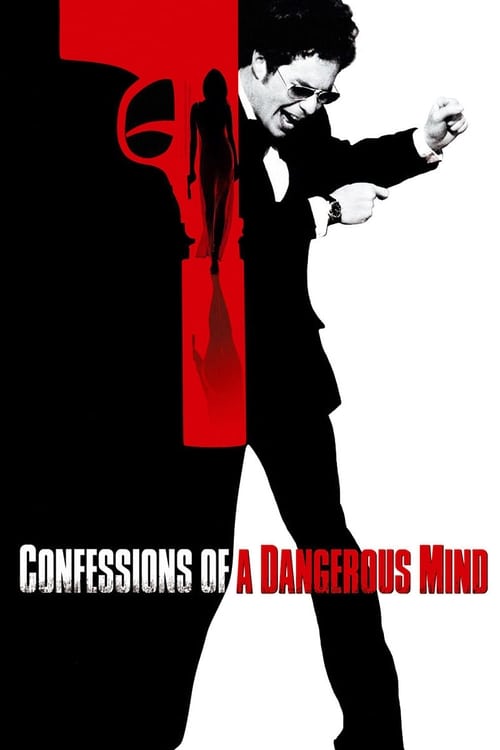
Confessions of a Dangerous Mind
2002 · George Clooney
For when you want something clever and off-kilter — a true-story-that-probably-isn't to grin at and puzzle over afterward. Great for a night when straight biopics feel too dutiful.
What it's about
Chuck Barris invented The Dating Game, The Newlywed Game, and The Gong Show — and claimed, in his memoir, that all the while he was moonlighting as a CIA assassin. The film takes him at his word and doesn't, at the same time: it follows a TV producer whose life splits between garish studio stages and shadowy Cold War errands, with a long-suffering girlfriend at home and a glamorous fellow agent in the field. Whether any of it happened is exactly the point.
The experience
Playful, stylish, and increasingly melancholy — a comedy that keeps darkening at the edges. It moves fast, winks often, and then catches you off guard with how sad and paranoid it lets itself become.
Performances
Sam Rockwell's breakout: he plays Barris as showman, sad sack, and possible killer all at once, and makes the contradictions feel like one coherent, unraveling man. Clooney, Drew Barrymore, and Julia Roberts orbit him in sharply judged supporting turns.
The craft
Charlie Kaufman's script embraces the unreliability of its source rather than resolving it, and George Clooney's directorial debut is startlingly confident — in-camera transitions, theatrical lighting shifts, and sets that slide between game-show kitsch and spy-movie shadow. It's a visually inventive film that keeps style and psychology fused.
Why it matters
It announced Clooney as a real director and Rockwell as a leading man, and it stands as a high point of the early-2000s wave of self-aware, truth-bending biographical films.
Snapshot
Confessions of a Dangerous Mind is George Clooney's directorial debut, an adaptation of game-show impresario Chuck Barris's 1984 memoir of the same name, in which Barris claimed that, while inventing The Dating Game, The Newlywed Game, and The Gong Show, he was simultaneously moonlighting as a contract assassin for the CIA. The film treats this almost certainly fabricated double life not as a puzzle to be solved but as a confession to be inhabited — a portrait of a man whose grip on the difference between performance and reality has dissolved. Adapted by Charlie Kaufman and anchored by Sam Rockwell's breakout lead performance, it sits at the intersection of the early-2000s vogue for unreliable, self-reflexive narration and the prestige-indie production culture of Steven Soderbergh and Clooney's Section Eight company. It is a film about American television's hollow brightness shadowed by Cold War violence, told with a stylistic restlessness that announces a first-time director eager to demonstrate range. Modestly received and commercially underwhelming on release, it has aged into a respected curio — Kaufman's least discussed major script of the period and the seed of Clooney's subsequent, more disciplined career behind the camera.
Industry & production
The project had one of the longer development gestations of its era. Charlie Kaufman wrote the screenplay in the late 1990s, and over several years the adaptation passed through the orbit of multiple directors — names associated with the project at various points included Bryan Singer, David Fincher, and Curtis Hanson — without a film materializing. The package was perennially "almost made," a familiar limbo for ambitious, tonally slippery material. The film ultimately came together under Miramax, with the production muscle of Section Eight, the company Clooney and Soderbergh had founded, and producer Andrew Lazar (whose Mad Chance had long shepherded the property). Soderbergh's involvement as a producer-mentor gave Clooney, then primarily known as a movie star coming off the Soderbergh-directed Ocean's Eleven and the ER television years, the institutional cover and creative confidence to direct.
Casting reflected the project's pedigree and Clooney's relationships. Sam Rockwell — not a marquee name at the time — won the central role of Barris after a reportedly competitive process, a piece of casting that proved decisive to the film's identity. Drew Barrymore played Penny, Barris's long-suffering free-spirited partner; Julia Roberts appeared as the enigmatic spy Patricia; and Clooney himself took the supporting role of the CIA recruiter Jim Byrd. Rutger Hauer rounds out the espionage thread. Several real figures from Barris's television world appear in cameo or archival form, and the film incorporates documentary-style talking-head interviews with actual associates and acquaintances of Barris — including, at the film's close, the real Chuck Barris himself — a device that deliberately blurs the documentary and fictional registers.
Budgetary specifics and precise box-office returns are not something I will assert from memory, but the broad commercial record is clear: the film was a relatively modest theatrical performer that did not recoup the kind of returns a star-laden Miramax release of its moment might have hoped for. Its value to its makers was reputational rather than financial — it established Clooney as a serious director and consolidated Rockwell's standing as a leading character actor.
Technology
The film was produced and finished on photochemical 35mm, consistent with mainstream practice in 2002, before digital intermediate workflows had become the default for this scale of release. Its technological interest lies less in capture format than in its pastiche of period broadcast media. The film recreates the look of 1960s and 1970s American television — the grain, the color temperature, the videographic flatness of game-show staging — and intercuts or simulates archival footage, deploying changes in stock, format, and image texture as expressive tools. The contrast between the saturated, plastic brightness of the TV-studio world and the desaturated, often wintry palette of the espionage sequences is built into the film's image-making, an early-2000s example of using format and grading to demarcate diegetic worlds rather than merely to record them.
Technique
Cinematography
Newton Thomas Sigel — Bryan Singer's regular collaborator — shot the film, and his work is the most conspicuous evidence of a debut director reaching for effect. The cinematography is consciously eclectic: bravura long takes, in-camera transitions where one location dissolves or rotates into another, theatrical lighting changes within a single shot, and self-aware compositions that foreground their own artifice. One celebrated technique is the use of staged, almost proscenium-like spaces in which lighting and set elements shift around a static character to signal a jump in time or place without a cut. The visual scheme distinguishes the two halves of Barris's claimed life through palette and texture, while the bravura flourishes externalize his theatrical, self-mythologizing sensibility. The danger of such an approach — that style overwhelms substance — is one critics noted, but the photography is undeniably accomplished and gives the film its distinctive surface.
Editing
Stephen Mirrione, fresh from cutting Traffic and Ocean's Eleven for Soderbergh, edited the film, and the editing carries much of its tonal control. The cutting modulates between the brisk, ironic rhythm of the television-career sections and the colder, more elliptical assembly of the espionage material, while threading in the documentary interview inserts. Mirrione's challenge was to keep an unreliable, time-skipping narrative legible without resolving its central ambiguity — to let the assassin story feel both vividly experienced and possibly delusional. The mock-archival and interview segments are integrated as punctuation, repeatedly puncturing the fiction with the texture of "real" testimony.
Mise-en-scène / staging
The film's production design and staging lean into theatricality. The game-show sets are recreated with affectionate accuracy — the gaudy geometry of The Dating Game's partition, the manic carnival of The Gong Show — and the film treats these as stages within the stage, environments where Barris is always performing. The espionage sequences, by contrast, favor the iconography of Cold War spy cinema: drab European interiors, snowbound exteriors, anonymous hotel rooms. Clooney repeatedly stages scenes so that the boundary between set and world is porous, with theatrical lighting cues and constructed transitions reminding the viewer that everything is mediated through Barris's account.
Sound
Alex Wurman composed the score, which moves between lounge-inflected, period-evocative cues for the television world and tenser, more conventional suspense scoring for the spy material. The soundtrack also draws on period popular music to anchor the era. As with the image, the sound design participates in the film's two-register structure, using musical idiom to mark which version of Barris's life we are watching. The documentary-interview inserts bring their own flatter, more naturalistic sound, heightening the contrast with the stylized fiction.
Performance
Sam Rockwell's performance is the film's center of gravity and its most lasting achievement. He captures Barris's manic showman energy — the nervous patter, the physical looseness, the neediness beneath the bravado — while leaving open the question of whether this is a man recounting a secret life or constructing one to give meaning to a tawdry career. The performance is large but controlled, and it earned Rockwell significant critical attention. Drew Barrymore brings a wounded warmth to Penny that grounds the film emotionally; Julia Roberts plays against her image as a cold, knowing operative; and Clooney, in a deliberately self-effacing supporting turn, plays the recruiter with a worn, ambiguous calm. The ensemble's willingness to serve a stylized conceit rather than naturalistic realism is part of the film's coherence.
Narrative & dramatic mode
The film is structured as a confession — an unreliable first-person account dramatized as if true while continuously signaling its own dubiousness. It runs two parallel biographies: the documented rise of a television producer and the undocumented (and historically unsupported) career of a CIA assassin, braided so that espionage assignments shadow professional milestones. Kaufman's adaptation resists the obvious move of adjudicating the truth; instead it dramatizes the psychology of a man for whom the lie may be more real than the facts. The interpolation of genuine documentary interviews — people who knew Barris speaking to camera — sets a register of "evidence" against the fiction, but the testimony is inconclusive, and the film closes on the real Barris, refusing the audience a verdict. The dramatic mode is thus ironic and confessional at once: we are asked to feel the emotional weight of a life while doubting its literal content.
Genre & cycle
The film is a deliberate hybrid — biopic, spy thriller, showbiz comedy, and romance, none played entirely straight. It belongs to an early-2000s cycle of self-reflexive, unreliable-narrator films preoccupied with the instability of identity and memory, a cycle in which Kaufman himself was a central author (Being John Malkovich, Adaptation, Eternal Sunshine of the Spotless Mind). It also participates in the showbiz-biopic tradition while subverting it: rather than charting talent and triumph, it uses the biopic frame to interrogate the emptiness and self-delusion at the heart of celebrity. Its espionage material knowingly quotes Cold War spy cinema, treating genre iconography as another layer of Barris's self-dramatization.
Authorship & method
The film is a meeting of two authorial sensibilities. Charlie Kaufman, the screenwriter, brings his signature concerns — fractured identity, the porous line between self and performance, the unreliability of the narrating mind — though, notably, his involvement with the finished film was distant, and the production was very much Clooney's. George Clooney, directing for the first time, treats the material as an opportunity to showcase technique, drawing heavily on lessons absorbed from Steven Soderbergh, whose producing presence and stylistic influence are felt throughout. The result is a debut that is stylistically maximalist where Clooney's later films (Good Night, and Good Luck., The Ides of March) would become more classical and restrained. The key collaborators reinforce the Soderbergh lineage: cinematographer Newton Thomas Sigel, editor Stephen Mirrione, and composer Alex Wurman each supply craft that holds the film's competing registers together. The method is one of controlled pastiche — recreating period media textures and genre idioms and letting their friction express the protagonist's divided consciousness.
Movement / national cinema
The film is a product of a specific American formation: the prestige-independent ecosystem of late-1990s and early-2000s Miramax and the auteur-driven, mid-budget star vehicles fostered by Soderbergh and Clooney's Section Eight. This was a moment when major stars used their leverage to make idiosyncratic, writer-driven films within the studio-adjacent system. It is not part of any national-cinema movement in the strict sense, but it is emblematic of an American independent-prestige sensibility that prized formal experimentation, irony, and literary screenwriting, and that briefly flourished before the contraction of the mid-budget adult drama.
Era / period
The film was made in 2002 but is set largely across the 1960s and 1970s, the heyday of Barris's television career and the height of the Cold War. Its period reconstruction is central to its meaning: the bright, brittle optimism of American network television is continuously set against the paranoia and moral murk of Cold War espionage. The film thus reads the postwar American century as a split screen — entertainment and covert violence as twin faces of the same national self-image — and uses the texture of period media to make that argument visually. Produced at the start of the post-9/11 decade, it also arrives at a moment of renewed cultural preoccupation with secrecy, surveillance, and the unreliability of official narratives, though it wears these resonances lightly.
Themes
The film's governing theme is the dissolution of the boundary between performance and reality — the possibility that a life spent manufacturing spectacle can hollow out a person until invented violence feels more authentic than documented success. Related concerns run throughout: the emptiness behind celebrity and the self-loathing of the man who gives the public what it wants; the unreliability of memory and autobiography; the seductiveness of secret identity as a remedy for a meaningless public one. The espionage fantasy functions as a metaphor for the lethal undercurrent the film perceives beneath American mass entertainment — and as a study of self-mythologizing as a survival strategy. The romance with Penny supplies the film's emotional counterweight: a real connection repeatedly sacrificed to Barris's compulsions, the cost of a life lived as performance.
Reception, canon & influence
Critical reception was respectful but divided. Reviewers widely praised Sam Rockwell's performance and acknowledged Clooney's audacity and visual flair as a first-time director, while a recurring reservation held that the film's stylistic exuberance sometimes outran its emotional or thematic purchase — that the technique called attention to itself at the expense of the human core. It was generally regarded as a promising, intelligent debut rather than a masterpiece, and its commercial performance was muted; it did not become a popular hit.
Looking backward, the film draws on the unreliable-narrator and identity-dissolution preoccupations of Kaufman's own body of work, on the showbiz biopic it subverts, and on the conventions of Cold War spy cinema it quotes; stylistically it is deeply indebted to the Soderbergh school of fragmented, format-conscious storytelling. Looking forward, its most concrete legacy is the directorial career it launched: Clooney moved from this maximalist debut toward the more measured, classically composed political and historical films that followed, and the experience cemented his working relationships with collaborators like Mirrione. For Rockwell, the film was a significant step toward recognition as a leading character actor. As an artifact, Confessions of a Dangerous Mind endures less as a widely cited influence than as a distinctive object — a Kaufman script realized by another hand, a star's confident debut, and a sly meditation on the violence latent in American entertainment that has earned a durable cult regard even as it remains, fittingly for a film about an unverifiable life, difficult to place.
A Deleuzian reading
Watch the room change without a cut.
The full Deleuzian reading of Confessions of a Dangerous Mind →
Reception
It underperformed at the box office in 2002 and got respectful-but-muted reviews, overshadowed by that year's other Charlie Kaufman film, Adaptation. Two decades on it's been quietly reappraised as Sam Rockwell's breakout showcase and, for many, still the best thing Clooney has directed.
How Confessions of a Dangerous Mind was received, from release to now →
Influences: the films it descends from and the films it influenced
- Citizen Kane (1941) — Its 'News on the March' mock-newsreel insert and reconstruction of an unverifiable life through conflicting interview testimony are the template for Confessions' talking-head witnesses and biopic skepticism.
- Zelig (1983) — Faux-archival format pastiche and mock-documentary talking heads that recreate period media textures to chronicle a chameleonic, performing self.
- All That Jazz (1979) — Proscenium-staged numbers and fantasy interludes that externalize an autobiographical subject's divided consciousness, splitting the film into two tonal registers.
- The Limey (1999) — Time-fractured associative editing, with dialogue and sound sliding across temporal planes, is the Soderbergh-school grammar Clooney imports wholesale.
- Traffic (2000) — Establishes editor Stephen Mirrione's multi-strand cross-cutting and format-coded color cinematography, the collaborator method carried into Confessions.
- Out of Sight (1998) — Freeze-frames and elliptical, playful temporal restructuring of genre material, the in-camera flourish vocabulary the debut emulates.
- Being John Malkovich (1999) — Kaufman's identity-dissolution conceit and porous self/performance boundary, the screenwriter's signature returned to in the Chuck Barris material.
- The Ipcress File (1965) — Baroque obstructed framings and in-camera optical flourishes that aestheticize the Cold War spy idiom Confessions quotes for its assassin fantasy.
- Ed Wood (1994) — Affectionate showbiz biopic of a disreputable American entertainer rendered through loving period-pastiche reconstruction of its era's media.
- Man on the Moon (1999) — Performer biopic built entirely on performance-vs-reality, leaving the boundary between the act and the man deliberately unverifiable.
- To Die For (1995) — Interleaves a TV producer's self-mythologizing account with real talking-head interviews, using the documentary insert to undercut rather than corroborate the narrator — the exact irony-by-juxtaposition edit To Die For runs between Suzanne's monologues and everyone else's.
- The Informant! (2009) — Mirrione-edited unreliable-narrator voiceover over period-pastiche corporate-spy material, with a deliberately mismatched two-register comic score.
- Good Night, and Good Luck. (2005) — The Clooney/Mirrione partnership turned to format-conscious period-media recreation, now stripped to classical, restrained composition.
- Synecdoche, New York (2008) — Pushes the proscenium/theatrical staging device to its limit, dramatizing the total collapse of self into endlessly nested performance.
- I'm Still Here (2010) — Feature-length sustained mock-documentary on celebrity emptiness, weaponizing the performed-self/real-self ambiguity as its entire formal premise.
- Iron Man 2 (2010) — Sam Rockwell's fast-talking, oily comic-foil persona is the throughline he weaponizes as Justin Hammer's screwball antagonist.
- Adaptation (2002) — Released the same year, Kaufman's other self-reflexive, unreliable autobiographical structure that destabilizes the line between author, subject, and invention.
- American Splendor (2003) — Hybrid biopic that interleaves its real subject with staged reenactment and mock-documentary, blurring document and performance the way Confessions does.
Similar films
- Being John Malkovich (1999) — influence & lineage
- Adaptation. (2002) — influence & lineage
- Synecdoche, New York (2008) — influence & lineage
- Good Night, and Good Luck. (2005) — influence & lineage
- Citizen Kane (1941) — influence & lineage
- Zelig (1983) — influence & lineage
- A Beautiful Mind (2001) — shared sensibility
- The Aviator (2004) — shared sensibility