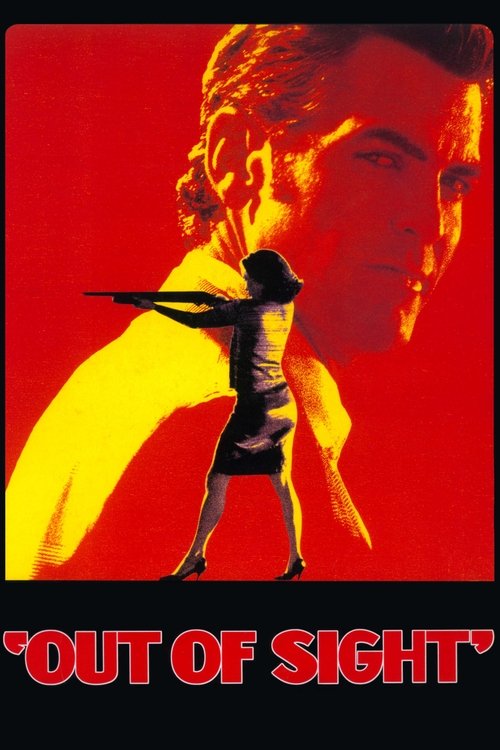
Out of Sight
1998 · Steven Soderbergh
For when you want to feel like an adult watching a movie for adults — a stylish night in that's equal parts romance and caper. Pure pleasure, zero homework.
What it's about
Jack Foley is a career bank robber — courteous, unhurried, very good at his job — who breaks out of a Florida prison and, in the chaos, ends up locked in a car trunk with Karen Sisco, the federal marshal whose job is to put him back. The chemistry in that trunk is instant and mutual, and it complicates everything as Foley heads north for one last score: a corrupt millionaire's stash of diamonds, with a genuinely dangerous ex-con circling the same prize. Cat and mouse, except both of them keep wondering what would happen if they just stopped playing.
The experience
Cool, sexy, and effortlessly funny — a crime movie that runs on flirtation instead of suspense, all snappy dialogue and smoldering pauses. It's the rare thriller that feels like a great date.
Performances
George Clooney and Jennifer Lopez generate the kind of screen chemistry movies chase for decades — their trunk scene alone is a masterclass in talking around desire. It's arguably the best work of Lopez's career: wry, tough, and completely in control.
The craft
Steven Soderbergh cuts the story out of chronological order and uses freeze-frames and time-shuffled seductions that make the romance feel like memory while it's happening — playful technique in service of feeling. Scott Frank's script keeps Elmore Leonard's dialogue intact, and the whole thing has a jazzy, sun-and-neon polish that goes down like a good cocktail.
Why it matters
It rescued Soderbergh's career and pointed straight toward his run of sleek studio crime films — and it set the modern standard for how to put a romance and a heist in the same movie without shortchanging either.
Snapshot
Out of Sight is the film that rescued Steven Soderbergh's career and, in doing so, helped define a strain of glossy, formally playful American crime cinema at the end of the 1990s. Adapted by Scott Frank from Elmore Leonard's 1996 novel, it pairs a career bank robber, Jack Foley (George Clooney), with the federal marshal who is supposed to bring him in, Karen Sisco (Jennifer Lopez). Their mutual attraction — sparked, indelibly, while crammed together in a car trunk during Foley's prison break — becomes the film's engine, played out against a heist plot involving a sadistic ex-con and a corporate millionaire's stash of diamonds. The picture is at once a crime film, a screwball romance, and a mood piece: cool, witty, and sexually charged, organized less around suspense than around the pleasure of two attractive professionals circling a relationship they both know is impossible. It underperformed commercially on release but was widely admired, and its reputation has only grown. For Soderbergh it marked the pivot from arthouse experimenter to A-list director; for Clooney it was the role that proved he could carry a movie; and for the broader Leonard adaptation cycle it stands, with Get Shorty and Jackie Brown, as one of the three definitive screen translations of the novelist's voice.
Industry & production
The film was produced by Jersey Films, the company founded by Danny DeVito, Michael Shamberg, and Stacey Sher, and released through Universal Pictures. Jersey Films had already shepherded Get Shorty (1995), the Barry Sonnenfeld–directed Leonard adaptation that demonstrated the commercial viability of the author's deadpan-criminal milieu; Out of Sight extended that relationship, again using a Scott Frank screenplay. Frank, who had written Get Shorty, was by this point the screenwriter most closely identified with rendering Leonard's elliptical dialogue and shifting points of view into workable scripts.
Soderbergh came to the project from a professional trough. After his Palme d'Or–winning debut sex, lies, and videotape (1989) made him a figurehead of the American independent movement, a run of commercially marginal and deliberately difficult films — Kafka, King of the Hill, The Underneath, and the self-financed experiments Schizopolis and Gray's Anatomy — had left him with critical respect but little industry heat. Out of Sight was a studio assignment, and he treated it as a chance to prove he could deliver a polished, star-driven entertainment without surrendering his sensibility. Casting was central to the gamble: George Clooney was still trying to translate television stardom from ER into film success after several misfires, and Jennifer Lopez was on the cusp of major celebrity, not yet the icon she would shortly become. The supporting ensemble was unusually deep, including Ving Rhames, Don Cheadle, Steve Zahn, Dennis Farina, Albert Brooks, Catherine Keener, Luis Guzmán, and Isaiah Washington.
On release in the summer of 1998, the film was a commercial disappointment relative to its budget — a recurring fact in its history that critics have long found ironic given its quality. Universal's marketing struggled to position a film that was neither a conventional action thriller nor a straightforward romantic comedy. I would not want to assert precise grosses from memory, but the consensus account is that it failed to recoup robustly in theaters and found its larger audience and durable reputation later, on home video and through critical reassessment.
Technology
Out of Sight was shot photochemically on 35mm, in the conventional manner of late-1990s studio production, before Soderbergh's later, well-documented embrace of digital capture. Its technological interest lies less in hardware than in post-production and color: Soderbergh and cinematographer Elliot Davis used heavy color grading, filtration, and stylized lab work to give each location a distinct palette — warm, sun-saturated ambers for Florida, cold steel-blue and desaturated grays for wintry Detroit. This location-coded color scheme, achieved largely through traditional means, anticipates the far more aggressive process work Soderbergh would deploy in Traffic (2000), where each storyline was assigned its own filter regime. In this sense Out of Sight is an early laboratory for an authorial technique that became one of his signatures.
Technique
Cinematography
Elliot Davis's photography is loose, mobile, and intimate, favoring handheld framing, available-light naturalism, and a willingness to let focus drift. The camera tends to sit close to faces, catching the micro-expressions on which the central romance depends. The most celebrated visual idea is the recurrent use of the freeze-frame — the image stuttering and holding on a gesture or a glance — which lends the film a snapshot quality, as if certain moments are being pinned in memory even as they pass. The color separation between Miami's heat and Detroit's chill does narrative work too, marking the geographic and emotional distance the characters travel.
Editing
The editing, by the veteran Anne V. Coates, is the film's most discussed formal achievement, and the casting of Coates is itself a piece of film history: she had cut Lawrence of Arabia (1962), and her presence on a hip Elmore Leonard adaptation linked classical Hollywood craft to a contemporary, fragmented style. Coates and Soderbergh restructure Leonard's chronology into a lattice of flash-forwards and flashbacks, withholding and then supplying information so that the romance accrues meaning through juxtaposition rather than linear progression. The signature sequence is the seduction at the Detroit hotel bar, in which Foley and Sisco's flirtation over drinks is intercut, in elegant slow dissolves and freeze-frames, with their subsequent move upstairs — the conversation and its consummation braided together so that anticipation and fulfillment occupy the screen at once. It is one of the most admired love scenes of the decade precisely because of its editing logic: the cut, not the choreography, generates the eroticism.
Mise-en-scène / staging
Soderbergh stages the film with a relaxed, character-first attention. Spaces are used for texture and class signaling — the corporate sleekness of the villain Ripley's world, the down-at-heel rooms of small-time crooks, the institutional flatness of prisons and marshals' offices. The trunk sequence is a model of confined staging: two strangers pressed nose-to-nose in a dark, cramped space, lit by intermittent flashes, the physical compression standing in for an emotional one. Throughout, blocking favors the oblique Leonard rhythm in which characters talk past, around, and through their actual intentions.
Sound
David Holmes's score is integral to the film's identity: a cool, groove-driven blend of jazz, funk, and electronica that gives the picture its unhurried swing. Holmes's work here established the musical idiom Soderbergh would carry forward into the Ocean's films, where the director again used propulsive, retro-inflected scoring to lend criminal enterprise a sense of style and play. The sound design favors intimacy — the hush of the trunk, the murmur of the bar — over spectacle.
Performance
The performances are the film's foundation. Clooney recalibrates his television charisma into something more rueful and self-aware; his Foley is a gentleman thief who is genuinely good at his trade and genuinely bad at staying out of trouble, and Clooney plays the contradiction with disarming lightness. It is frequently cited as the role that established him as a movie star rather than a TV actor in transit. Lopez gives what many regard as her finest dramatic performance — a Karen Sisco who is competent, unsentimental, and quietly amused, holding her own against, and over, the men around her. The chemistry between the leads is the film's irreplaceable asset. Around them, Ving Rhames brings warmth to Foley's partner Buddy, Don Cheadle is genuinely menacing as the ex-boxer Maurice "Snoopy" Miller, Steve Zahn supplies comic ineptitude, and Dennis Farina grounds the film as Karen's protective father.
Narrative & dramatic mode
The film operates in a romantic-ironic mode characteristic of Leonard: crime as a workplace, criminals as professionals with codes and grievances, violence arriving suddenly and without melodrama. Its dramatic question is not really "will the heist succeed?" but "can these two people be together?" — and the answer is structurally foreordained as no, which lends the romance its melancholy. The nonlinear construction is essential to this mood; by showing us the consequences before the causes, the film frames the love story as something already half-remembered, suffused with the awareness that it cannot last. The tone braids comedy and tenderness with genuine danger, modulating fluidly between the two.
Genre & cycle
Out of Sight belongs squarely to the post-Tarantino, late-1990s crime cycle, in which independent-minded filmmakers brought irony, structural play, and pop sophistication to genre material. More specifically it sits within the wave of Elmore Leonard adaptations that flourished in that decade — Get Shorty (1995), Jackie Brown (1997), and Out of Sight forming a loose trilogy of the author's screen prime. The connection to Jackie Brown is made literal: Michael Keaton appears, uncredited, as ATF agent Ray Nicolette, the same character he played in Tarantino's film, creating a shared Leonard cinematic universe across two studios and two directors. The film also revives and modernizes the screwball tradition of antagonists-as-lovers, grafting it onto the heist film.
Authorship & method
The dossier's authorial center is Soderbergh, but the film is a model of collaborative craft. His method here — taking studio material and inflecting it with formal experiment (nonlinear time, freeze-frames, location-coded color) while keeping it accessible — became the template for his subsequent commercial work. Scott Frank's screenplay is a master class in Leonard adaptation, preserving the novelist's dialogue rhythms and amorality while imposing dramatic shape. Anne V. Coates's editing supplies the temporal architecture. Elliot Davis's cinematography establishes the warm/cold visual scheme. David Holmes's score sets the tone. The Jersey Films producers provided the institutional continuity from Get Shorty. The most consequential relationship the film initiated, however, was Soderbergh's with Clooney: the two went on to found the production company Section Eight and to collaborate repeatedly, most visibly on Ocean's Eleven (2001) and its sequels.
Movement / national cinema
This is American studio filmmaking by a director formed in the independent movement — a hybrid that typifies a particular late-1990s moment when Sundance-bred talents moved into the mainstream without wholly abandoning their formal interests. Soderbergh is one of the central figures of that migration, and Out of Sight is among its exemplary texts: an experimentalist's sensibility deployed on a glossy commercial property.
Era / period
Released in 1998, the film captures the pre-millennial American crime film at a high point of stylistic confidence. It reflects the era's fascination with nonlinear storytelling (in the wake of Pulp Fiction), its appetite for pop-scored cool, and its star economy in transition — Clooney crossing from television, Lopez ascending toward multi-platform stardom. It is also a period piece about late-90s class textures: corporate raiders, prison overcrowding, the gap between Florida sun and Rust Belt decline.
Themes
At its core the film is about professionalism and desire — two people defined by their work, drawn to each other across the line that work draws between them. It meditates on the romance of the outlaw and the limits of that romance; Foley's charm cannot finally exempt him from consequence. Class and ambition run throughout, from Foley's "one last job" fantasy to Ripley's predatory wealth to Snoopy's resentment. Time and memory are thematized formally, the editing making the love story feel elegiac even as it unfolds. And there is a persistent irony about identity and role — cop and robber, hunter and hunted — and the pleasure of watching people who are very good at being exactly what they are.
Reception, canon & influence
Critically, Out of Sight was warmly received, frequently singled out for its screenplay, its editing, and the Clooney–Lopez chemistry, and it has been retrospectively canonized as one of the best films of 1998 and one of the finest Elmore Leonard adaptations ever made. Its commercial underperformance is invariably noted as the counterpoint to that acclaim. The film's influences run backward to the Leonard adaptation cycle and the screwball tradition of sparring lovers, and to the structural experiments of 1990s crime cinema. Its forward legacy is substantial: it relaunched Soderbergh, leading directly to Erin Brockovich and Traffic in 2000 (the latter winning him the Academy Award for Best Director) and to the Ocean's franchise; it cemented Clooney's film stardom and the Soderbergh–Clooney partnership; it gave Lopez her most respected acting showcase; and the Karen Sisco character was popular enough to anchor a short-lived television series. The hotel-bar seduction is routinely cited in discussions of how to build eroticism through editing. More broadly, the film's marriage of art-house technique and mainstream pleasure became a working model — for Soderbergh's own subsequent career, and for a generation of filmmakers seeking to smuggle formal play into studio entertainment.
A Deleuzian reading
Start with the trunk.
The full Deleuzian reading of Out of Sight →
Reception
A box-office disappointment in summer 1998 despite glowing reviews — but the National Society of Film Critics named it the year's best film, and it's since been canonized as the movie that saved Soderbergh's career and minted Clooney as a real movie star.
How Out of Sight was received, from release to now →
Influences: the films it descends from and the films it influenced
- Get Shorty (1995) — The immediate Jersey Films/Elmore Leonard predecessor whose deadpan fidelity to Leonard's dialogue cadence and criminal-as-professional cool established the adaptation template Scott Frank refined here.
- Pulp Fiction (1994) — Set the post-Pulp template of reshuffled chronology and pop-cut crime cinema that licensed Out of Sight's nonlinear, flashback-braided structure for a studio audience.
- Lawrence of Arabia (1962) — Anne V. Coates's career-defining match-cut and temporal-compression editing technique is the same architectural hand supplying Out of Sight's fragmented timeline.
- Point Blank (1967) — Pioneered the elliptical, flash-forward/flashback fracturing of a heist-and-revenge plot that Coates's cutting echoes in the trunk and prison strands.
- Don't Look Now (1973) — Its love scene intercut between the act and its calm aftermath is the direct formal precedent for the hotel-bar seduction built entirely through cross-cutting.
- The Thomas Crown Affair (1968) — Modeled the cool criminal/investigator romance staged as stylized erotic gamesmanship, where editing and flirtatious role-play carry the heat instead of explicit action.
- The 400 Blows (1959) — Canonized the freeze-frame as expressive punctuation, the device Soderbergh redeploys to arrest motion and italicize moments of decision and desire.
- Breathless (1960) — Source of the handheld immediacy and doomed-cool criminal-romance register, with cutting that breaks continuity for rhythm rather than clarity.
- His Girl Friday (1940) — The screwball template of antagonists who flirt through overlapping verbal sparring underwrites the crime-screwball hybrid of Karen and Jack's banter.
- Bonnie and Clyde (1967) — Imported French New Wave tonal whiplash and freeze-frame-adjacent stylization into American crime, romanticizing the outlaw couple in a way Out of Sight refines into seduction.
- The Friends of Eddie Coyle (1973) — Carries forward the Elmore Leonard dialogue tradition Higgins helped seed — criminals defined by laconic, specific, deal-making talk rather than action.
- The Limey (1999) — Soderbergh immediately pushes Out of Sight's associative, time-shuffling editing further, scattering a single conversation across past and present.
- Traffic (2000) — Systematizes the warm/cold location-coded color scheme into the film's entire visual grammar, expanding the technique trialed here.
- Ocean's Eleven (2001) — Directly launched by the Soderbergh–Clooney partnership, it scales the same method of smuggling freeze-frames and formal play into glossy studio entertainment.
- Erin Brockovich (2000) — The other half of the relaunch, reusing Coates's editing and Soderbergh's accessible-but-controlled craft to build a star vehicle around performance rhythm.
- Logan Lucky (2017) — Extends the crime-screwball hybrid and professionals-pulling-a-job structure with the same affectionate, deadpan ensemble cool.
- Ocean's Thirteen (2007) — Soderbergh's proto-Peter Andrews style: DI warm palette for seductive interior sequences, handheld proximity to actors rather than architectural framing, and comedic calibration of genre-thriller material — the technical and tonal vocabulary he carries directly into the Ocean's trilogy.
- Confessions of a Dangerous Mind (2002) — Freeze-frames and elliptical, playful temporal restructuring of genre material, the in-camera flourish vocabulary the debut emulates.
- Ocean's Eight (2018) — Soderbergh's fractured-chronology, freeze-and-jazz cool established the crime-picture idiom he later franchised into Ocean's and that Eight is a downstream execution of.
- Challengers (2024) — Anne V. Coates's intercut flashback braid organizes a romance around nonlinear time-jumps, cross-cutting deferred consummation with its buildup — the editing architecture Marco Costa extends across the match.
- Jackie Brown (1997) — A contemporaneous Leonard adaptation (Rum Punch) that likewise prizes unhurried character rhythm, slow-burn cross-generational attraction, and soundtrack-driven cool over plot mechanics.
- Drive (2011) — Carries forward the pop-scored, color-coded crime romance of professionalism and restrained desire, where mood and electronic score do the seduction.
- Spy Game (2001) — Builds romance through a nested flashback architecture punctuated by freeze-frames and step-printed accents, the same time-jumping construction Spy Game uses to thread the Muir–Bishop bond.
- The Thomas Crown Affair (1999) — Near-contemporary that frames thief and law-woman as cool, jazzy equals whose mutual pursuit is openly erotic — romance staged as a professional contest between adversaries.
- Ocean's Twelve (2004) — Source of the time-fractured, freeze-and-elide editing grammar and sun-flared telephoto intimacy that Soderbergh later folds into Twelve's withheld, non-linear heist construction.
- Go (1999) — Contemporary reworking of the Tarantino time-shuffle into a slicker crime register, using freeze-frames and reordered chronology so flirtation and heist intercut across nonlinear blocks.
Similar films
- Pulp Fiction (1994) — influence & lineage · same viewing thread
- Ocean's Eleven (2001) — influence & lineage
- Get Shorty (1995) — influence & lineage
- Traffic (2000) — influence & lineage
- Jackie Brown (1997) — influence & lineage
- GoodFellas (1990) — same viewing thread
- Donnie Brasco (1997) — same viewing thread
- The Limey (1999) — influence & lineage · often watched together
All the films related to Out of Sight →
Watch it with: curated runs of related films
- The Great American Crime Film — A run through the seductions and wreckage of American crime — mob epics that span a whole life beside capers that unravel over a weekend, all told with the same eye for how ordinary greed curdles into violence.