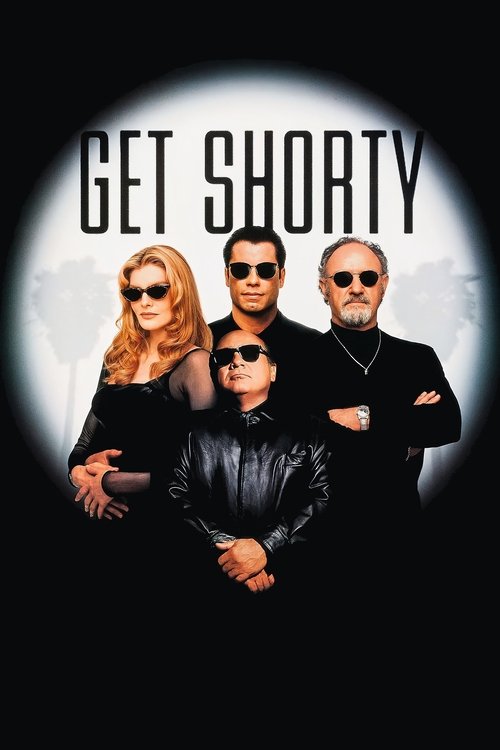
Get Shorty
1995 · Barry Sonnenfeld
For when you want something effortlessly cool and clever — a crime comedy you can pour a drink to, all snap and swagger, zero stress. Pure comfort viewing for people who like sharp dialogue.
What it's about
Chili Palmer, a Miami loan shark who loves movies, flies to L.A. to collect a debt from a producer of cheap horror pictures — and realizes his day job has prepared him perfectly for show business. Soon he's pitching his own life story as a film, romancing the producer's scream-queen leading lady, and outmaneuvering mobsters and studio types alike, who turn out to be roughly the same animal.
The experience
Breezy, confident, and very funny in a dry way — the pleasure is watching the coolest guy in every room stay three moves ahead without ever raising his voice. It moves like a caper but plays like a hangout.
Performances
John Travolta, fresh off his mid-90s comeback, is perfectly cast as Chili — the stillness and the movie-buff enthusiasm are the whole joke. Gene Hackman is a delight as the schlock producer in over his head, and Danny DeVito's preening movie star is a small comic gem.
The craft
Scott Frank's script keeps Elmore Leonard's voice intact — the crooked logic, the deadpan negotiations, the sense that every conversation is a con. Barry Sonnenfeld directs it light and quick, letting the dialogue carry the action; it's a film you enjoy with your ears as much as your eyes.
Why it matters
It cracked the code for putting Elmore Leonard on screen — keep the talk, trust the tone — and opened the door for the wave of stylish crime adaptations that followed in the late '90s, while cementing Travolta's resurrection as a leading man.
Snapshot
Get Shorty is a Hollywood-set crime comedy in which a Miami loan shark discovers that the skills of the rackets translate, almost without friction, into the skills of the movie business. Adapted by Scott Frank from Elmore Leonard's 1990 novel and directed by Barry Sonnenfeld, it arrived in October 1995 carrying two distinct charges. The first was John Travolta, freshly resurrected by Pulp Fiction the previous year and here cast as Chili Palmer, a shylock who is also a connoisseur of cinema. The second was the cultural moment's appetite for crime fiction told with verbal swagger and structural play — a wave Leonard's prose had helped seed long before Tarantino made it a style. The film's premise is its thesis: that the producer and the gangster are versions of the same animal, both running on intimidation, leverage, and the confident pitch. It is at once a glossy studio comedy and a sly piece of industry self-portraiture, affectionate toward the very Hollywood venality it anatomizes.
Industry & production
The picture was a Jersey Films production for Metro-Goldwyn-Mayer, and Jersey's identity matters to how it was made. Jersey Films was the company of Danny DeVito, Michael Shamberg, and Stacey Sher — the same outfit that had produced Pulp Fiction — and DeVito both produced Get Shorty and took the on-screen role of Martin Weir, the vain superstar Chili wants to attach to his movie. That doubling, a producer playing a parody of movie-business ego inside a film about movie-business ego, is one of the project's running jokes.
The casting of Travolta is the production's pivotal story, and the credible, repeatedly reported account is that Travolta initially passed and that Quentin Tarantino — who had just relaunched the actor — urged him to take the part. The film thus sits in the immediate slipstream of Pulp Fiction, trading on the audience's renewed pleasure in watching Travolta be cool, controlled, and quietly dangerous. Around him the production assembled a deep ensemble: Gene Hackman as the schlock-horror producer Harry Zimm, Rene Russo as scream-queen actress Karen Flores, Dennis Farina as the volatile Miami mobster Ray "Bones" Barboni, Delroy Lindo as drug-money financier Bo Catlett, and, in a small early role, James Gandolfini as a stuntman-enforcer. Scott Frank's screenplay was the connective tissue, and its success would help make Frank one of the most sought-after adapters in Hollywood.
Beyond these well-documented points, granular production detail — budget figures, shooting-schedule specifics, precise box-office tallies — should be treated cautiously; I will not assign numbers I cannot verify. What is securely established is that the film was a commercial and critical success that revived interest in Leonard adaptations and led, a decade later, to the Travolta-starring sequel Be Cool (2005).
Technology
Get Shorty is a conventional mid-1990s 35mm studio production, made on photochemical film with optical-era finishing rather than the digital intermediates that would standardize a few years later. Its technological interest lies less in apparatus than in subject: the film is partly about the machinery of moviemaking, and it stages the rituals of pitching, casting, and dealmaking as the real "technology" of Hollywood — the social-economic engine through which pictures get willed into existence. The production itself is unshowy in its tools, betting instead on performance, dialogue, and a polished, high-key Hollywood surface.
Technique
Cinematography
The photography is by Don Peterman, ASC, and it is worth stressing that the director, Barry Sonnenfeld, had himself been a cinematographer of real distinction before turning to directing — he shot the Coen brothers' Blood Simple, Raising Arizona, and Miller's Crossing, as well as Big and When Harry Met Sally. That background is legible throughout Get Shorty: the film has a more deliberately composed, camera-forward visual personality than its loose comic tone might suggest. Sonnenfeld's signature devices — emphatic, slightly aggressive camera moves, low and canted angles, sudden push-ins that punctuate a line — recur here, lending visual wit to dialogue scenes. The L.A. material is shot in bright, saturated, almost advertising-clean light, a deliberate contrast that flatters the city as Chili's seductive new world. The look is glossy by design, a Hollywood film about how good Hollywood makes things look.
Editing
Cut by Jim Miller, the film's editing serves a famously talky, plot-dense Leonard story, and its job is clarity as much as comedy. Leonard's narratives run on overlapping schemes, double-crosses, and money moving between parties, and the film must keep multiple criminal and commercial threads legible while sustaining comic tempo. The cutting favors crisp, beat-driven exchanges that let actors land lines, and it manages the story's interlocking deceptions without resorting to heavy expository scaffolding. Pacing is brisk but not frantic; the humor often lives in a held reaction or a precisely timed cut to a deadpan face.
Mise-en-scène / staging
The film's design — production design by Peter Larkin — draws a pointed contrast between two milieus that turn out to be morally identical: the seedy hustle of Miami loan-sharking and the chrome-and-glass glamour of Los Angeles dealmaking. Restaurants, hotel suites, production offices, and screening rooms become the arenas where power is negotiated, and the staging repeatedly frames conversation as confrontation. A recurring motif is the pitch and the threat occupying the same physical postures — leaning in, holding eye contact, controlling the room — so that the blocking itself argues the film's central equivalence between the gangster and the producer.
Sound
The score is by John Lurie, the saxophonist and Lounge Lizards leader known for a cool, jazz-inflected sensibility, and the musical character is appropriately loungey and laid-back — a sound that mirrors Chili's unflappable composure. The needle-drops and source music help locate the film in a knowing, retro-cool register that complements Travolta's poise. Beyond the music, the film's sound design is conventional studio work in service of dialogue, which is the true engine here: Leonard's and Frank's lines need to be heard cleanly, and the mix prioritizes them.
Performance
Performance is the film's center of gravity. Travolta plays Chili Palmer as a study in stillness and certainty — a man who never raises his voice because he never needs to, whose menace is a function of calm. His repeated instruction, "Look at me," delivered flat, became the film's emblematic beat. Hackman, by contrast, plays Harry Zimm as flustered, greedy, and out of his depth, and the comedy of their scenes is the collision of Chili's control with Harry's panic. Rene Russo gives Karen Flores intelligence and skepticism, refusing the ornamental role the genre might assign her. Dennis Farina's Ray Bones is a vein-popping engine of grievance; Delroy Lindo brings genuine danger and dignity to Bo Catlett; and DeVito's Martin Weir is a precise miniature of movie-star self-absorption. The ensemble's calibration — broad where it should be broad, cool where it should be cool — is the film's chief achievement.
Narrative & dramatic mode
The dramatic mode is comic crime, told with the cross-cut, multi-party plotting characteristic of Leonard. The engine is irony: Chili, an enforcer sent west to collect debts, finds his criminal competencies — reading people, applying pressure, projecting unshakable confidence — perfectly suited to producing a movie, and the film's pleasure comes from watching him glide through Hollywood as if it were just another territory. The structure interleaves several schemes (the loan-shark debt, a tangled subplot involving lost airline money, a drug-money laundering operation) and lets them braid toward a convergence. Tonally the film keeps violence largely offstage or played for dark comedy, maintaining a light surface over genuinely lethal stakes — a balance that depends entirely on Travolta's coolness as a stabilizing pole.
Genre & cycle
Get Shorty belongs to two overlapping cycles. The first is the Elmore Leonard screen adaptation, a lineage that the film helped reinvigorate and that would continue through Tarantino's Jackie Brown (1997, from Rum Punch) and Steven Soderbergh's Out of Sight (1998) — the latter also written by Scott Frank, and often considered the finest Leonard film. The second is the self-reflexive Hollywood satire, the movie-about-the-movies tradition stretching back through The Player (1992), Sunset Boulevard, and The Bad and the Beautiful. Get Shorty fuses these: it is a crime comedy whose criminal protagonist becomes the vehicle for industry satire. It also rides the broader mid-1990s vogue for talky, stylish, structurally playful crime pictures that Pulp Fiction had made commercially fashionable.
Authorship & method
The film is best understood as a meeting of several authorial sensibilities. Barry Sonnenfeld, the director, brought a cinematographer's eye and a taste for kinetic comic style, fresh off The Addams Family and its sequel and immediately preceding his massive success with Men in Black (1997); his method favors visual punctuation and tonal control. Scott Frank, the screenwriter, is the project's crucial craftsman: his adaptation preserves Leonard's voice — the laconic dialogue, the moral flatness, the comedy of criminal professionalism — while shaping the novel's sprawl into a tractable screen structure, and his work here helped establish him as a premier adapter (later Out of Sight, Minority Report, Logan, and the television series The Queen's Gambit). Elmore Leonard is the originating author, and the film's fidelity to his sensibility is its defining method; it succeeds precisely where many Leonard adaptations had failed, by trusting the dialogue and the deadpan. Among collaborators, cinematographer Don Peterman, editor Jim Miller, composer John Lurie, and production designer Peter Larkin translated that sensibility into a glossy, controlled studio object. And Danny DeVito, as producer and performer, embodied the film's insider knowingness about the business it satirizes.
Movement / national cinema
The film is firmly within mainstream American studio filmmaking — a Hollywood product about Hollywood, made by a major (MGM) with movie stars. It does not belong to any avant-garde or national-cinema movement; its lineage is industrial American cinema, specifically the strand of self-aware, star-driven genre entertainment of the 1990s. If it has a "movement" affiliation at all, it is to the post-Pulp Fiction commercial wave of hip, dialogue-rich crime comedies, a thoroughly American and thoroughly studio-bound phenomenon.
Era / period
Get Shorty is a quintessential mid-1990s artifact. It captures a moment when independent crime cinema's energy had been absorbed by the studios, when Travolta's stardom had been spectacularly reborn, and when Hollywood was newly comfortable laughing at its own appetites onscreen. Its glossy production values, its retro-cool soundtrack sensibility, and its faith in the movie star as the engine of pleasure all date it precisely to that decade. It also marks a transitional point in the Leonard adaptation record — the moment the author's voice finally translated reliably to screen — and stands at the threshold of Sonnenfeld's late-1990s ascent to blockbuster scale.
Themes
The governing theme is the equivalence of crime and showbusiness: both run on coercion, confidence, debt, and the persuasive pitch, and the film argues this not as cynical metaphor but as plain observation. Allied to it is the idea of the pitch as the fundamental currency of Hollywood — the notion that a story confidently told can become real, that performance and self-belief manufacture value. There is a sustained meditation on cool itself, on the power of composure, with Chili as its avatar; his refusal to be rattled is both character trait and worldview. The film is also about cinephilia and reinvention — Chili's genuine love of movies is what makes his transformation feel earned rather than merely opportunistic, and the picture flatters the audience's own movie-love in the process. Underneath the comedy runs a steady awareness of money and leverage as the true language everyone speaks.
Reception, canon & influence
Get Shorty was warmly received as one of the most successful Elmore Leonard adaptations and a confirmation of Travolta's revived stardom; his performance was singled out as the film's anchor, and the picture's blend of crime and Hollywood satire was widely praised. (Specific award outcomes and exact critical tallies should be checked against the record rather than asserted from memory; what is secure is that the film was both a commercial success and a critical favorite.)
Its influences run backward to Leonard's decades of crime fiction and to the long tradition of Hollywood-on-Hollywood satire — The Player being the immediate antecedent — as well as to the post-Pulp Fiction taste for stylish, talky crime comedy that made its moment possible. Looking forward, the film helped catalyze a renewed cycle of Leonard adaptations, most consequentially Soderbergh's Out of Sight (1998), again scripted by Scott Frank and again starring a charismatic criminal lead, which many regard as the genre's high-water mark. Get Shorty generated its own direct continuations: the sequel Be Cool (2005), with Travolta returning as Chili Palmer in a story now satirizing the music industry, and a later television series, Get Shorty (2017–2019), only loosely derived from the novel. Within Sonnenfeld's career, the film's success immediately preceded Men in Black and his elevation to blockbuster director; within Scott Frank's, it launched one of the most durable screenwriting careers of the era. Its enduring critical standing rests on the proposition it dramatizes with such ease — that the gangster and the producer are, finally, the same man — and on Travolta's portrait of cool as a form of power.
A Deleuzian reading
Start with the line everyone remembers.
The full Deleuzian reading of Get Shorty →
Reception
A genuine hit in 1995 — critics hailed it as the movie that finally cracked Elmore Leonard on screen — and it's since settled into 'quietly underrated 90s gem' status, the comfort-watch Hollywood satire people rediscover and wonder why nobody talks about it more.
How Get Shorty was received, from release to now →
Influences: the films it descends from and the films it influenced
- The Player (1992) — Established the modern Hollywood-on-Hollywood satire where pitch meetings double as moral combat — the direct template for Get Shorty's 'pitch-as-threat' staging and its conceit that the producer is just a gangster with a parking space.
- Pulp Fiction (1994) — Rehabilitated Travolta into an icon of criminal stillness and licensed the post-pulp wave of talky, deadpan crime comedy whose rhythms of digression and lounge-cool Get Shorty rides directly.
- The Addams Family (1991) — Sonnenfeld's prior feature where he forged his signature kinetic comic grammar — aggressive dolly/crane moves and high-key glossy framing as visual punctuation — the exact directorial toolkit he carries into Get Shorty.
- 52 Pick-Up (1986) — An earlier Leonard adaptation that proved the material's screen potential when its hardboiled dialogue and criminal-professionalism comedy are trusted, a problem Get Shorty finally solved tonally.
- Blood Simple (1984) — Sonnenfeld served as cinematographer, learning the prowling, aggressive camera moves and high-contrast framing he later deploys as a director's visual punctuation in Get Shorty.
- Elmore Leonard / Stick (1985) — A failed Leonard adaptation that demonstrated the negative lesson Get Shorty inverts — punching up Leonard's voice destroys it — defining by contrast the trust-the-dialogue method.
- Out of Sight (1998) — Scott Frank again adapts Leonard around a charismatic-criminal lead, extending Get Shorty's screenwriting method — preserving the laconic banter and ironic reversals while imposing tractable screen structure — into the genre's high-water mark.
- Be Cool (2005) — Direct sequel that re-runs Chili Palmer's deadpan-operator cool against the music industry, literalizing Get Shorty's 'crime equals showbiz' thesis with the same insider-satire engine.
- Men in Black (1997) — Sonnenfeld scales up Get Shorty's method — beat-driven editing, deadpan ensemble calibration, and showy camera moves as comic punctuation — into blockbuster register immediately after.
- The Limey (1999) — Extends the post-Get Shorty/Out of Sight strain of cool-criminal cinema with fractured, beat-driven editing and a charismatic stillness in the lead, carrying forward 'cool as a form of power.'
- Ocean's Eleven (2001) — Soderbergh extends the Get Shorty/Out of Sight ensemble-cool template — calibrated star ensemble, lounge-jazz scoring, and crime-as-glamorous-showbiz — into the heist register.
- Be Cool / Get Shorty (TV) (2017) — The television series loosely re-derives Chili Palmer's gangster-turned-producer arc, dramatizing again the 'crime equals showbiz' equation at long-form scale.
- Jigarthanda (2014) — Directly models the crime-meets-cinema plot machine — a mobster who wants a movie made — turning the collision of the underworld and the film industry into narrative structure.
- The Gentlemen (2020) — Elmore Leonard's professional-criminal register — negotiation, etiquette and understatement doing the work of threat — plus the crime-story-as-movie-business conceit that lets a hood talk in development jargon; Ray's unflappable politeness is Chili Palmer's.
- Jackie Brown (1997) — Another reverent Elmore Leonard adaptation that trusts the laconic dialogue and moral flatness rather than amping the plot — the same fidelity-to-Leonard's-voice method, with crime professionals treated as deadpan workmen.
- Be Yourself, but Cooler
- Fargo (1996) — Crime comedy built on deadpan professionals and ironic reversals, treating violence as banal business — the same flat moral comedy of competence, with Sonnenfeld's Coen-adjacent (he shot their early films) glossy-controlled visual lineage.
- Burn After Reading (2008) — Multi-party cross-cut crime comedy of incompetent operators and ironic reversals, sharing Get Shorty's structural braid of converging schemers and deadpan tonal control.
- Soderbergh's Get Carter
- Wild Things (1998) — Mid/late-90s glossy, high-key crime entertainment built on ironic reversals and a sun-bright Florida palette, sharing Get Shorty's bright-surface-over-dark-deeds visual irony.
Similar films
- Pulp Fiction (1994) — influence & lineage
- Out of Sight (1998) — influence & lineage
- The Player (1992) — influence & lineage
- Jackie Brown (1997) — influence & lineage
- Casino (1995) — shared sensibility
- Scarface (1983) — shared sensibility
- Carlito's Way (1993) — shared sensibility
- Go (1999) — shared sensibility