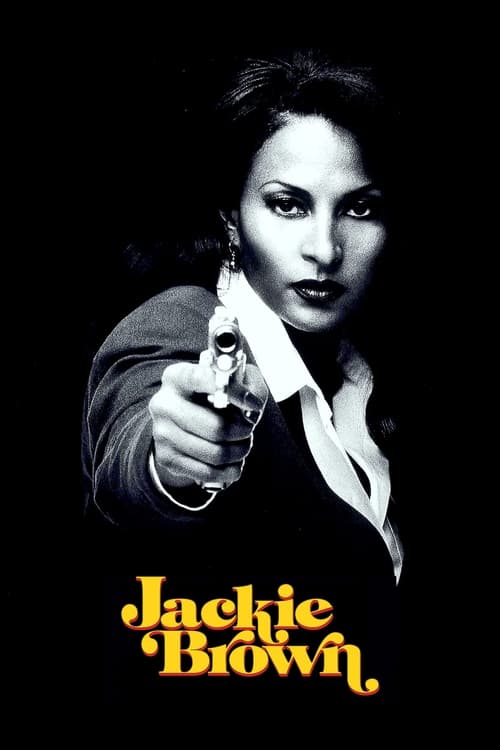
Jackie Brown
1997 · Quentin Tarantino
Generates discourse without releasing anything: the abandoned Movie Critic "final film," podcast hot takes (dunking on Marvel actors as "not movie stars," snubbing Toy Story 3), and the eternal "what will the tenth film be" watch. The industry's loudest opinion-haver.
For when you want a crime movie that lets you sink into it — cool, talky, soundtrack-driven, made for a late night when you're not in a hurry. Pure hangout pleasure with a sting of real feeling.
What it's about
Jackie Brown is a 44-year-old flight attendant scraping by on a budget airline and smuggling cash for an L.A. gunrunner on the side. When federal agents catch her at the airport, she's squeezed between the law and a boss who tidies up loose ends — so, with a weary bail bondsman as her only ally, she starts playing everyone at once for a half-million dollars.
The experience
Unhurried and confident, more soulful than tense — long conversations, great needle-drops, and a slow-building con that snaps together in the last act. It's funny, a little melancholy, and unexpectedly romantic in a grown-up, nothing-stated way.
Performances
Pam Grier carries the film with hard-won poise — a woman who's been underestimated her whole life quietly running the table — and Robert Forster matches her with a tender, understated turn that earned him an Oscar nomination. Samuel L. Jackson makes the gunrunner Ordell both hilarious and genuinely frightening.
The craft
Adapted from an Elmore Leonard novel, it's Tarantino's most patient piece of writing — dialogue that reveals character instead of showing off — with a soul soundtrack that does half the emotional work. One key sequence replays the same stretch of time from different characters' viewpoints, letting you assemble the con yourself.
Why it matters
Long treated as the quiet one between Tarantino's flashier films, it's now widely seen as his most mature work, and it revived the careers of Pam Grier and Robert Forster while proving Leonard's crime novels could translate whole to the screen.
Snapshot
Quentin Tarantino's third feature is his most formally composed and emotionally generous work — a crime picture that slows down to watch its characters breathe. Adapted from Elmore Leonard's 1992 novel Rum Punch, the film follows Jackie Brown, a middle-aged flight attendant working low-paying runs for Del Amo Airlines while moonlighting as a cash mule for Compton arms dealer Ordell Robbie. When federal agents catch her at LAX with cash and cocaine, she is squeezed between the ATF and the man who employed her, and she decides, quietly and deliberately, to outmaneuver everyone. The film is simultaneously a blaxploitation homage, a Leonard adaptation, a heist picture, and — most distinctively — a meditation on time, aging, and survival. Tarantino cast Pam Grier in the lead, changed the protagonist's race from the novel's white Jackie Burke, and built the film around what Grier's specific history meant to audiences who remembered her.
Industry & production
Jackie Brown was produced through Tarantino and Lawrence Bender's production company A Band Apart and released by Miramax on December 25, 1997, capitalizing on the awards-season window. The film arrived three years after Pulp Fiction (1994) had made Tarantino the most celebrated American director of his generation and had returned roughly $200 million worldwide on a $8 million budget. The commercial pressure and critical expectation surrounding the follow-up were unusually high; Miramax's promotional campaign emphasized the ensemble cast and the blaxploitation lineage as selling points.
Tarantino purchased the rights to Leonard's novel himself, making it his first adaptation of an existing literary property. Leonard, whose work had already yielded Get Shorty (1995) and would soon produce Steven Soderbergh's Out of Sight (1998), was known for dialogue-driven crime fiction with morally ambiguous characters and intricate confidence-game plots — a natural match. The screenplay closely follows Rum Punch's structure, with the significant alteration of the protagonist's racial identity; Tarantino has consistently cited this casting decision as central to the film's meaning, framing it as an act of reclamation for Grier specifically. Samuel L. Jackson, Robert Forster, Bridget Fonda, Michael Keaton, and Robert De Niro round out a cast Tarantino assembled with care for what each actor's cultural weight would bring to the screen.
The production budget is reported to have been modest relative to post-Pulp Fiction expectations — figures cited in trade coverage place it in the low tens of millions of dollars, though confirmed breakdowns are not publicly detailed. The film's domestic box office performance was profitable but not the phenomenon its predecessor had been, a reception that influenced how Jackie Brown was discussed critically in its immediate wake.
Technology
Jackie Brown was photographed on 35mm film by Guillermo Navarro, who would later win an Academy Award for his work on Guillermo del Toro's Pan's Labyrinth (2006). Shooting on photochemical film was the standard of theatrical production in 1997; no digital intermediate process was used. The film's warm, slightly desaturated palette — suggestive of Kodak emulsions favored for natural interior light — was in part a deliberate period reference, aligning the film's visual texture with 1970s crime pictures.
The post-production workflow was entirely analog in terms of editorial methodology; editor Sally Menke, Tarantino's closest creative collaborator on every film from Reservoir Dogs through Inglourious Basterds, cut on a flatbed (or early non-linear system, as the industry was transitioning) and shaped the film's famously unhurried pace through decisions made against industry norms of the period. The film runs approximately 154 minutes, notably longer than the commercial thriller template.
Technique
Cinematography
Navarro's work on Jackie Brown is notably restrained by Tarantino's standards. The camera is observational rather than exhibitionistic — holding on faces in medium shots, tracking characters through the mundane corridors of a Del Amo shopping mall in Torrance with an anthropological patience. Wide-angle distortions and aggressive rack-focusing, common tics of the post-Pulp Fiction "indie cool" aesthetic, are largely absent. The film favors natural light or tungsten-tempered sources, and interiors carry a sense of lived heat — the apartment of Louis Gault (De Niro), perpetually dim, shot glasses and a television as its only light sources.
The shopping-mall sequence, in which the money exchange is shown three times from three perspectives, deploys handheld camera work contextually, shifting register as it shifts viewpoint. What begins as confident wide coverage becomes, on the third iteration, a tighter, more anxious view aligned with Jackie's subjective experience. This earned variation in visual grammar rewards close attention and distinguishes Navarro and Tarantino's work from the purely decorative multi-angle stylistics of contemporaries.
Editing
The Menke-Tarantino editorial relationship is at its most disciplined here. The film's most discussed formal move — the three-angle repetition of the mall exchange — works because Menke's cuts within each iteration are clean and purposeful rather than flashy. Duration is used as dramatic pressure: scenes play longer than genre comfort allows, and the discomfort this produces in audiences conditioned to faster cutting is itself expressive, aligning the viewer with the patience Jackie must maintain to survive.
The film also resists the temporal fragmentation of Pulp Fiction's non-linear structure. The narrative is largely chronological, which grants emotional weight to scenes that depend on accumulated knowledge of character — particularly Max Cherry (Forster) and Jackie's developing wordless understanding.
Mise-en-scène / staging
The Torrance and Compton locations are allowed to mean something. The Del Amo Fashion Center — one of the largest malls in the United States — is staged not as ironic backdrop but as a believable geography of working-class Southern California commerce, familiar and slightly airless. Jackie's apartment is lived-in and modest; Melanie's (Fonda) is the apartment of someone coasting toward entropy. Ordell's home is stocked with the signifiers of mid-tier success and paranoia. These spaces are not dressed for set design awards; they are calibrated for sociological accuracy.
Staging choices emphasize the distance and proximity between characters as information. The scene in which Jackie and Max first speak in the parking lot of Cherry Bail Bonds runs long on purpose — Tarantino holds the two-shot, confident that Forster and Grier will fill it.
Sound
Sound design in Jackie Brown is unremarkable in the technical-innovative sense and extraordinary in its deployment of recorded music. Tarantino opens and closes the film with Bobby Womack's "Across 110th Street" (1972), originally recorded for Barry Shear's blaxploitation film of the same name — a gesture that frames the entire picture as an extension of a tradition rather than merely a reference to it. The song's words about survival and indignity are not ironic commentary; they are the film's emotional thesis.
The soundtrack draws from soul, funk, and R&B of the 1970s: Minnie Riperton, Bill Withers, the Brothers Johnson, Bloodstone. No conventional underscore was composed. The music is diegetically plausible — heard through car radios, stereos — or used as emotional chapter-markers. This practice, established in Reservoir Dogs and Pulp Fiction, here serves a more specific historiographic purpose: the music places Jackie Brown in a moment in Black American cultural production, and its use is politically conscious in a way that Tarantino's soundtrack choices are not always.
Performance
Pam Grier's performance is the film's center of gravity and its primary argument. Grier, whose career had peaked in the blaxploitation cycle of Coffy (1973) and Foxy Brown (1974) and had largely subsided since, was 48 years old during production. Tarantino builds the film around the specific quality of a person who has learned that survival requires intelligence, composure, and the willingness to be underestimated. Grier does not play Jackie's intelligence as cleverness; she plays it as accumulated fatigue and will. It is a performance of extraordinary economy.
Robert Forster's Max Cherry is the film's other revelation. Forster had not had a significant role in years; the specificity of what Tarantino offered him — a decent man, past his prime, falling into a quiet feeling for a woman he barely knows — suited his laconic precision exactly. He received an Academy Award nomination for Best Supporting Actor. Samuel L. Jackson plays Ordell as menacing and self-regarding, calibrating charm and violence with practiced ease. Bridget Fonda's Melanie — stoned, sardonic, disposable in her own narrative estimation — is a performance of careful comic timing. Robert De Niro's Louis Gault is deliberate anti-spectacle: the most celebrated actor in the film barely registers as present, which is entirely correct for the character.
Narrative & dramatic mode
Jackie Brown operates within what might be called the Leonardian confidence-game mode: a middle-intelligence protagonist outmaneuvers more powerful actors through patience, nerve, and the exploitation of others' arrogance. The narrative satisfaction is not pyrotechnic but structural — the pleasure of watching someone who has been underestimated orchestrate a successful deception.
The tripartite repetition of the mall exchange is the film's central formal statement. By showing the same event from three perspectives — Ordell and Ray's surveillance, Louis and Melanie's participation, Jackie's execution — Tarantino makes explicit what the entire film is doing narratively: withholding information about Jackie's plan until she has already won. The viewer, like Ordell, is not given full access to her mind. This is an act of narrative respect as much as craft; Jackie is never entirely knowable, which preserves her agency.
Genre & cycle
Jackie Brown sits at the intersection of the blaxploitation revival, the Elmore Leonard crime-fiction adaptation cycle, and the post-Pulp Fiction independent crime wave. The blaxploitation invocation is direct and specific rather than parodic: Grier's casting, the funk soundtrack, the Compton setting, and the protagonist's self-reliance all invoke a genre tradition without condescending to it. The film does not treat blaxploitation as kitsch; it treats it as a legitimate aesthetic inheritance.
The Leonard cycle — Get Shorty, Out of Sight, and the later television adaptation Justified — shares with Jackie Brown an interest in crime not as violence but as intelligence, and in characters whose moral compromises are rooted in comprehensible economic desperation rather than psychopathy. Soderbergh's Out of Sight (1998), arriving the following year with a similarly observed, character-driven tone, suggests that Leonard's fictional mode was particularly well-served by directors willing to subordinate style to character at that historical moment.
Authorship & method
Tarantino's authorial signature — the curated soundtrack, the extended dialogue scenes, the pop-cultural digression as dramatic mode — is present but sublimated to character and material. He has described Jackie Brown as his most personal film, which is counterintuitive given that it is his only adaptation. The personal investment appears to be precisely in the act of tribute: to Grier, to Leonard, to a generation of filmmakers and performers whose work formed Tarantino's sensibility and whom he was, through this film, attempting to validate and restore.
Guillermo Navarro's contribution is considerable; the film's visual restraint represents a deliberate creative negotiation between Navarro's precise, controlled style and the material's demands. Sally Menke's editorial collaboration shaped the film's most unusual formal choice — its willingness to hold duration — and the cumulative effect of her work is a film that trusts its audience to stay present without stimulation. Lawrence Bender's production relationship with Tarantino, consistent across the earlier films, provided the structural support for a project that was commercially riskier than its predecessor.
Movement / national cinema
Jackie Brown is an American film in the fullest sense: it is concerned with specifically American economies of race, work, and survival, set in an unglamorous corner of Los Angeles that Hollywood typically uses only as backdrop. Its engagement with blaxploitation positions it within a tradition of Black American genre cinema that Tarantino is approaching as an admiring outsider — a position that has produced ongoing critical debate about the film's racial politics, which are sincere in intent and complicated in execution.
The film has no significant relationship to any national cinema movement beyond its American context, though its debt to the French New Wave, via Tarantino's broader cinephile formation, inflects the confidence with which it holds duration and withholds conventional genre pleasures.
Era / period
The film belongs to the mid-to-late 1990s moment of American independent cinema consolidation, when Miramax and similar distributors were industrializing the "indie" aesthetic that Tarantino and others had crystallized. Jackie Brown sits at the end of that wave's first flush — released the same year as Good Will Hunting and L.A. Confidential, and sharing cultural space with a moment in which crime fiction and literary adaptation were commercially favored. It does not fit neatly into the ironic, fast-cutting stylistics that Pulp Fiction had inadvertently licensed; its deliberateness marks it as a correction.
Themes
Survival through underestimation is the film's structural and moral core. Jackie Brown is a woman whom the state, her employer, and her circumstances have all arranged to consume; she escapes by making herself legible as less competent, less dangerous, and less intentional than she is. This is framed not as trickery but as the accumulated skill of a woman who has spent decades navigating systems designed without her interests in mind.
Aging and dignity are inseparable from the film's emotional register. Jackie is 44; Max Cherry is past middle age; Louis Gault is inert with time. The film takes seriously the experience of living past the age at which American popular culture typically finds people interesting, and its central affective gesture — the tentative, unspoken regard between Jackie and Max — depends entirely on the specific weight of age and missed time.
Race is present throughout without being treated as theme in the didactic sense. Jackie Brown's survival in a system dominated by white legal authority and Black criminal economy requires constant navigation of racial expectation, and the film records this without editorializing. Ordell's violence is not racialized; it is individual. Jackie's competence is not framed as exceptional; it is earned.
Reception, canon & influence
Influences on the film. Barry Shear's Across 110th Street (1972) is the primary acknowledged ancestor, opening and closing the film with its title song. Grier's own vehicles — Coffy and Foxy Brown, directed by Jack Hill — provide the specific lineage the casting invokes. Elmore Leonard's novel offers its structural intelligence and deadpan moral vision. Robert Altman's The Long Goodbye (1973) — another revisionist Los Angeles crime film concerned with a decent man out of time — is a visible spiritual forefather, particularly in the treatment of Max Cherry. The 1970s films of John Cassavetes, with their patience for actors and resistance to conventional narrative efficiency, are a less acknowledged but plausible influence on the film's pace.
Critical reception. Initial reviews were divided in ways that now seem diagnostic of critical expectations rather than the film's qualities. Some critics, measuring against Pulp Fiction, found it slow and underpowered; others recognized immediately that its restraint was its achievement. Roger Ebert awarded it four stars and praised it as Tarantino's most mature work. The Academy nomination for Forster generated attention, but Grier's performance — arguably the greater achievement — was not nominated, a critical oversight widely noted at the time and since.
Legacy. The film's reputation has grown steadily and substantially in the decades since its release. It is now commonly regarded as one of Tarantino's finest works and is frequently cited in discussions of the best American films of the 1990s. The revival of Pam Grier's career, though it did not produce the sustained industry rehabilitation it deserved, stands as a meaningful cultural act. Robert Forster's career was genuinely restored: he worked steadily and with distinction until his death in 2019, most notably in AMC's Breaking Bad.
The film's influence on subsequent crime cinema is less direct than Pulp Fiction's but perhaps more durable in the specific sense: the Leonard adaptation cycle it joined and helped legitimize — through Out of Sight, Justified, and into prestige television crime fiction — owes something to the proof of concept that character-driven, dialogue-dependent crime films could hold large audiences. The model of the long-form confidence-game narrative, trusting viewers to withhold judgment until the full design reveals itself, has currency in contemporary prestige television that can be traced through this lineage. Jackie Brown remains the film Tarantino made when he was most willing to subordinate himself to his characters, and that quality of restraint is, in retrospect, one of its most instructive achievements.
A Deleuzian reading
She is standing still and moving.
The full Deleuzian reading of Jackie Brown →
Reception
In 1997 it landed as a muted disappointment — audiences wanted Pulp Fiction 2 and got a patient, middle-aged crime story instead. Now it's routinely reappraised as Tarantino's most mature film, and 'Jackie Brown is secretly his best' has gone from hot take to respectable opinion.
How Jackie Brown was received, from release to now →
How to watch Jackie Brown: what to notice on a first viewing
- Watch the opening shot hold on Jackie riding the travelator. She glides left to right against a tiled wall in her Del Amo blues while Bobby Womack plays. She does nothing at all, and the shot runs well past where a thriller would hand her a task. The film decides to watch a woman be a person before it turns her into a plot.
- Watch Pam Grier's face during the long two-shots. She plays intelligence as accumulated fatigue and will rather than as cleverness. In the bail-bonds parking lot Tarantino refuses to cut, and she and Forster fill the take with almost no movement. A feeling registers on the face and never discharges into action, and that is where the scene actually happens.
- Time how long a conversation runs before anyone cuts. Sally Menke lets scenes play well past genre comfort. Nothing is trimmed to keep you stimulated. The discomfort of waiting is expressive, and it puts you on the same clock Jackie is on. You feel how long survival takes for somebody who cannot solve her problem with a single move.
- Listen for music coming from car radios and stereos. There is no composed score. Soul and funk of the 1970s arrive inside the scenes, on real speakers, and 'Across 110th Street' opens and closes the picture as a whole song rather than a cue. The music gives Jackie a past and a place, and the film treats that inheritance as owed rather than quoted.
- Notice the mall, the apartments, and the office carpet. Guillermo Navarro shoots the Del Amo Fashion Center as a real working-class geography instead of an ironic backdrop. The apartments are modest and dim and accurate about how much money each person has. The places tell you the economic pressure on every character before the plot explains anything about it.
The whole guide to watching Jackie Brown, with the keys for a rewatch →
Influences: the films it descends from and the films it influenced
- Coffy (1973) — Established Pam Grier's performance register — composed, physically self-contained, navigating a hostile male world through wit — which Tarantino literalizes as both casting template and tonal blueprint, building Jackie Brown around what Grier's specific screen history already meant.
- Foxy Brown (1974) — Codified the blaxploitation genre grammar Tarantino specifically homages: soul/funk diegetic score, Black urban sociological specificity, and a female protagonist who outmaneuvers institutional and criminal power through intelligence rather than brute force.
- Across 110th Street (1972) — Bobby Womack's title theme, reused verbatim as Jackie Brown's opening and closing bookend, was written and first performed for this film — making it a direct sonic citation and establishing the template of using a soul title track to locate genre in Black urban geography.
- Shaft (1971) — Isaac Hayes's score pioneered the diegetic soul/funk soundtrack as a means of encoding racial identity and urban geography within genre form — the foundational model for how blaxploitation used music as structural and ideological signifier that Jackie Brown inherits.
- Sweet Sweetback's Baadasssss Song (1971) — Originated the independent Black cinema aesthetic that made blaxploitation's racial politics possible — shooting on location in Black urban space as a declaration of authorial sovereignty, and using music (Earth, Wind & Fire's score) as a formal organizing element rather than incidental underscoring.
- The Friends of Eddie Coyle (1973) — Established the unglamorous, observational crime picture centered on an aging low-level operator: natural light, real locations, medium shots held long enough to register exhaustion on actors' faces — the anti-spectacle realism Tarantino and Navarro apply to Jackie and Max Cherry.
- The Long Goodbye (1973) — Demonstrated that a genre picture could adopt observational patience and behavioral naturalism — handheld camera, long takes, ambient sound as texture — to demythologize a genre hero, a methodology Tarantino applies to revise the blaxploitation template from reverence toward portraiture.
- Night Moves (1975) — Establishes the anti-resolution crime film in which protagonist interiority is systematically withheld — Gene Hackman's Harry Moseby acts without fully understanding his own motivations — a formal model for how Tarantino renders Jackie's internal life through behavior rather than confession.
- Pulp Fiction (1994) — Established the Tarantino-Menke editorial vocabulary — long dialogue scenes held past conventional comfort, rhythm built through selective cut timing rather than pace — which Jackie Brown inherits but transposes from fractured non-linear chronology into strict linear accumulation.
- True Romance (1993) — The pop-object accumulation staging — soul records and Inglewood shopping mall consumer objects as character identity markers — and the elongated real-time scene sequences (the triple-perspective mall sequence) develop the True Romance approach to space and duration in Tarantino's most Scott-paced directorial work.
- The Killing (1956) — Replays the mall money-handoff three times from different characters' vantage points — a near-direct elaboration of Kubrick's racetrack robbery shown from converging angles.
- Django Unchained (2012) — Extends Tarantino's blaxploitation-homage methodology: using a Black protagonist's genre-fictional agency as political reclamation, with a soul/R&B diegetic score deployed against historical spectacle — the same citation logic Jackie Brown uses with Bobby Womack, scaled to antebellum genre pastiche.
- Hustle & Flow (2005) — Deploys diegetic music as a character's survival tool in a working-class Black Southern milieu, shot with observational intimacy and available-light texture directly in the tradition of Jackie Brown's unglamorous sociological portraiture of people outrunning circumstance through craft.
- Inherent Vice (2014) — Extends the Leonard-adjacent observational crime-comedy through extreme withheld protagonist interiority — characters register confusion and feeling without explaining it — a formal strategy descended from how Jackie Brown handles Jackie's internal life as inference rather than exposition.
- Killing Them Softly (2012) — Tarantino's Elmore Leonard adaptation honors the same dialogue-saturated crime tradition as Higgins, sustaining long two-shot conversations where talk, not plot mechanics, carries the scene.
- Get Shorty (1995) — The first major Hollywood Leonard adaptation to preserve his dialogue-as-character architecture and confidence-game structure intact, establishing the template Jackie Brown extends: ensemble of morally flexible operators, humor from behavioral specificity, crime plotting that rewards patience over sensation.
- Set It Off (1996) — Deploys a female-ensemble crime structure with Black working-class Los Angeles as sociological ground, using observational medium shots in institutional spaces to establish economic desperation as heist motivation — parallel spatial and political grammar to Jackie Brown's Torrance milieu.
- Boogie Nights (1997) — Uses a period soul/funk diegetic soundtrack as structural architecture — not mood underscoring but scene-by-scene musical anchoring that encodes the 1970s milieu in the body — a parallel deployment of the same blaxploitation sonic tradition Jackie Brown inherits from Shaft and Across 110th Street.
- Out of Sight (1998) — Soderbergh's Leonard adaptation uses freeze-frame and fractured chronology to formalize Leonard's interleaved plotting, working the same source-material tradition as Jackie Brown but through an inverse formal strategy — showing that the same prose architecture can yield opposite cinematic grammars.
- The Limey (1999) — Parallel act of generative meta-casting — building meaning from Pam Grier's and Robert Forster's 70s screen histories — to turn a mechanical crime story into a melancholy elegy for aging.
- Black Dynamite (2009) — Sibling in blaxploitation reverence: casts Pam Grier and rebuilds the genre's soul-scored, slow-cool rhythms as homage rather than mockery.
Similar films
- Pulp Fiction (1994) — influence & lineage
- Django Unchained (2012) — influence & lineage
- Lock, Stock and Two Smoking Barrels (1998) — same viewing thread · often watched together
- Shaft (1971) — influence & lineage · often watched together
- Chungking Express (1994) — often watched together
- Reservoir Dogs (1992) — often watched together
- The Grifters (1990) — often watched together
- Heat (1995) — often watched together
All the films related to Jackie Brown →
Watch it with: curated runs of related films
- Schemers, Crews, and the Big Score — A run of witty crime pictures where somebody always has an angle — watch these together for intricate plans, colliding crooks, and heists that go gloriously sideways.